Agricultural Land Clearing Guide — Bajío Region, Mexico
PTO Stone Crusher for Mexican Farmland:
Clearing Caliche, Tepetate, and Volcanic Rock in the Bajío Region
A complete technical guide for farmers and land preparation professionals working across Guanajuato, Querétaro, Jalisco, and Michoacán — covering machine action, structural engineering, material systems, legal compliance, and equipment selection.
1. Why the Bajío Region Presents a Unique Land Preparation Challenge
The Bajío corridor — stretching across central Mexican states including Guanajuato, Querétaro, and parts of Jalisco and Michoacán — is one of the most agriculturally significant zones in Latin America. Yet the soils here are notoriously hostile to conventional tillage equipment. Farmers routinely encounter three distinct geological barriers: caliche, a calcium carbonate hardpan that forms crusts up to 60 cm thick; tepetate, a compressed volcanic tuff layer that resists plowing and restricts root development; and surface or sub-surface volcanic rock deposited across broad fields by historical eruptions from the Trans-Mexican Volcanic Belt. These obstacles do not simply slow agricultural operations — they can destroy standard tillage equipment, render fields unusable for mechanized planting, and drastically limit water infiltration, which is already a concern given the region’s semi-arid climate.
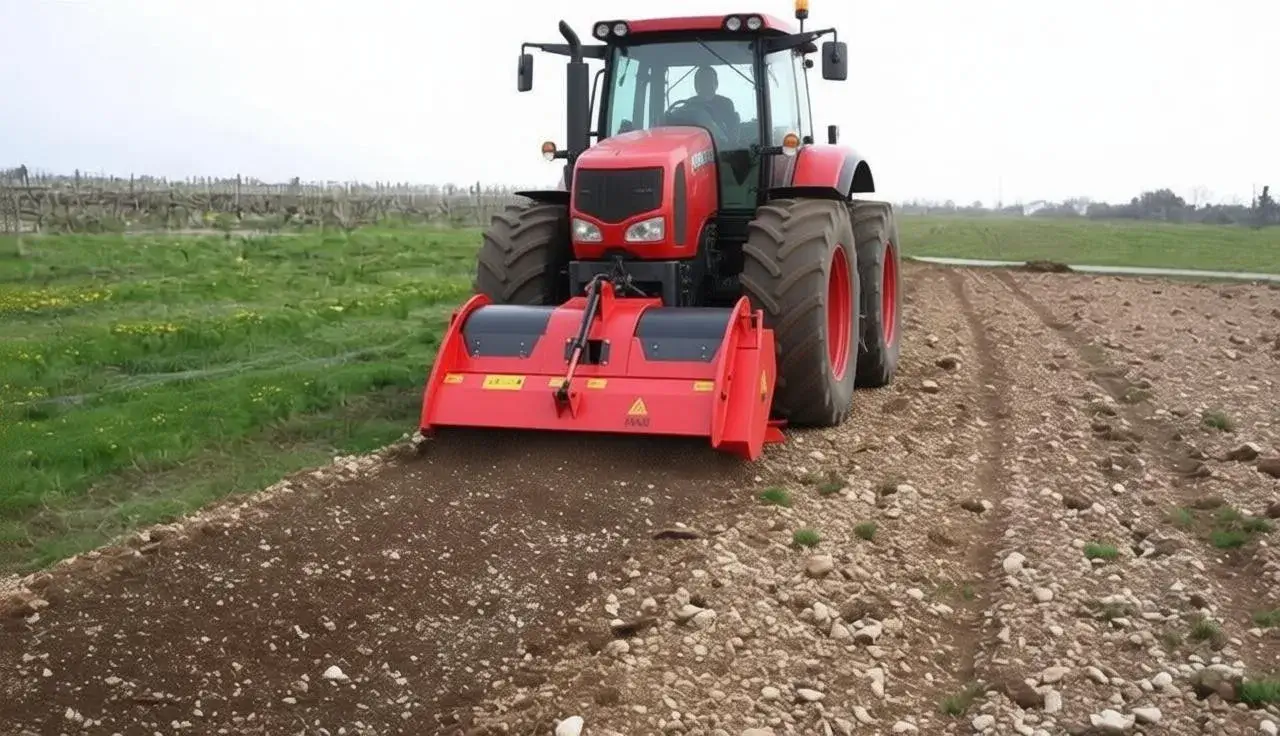
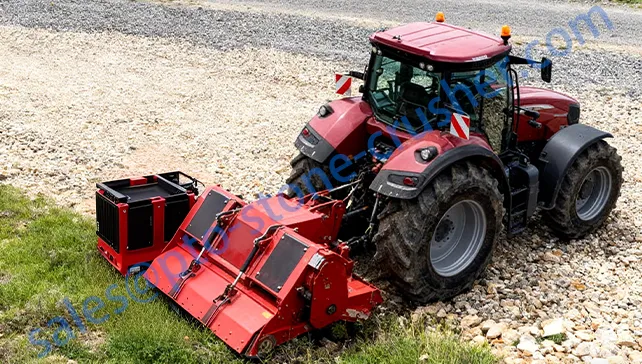
In recent years, farmers across the Bajío have discovered that the most cost-effective and operationally efficient solution is a tractor-mounted PTO stone crusher — a category of agricultural stone crusher equipment that uses high-speed rotating rotors to pulverize surface and sub-surface rock in a single pass. Rather than removing stone from the field (which requires multiple machine passes, labor, and disposal logistics), a PTO stone crusher breaks rock into fine gravel that is redistributed into the soil profile, simultaneously improving drainage and creating a workable seedbed.
This guide draws on product specifications from proven stone crusher for tractor platforms and examines how each technical dimension applies specifically to Bajío farming conditions.
2. Action Method: How a PTO Stone Crusher Processes Rock
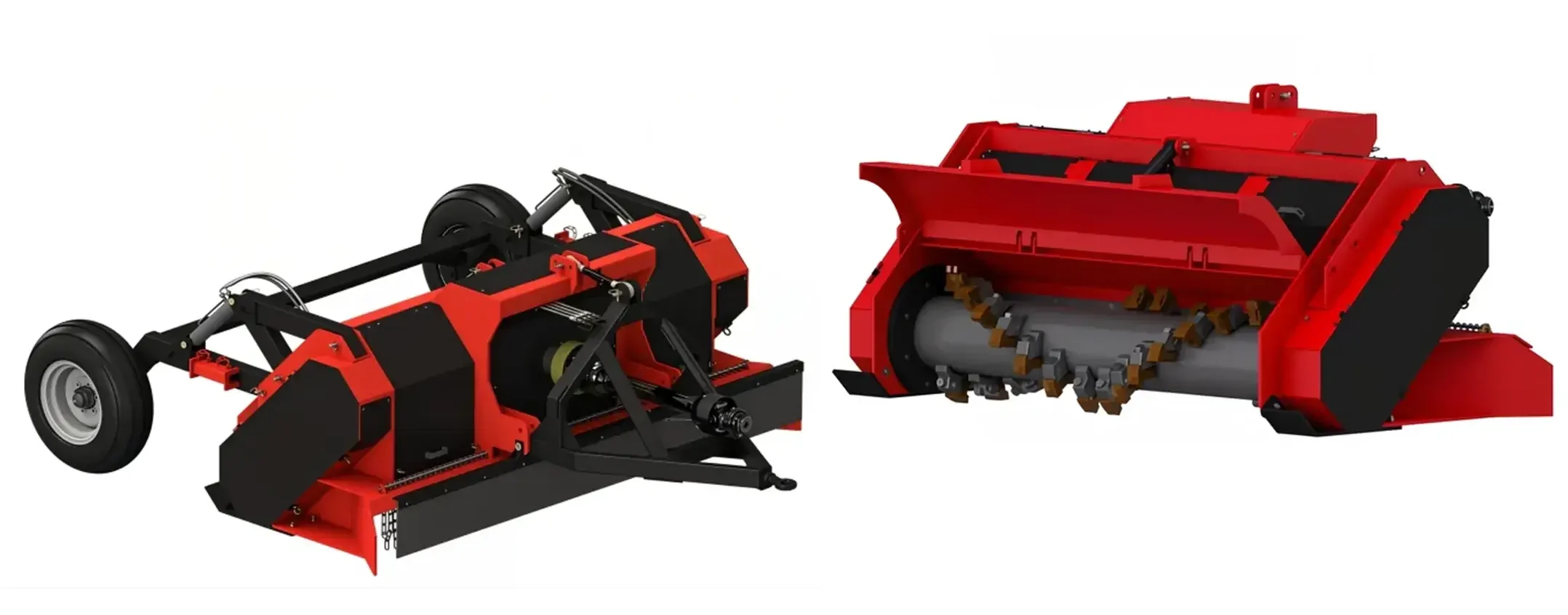
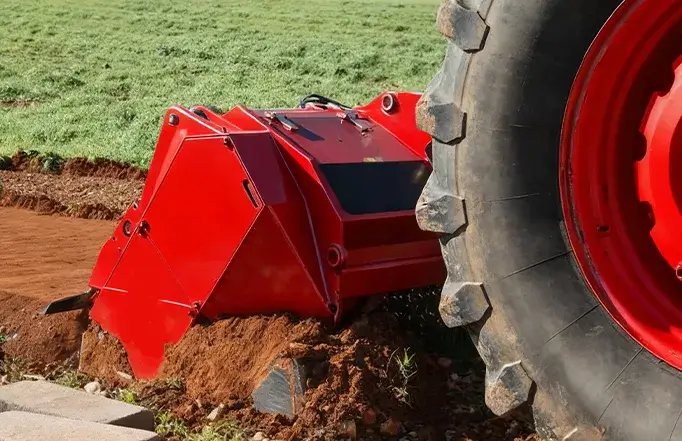
Understanding the crushing action is critical for selecting the right machine for Bajío soil types. A PTO stone crusher transfers rotational energy from the tractor’s power take-off shaft directly to a high-inertia rotor fitted with multiple fixed or free-swinging teeth. As the tractor advances at operational speed — typically 3 to 5 km/h — the rotor spins at 1000 RPM, generating impact forces that shatter rock against internal counter-blades (also called anvil plates) positioned within the crushing chamber. The fragmented material exits through a rear opening, the gap of which can be adjusted using hydraulic controls directly from the tractor cab.
For caliche processing, the high-frequency impact action is particularly effective because caliche, while hard, is brittle. A single pass with a correctly sized stone crusher machine reduces caliche layers into sub-centimeter fragments that integrate with the surrounding soil. Tepetate, by contrast, is denser and more fibrous in structure, requiring deeper penetration and higher rotor torque — a factor that directly influences model selection when working fields in the highland areas of Guanajuato or around Querétaro. For surface volcanic basalt, a larger maximum shredding diameter becomes the key specification, since basalt stones in post-volcanic terrain can frequently exceed 300 mm diameter.
The rotor speed and tooth geometry also control the final particle size of crushed material. A tighter counter-blade gap produces finer gravel — ideal when the goal is seedbed preparation for crops like sorghum, maize, or strawberry, which are all significant Bajío cash crops. A wider gap allows coarser output, which is preferable when the end goal is surface drainage improvement rather than soil tilth. This adjustability gives operators meaningful control over the field outcome without additional equipment passes.
It is worth noting that this crushing-in-place method generates substantially less dust and airborne debris than explosive or pneumatic rock-breaking methods, a meaningful advantage on the open, wind-exposed flatlands between Celaya and León where both neighboring fields and irrigation infrastructure can be damaged by uncontrolled stone projection.
3. Manufacturing Structure: What Makes a Durable Stone Crusher
A well-manufactured agricultural stone crusher is not simply a rotor inside a box. The structural engineering of each component must account for the sustained mechanical shock loads generated during rock-on-steel impact — loads that routinely exceed those encountered in conventional tillage. The outer housing, or frame, is fabricated from thick-gauge structural steel plate, often reinforced with additional weld beads at high-stress junctions. The housing serves a dual purpose: it contains the crushing energy within a defined chamber, preventing projectile ejection, and it provides the structural backbone to which all other components attach.
The rotor drum itself is the heart of the machine. Rotor diameters vary by model — the entry-level PSC series uses a 450 mm rotor, mid-range STCM configurations carry a 550 mm diameter rotor, and high-horsepower platforms like the RSM series feature rotors up to 940 mm in diameter. Larger rotors store greater rotational inertia, which directly translates to the crushing power available per impact event. When operators encounter hard volcanic basalt with compressive strength above 200 MPa — values common in lava-flow soils south of Lago de Chapala — that inertia reserve is what keeps the rotor spinning through dense material without stalling or overloading the tractor PTO shaft.
Tooth holders are forged from heat-treated steel and are designed as bolt-on replaceable units. This is not a minor convenience feature — on abrasive tepetate and silica-heavy volcanic soils, tooth wear is a predictable consumable cost. Machines with quick-change tooth systems allow farm operators or local mechanics to replace worn teeth in the field without specialized tools, avoiding extended downtime during the narrow seasonal window between final rainy-season irrigation and pre-planting soil preparation. The counter-blade, positioned opposite the rotor inside the crushing chamber, is fabricated from Hardox wear-resistant steel plate. Modern designs allow hydraulic remote adjustment of the counter-blade gap from the tractor cab, enabling the operator to adapt output granulometry in real time as soil conditions change across a single field — something genuinely useful when working transitional zones where caliche grades into softer volcanic loam.
Protection chains or solid rear guards are mounted at the rear exit aperture of the machine. These chains serve as kinetic energy absorbers, slowing material as it exits the chamber and dramatically reducing the forward-projection hazard of stone fragments. For Bajío fieldwork alongside irrigation canals or near PVC drip-tape installations, this protection is practically non-negotiable.
4. Material System: Teeth, Counter-Blades, and Wear Steels
The material science built into a modern stone crusher for tractor applications is one of the most significant differentiators between budget agricultural stone crushing equipment and professionally engineered machines. The active wear components — teeth and counter-blades — experience thousands of rock impacts per hour, generating both abrasive wear (gradual material removal by friction) and impact wear (microcracking and chipping from sudden high-energy contacts). Designing for both failure modes simultaneously requires steel metallurgy that balances hardness with toughness — two properties that are typically in tension.
Hardox steel, produced to SSAB international standards, is the dominant material for internal wear plates and counter-blades across professional-grade stone crushers. Hardox 400 and Hardox 500 grades offer Brinell hardness ratings in the 370–550 HB range while retaining sufficient impact toughness to resist shattering under heavy loads. For Bajío farmers processing hard volcanic basalt, Hardox-lined crushing chambers provide dramatically longer service intervals compared to standard mild-steel construction — a direct operational cost advantage. Tooth inserts are often manufactured from tungsten carbide or high-chrome white iron, materials selected for extreme abrasion resistance on silica-rich soils. The PSC series offers tooth configurations in STC/3, STC/3/HD (heavy duty), and STC/3/FP (field preparation) formats, each optimized for different material hardness profiles. STC/3/HD teeth are the correct choice for compacted tepetate and raw caliche; STC/3/FP teeth are better suited to mixed soil-and-gravel conditions during final seedbed finishing passes.
The gearbox housing — critical for converting tractor PTO input speed into appropriate rotor RPM — uses sealed bearing assemblies and gear sets lubricated with high-viscosity gear oil specified to ISO VG 220 or equivalent. This lubricant grade is particularly relevant in the Bajío, where ambient temperatures in the dry season can exceed 35°C, accelerating oil degradation in poorly sealed gearboxes. Machines with synthetic gear oil specifications and labyrinth-sealed input shafts substantially reduce maintenance frequency on summer land preparation campaigns.
5. Product Comparison: PSC / STCM / RockMaster Series — Key Specifications
The following comparison draws on specifications published for models in the stone crusher for tractor range suitable for Mexican Bajío conditions. Model selection should be based primarily on tractor horsepower availability and the dominant rock type encountered on-farm.
| Model / Series | Tractor Power (HP) | PTO Speed (RPM) | Max Stone Ø (mm) | Max Working Depth (mm) | Rotor Ø (mm) | Best For (Bajío) |
|---|---|---|---|---|---|---|
| PSC / STCL Series | 70–150 | 540–1000 | 150 | 150 | 450 | Small farms, caliche crust, orchards |
| STCM Series | 80–280 | 1000 | 300 | 200 | 550 | Tepetate, mixed volcanic gravel, mid-size farms |
| STCH Series | 280–400 | 1000 | 500 | 250 | 700 | Large basalt boulders, heavy tepetate, commercial scale |
| RockMaster / RSL | 80–190 | 540–1000 | 300 | 150–280 | 595–612 | Mixed stone-soil conditions, roadside clearing |
| RSM / RSM-HP | 200–360 | 1000 | 500 | 400 | 940 (G/3) | Deep lava rock, large commercial fields |
6. Understanding Caliche, Tepetate, and Volcanic Rock in Agricultural Context
Each of the three dominant rock types in the Bajío presents different challenges for agricultural stone crushing equipment, and a field assessment before equipment selection can save considerable operating cost. Caliche is a secondary calcium carbonate deposit that forms when calcium-laden groundwater evaporates near the soil surface — a process accelerated by the Bajío’s seasonal drought-flood cycle. Caliche layers can range from loose nodules scattered at 20 cm depth to continuous hardpan slabs 50 cm or more thick that physically prevent any tillage tool from penetrating. Its compressive strength is moderate (roughly 10–50 MPa), making it an ideal candidate for the STCL or PSC series machines on smaller farms or the STCM series where larger acreage demands higher daily throughput.
Tepetate is geologically distinct — it is a lithified (rock-like) horizon formed from volcanic ash consolidation over millennia, found extensively across the volcanic highlands of central Mexico. Tepetate’s compressive strength can approach 60–80 MPa, well above caliche, and its dense, low-porosity structure means conventional subsoiling creates cracks but does not remove the material. Stone crusher for tractor machines address tepetate differently than surface stones: by operating at depth settings of 150–200 mm and using high-rotor-inertia platforms, the crusher fragments tepetate in situ, converting it from a root barrier into a loose, gravel-like layer that actually improves drainage and aeration. This “tepetate conversion” approach has been documented in research from Mexico’s INIFAP (National Institute for Forestry, Agriculture, and Livestock Research) as a cost-effective reclamation strategy for degraded highland fields.
Volcanic rock — primarily basalt and andesite in the Bajío context — presents the most demanding challenge due to its extreme hardness (100–300 MPa compressive strength) and unpredictable distribution. Fields near the Primavera volcanic complex west of Guadalajara, or in the transition zones of Michoacán, can contain boulders of 300–500 mm diameter sitting at shallow depth. For these conditions, the STCH series (max shredding diameter 500 mm) or the RSM series with its 940 mm diameter rotor are the appropriate tools. Attempting to use an undersized tractor stone crusher on large basalt boulders not only fails to process the material but can cause severe drivetrain shock loads that damage both the machine and the tractor PTO shaft.
7. Gearbox Standards, PTO Safety, and Regional Regulations
The gearbox and PTO shaft assembly on a stone crusher machine must meet defined mechanical and safety standards regardless of which country the equipment operates in — and in Mexico’s Bajío agricultural belt, several layers of regulation apply. At the federal level, Mexico’s Norma Oficial Mexicana NOM-007-STPS-2000 establishes occupational safety requirements for agricultural machinery including guarding on rotating PTO shafts and connection points. Operators are legally required to use PTO shafts with fully enclosed safety guards on the telescoping sections and both yoke connections. Machines without conformant PTO shaft guards are technically non-compliant even for private farm use, and IMSS (Instituto Mexicano del Seguro Social) workplace inspection programs increasingly extend into rural operations.
For gearbox construction specifically, the ISO 6336 standard series covers gear tooth load capacity calculations, and professionally engineered stone crushers reference these standards in their design documentation. The gearbox on an agricultural stone crusher must sustain the full rated torque output at 1000 RPM PTO speed — typically 6,000–15,000 Nm depending on model size — without excessive heat buildup. Thermal management within the gearbox is addressed through oil fill volume, ventilation baffles, and in some high-HP models, external oil coolers. Buyers sourcing agricultural stone crushing equipment for Bajío fieldwork should request ISO certification documentation and confirm that the gearbox oil specification is available from local suppliers in Guanajuato or Querétaro — 80W-90 and 85W-140 GL-5 gear oils are the most commonly specified and broadly available grades.
In the European context (relevant for machines imported or certified under EU frameworks and then re-exported to Mexico), gearbox and machine CE marking requirements fall under the Machinery Directive 2006/42/EC, which mandates conformity assessment, risk analysis documentation, and technical file maintenance. Many professional-grade stone crushers carry CE marking, and this documentation is increasingly requested by Mexican importers and customs brokers as evidence of design quality.
South Korea, a significant technology partner for Latin American agriculture, follows KS (Korean Standards) and ISO alignments for tractor attachment gearboxes under KS B ISO 5673. Korean agricultural machinery exports to Mexico — including tractor-mounted implements — must comply with both Korean export certification requirements and Mexican import standards under COFEPRIS and SENASICA oversight where applicable to soil treatment equipment with pesticide or biological agent implications. For Korean buyers or re-exporters evaluating PTO stone crusher equipment for distribution across Southeast Asia or Latin American markets, CE certification combined with ISO 6336-compliant gearbox documentation represents the strongest commercial differentiator.
8. Matching Tractor Power to Rock Type in Bajío Conditions
One of the most practical questions any Bajío farmer or agricultural contractor faces when evaluating a tractor stone crusher purchase is: does my existing tractor have enough power? The answer depends on both the rated horsepower and the available PTO torque at the shaft — two values that are related but not identical. PTO horsepower is typically 85–92% of the engine horsepower on modern tractors, but under-engine tractor configurations used in some cooperative farming operations in the region may deliver lower PTO efficiency.
As a practical guideline for Bajío conditions: light caliche crusting and loose surface stones up to 150 mm can be addressed with tractors from 70 HP upward using the PSC or STCL series; compacted tepetate at depth 150–200 mm requires a minimum of 100–150 HP with an STCM series machine; continuous hard volcanic rock or large basalt boulders require 180 HP minimum and an STCM or STCH platform. Working at walking speed (around 3 km/h) is generally correct for stone-dense conditions — increasing forward speed reduces rotor dwell time per unit area and directly reduces crushing thoroughness, which is a common mistake among first-time operators.
Three-point linkage compatibility is also worth confirming. Most professional-grade small PTO stone crusher and mid-range machines use Category II three-point linkage, which is standard across tractors in the 50–200 HP range. The STCM and STCH series heavier machines may require Category III linkage, found on tractors above 150 HP. The THOR 2.4 drawbar kit variant offers an alternative connection method for operators whose tractor three-point system is unsuitable or where the machine will be towed rather than rear-mounted — a useful configuration for road-verge clearing and irrigation canal bank stabilization work common across the Bajío irrigation districts.
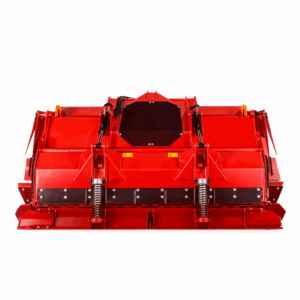
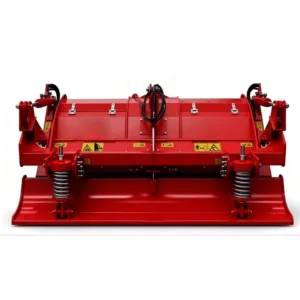
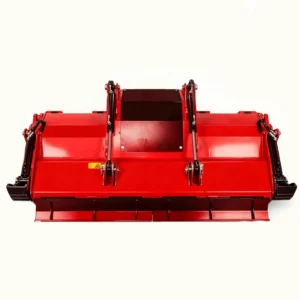
9. Explore the Stone Crusher Product Range
10. Practical Field Application Across the Bajío: Zones and Crops
The Bajío is not a uniform landscape. Conditions differ significantly between the flat irrigated plains around Celaya and Irapuato — where caliche crusting is the dominant issue — and the sloped, rocky terraces of the Guanajuato highlands or the volcanic transition zones near Pátzcuaro in Michoacán. Understanding these micro-regional differences allows more precise equipment selection and operating parameter settings.
On the valley floors and irrigated districts of the Lerma-Chapala basin, agricultural contractors most commonly encounter caliche at 20–40 cm depth. Here, the PSC series or STCM-150 platform at standard depth settings (150–200 mm) deliver effective first-pass clearing for strawberry, garlic, and vegetable production — crops that have expanded rapidly across the Guanajuato and Michoacán portions of the Bajío due to export market growth. Post-clearing, fields can typically be direct-seeded or transplanted within one to two irrigation cycles without additional tillage, because the crushed caliche provides a stable, well-drained sub-base that retains sufficient moisture for germination.
In the volcanic upland zones — including areas around San Miguel de Allende, Dolores Hidalgo, and portions of northern Michoacán — farmers dealing with mixed tepetate and surface basalt typically require a two-pass approach: a first pass with a heavier machine (STCM-200 or above) at maximum depth to fracture the tepetate layer, followed by a finishing pass at shallower depth to produce the fine, homogeneous seedbed required for maize, sorghum, and bean production. The STCM series is particularly well-suited to this two-pass protocol because its hydraulically adjustable counter-blade allows the operator to widen the output gap for the first (deep) pass and tighten it for the second (finishing) pass without leaving the tractor cab.
In areas where groundwater irrigation is combined with volcanic soil management — such as the tomato-producing regions around Pénjamo and La Piedad — the stone crusher also serves an indirect drainage management function. By eliminating tepetate layers that perch water above the impermeable zone, the machine improves deep percolation, reducing the risk of salinity build-up that is a growing concern in intensively irrigated Bajío districts under CONAGUA’s water allocation management programs.
11. Operational Best Practices for Long Machine Life
Daily Pre-Start Inspection
Check tooth condition before each shift. Worn teeth reduce crushing efficiency and increase load on the gearbox. Replace individual teeth before they reach the holder — not after.
Gearbox Oil Monitoring
In high-ambient-temperature Bajío conditions (35°C+), check gearbox oil temperature with a contact thermometer after first hour of operation. Sustained oil temperatures above 90°C indicate either over-loading or insufficient oil volume.
Counter-Blade Adjustment Sequence
Always adjust the hydraulic counter-blade while the rotor is at full operational speed. Adjustments made at rest do not account for thermal expansion of the rotor — gaps set cold may be too tight at working temperature.
Seasonal Storage (Off-Season)
After the dry-season clearing campaign, drain and flush the gearbox, apply corrosion-inhibitor spray to the rotor and housing interior, and store in a covered location. Volcanic dust and alkaline soil residue from caliche are particularly corrosive over extended storage periods.
PTO shaft maintenance is equally important: the cross-joint universal joints on the PTO shaft should be greased after every 8 hours of operation in heavy stone conditions. Failing to maintain the PTO shaft leads to joint wear that introduces vibration into the driveline — vibration that is then transmitted directly to the gearbox input shaft, accelerating bearing wear in both the machine and the tractor.
12. Environmental and Agronomic Benefits of Stone Crushing vs. Stone Removal
There is a genuine agronomic debate about whether crushing stone in place is preferable to stone collection and removal. For the Bajío context, the in-place crushing approach supported by an agricultural stone crusher has several documented advantages. First, the crushed material — particularly crushed caliche — contributes calcium carbonate to the soil, which in the slightly acidic volcanic soils of some highland zones can function as a natural lime amendment, raising pH toward the neutral range preferred by most crops. This is not a substitute for a targeted liming program, but it is a positive secondary outcome of the crushing operation.
Second, incorporating crushed tepetate improves the soil’s mechanical structure by creating a fractured layer that roots can penetrate — roots that previously stopped dead at the intact tepetate surface. Research from CIMMYT (International Maize and Wheat Improvement Center), whose principal research station is located near Texcoco with extensive work in central Mexican highland soils, has documented measurable yield increases in rainfed maize following tepetate disruption, attributed primarily to improved root depth and water access. A stone crusher for tractor operation accomplishes this disruption far more thoroughly than a chisel plow, which creates isolated cracks rather than continuous fragmentation.
Third, from a water management standpoint under CONAGUA’s growing pressure on irrigation efficiency, any intervention that improves soil water-holding capacity and deep percolation simultaneously reduces the irrigation water requirement per crop cycle — a meaningful consideration in basins like the Lerma-Chapala where groundwater over-extraction is already a regulated concern. The stone crusher’s contribution to this outcome, while indirect, is measurable over multiple cropping seasons.
13. Economic Considerations: Cost of Ownership and Return on Investment
Agricultural stone crushing equipment represents a meaningful capital investment, and Bajío farmers evaluating a purchase or a rental arrangement benefit from thinking through the full economic picture. On the cost side, the primary variables are acquisition cost, consumable wear parts (teeth and counter-blade plates), gearbox oil, PTO shaft maintenance, and fuel consumption (expressed through increased tractor fuel burn during stone crushing operations versus lighter tillage tasks). Fuel consumption during stone crusher operation is typically 20–40% higher than during conventional tillage at the same forward speed, due to the rotor load — a factor to include in per-hectare operating cost estimates.
On the return side, the economic case for stone clearing is strongest in three Bajío scenarios: conversion of previously unused or marginal caliche-dominated land to productive annual cropping; renovation of fields where tepetate has caused progressively declining yields over multiple seasons; and one-time clearing of new irrigation district allocations where virgin land requires preparation before any mechanized planting can occur. In each case, the stone crusher enables subsequent operations — planting, fertilization, and pest management — that would otherwise be blocked or severely compromised by the rock layer. The incremental value of those enabled operations, discounted appropriately, determines the economic justification for the investment.
Farmers or agricultural contractors interested in discussing which model best fits a specific field situation and budget — including information on used tractor stone crusher for sale options or new PTO stone crusher for sale pricing — are encouraged to reach out directly for a consultation.
அடிக்கடி கேட்கப்படும் கேள்விகள்
Q1. What kind of PTO stone crusher is best for clearing caliche hardpan in the Bajío region of Mexico for maize farming?
Q2. How deep can a tractor-mounted stone crusher work into volcanic rock soil in highland Guanajuato farmland?
Q3. How does a PTO stone crusher compare to a ripper or subsoiler for breaking tepetate in Mexican agricultural fields?
Q4. What PTO speed and tractor horsepower do I need to run an agricultural stone crusher on volcanic basalt farmland in Michoacán?
Q5. Which gearbox oil specification should I use for a stone crusher operating in high-temperature summer conditions in the Bajío?
Q6. Are there any Mexican federal regulations I need to comply with when operating a PTO stone crusher on a farm?
Q7. What is the difference between a stone crusher machine and a stone mulcher, and which one does a Bajío strawberry farmer actually need?
Q8. When is the best time of year to schedule stone crushing operations in the Bajío for spring planting preparation?
பதிப்பாசிரியர்: PXY