Commercial Farming Knowledge Series · Southern Africa
PTO Stone Crusher for South African Commercial Farming
From the basalt-studded Highveld grain lands of Mpumalanga and the Limpopo bushveld to the dolerite-capped Karoo plains — a complete technical guide for South African commercial farmers and contractors seeking effective stone management solutions.
Introduction
1. The South African Stone Challenge: Rocky Reality of Commercial Farmland
South Africa’s commercial farming sector encompasses an extraordinary range of geological and agricultural contexts, from the deep basaltic soils of the Highveld maize triangle to the thin red clay soils of Limpopo’s subtropical crop zones. Across this diversity, surface and near-surface stones represent a consistent challenge that reduces land productivity, damages high-value tillage and harvesting equipment, and limits the uptake of precision agriculture technologies that require uniform, obstacle-free seedbeds.
South African agricultural geology presents several distinct stone management scenarios. The Mpumalanga and Free State Highveld — the heartland of South Africa’s commercial maize, sorghum, and sunflower production — is underlain by Karoo Supergroup dolerite intrusions that weather into rounded to angular rock fragments concentrated in the plough layer and near-surface zone. Annual subsoil exposure through deep tillage practices progressively brings new stone material to the surface, requiring regular stone management as part of the farm’s field preparation calendar.
In KwaZulu-Natal’s sugarcane growing regions, basalt and dolerite stones challenge both the mechanical planting systems used in large-scale cane establishment and the harvesting machinery that requires a clear, level field surface. In the Limpopo basin, where citrus, avocado, and macadamia orchards are developed on rocky hillsides, stone crushing forms an essential part of orchard establishment — clearing not just surface stones but also preparing the precise planting rows required by these high-value perennial crops. For all these applications, a PTO stone crusher provides a practical, tractor-compatible solution well-suited to the range of tractors deployed on South African commercial farms.
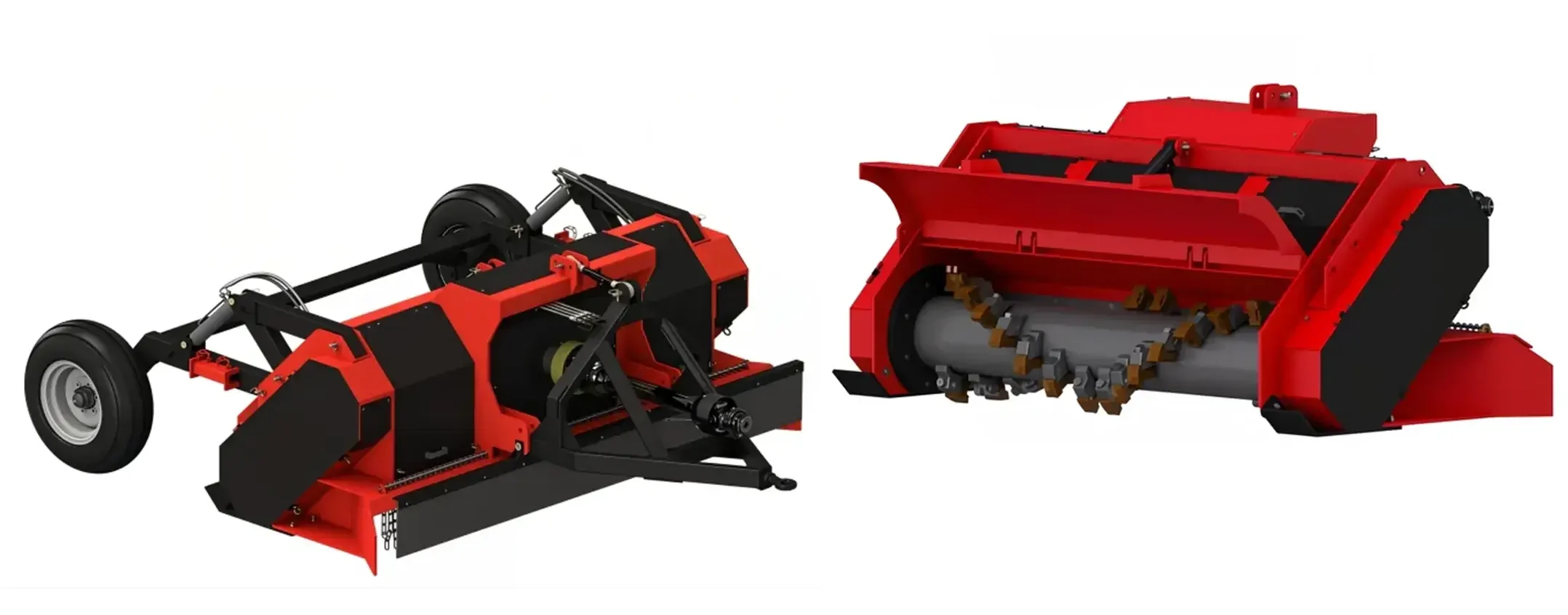
Action Mode
2. How PTO Stone Crushers Work: Mechanism and Physics for African Field Conditions
The operating mechanism of a PTO stone crusher begins at the tractor’s PTO output shaft. In South Africa, most commercial tractors — predominantly in the 100–300 hp range from major brands used across the Highveld and Western Cape — provide PTO output at 540 RPM or 1000 RPM. This rotational input enters the stone crusher’s sealed bevel gearbox, which steps up the speed and redirects it to the transverse rotor shaft running perpendicular to the direction of travel.
Inside the crushing chamber, the rotor carries rows of hardened pick-teeth or hammer tools — the exact configuration depends on the machine series. As the rotor accelerates to operating speed, the tips of the hammers achieve velocities that allow them to impart high kinetic energy to each rock fragment they contact. South Africa’s dolerite — the dominant stone type on the Highveld — has a uniaxial compressive strength of 100–200 MPa. At operational rotor tip speeds, the impact energy delivered by a quality pick-tooth is more than sufficient to fracture dolerite cobbles into sub-150 mm fragments in the primary impact stage.
Following primary fragmentation, the crushed pieces are redirected by the chamber geometry against the rear counter-blade assembly. This secondary impact zone reduces the remaining coarse fragments to sizes that will pass through the rear grate (on models so equipped). The output aggregate is deposited directly on the prepared surface, where it can be incorporated by subsequent cultivation or left as a gravel mulch between crop rows in orchard systems.
South African operators working in the Limpopo bushveld should be particularly attentive to depth control. Limpopo soils are often shallow over hardpan or laterite, meaning that exceeding the working depth can bring the rotor into contact with extremely hard laterite concretions that can severely accelerate tooth wear. Hydraulically adjustable skid shoes — available on mid and heavy-range models — provide the precise, responsive depth control needed in these variable-profile soils.
| SA Region | Dominant Stone Type | Hardness (MPa UCS) | Recommended Model Class |
|---|---|---|---|
| Mpumalanga / Free State Highveld | Dolerite (Karoo intrusions) | 100–200 | STCM / PSC mid-range |
| KwaZulu-Natal (cane country) | Basalt / weathered dolerite | 80–150 | PSC compact / STCM |
| Limpopo Basin (orchards) | Dolerite + laterite concretions | 150–300 | STCM / Tractor-Mounted Rock Crusher |
| Western Cape (wine / fruit) | Malmesbury Shale / granite | 80–200 | PSC / Tractor-Mounted Rock Crusher |
| Karoo semi-arid land | Silcrete / calcrete / dolerite dykes | 100–350 | RockMaster heavy-duty |
Construction
3. Manufacturing Structure: What the Machine Is Made Of and Why It Matters
South African commercial farming operates under conditions that expose machinery to exceptional stress: high ambient temperatures (routinely 35–42°C on the Highveld and in Limpopo during summer), abrasive dust-laden air, long distances from dealer support infrastructure, and operating pressures that demand high machine availability during short seasonal windows. These conditions make the structural quality of a stone crusher’s manufacturing a primary purchasing consideration rather than a secondary one.
The heavy-gauge structural steel main frame — manufactured from S355 or equivalent high-tensile plate — is the foundation of durability in South African conditions. Weld quality at the rotor housing joints is particularly critical; poor welds that appear intact under European conditions may develop fatigue cracks under the sustained high-temperature operation and longer daily working hours typical of South African commercial farming. Certified welds with documented weld procedure specifications (WPS) are a mark of manufacturing quality worth asking about when selecting a machine.
The rotor bearing assembly must be robust against the dual stresses of continuous operation in high-ambient-temperature environments and the ingress of fine abrasive silica dust. Sealed spherical roller bearings with enhanced grease capacity, accessed via external grease nipples, provide the best service life in these conditions. On the THOR 2.4 and THOR 3.0 series machines, the drawbar configuration distributes transport loads more evenly across the machine frame — particularly useful for the long farm road distances common on large South African commercial holdings in the Free State and Northern Cape.
The Category 2 three-point linkage mount is standard. The hydraulic connection requirement — two remote control valves for machines with hydraulic rear gate and depth adjustment — is compatible with the hydraulic systems of the modern tractor fleet common on South African commercial farms. Operators running older tractors should verify their hydraulic remote flow rates against the machine’s specification before purchase.
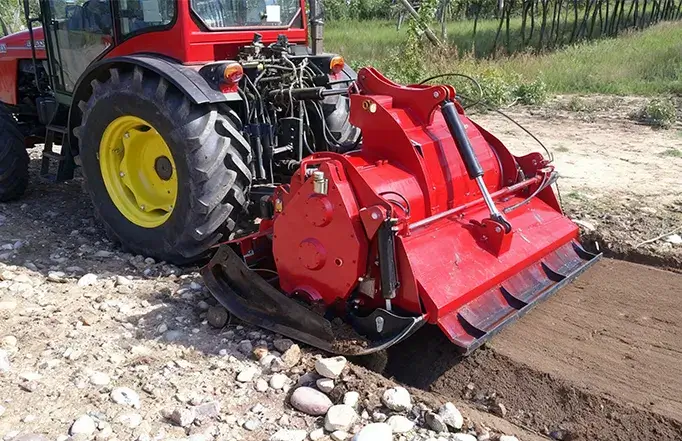
Materials
4. Material System: Hardness, Heat, and the African Operating Environment
South African dolerite is notorious in the agricultural machinery industry for its combination of high compressive strength, abrasive silica-enriched matrix, and tendency to present as rounded, apparently innocuous cobbles that conceal very high hardness. The correct material specification for cutting tools operating in South African dolerite is tungsten carbide tipped inserts on a manganese steel body. The carbide hardness of 89–92 HRA resists the silica-abrasive attack of dolerite at sustained operating speeds; the manganese steel body absorbs the kinetic shock of impact without brittle fracture — a failure mode common with all-carbide tools in the shock-loading environment of an impact crusher rotor.
The internal wear plate material — Hardox 450 or 500 — is critical in South African conditions because the silica content of dolerite-derived grit circulating inside the crushing chamber during secondary fragmentation causes rapid abrasive wear on softer steel linings. At 450–500 BHN, Hardox plate typically provides 2.5–4 times the service life of standard mild steel linings in South African dolerite conditions. The replaceable bolted installation of these plates allows field replacement — important on large commercial holdings where returning the machine to a dealer during peak season is not feasible.
Temperature effects on lubricant performance are a specific concern for South African operators. Bearing grease in machines operating at 40°C ambient temperatures degrades faster than in European conditions — the high-temperature operating rating of the grease specified by the manufacturer should be verified before selecting a lubricant for South African service. Synthetic base oil greases rated to 160°C operational temperature perform significantly better than mineral oil greases in high-temperature South African conditions.
External paint systems on machines used in South Africa’s semi-arid Karoo or Limpopo conditions must withstand intense UV radiation alongside high heat. Two-component polyurethane topcoats with UV stabilisers are the minimum appropriate specification; some operators apply additional UV-protective clear coat layers to extend the service life of the painted surface beyond the 5-year benchmark achievable with standard agricultural coatings.
| Component | Material | SA Dolerite Service Life | Notes for SA Conditions |
|---|---|---|---|
| Pick teeth (WC-tipped) | WC-Co / Mn steel body | 200–350 hrs | Preferred for dolerite |
| Pick teeth (steel) | High-Cr alloy 58–62 HRC | 60–100 hrs | Short intervals in dolerite |
| Counter-blade | Hadfield 12% Mn steel | 300–500 hrs | Reverse when first face worn |
| Chamber wear plates | Hardox 450–500 | 500–800 hrs | Field-replaceable bolt-on |
| Rotor bearings | Spherical roller, sealed | Machine lifetime | Use high-temp grease (160°C) |
Regulations
5. South African Regulatory Framework for Agricultural Machinery and Gearboxes
South Africa’s primary occupational health and safety framework for agricultural machinery is the Occupational Health and Safety Act No. 85 of 1993 (OHSA) and the Driven Machinery Regulations (DMR), published under Government Notice R295/1995 and amended since. The DMR applies to all machinery driven by an external power source — including PTO-driven stone crushers — and imposes obligations on both employers and the users of such machinery.
Under DMR Regulation 9 (Guards and Safety Devices), all moving parts of driven machinery that could constitute a danger to persons must be adequately guarded. This includes the PTO driveline shaft, the rotor, and all other rotating components accessible from outside the crushing chamber. Guards must be designed to remain in place during operation and must not be removed without tools. The employer is responsible for ensuring guards are maintained in good condition and that machine operators receive adequate instruction on safe operation before use.
For PTO drivelines specifically, the South African Bureau of Standards (SABS) standard SANS 4254-1 (technically equivalent to ISO 4254-1) provides the baseline requirements for agricultural machinery safety. Under this standard, PTO driveline guards on implements must extend beyond the rotating yoke at each end, rotate freely on the shaft, and be resistant to deformation under foreseeable operating loads. Machines imported into South Africa should carry documentation demonstrating compliance with SANS 4254-1 or equivalent international standard.
Environmental regulatory considerations in South Africa are governed by the National Environmental Management Act 107 of 1998 (NEMA) and the associated regulations. Under NEMA, any activity that may have a significant effect on the environment requires an Environmental Impact Assessment (EIA). For most routine agricultural stone crushing operations within existing farm boundaries, this threshold is not triggered. However, reclamation projects that involve significant topsoil disturbance (over 5 hectares in Gauteng and the more sensitive provinces), activities within a riparian zone, or operations in a declared protected area may require notification to the relevant provincial Department of Environmental Affairs.
South African farmers operating near watercourses should be aware of the National Water Act No. 36 of 1998, which designates a riparian zone (typically 20–50 m from a watercourse bank) within which land disturbance requires authorisation from the Department of Water and Sanitation. This is particularly relevant for Limpopo basin orchard development where stone crushing forms part of new land clearing adjacent to irrigation channels or seasonal rivers.
The Agricultural Produce Agents Act and the Fertilizers, Farm Feeds, Agricultural Remedies and Stock Remedies Act are not directly applicable to stone crushing equipment, but the Agricultural Research Council (ARC) of South Africa publishes extension guidance on mechanised land preparation — including stone management — that is widely consulted by commercial farming operators and their machinery advisors.
Application Focus
6. Stone Crushing for South African Orchard, Grain, and Sugarcane Operations
For South Africa’s Limpopo citrus, avocado, and macadamia sectors — the country’s highest-value horticultural export industries — stone crushing during orchard establishment represents a significant capital investment that is justified by the long productive life of these perennial crops. Avocado orchards, for example, have productive lifespans of 25–50 years; the one-time cost of thorough stone crushing during establishment protects the root development of the entire orchard over this period and prevents ongoing equipment damage to the mechanical harvesting aids increasingly used in large-scale avocado operations.
For grain producers on the Highveld, stone management is an annual or biennial activity driven by dolerite frost-heave and tillage-induced stone migration. The strategic approach for grain farmers is to combine deep tillage (subsoiling) with stone crushing in the same field preparation campaign — subsoiling exposes deeper-lying stones that are then crushed in a subsequent pass. This integrated approach maximises the depth of stone-free tillage, which is directly correlated with improved water infiltration rates in the clay soils of the Free State maize belt.
For KwaZulu-Natal sugarcane operations — particularly on the hillside ratoon areas of the Natal Midlands — the challenge is combining stone clearing with minimal soil disturbance to protect existing soil carbon and organic matter accumulated under long-term cane cultivation. Compact PSC or STCM-class crushers operated at moderate working depths achieve effective stone reduction without the excessive soil disturbance that could accelerate the erosion processes already present on steeper KZN hillside cane land.
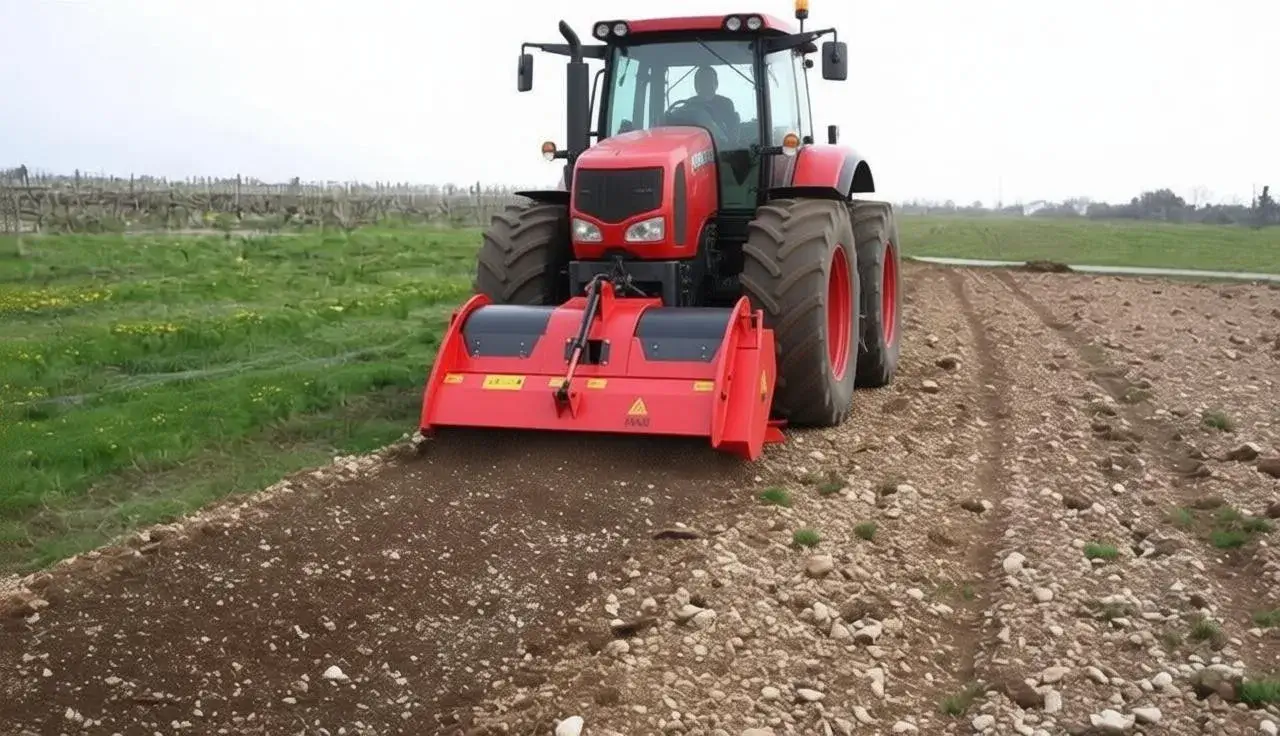
Produkty
7. Recommended PTO Stone Crusher Models for South African Commercial Farming
PSC Series Field Stone Crusher
Compact and versatile. Working widths 1110–2070 mm. Suits KZN sugarcane hillside operations and Highveld maize field renovation with tractors 70–150 hp. Max stone 150 mm.
Sealed bearings · Cat. 2 mount · 540/1000 RPM
Drvič poľnohospodárskeho kameňa RockMaster
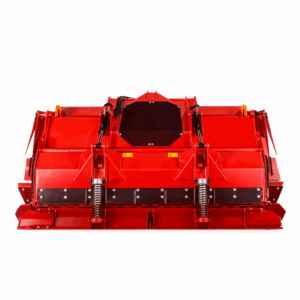
Heavy-duty. Handles rocks to 500 mm. Ideal for Karoo silcrete and dolerite dyke reclamation. 280–400 hp tractors. Models from 2080–2560 mm working width.
Max depth: 250 mm · For large-scale reclamation
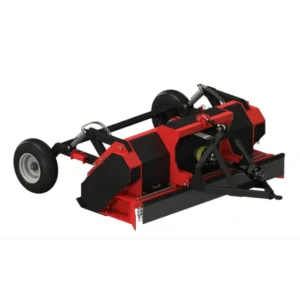
THOR 2.4 + Kit Drawbar
2.4 m working width, 2300 kg, 180 hp minimum. Drawbar transport configuration suits long hauls on South African farm roads. Suitable for Limpopo orchard establishment.
3 km/h working speed · Cat. 2 linkage
FAQ
Frequently Asked Questions
Q1. Which agricultural stone crusher model is best suited for crushing Highveld dolerite on a South African commercial grain farm?
For Highveld dolerite on commercial grain land, a mid-range machine in the STCM class — matched to a 150–220 hp tractor — handles typical dolerite cobble sizes (80–200 mm) efficiently. For larger dolerite blocks encountered after subsoiling operations, the Tractor-Mounted Rock Crusher with its 280 mm working depth and 300 mm max crushing diameter provides additional capability. Specify tungsten carbide tipped teeth for longer service intervals on dolerite.
Q2. How does South Africa’s Occupational Health and Safety Act apply to PTO stone crusher operation on a commercial farm employing labour?
Under OHSA No. 85 of 1993 and the Driven Machinery Regulations, all driven machinery used in workplaces where employees are present must have guards on all rotating parts, operators must be trained before use, and machinery must be inspected and maintained. The employer is legally responsible for ensuring compliance. Farms employing seasonal or permanent workers are subject to OHSA in full, including the DMR provisions for PTO driveline guarding.
Q3. What is the difference between a stone crusher for tractor and a rock picker when preparing avocado orchard land in Limpopo?
A stone crusher reduces rocks to fine aggregate in-situ, which remains in the soil and can benefit drainage and aeration around avocado root zones. A rock picker collects stones and removes them, which is more appropriate where you want a completely clean surface. For avocado orchard establishment on rocky Limpopo hillsides, crushing is typically preferred for the initial heavy-rock pass, followed by picking to remove any surface cobbles that remain visible before drip irrigation line installation.
Q4. What is the required PTO speed for a stone crusher operating on Limpopo laterite and dolerite mixed soil conditions?
Operate at the rated PTO speed — 1000 RPM for modern dual-speed models. At 1000 RPM, the rotor achieves optimal tip speed for dolerite fragmentation. Operating below rated speed reduces kinetic energy per tooth strike and can lead to rotor stalling when the machine encounters large dolerite cobbles or laterite concretions. If your tractor cannot sustain 1000 RPM PTO output under load, consider the 540 RPM configuration models matched to your tractor’s power range.
Q5. Does the National Water Act apply to stone crusher operations near irrigation channels on a Limpopo citrus farm?
Yes. Under the National Water Act No. 36 of 1998, land disturbance within the riparian zone of a watercourse — typically defined as the area within 30–50 metres of the high water mark — requires authorisation from the Department of Water and Sanitation. Irrigation channels registered as water use infrastructure may have additional restrictions. Contact your local DWS regional office before undertaking stone crushing within this zone.
Q6. How often should cutting teeth be replaced on a stone crusher used in South African Karoo silcrete conditions?
Silcrete is among the hardest agricultural stone types encountered anywhere — Mohs hardness of 7–8, similar to quartzite. Standard steel teeth in silcrete conditions may last as few as 40–60 hours. Tungsten carbide tipped teeth typically achieve 150–250 hours in silcrete. Plan to carry a full replacement set of teeth when operating in remote Karoo conditions where dealer access is limited during the working season.
Q7. Can a small PTO stone crusher handle the mixed stone and clay conditions found in KwaZulu-Natal sugarcane hillside ratoon renovation?
Yes. The PSC Series compact crusher is well suited to KZN hillside ratoon renovation. Its light weight (from 1,230 kg at the 1110 mm model) limits soil compaction risk on the steep clay slopes, and its 150 mm working depth is adequate for the basalt cobbles and weathered dolerite fragments typical of KZN cane land. Specify the 540/1000 RPM dual-speed option for compatibility with the range of tractors used in KZN cane operations.
Q8. What bearing lubrication is recommended for a PTO stone crusher working in the high-temperature summer conditions of the South African Lowveld?
Use a synthetic base oil grease with an operational temperature rating of at least 160°C, such as a polyurea-thickened synthetic grease or a complex calcium sulphonate grease. Mineral oil greases rated only to 120°C will degrade rapidly during sustained summer operations at 40°C+ ambient temperatures, increasing bearing wear. Check grease nipple access before each work day and re-grease rotor bearings at the intervals specified in the machine’s operating manual.
Editor: PXY