Deskripsi
EP-4550mm Rock Rake — EW-4000 & EW-4000T Series
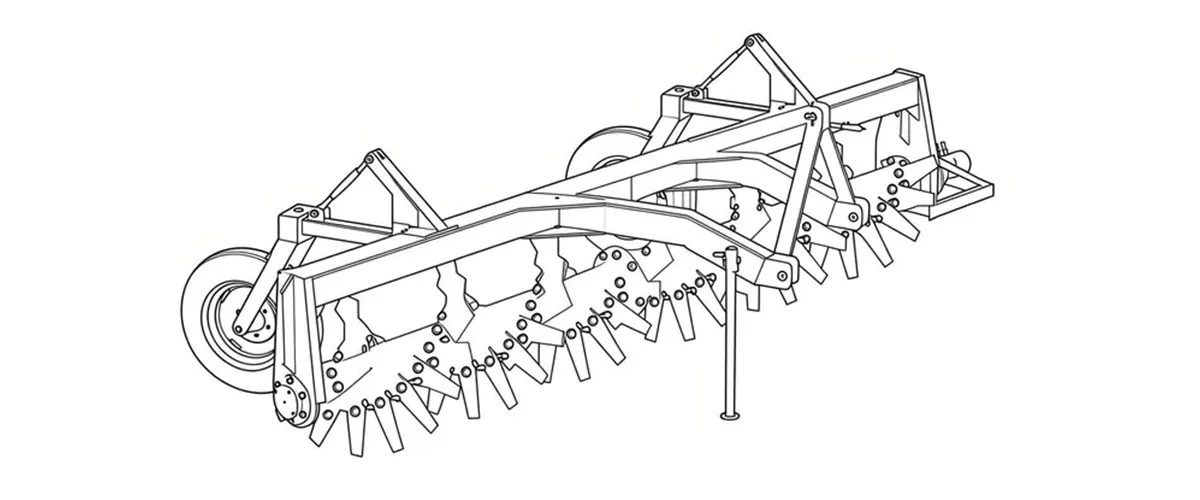
Clearing a field of surface rocks is one of the most labor-intensive and equipment-punishing tasks in agricultural land preparation. The EP-4550mm penggaruk batu transforms that challenge into a single, efficient tractor pass across a 3.6-meter working width. Designed for professional land preparation, orchard establishment, and large-scale soil remediation, this heavy-duty tractor-mounted implement systematically combs the soil surface, separating stones and debris from finer soil particles and consolidating them for easy collection or windrow disposal. It is a purpose-built rock rake for tractor operations — not a lightweight accessory, but a serious field machine rated at 1,800 kg (EW-4000) and 1,900 kg (EW-4000T) and requiring a minimum 100 cv tractor engine on the hydraulic variant.
The EP series comes in two distinct configurations: the EW-4000, which uses hydraulic oil flow from the tractor (minimum 60 L/min.) to drive its working mechanism, and the EW-4000T, a transmission-drive variant requiring a minimum engine power of 75 cv with no dedicated oil-flow requirement. Both share identical footprint dimensions — 4,550 mm length × 2,400 mm width — and attach via a Category 2 three-point bottom linkage, making them compatible with the full range of mid-to-large agricultural tractors common across Korean farmland, Japanese-market export tractors, and global B2B equipment fleets. For buyers in South Korea evaluating a landscape rock rake at commercial scale, this product is engineered specifically for the performance levels Korean agricultural export standards and domestic field-preparation contractors demand.
1. Technical Specifications — EP-4550mm Rock Rake (EW-4000 Series)
The table below covers the complete technical data for both variants of the EP-4550mm EW-4000 series. All dimensions are in millimeters unless stated. Engine power is expressed in metric CV (horsepower). Oil flow requirement applies to the EW-4000 hydraulic variant only.
| Technical Parameter | EW-4000 | EW-4000T |
|---|---|---|
| Ukuran | ||
| Panjang (mm.) | 4,550 | |
| Lebar (mm.) | 2,400 | |
| Tinggi (mm.) | 1,380 | 1,960 |
| Berat | 1,800 Kg | 1,900 Kg |
| Bottom Linkage Category | 2 | |
| Lebar Kerja | 3.6 m. | |
| Tractor Requirements | ||
| Engine Power (min.) | 100 cv | 75 cv |
| Oil Flow (min.) | 60 L/min. | — |
| Kecepatan Kerja | 3 – 5 Km/h | |
| Required Control Valves | 2 | |
2. Five Key Advantages of the EP-4550mm Rock Rake
① Wide 3.6 m Working Width — Fewer Passes
At 3.6 meters of effective working width, this power rock rake covers substantially more ground per pass than smaller landscape or garden units. For commercial field preparation contractors working on new crop establishment, vineyard clearance, or pasture improvement in South Korea’s Jeolla, Gyeonggi, or North Chungcheong agricultural regions, fewer passes means less fuel consumption, less operator fatigue, and significantly lower cost per hectare cleared. The wide working geometry is matched to the drawbar geometry of modern four-wheel-drive tractors commonly operated at Korean agricultural cooperatives and land reclamation projects across the peninsula.
② Dual-Configuration Flexibility — Hydraulic or Transmission Drive
The EW-4000 uses the tractor’s hydraulic system (minimum 60 L/min. oil flow), while the EW-4000T relies on a mechanical transmission drive, opening the machine to operators whose tractors have limited auxiliary hydraulic capacity. This dual-configuration design means that a single product family — the EP-4550mm — covers the broadest possible range of available tractor types. Korean agri-contractors managing mixed tractor fleets can standardize on this rock rake attachment series without worrying about hydraulic compatibility across every machine in their yard.
③ Category 2 Three-Point Linkage — Universal Mounting
Mounting via a Category 2 bottom linkage means the EP-4550mm connects to any standard Category 2 tractor hitch — the most common configuration on tractors in the 75–200 cv range sold across South Korea, Japan, and Southeast Asia. There is no proprietary coupling hardware and no need for an adapter frame. The implement lifts fully clear of the ground for road transport and lowers precisely to working depth via the tractor’s existing draft control system. This universal mounting approach is one of the key reasons this 3 point rock rake design is specified by B2B buyers managing large fleet deployments.
④ Heavy-Duty Construction — Built for Commercial Loads
At 1,800–1,900 kg of operating weight, this is unmistakably a commercial-grade heavy duty rake for removing rocks, not a light landscape tool. The main frame is fabricated from structural steel sections, welded and reinforced at high-stress junctions to absorb the continuous impact loads generated during rock-strewn field operation. The tines and working elements are made from hardened steel alloys selected specifically for wear resistance against abrasive contact with granite, basalt, and compacted clay soils — the rock types most commonly encountered across Korea’s Jeju Island volcanic terrain and mountainous inland farmland.
⑤ Replaceable Wear Parts — Low Lifetime Maintenance Cost
The working tines and wear-contact components of the EP series rock rake machine are designed as bolt-on replaceable parts. When a tine wears down or suffers impact damage, field replacement takes minutes with standard hand tools — no specialized workshop required. For operations in remote Korean highland areas or island farming communities where downtime directly translates to lost planting windows, this serviceability is a genuine operational advantage. A well-maintained set of replacement parts held on-hand keeps the machine productive across multiple seasons without major overhaul costs.
3. How the EP-4550mm Rock Rake Works
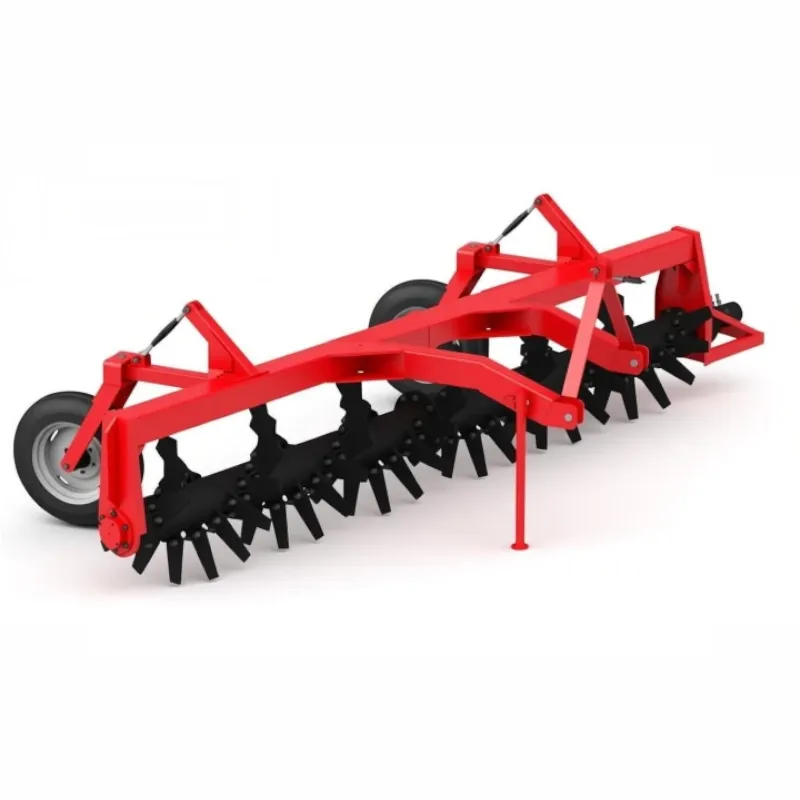
The fundamental principle behind any tractor-mounted penggaruk batu is the separation of surface and shallow-subsurface stones from cultivable soil without removing soil from the field. As the tractor advances at a working speed of 3–5 km/h, the machine’s arched frame lowers the tine bar assembly into contact with the soil surface at a consistent, adjustable working angle. The forward motion drags the tines through the soil, catching rocks, clods, root masses, and debris while allowing finer soil particles to fall back through the gaps between tine tips. This screening action is continuous — there are no cycles, no dumping pauses, and no collection hopper to empty — making the rock rake one of the fastest methods available for initial field clearance prior to seeding or planting.
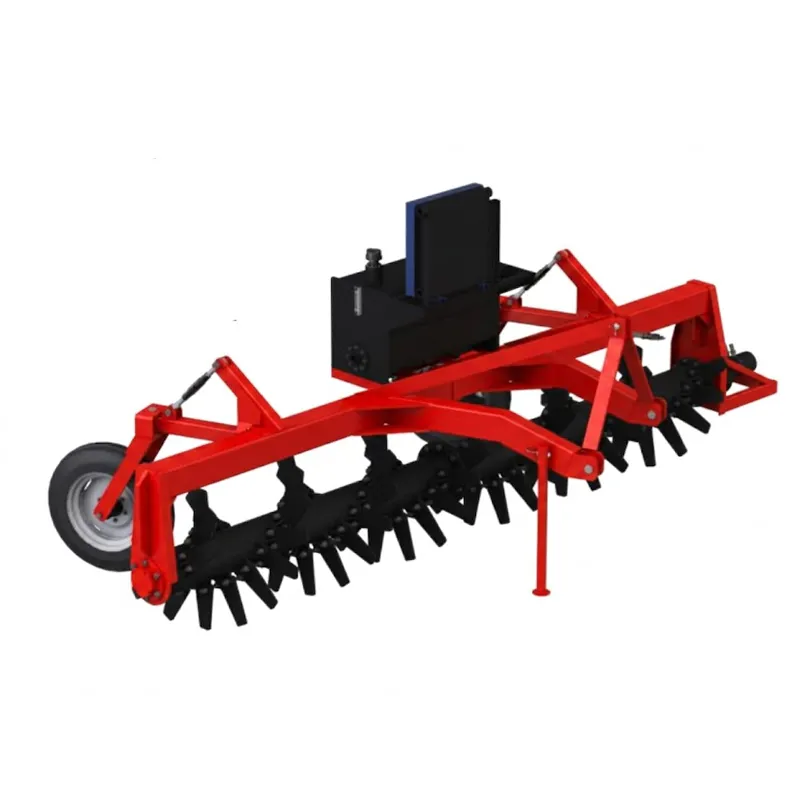
In the EW-4000 hydraulic configuration, the tractor’s auxiliary hydraulic circuit supplies a minimum 60 L/min. oil flow to power the working mechanism’s active elements — typically an oscillating or rotating tine bar that improves rock-dislodging action in compacted or clay-heavy soils. The EW-4000T transmission-drive variant instead receives mechanical energy from a ground-drive wheel or PTO-linked transmission, making it suitable for tractors with limited hydraulic capacity. In both cases, the operator controls working depth and lateral pressure via the tractor’s three-point linkage and can adjust on-the-go without leaving the cab. Two control valves are required to manage the hydraulic functions — raising, lowering, and active mechanism control — both of which are standard outputs on any modern agricultural tractor sold in Korea or globally.
Rocks gathered by the tines accumulate progressively ahead of the working bar, forming a loose windrow that runs parallel to the direction of travel. Once the tractor reaches the headland, it turns, and the accumulated rocks remain in their windrow for subsequent mechanical collection or boundary disposal. Over multiple passes with progressively finer working angles, even heavily rock-infested fields can be brought to a planting-ready surface condition. This systematic approach is what distinguishes the professional rock rake for tractor from hand methods or smaller garden equipment, and it is why land reclamation contractors and large-scale agricultural developers in South Korea, as well as buyers across Europe, North America, and Southeast Asia, consistently specify this equipment class for new land development projects.
4. Materials & Build Quality
The main structural frame of the EP-4550mm rock rake machine is fabricated from high-tensile structural steel, typically S355 or equivalent grade, selected for its combination of yield strength and weldability. The frame members are square- and rectangular-section hollow steel profiles, welded using automated or semi-automated MIG/MAG processes at junctions that carry the highest bending and torsional loads during field operation. Post-weld inspection and stress-relief treatments are applied at critical connection points to reduce the risk of fatigue cracking under the cyclical loading generated by continuous rock impact.
The working tines — the primary soil-contact elements — are produced from boron-alloyed hardened steel (typically 27MnCrB5 or similar), achieving a surface hardness of approximately 45–52 HRC after heat treatment. This hardness level is specifically chosen to resist abrasive wear from quartz-bearing rock surfaces, while maintaining enough core toughness to absorb the bending energy of striking a partially buried stone without shattering. Tines are bolted to the carrier bar using high-tensile fasteners (Grade 10.9), allowing field replacement of individual worn or damaged elements without specialized tooling. The complete tine bar assembly is mounted on the frame with adjustable working-angle brackets, enabling the operator to tune the raking depth and aggressiveness to match field conditions.
External surfaces of the machine are prepared by shot-blasting to Sa 2.5 cleanliness standard before application of a two-coat paint system: an epoxy primer for corrosion protection and a polyurethane topcoat in the product’s characteristic high-visibility yellow-green color. This finish withstands the UV exposure, moisture, and mechanical abrasion typical of outdoor agricultural operation across the variable climate conditions of South Korea — from the humid summers of the southern coastal plains to the colder winters of Gangwon-do highland farming areas. All pivot and hinge points are equipped with grease nipples for regular lubrication maintenance, extending the service life of articulating components significantly beyond that of sealed-for-life alternatives in this duty class.
5. Regulatory Compliance & International Standards
Agricultural implements mounted on tractors operate within regulatory frameworks that govern machinery safety, tractor compatibility, and in some countries, noise and vibration standards. Understanding the applicable regulations is an important part of procurement for B2B buyers operating commercial fleets in Korea and internationally.
South Korea — Rural Development Administration (RDA) & KATS
In South Korea, agricultural machinery standards are administered by the Rural Development Administration (RDA / 농촌진흥청) and the Korean Agency for Technology and Standards (KATS). Tractor-mounted implements must be compatible with the Category 2 three-point linkage standard per ISO 730, which this implement fully satisfies. Korean agricultural machinery safety regulations under the Agricultural Machinery Safety Act govern operator protection requirements; buyers should verify that the tractor cab and guarding provisions comply with local requirements when operating this implement at commercial scale. The Korea Forest Service (KFS / 산림청) additionally has guidelines for machinery used in forest land preparation, which is a common application for heavy-duty rock rakes in Korea’s extensive afforestation programs.
ISO Standards — Three-Point Linkage & Safety
The Category 2 bottom linkage of this implement is designed to ISO 730:2009 (Agricultural wheeled tractors — Rear-mounted three-point linkage). This is the globally recognized standard that ensures dimensional interchangeability across tractor brands and implement suppliers. ISO 11684 governs safety signs and hazard pictograms on agricultural machinery, and this product series uses internationally standardized warning symbols at all pinch-point and hydraulic-hazard locations. Buyers in European export markets or those operating under CE-marked machinery frameworks should note that agricultural implements are covered by the EU Machinery Directive 2006/42/EC when placed on the EU market.
European Union — Machinery Directive & CE Marking
For buyers in EU member states, tractor-mounted implements including rock rakes may require CE marking under the Machinery Directive 2006/42/EC, with a Declaration of Conformity provided by the manufacturer. ISO 4254-1 (Agricultural machinery — Safety — General requirements) sets the design framework for operator protection. Buyers importing this implement into EU markets should confirm documentation requirements with the relevant national authority.
United States — ASABE Standards
In the US market, the American Society of Agricultural and Biological Engineers (ASABE) publishes Standard S217 governing three-point hitch dimensions. The Category 2 linkage on this implement conforms to ASABE S217 dimensions, ensuring compatibility with American-market tractors. OSHA agricultural equipment regulations (29 CFR Part 1928) set worker safety requirements around tractor-mounted implements during commercial operation.
Australia & Selandia Baru
Australian Standard AS 2671 covers hydraulic fluid power requirements relevant to the EW-4000 hydraulic variant. Safe Work Australia guidelines for agricultural machinery operation apply when this implement is used by employees on commercial farms or contract land-clearance operations. New Zealand buyers should refer to WorkSafe NZ guidelines on tractor-implement safety in forestry and agriculture contexts.
6. Application Scenarios
The EP-4550mm penggaruk batu is a versatile land preparation tool suited to a wide range of environments and project types. Its 3.6-meter working width and heavy-duty construction make it particularly effective in commercial-scale operations where efficiency per hectare is the primary driver.
New Crop Field Establishment
When converting previously uncultivated land — reclaimed hillside terracing in Korea’s Gangwon-do province, newly drained lowland areas in Jeolla-do, or former forest clearances — the soil surface is typically laden with rocks, root stocks, and debris. A single pass with this landscape rock rake across the prepared ground consolidates that material into manageable windrows, leaving a stone-free seedbed ready for direct drilling or transplanting. The 3.6 m working width ensures that even large new-development sites are ready within a practical number of working days, critical for meeting seasonal planting windows.
Orchard & Vineyard Preparation
Establishing orchards on rocky slopes — apple and pear orchards in Korea’s Chungcheong regions, or citrus groves on Jeju Island’s volcanic terrain — requires thorough rock removal before tree planting to protect subsequent cultivation equipment and prevent fruit quality issues from shallow rocky rootzones. The rock rake for tractor efficiently handles the surface and near-surface stone load, while the adjustable working angle prevents damage to loosened topsoil structure. The rock rake’s wide working pass keeps pre-planting preparation costs manageable even on larger orchard plots.
Golf Course & Sports Field Construction
Golf course development and sports field construction in South Korea’s rapidly expanding leisure sector demands rigorous sub-surface and surface preparation. Rocks left in a sports turf sub-base cause uneven settlement, drainage problems, and injury risk. The EP series power rock rake efficiently processes the upper soil profile before final grading and turf installation, providing the clean, well-structured growing medium that high-quality turf grass establishment requires. Its working speed and width make it productive even on large fairway areas or full-scale football pitch projects.
Reforestation & Forest Land Preparation
Korea’s ambitious national afforestation programs — managed by the Korea Forest Service — involve planting large areas of highland and coastal forest. Before young tree seedlings can be planted, the ground must be cleared of surface rocks that would impede planting machinery and damage seedling roots. The rock landscape rake handles this preparatory task efficiently, processing wide strips of forestry ground ahead of the planting crew or automated planting equipment. The machine’s hydraulic or transmission-drive versatility accommodates the range of tractor types used in Korean forestry operations.
Perbaikan Padang Rumput & Peningkatan Lahan Padang Rumput
Pasture renovation — overseeding degraded grassland with improved grass varieties for cattle or dairy production — requires a clean, stone-free seed contact zone for good germination. Residual surface rocks left after initial cultivation prevent uniform seeding depth and can damage roller equipment used to firm the seedbed. The tow behind rock rake class of implement, of which the EP-4550mm is the heavy commercial equivalent, collects these stones systematically ahead of the seeder, delivering the clean surface needed for high germination rates on Korean dairy farms in Gyeonggi-do and Gangwon-do regions.
Land Reclamation & Construction Site Cleanup
Construction site topsoil restoration requires removal of rubble, coarse gravel, and building debris mixed into disturbed soil before that area can be returned to agricultural or landscaping use. The rock screening rake function of the EP series — passing soil through the tine gaps while retaining larger material — is directly applicable to this type of land remediation project. Korean municipal and government-funded land reclamation projects along the West Sea coastal reclamation zones and on former industrial sites increasingly specify this type of equipment for post-construction soil cleaning prior to agricultural return.
7. About Us
We are a specialist manufacturer and international distributor of professional agricultural land preparation equipment, with an established supply track record covering B2B buyers in South Korea, Japan, Australia, North America, Europe, and Southeast Asia. Our product range — including rock rakes, stone crushers, PTO-driven soil preparation attachments, and associated drive components — is developed and quality-tested for demanding commercial field conditions. Every machine leaves our production facility with a full dimensional check, hydraulic pressure test (where applicable), and pre-delivery inspection against the published specification sheet.
For Korean buyers, we have experience coordinating shipments through Busan Port and Incheon logistics hubs, and we can prepare documentation in the format required by Korean customs authorities (관세청) and the Rural Development Administration’s machinery registration process. Technical support is available for machine commissioning, operator training, and spare-parts supply. We stock the most commonly replaced wear items — tines, mounting hardware, and hydraulic fittings — for dispatch without lead time delays that would impair seasonal field preparation schedules.
WorkShop
8. Related Products — Complete Drive System
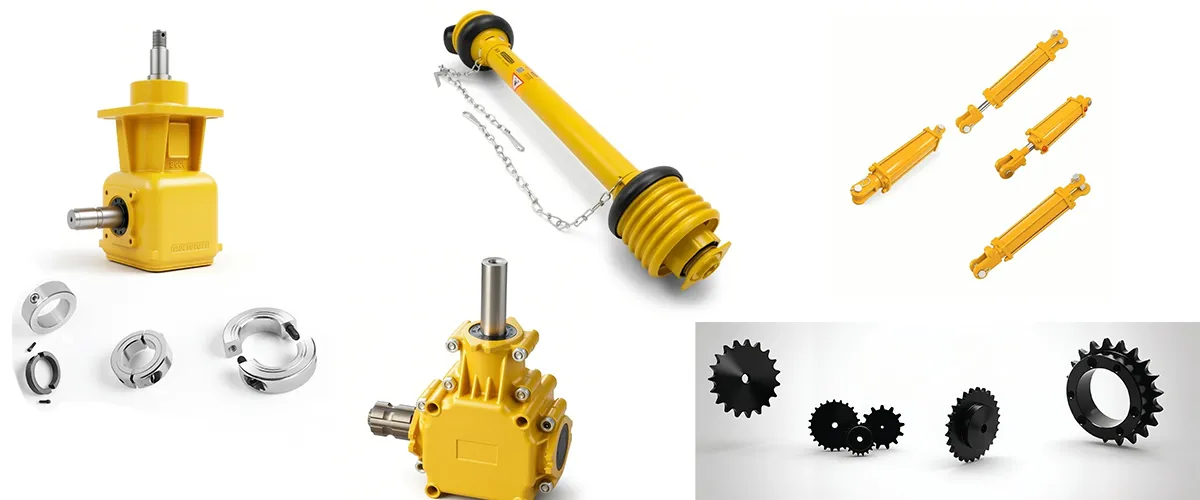
The EP-4550mm rock rake is part of a complete soil preparation and land clearance system. We also produce and supply the compatible drive components that keep your implement running efficiently — covering PTO shafts, gearboxes, and power transmission accessories for the full range of PTO-driven land preparation equipment.
Sprockets — Drive System Components
Precision-engineered sprockets for PTO-driven and hydraulically actuated agricultural implements. Correct sprocket sizing ensures full power transfer from the tractor to the working mechanism of your rock rake attachment, extends chain and drive component life, and reduces the heat generated by mismatched drive geometry. Sourcing your implement and its drive sprockets from the same technical supply chain eliminates compatibility guesswork and simplifies spare-parts management across your fleet.
Gearboxes — Power Transmission
Agricultural gearboxes for PTO-driven soil preparation machinery, stone crushers, and rock rake systems. Our gearbox range covers the speed reduction and torque multiplication requirements of medium to heavy implements operating at PTO speeds of 540–1000 RPM. Paired with the EW-4000T transmission-drive variant, a correctly specified gearbox ensures the working mechanism receives consistent drive power across the 3–5 km/h operating speed range without thermal or fatigue issues. One-stop supply of implement, gearbox, and drive shafts simplifies your procurement process significantly.
Pertanyaan yang Sering Diajukan
Editor: PXY