Land Clearing Equipment Guide
PTO Stone Crusher vs. Stone Picker vs. Rock Rake: Which Machine Fits Your Land Clearing Job?
A practical, side-by-side breakdown of three fundamentally different approaches to removing rocks from agricultural land — so you can invest with confidence.
Ask a Korean farmer in Gangwon-do what the biggest obstacle to expanding a vegetable plot is, and the answer comes up quickly: rocks. Surface stones, buried boulders, fist-sized gravel scattered through clay — each presents its own challenge and demands a distinct mechanical answer. Walk into any agricultural machinery dealership in South Korea today and you will find at least three categories of equipment lined up to solve these problems: the PTO stone crusher (sometimes called a tractor stone crusher or agricultural stone crusher), the stone picker, and the penggaruk batu. All three attach to the rear of a tractor via the three-point hitch, and all three deal with stone in some way. The similarities, however, end there.
Choosing the wrong machine means paying twice — once for the wrong piece of equipment and once for the rental or purchase of the right one. This guide breaks down how each machine actually works, what it is built from, where each earns its keep, and which scenarios genuinely call for one over the others. Real technical specifications from the product range are included where relevant, along with notes on relevant regulations across key agricultural markets.
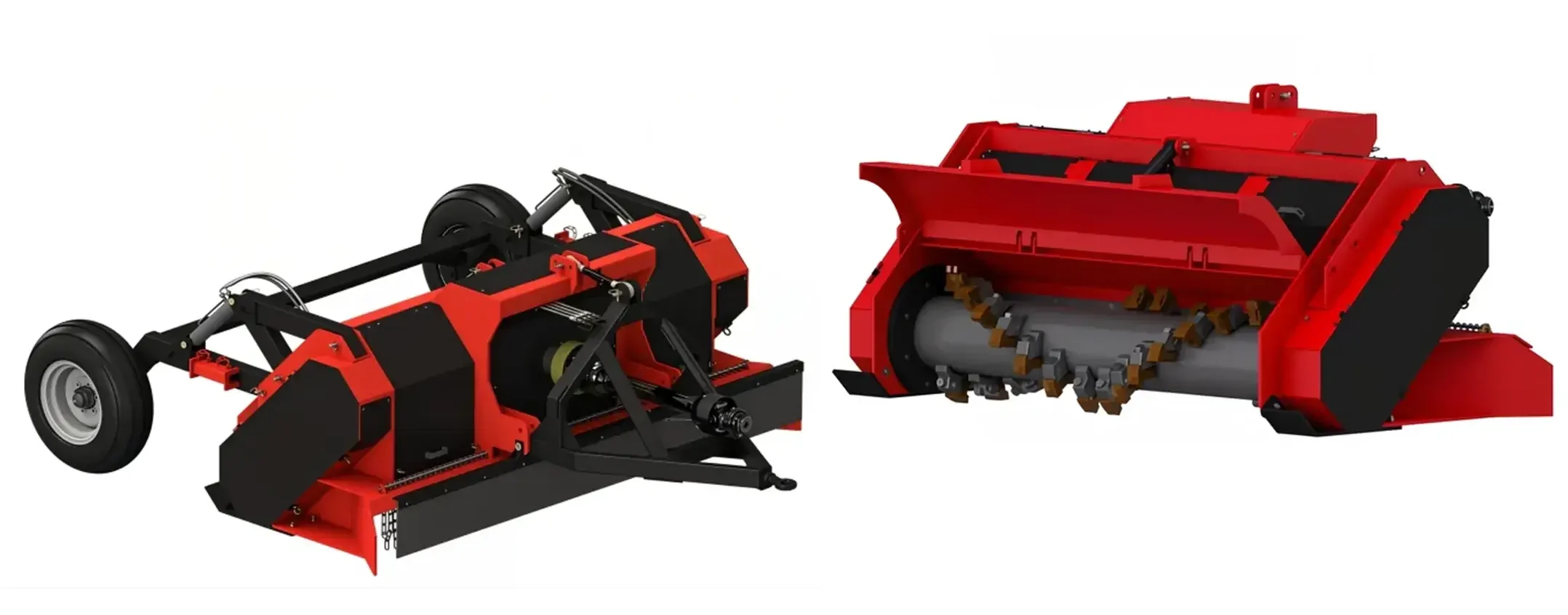
1. Action Method: How Each Machine Actually Handles Stone
PTO Stone Crusher — Impact and In-Situ Reduction
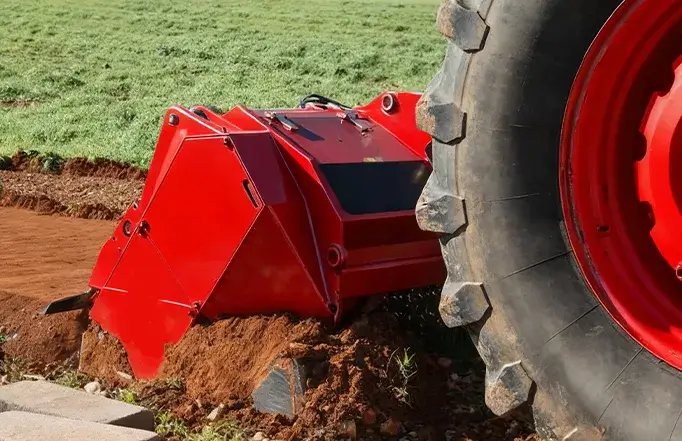
A PTO stone crusher converts mechanical power from the tractor’s Power Take-Off shaft directly into high-velocity rotor rotation. Inside a heavy-duty steel housing, a rotor fitted with rows of hardened-steel hammers or fixed teeth spins at speeds typically between 540 and 1,000 RPM. When the machine passes over a stone, the hammers strike it with tremendous kinetic force, shattering it against a set of adjustable counter-blades. The resulting fragments — graded by a rear hood — fall back into the seedbed as fine aggregate. Nothing is collected and nothing needs to be hauled away. The crushed material stays in the field and actually improves the soil’s drainage and texture. This is what makes the PTO stone crusher fundamentally different from every alternative: it eliminates stones rather than relocating them.
Direct PTO transmission is central to the performance advantage. By driving the rotor without intermediate belt slippage, the machine maintains consistent crushing force across variable stone densities. Models in the PSC series, for example, operate at 1,000 RPM PTO speed and can process stones up to 300 mm in diameter at working depths up to 200 mm — performance figures that a rock rake or stone picker cannot begin to replicate.
Stone Picker — Mechanical Collection and Bunker Storage
A stone picker uses a rotating tine or paddle mechanism to scoop stones off the surface or shallow subsurface, elevating them onto a conveyor that deposits them into an on-board bunker. Once the bunker is full, the operator drives to a designated collection point and empties it. The stones remain whole — they are not crushed or reduced in any way. The CT-2100 Rock Picker, for instance, features a working width of 1.95 m and a bunker capacity of 2.5 m³, requiring a minimum of 110 cv of tractor power and a hydraulic oil flow of at least 60 L/min. This is an effective solution where you want to physically relocate stones — for instance, to build field-edge windbreaks, fill access roads, or simply dump the material off-field.
Stone pickers are hydraulically driven in most modern configurations, requiring 2 control valves. Working speed is typically 3–5 km/h. The key limitation is the bunker: once full, fieldwork stops. On heavily stone-laden ground, operators may empty the bunker multiple times per hour, which adds up to significant time overhead across large parcels.
Rock Rake — Passive Windrow Formation
A rock rake is a passive, unpowered (or lightly powered) implement that consists of a set of curved or straight tines arranged in a row. As the tractor pulls the rake across the field, the tines catch and drag surface stones into rows or windrows. The stones accumulate in a concentrated line that can later be collected with a loader bucket, stone picker, or by hand. The EW-4000 Rock Rake operates with a 3.6 m working width at 3–5 km/h, requiring either 100 cv (hydraulic version) or as little as 75 cv (tractor-powered variant). It weighs 1,800–1,900 kg and mounts on a Category 2 three-point hitch. There is no crushing, no bunker, and no hydraulic drive system involved in most configurations — making it the lowest-cost option by a considerable margin.
The rock rake is most appropriate as a surface-preparation tool on fields where stones are large, numerous, and concentrated near the surface. It does not deal with buried stones and does not reduce the stone to a smaller size. After raking, a secondary operation (loader, picker) is still required to actually remove the material from the field.
2. Quick-Reference: Action Method Comparison
| Attribute | PTO Stone Crusher | Stone Picker | Rock Rake |
|---|---|---|---|
| Stone outcome | Crushed in-field | Collected whole | Windrow on surface |
| Power source | PTO shaft (540/1000 RPM) | Hydraulic (60 L/min) | Tractor pull / hydraulic |
| Secondary operation needed? | No | No (self-collecting) | Yes (must collect rows) |
| Buried stone capability | Yes (up to 200–400 mm depth) | Shallow only | Surface only |
| Fieldwork interruptions | None | Frequent (bunker emptying) | None while raking |
| Typical working speed | 3 km/h | 3–5 km/h | 3–5 km/h |
3. Manufacturing Structure: What Goes Into Each Machine
Understanding the structural architecture of each implement helps explain both the price differential and the durability differences you will encounter in daily use.
PTO Stone Crusher Build Architecture
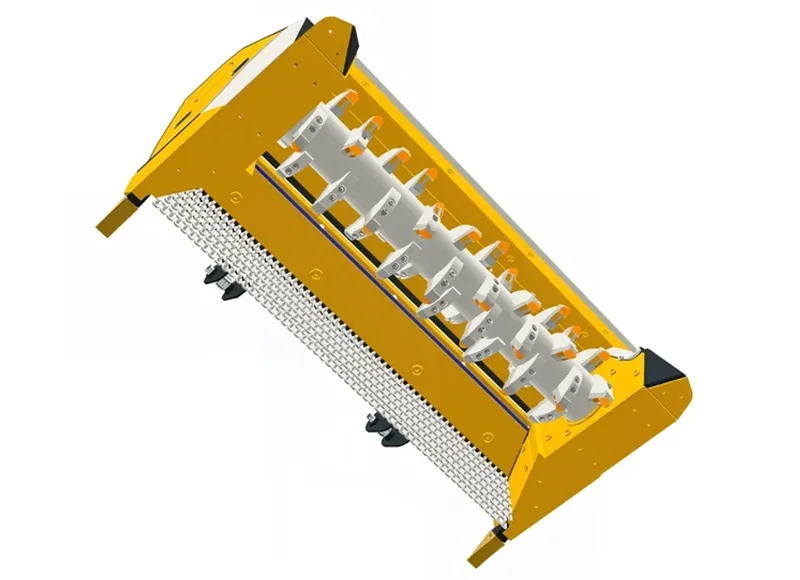
A well-engineered tractor stone crusher is essentially a rotating impact mill inside a torsionally rigid steel shell. The main housing is fabricated from thick-gauge structural steel, often reinforced with bolt-on Hardox wear plates at high-impact zones inside the crushing chamber. The rotor — the most mechanically demanding component — is typically machined from heat-treated alloy steel and carries interchangeable tool holders. These holders accept different tooth profiles: standard fixed teeth for general fieldwork, heavy-duty HD teeth for abrasive granite-heavy soils, and flat-profile FP teeth for fine finishing work. The adjustable Hardox counter-blade is hydraulically operated on mid-range and larger models, allowing the operator to tune the aggregate output size without stopping the tractor.
The gearbox or belt-drive transmission sits at the top of the housing, protected by its own sealed casing. On the THOR 2.4 model, the entire unit weighs 2,300 kg, spans 2,481 mm in width, and requires a minimum tractor output of 180 cv. The THOR 3.0 steps up to 2,800 kg and 3,000 mm wide, needing at least 230 cv. Both mount on a Category 2 three-point hitch and operate at a working speed of 3 km/h. On PSC-series (STCM-type) machines, the rotor diameter reaches 550 mm with working widths from 1,340 mm to 2,304 mm depending on model — covering everything from a compact orchard tractor to a 280-cv high-horsepower unit. The entire machine body is dust-sealed on these larger units, protecting internal bearings from the significant amounts of fine stone dust generated during operation.
Stone Picker Build Architecture
The stone picker (CT-2100) has an entirely different structural logic. Its frame spans 6,000 mm in length and 3,050 mm in width, standing 2,340 mm tall at an operating weight of 3,400 kg. The working mechanism is a rotating tine drum or cam-driven pickup system at the front, feeding onto a cleaning web that separates soil from stone before depositing the material into the hopper. A hydraulic tipping system empties the 2.5 m³ bunker. Because no crushing takes place, the internal components — tines, webs, drive sprockets — face lower peak forces than a stone crusher rotor, but face higher cycle fatigue from continuous rotation. Tine replacement is the most common maintenance task on these machines.
Rock Rake Build Architecture
The EW-4000 Rock Rake is the structural simplest of the three. At 4,550 mm long and 2,400 mm wide, it weighs 1,800–1,900 kg (slightly more in the tandem EW-4000 T configuration). The core of the implement is a set of spring-steel or hardened-steel tines mounted in a staggered pattern across the working width. Ground-following wheels and adjustable depth skids allow the tines to track surface contours without digging into soft soil. Two hydraulic control valves manage the tine angle and implement lift. There is no drive shaft, no rotor, and no gearbox — which is precisely why maintenance costs are low and reliability is high. The structural weak point is tine fatigue: on heavily-stoned ground, bent or broken tines are a regular service item.
4. Material System: Steels, Alloys, and Wear Components
The stone crushing industry relies on a specific vocabulary of specialty materials, and understanding these choices matters when comparing long-term operating costs across machine types.
Hardox wear steel (produced by SSAB) is the dominant choice for internal liner plates and counter-blades on professional-grade stone crushers. With a Brinell hardness rating typically between 400 and 600 HBW depending on grade, Hardox plates absorb impact energy without shattering, extending service intervals dramatically compared to standard structural steel. The PSC-series machines use interchangeable Hardox liner plates bolted inside the crushing chamber — when worn, they are replaced individually rather than requiring the entire housing to be rebuilt.
Rotor teeth on stone crushers are typically manufactured from tungsten-carbide-tipped alloy steel or forged heat-treated tool steel. The STC/3 tooth profile used on STCM-family crushers features a wide cutting edge that distributes impact load over a larger surface area, reducing fracture risk. STC/3/HD teeth offer additional mass for harder granitic material. The STC/3/FP flat-profile tooth is designed for secondary passes where granulometry control is the priority. Tooth-holder blocks are bolt-on and individually replaceable — an important design choice that reduces both downtime and spare parts cost in the field.
Stone picker tines are commonly produced from medium-carbon spring steel that can deform slightly on impact (absorbing energy) before returning to shape. After repeated flexing cycles, they develop fatigue cracks and must be replaced. Higher-end picker models use solid hardened tines that are more brittle but last longer on moderate-stone-density soils.
Rock rake tines face bending loads rather than impact, so spring-tempered flat-bar steel is the common material. Tines are bolted on, and replacement sets are typically available from dealers in-country. Because the tines do not contact stone at high velocity, wear rates are substantially lower than on any active crushing machine — a meaningful consideration for operations evaluating long-term parts cost.
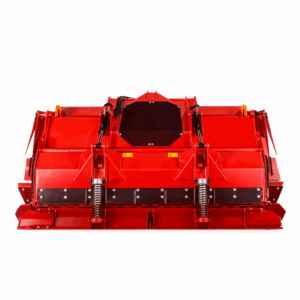
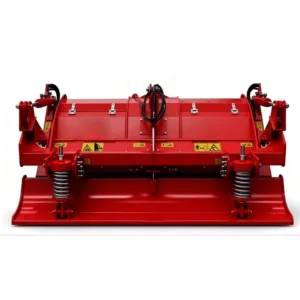
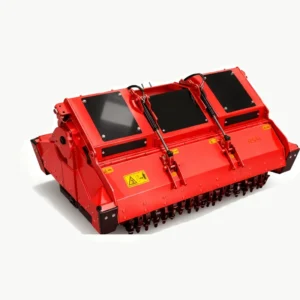
5. PTO Stone Crusher Model Range: Specifications at a Glance
The Mulchers / Stone Crushers product line covers a wide horsepower range. Below are the core models currently available, each suited to different tractor classes and field conditions.
6. Depth Capability and Application Fit
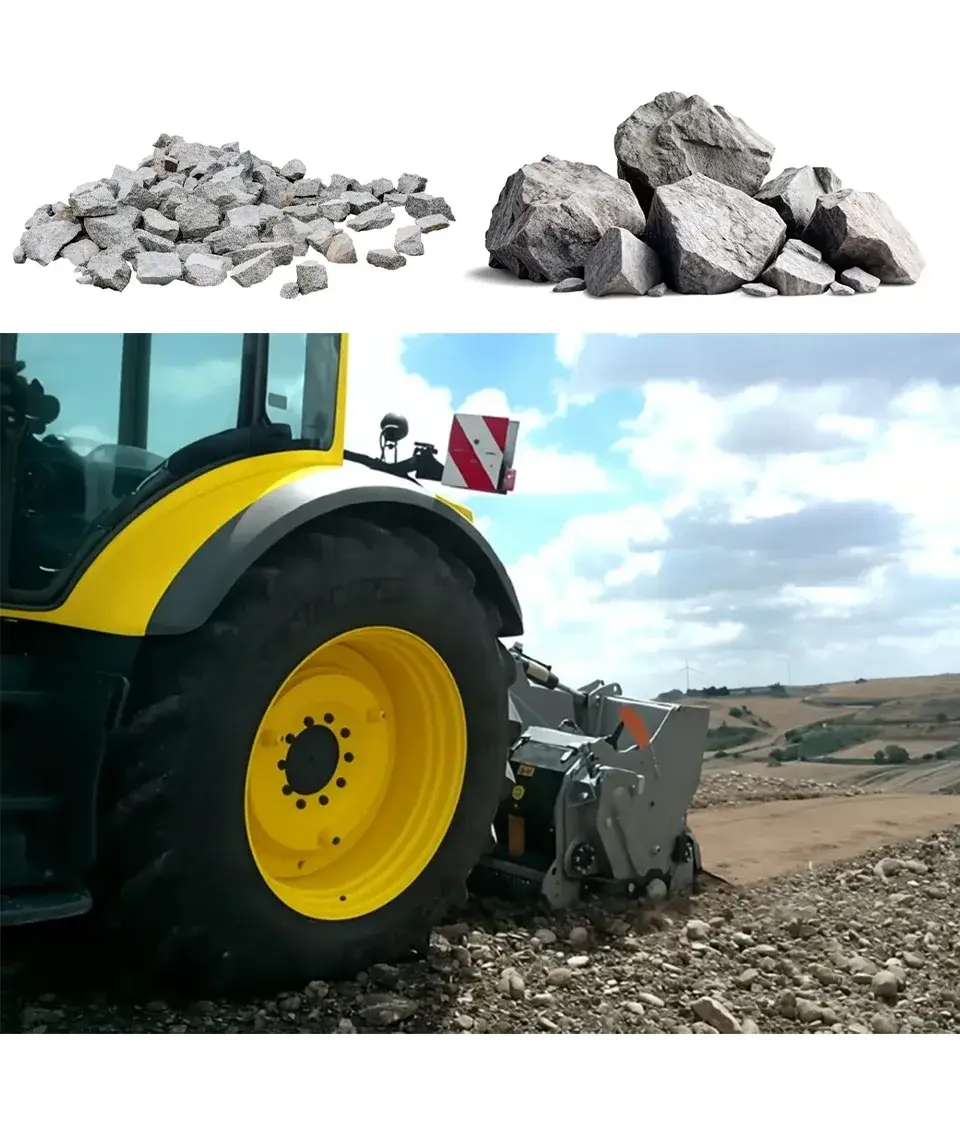
Depth capability is probably the single most decisive factor when choosing between these three machine categories. The rock rake operates purely on the surface — it cannot address anything below soil level. The stone picker can typically retrieve stones sitting within 50–100 mm of the surface, depending on tine geometry and soil hardness. The PTO stone crusher, by contrast, is the only one of the three that actively works below the plough layer. PSC-series (STCM) machines work to 200 mm depth; the larger RSM and RSH machines penetrate to 400–500 mm. This means a stone crusher can address subsurface stones that would cause plough or subsoiler damage in the next season — a capability that neither the picker nor the rake can touch.
For Korean agricultural operations dealing with the coarse granite soils common in the mountainous interior regions, subsurface stone management is not optional — it is a prerequisite for sustainable tillage. Fields that have been surface-raked or picked will still break cultivation implements on buried rock heads. Fields that have been processed with a small pto stone crusher or a full-size agricultural stone crusher reach a genuinely stone-clear profile that persists across multiple crop cycles.
The stone picker earns its keep in a different scenario: pasture renovation and sports turf projects where stones are on or just below the surface and the client specifically requires the stones to be removed from the site — perhaps to satisfy a landscape specification or environmental requirement. It is also the right choice on sandy or light soils where stones are abundant but the ground is soft enough that tines can penetrate freely without excessive resistance.
The rock rake is best deployed as the first pass on heavily-stoned ground before another operation. Raking concentrates the stone load, dramatically reducing the number of passes required by the picker. Some operators combine all three: rake first to gather large surface stones, pick them up, then run the PTO stone crusher to address the remaining embedded material. This multi-pass approach is common on severe land reclamation projects in the Jeju Island volcanic soil belt.
7. Tractor Requirements and PTO Compatibility
Matching the implement to the available tractor is not optional — it is a safety and performance requirement. Here is what each machine category demands.
| Model / Type | Min HP | PTO RPM | Hitch Cat. | Hydraulic Valves |
|---|---|---|---|---|
| THOR 2.4 Stone Crusher | 180 tenaga kuda | — | Cat. 2 | 2 |
| THOR 3.0 Stone Crusher | 230 tenaga kuda | — | Cat. 2 | 2 |
| PSC/STCM Series (small) | 80 cv | 540 / 1000 | Cat. 2 | 2 |
| PSC/STCM Series (large) | 280 cv | 1000 | Cat. 2 | 2 |
| CT-2100 Rock Picker | 110 cv | — | Cat. 2 | 2 (60 L/min) |
| EW-4000 Rock Rake (hydraulic) | 100 cv | — | Cat. 2 | 2 |
| EW-4000 T Rock Rake (tractor-powered) | 75 cv | — | Cat. 2 | 2 |
Note: The small PTO stone crusher (PSC/STCM 125) starts at just 80 cv, making it the most accessible entry point for compact or sub-100 hp tractors. Farmers operating Korean-market sub-compact units should confirm their PTO spline configuration (6-spline or 21-spline) and output speed before purchase.
8. Regulatory Considerations: Gearboxes, PTO Safety, and Agricultural Machinery Standards
Agricultural machinery operating in any jurisdiction is subject to safety standards that affect the design of PTO-driven implements. Understanding the applicable framework protects both the operator and the equipment supplier.
South Korea
In South Korea, agricultural machinery is regulated under the Agricultural Mechanization Promotion Act (농업기계화 촉진법), administered by the Ministry of Agriculture, Food and Rural Affairs (MAFRA). Tractor-mounted implements must comply with Korean Industrial Standards (KS) where applicable, and importers are required to obtain certification from the Korea Agricultural Machinery Industry Association (KAMIA) for safety-critical components. PTO-driven implements specifically must have an appropriate PTO shaft guard covering at minimum the rotating shaft between the tractor output flange and the implement gearbox input — a requirement derived from both the Occupational Safety and Health Act (산업안전보건법) and internationally harmonized EN ISO 11684 guarding standards. Stone crushers that incorporate exposed drive shafts without full-length guarding are not compliant with Korean workplace safety law, and operators face liability risk in the event of an incident.
European Union (CE Marking)
All agricultural machinery sold within the EU must carry a CE mark, affirming conformity with the Machinery Directive 2006/42/EC (to be replaced by the EU Machinery Regulation 2023/1230 from January 2027). PTO-driven stone crushers fall under Annex IV as high-risk machinery, requiring third-party conformity assessment. Gearboxes specifically must meet EN 13736 (safety requirements for gearboxes for agricultural tractors and self-propelled machinery), which governs housing integrity, shaft sealing, lubrication intervals, and overload protection. Torque limiters and shear-bolt couplings are generally mandatory on PTO inputs above a specified torque threshold to prevent drivetrain shock loading. The THOR and PSC-series machines include a central PTO shaft with integrated torque limiter for exactly this reason.
United States
The US does not mandate CE marking, but OSHA 29 CFR Part 1928 (agricultural operations) requires that all power-driven farm equipment be equipped with adequate guarding on rotating components, including PTO shafts. The ASABE (American Society of Agricultural and Biological Engineers) Standard ASAE S203.12 covers agricultural tractor PTO shaft speed and spline dimensions, while ASAE S318 addresses safety requirements for implement PTO systems. Stone crushers marketed in the US should carry documentation confirming compliance with these standards, and dealers offering a tractor stone crusher for sale in the US market should verify applicable state-level agricultural equipment registration requirements.
Australia and New Zealand
In Australia, AS 4024.3610 and the relevant Safe Work Australia Codes of Practice govern PTO implement guarding. New Zealand’s Health and Safety at Work (General Risk and Workplace Management) Regulations 2016 impose similar guarding requirements for rotating PTO-driven machinery. Importers of stone crushing equipment must ensure that PTO shaft guards are included and documented in the supplied machinery manual.
9. Maintenance and Operational Cost Factors
Total cost of ownership extends well beyond the purchase invoice. For stone management equipment specifically, wear-part replacement and downtime are the dominant cost drivers after the initial acquisition.
PTO stone crusher maintenance centers on rotor teeth and internal liner plates. On a machine working in abrasive granitic soil at full capacity, rotor teeth may need inspection every 50–80 hours of operation. Replaceable bolt-on tooth holders allow individual teeth to be swapped without workshop facilities — a straightforward 30-minute job for a single operator. Liner plates inside the crushing chamber are more durable and typically require replacement after 200–400 hours. The sealed gearbox or belt drive system requires periodic oil or belt inspection per the manufacturer’s schedule, with belt-drive units on smaller models checked more frequently. Overall, a well-maintained agricultural stone crusher operating in Korean agricultural conditions should deliver multiple seasons of productive work before requiring any major component overhaul.
Stone picker maintenance centers on tine replacement, web chain or belt servicing, and hydraulic system upkeep. Tine cost per unit is relatively modest, but frequency of replacement on stony ground adds up. Hydraulic hose condition should be checked regularly given the dusty environment. The emptying mechanism — usually a hydraulic tilting bunker — places repetitive load on the hydraulic cylinder seals and pivot points.
Rock rake maintenance is the simplest and least expensive of the three. Spring tines are the only regular consumable, and they are available as standard replacement sets from any dealer stocking the EW-4000 range. The hydraulic cylinders controlling tine angle and implement lift should be inspected for seal weeping during routine service. Because there is no high-speed rotating mechanism, bearing replacement and rotor balancing — two of the costlier stone crusher maintenance items — simply do not apply.
10. Which Machine for Which Job? A Decision Matrix
Choose the PTO Stone Crusher when:
- You need to permanently eliminate subsurface stones
- The field will be cropped next season and stone removal must be complete
- You want in-situ aggregate for drainage improvement
- Hauling stone off-field is impractical or too costly
- You are reclaiming new ground with dense embedded rock
- You manage multiple parcels and need a single versatile solution
Choose the Stone Picker when:
- Stones must physically leave the field
- Soil conditions are soft enough for tine penetration
- You are renovating pasture for livestock operations
- Stone depth is predominantly within 100 mm of surface
- You have a use for the collected stone (road fill, etc.)
Choose the Rock Rake when:
- Budget is a primary constraint
- Large surface stones need to be gathered before seeding
- You will follow with a loader bucket to collect windrows
- The terrain is too rough for a picker to operate smoothly
- Ground is frozen or very hard and picker tines cannot penetrate
11. Return on Investment and Long-Term Land Value
Investing in stone clearing equipment is ultimately a land-improvement decision. In Korea, where arable land is scarce and farmland transactions occur at a premium per pyeong, the ability to reclaim rock-strewn hillside fields and convert them into productive cultivated land represents a tangible increase in asset value. An agricultural stone crusher working a previously uncultivable rocky plot can transform it within one to three passes into land capable of supporting vegetable crops, orchards, or pasture — uses that generate ongoing revenue rather than remaining idle.
Beyond land conversion, the operational savings from in-situ crushing are frequently underestimated. Farms that previously hired excavators and dump trucks to periodically clear rocks from active fields — a common practice in Jeju, North Chungcheong, and Gyeonggi provinces — find that a tractor-mounted rock crusher eliminates this recurring cost entirely after the first season. The machine pays for itself not just in improved yields from cleared land but in the elimination of third-party hauling contracts and the reduction of implement damage caused by undetected subsurface stones.
Stone pickers and rock rakes, while less capable in isolation, can meaningfully reduce the number of passes required by a crusher on ground that carries a very heavy surface stone load. A strategic combination of implements — rake to gather, crush what remains, and periodically pick up oversized material after initial clearing — is the approach favored by professional land reclamation contractors operating across mountainous Korean agricultural zones.
Frequently Asked Questions
Q1. Which PTO stone crusher model works best for a Korean upland vegetable farm with rocky volcanic soil?+
For Korean volcanic upland conditions — typical in Jeju and parts of Gangwon — a mid-range PSC/STCM model (80–220 cv range) is the most common practical choice. The volcanic basalt fragments found in these soils are dense and hard, so the STC/3/HD tooth configuration is advisable for the initial passes. Once the bulk of large fragments are crushed, a switch to standard STC/3 teeth is appropriate for finishing. If your tractor is in the 80–120 cv class, the STCM-125 or STCM-150 fits the horsepower window. Higher-powered units in the 150–220 cv range should look at the STCM-175 through STCM-225 models, which offer working widths from 1,824 to 2,304 mm for faster coverage.
Q2. What is the maximum stone diameter that a mid-range agricultural stone crusher can handle in a single pass?+
STCM-series machines can process stones up to 300 mm (approximately 12 inches) in diameter. The larger STCH machines handle stones up to 500 mm (about 20 inches), requiring 280–400 cv tractors. For most Korean farming operations, the 300 mm capability of mid-range models is more than sufficient — field stones larger than this are typically relocated by loader before the crusher pass rather than fed directly into the machine.
Q3. What is the difference between a stone picker and a PTO stone crusher when reclaiming abandoned farmland in Korea?+
A stone picker collects surface stones intact and deposits them into a bunker — useful for light infestations on soft soil but slow on heavily stoned ground and ineffective on embedded stones. A PTO stone crusher pulverizes material in place, including subsurface rock, without requiring collection or hauling. For abandoned Korean farmland that has been out of cultivation for years — where erosion has exposed subsurface stones and vegetation roots have lifted embedded fragments — the stone crusher is almost always the more efficient first-pass choice, with the picker reserved for any subsequent tidy-up pass.
Q4. Which tractor-mounted rock crusher model is recommended for a 100 hp tractor used in Korean highland farming conditions?+
A 100 cv tractor sits comfortably in the operating range of the STCM-150 (150–220 cv range at the upper end, 80 cv minimum) and the STCM-175. The PSC model family covers this HP class with working widths from 1,584 to 1,824 mm — sensible widths for the narrower terrace-style field layouts common in Korean highland zones. At 1,000 RPM PTO speed, these machines deliver consistent crushing performance without overstressing the tractor drivetrain. If your tractor has a dual-speed PTO (540/1000), confirm with the dealer which speed the chosen model requires before purchase.
Q5. What safety certifications should I look for when buying a used tractor stone crusher for sale in the Korean market?+
For the Korean market, verify that any used machine includes: a full-length PTO shaft guard (or that a compliant replacement guard can be sourced), the original operator manual (ideally in Korean or accompanied by a translated safety section), evidence of gearbox service history, and documentation confirming the hitch category matches your tractor. Machines manufactured for EU markets will carry CE markings and have been designed to Machinery Directive standards — which are generally more stringent than the minimum Korean requirements — so EU-origin machines often represent a reliable baseline for safety compliance. Always inspect the PTO guard, housing welds, and rotor tooth holder bolts physically before any purchase.
Q6. When does a rock rake make more sense than a stone picker for Korean orchard preparation work?+
A rock rake makes more sense than a stone picker in Korean orchard settings when the stones are large (over 150 mm) and concentrated on the surface after a winter frost cycle — conditions that occur across apple orchard areas in North Gyeongsang and Chungcheong. On hard-packed or dry summer ground, a picker’s tines may struggle to penetrate enough to scoop stones efficiently, while a rake will simply drag surface material into rows without being limited by soil resistance. After raking, a loader bucket or skid steer can collect the windrows efficiently. For mixed operations, the EW-4000 T model (75 cv minimum) is a cost-effective entry point before committing to a heavier picker purchase.
Q7. How does a small PTO stone crusher compare to a portable stone crusher machine for on-farm aggregate production?+
A small PTO stone crusher (such as the PSC/STCM-125 or STCL-series starting at 70 cv) is a purpose-built implement that leverages your existing tractor as the power source, making it far more economical to own and operate than a dedicated portable stone crusher machine. Portable crushers are self-powered and designed for aggregate processing at fixed sites or construction projects — they produce significantly higher throughput but require fuel, maintenance of their own engine, and transport. For farm-scale use — clearing fields, processing driveway gravel, or preparing seedbeds — a tractor-driven small stone crusher is the vastly more cost-effective and operationally flexible solution.
Q8. What agricultural stone crusher models are specifically available for Korean tractor compatibility and local field conditions?+
The Agricultural Tractor Mounted Rock Crusher specifically designed for Korean conditions is available in our product range at the dedicated Korea-specific product page. It is configured for compatibility with the Korean tractor horsepower norms and the Category 2 three-point hitch system used on mainstream Korean tractor brands. The broader product range — including the THOR 2.4, THOR 3.0, RockMaster, PSC/STCM series, and the Tractor-Mounted Rock Crusher — can also be configured for use with Korean tractors once the PTO speed and spline profile are confirmed. We recommend contacting our technical team with your tractor make and model for a direct compatibility assessment.
Editor: PXY