1. What Makes European Terrain a Unique Challenge for PTO Stone Crusher Operation?
European agricultural land is anything but uniform. From the limestone-rich hillsides of the Iberian Peninsula to the basalt-studded volcanic fields of central France, from the glacially deposited gravels of the North German Plain to the rocky terraced slopes of the Balkans — every region presents a distinct stone profile that directly shapes which PTO stone crusher design will actually perform in the field. Farmers working these landscapes know that a PTO stone crusher built for flat, sandy soil rarely holds up when grinding through fractured granite or dense calcareous formations. This guide was written specifically to help operators, agronomists, and land managers in Europe understand the mechanical logic behind tractor stone crusher selection, not just the specification sheets.
European soil surveys consistently identify stone interference as one of the primary obstacles to mechanised agriculture in upland and semi-arid zones. When stones exceed 10–15 cm in diameter they begin to damage tillage implements, interrupt seed placement, and reduce irrigation uniformity. A well-matched PTO stone crusher solves all three problems simultaneously — reducing stones in a single pass and returning the processed material to the topsoil layer where it contributes to drainage and thermal regulation. That outcome, however, depends entirely on choosing a PTO stone crusher whose action method, build structure, and material system are calibrated to the specific stone type, field geometry, and tractor power available on the farm. Selecting the wrong agricultural stone crusher is a costly mistake — one that shows up immediately in poor fragmentation output, excessive tooth wear, and gearbox overloading.
The sections below break down each of these dimensions systematically, then place them in the context of the full PTO stone crusher range available for the European and Korean markets. Whether you are looking for a small PTO stone crusher for a compact 80 hp orchard tractor, or a heavy-duty PTO stone crusher for sale to handle boulder-laden land conversion on a large estate, the principles covered here will inform your choice.
2. Action Method: How a PTO Stone Crusher Breaks Rock
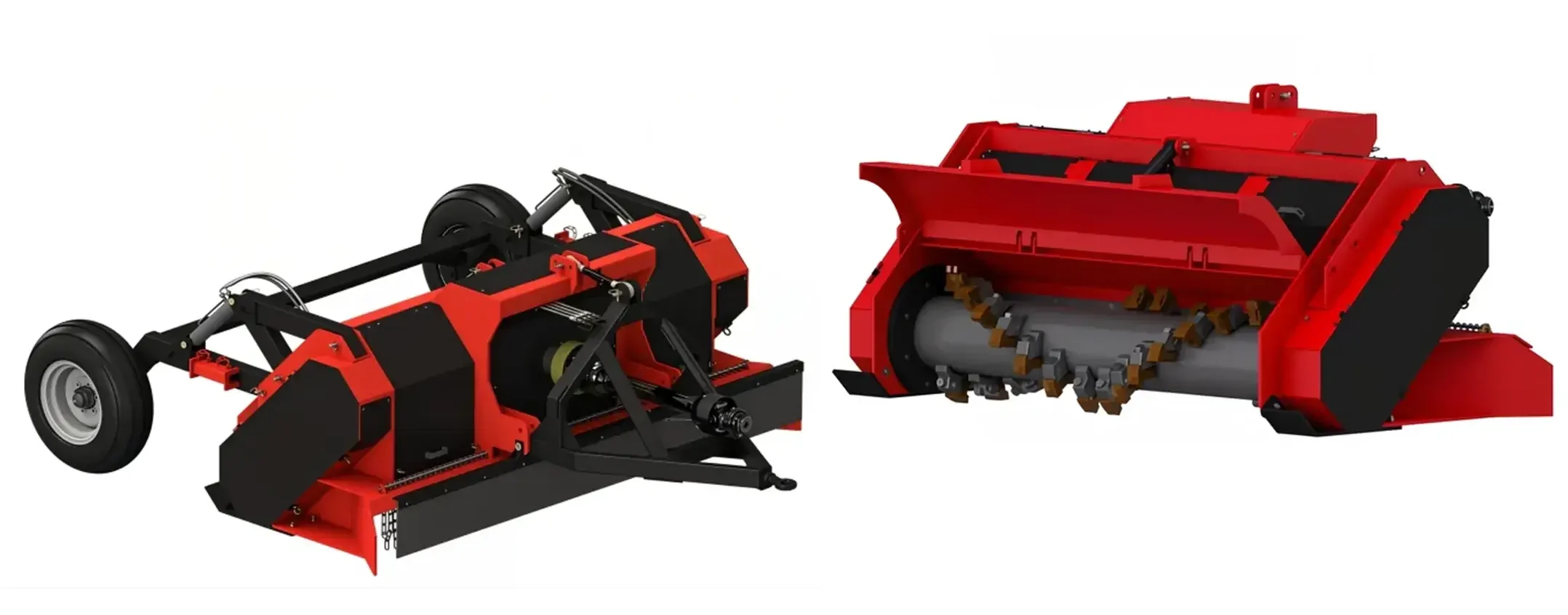
The “action method” describes the mechanical principle through which a PTO stone crusher converts rotary tractor power into stone fragmentation. For PTO-driven agricultural stone crushers, three principal action methods are in use today, and each carries specific advantages depending on the hardness, size, and distribution of stones in the field.
Fixed-Tooth Rotor Impact
The most widely adopted action method for field stone crusher applications in Europe, the fixed-tooth rotor spins at high velocity (typically at 540 or 1000 RPM PTO input) and strikes stones with hardened tool-steel picks. The kinetic energy of each PTO stone crusher tooth impact fractures the stone, and a combination of the rotor geometry and a counter-blade directs fragments downward and rearward, leaving processed material on the field surface or burying it slightly into the topsoil. Fixed-tooth PTO stone crusher systems handle a very wide range of stone sizes — from small pebbles up to 300 mm or more in the larger models — and adapt well to the irregular stone beds typical of ploughed European farmland. The PSC Models series (working widths 1110–2070 mm, tractor requirement 70–150 hp, PTO 540–1000 RPM, max stone diameter 150 mm) uses this action method in a compact, lightweight format purpose-built for farms where row spacing and hillside gradients restrict machine width and weight. This PTO stone crusher category is also the most commonly found used tractor stone crusher for sale in the European second-hand market.
Counter-Blade Compression and Shear
In heavier-duty PTO stone crusher models, a hydraulically adjustable counter-blade works in conjunction with the rotor to add a shear component to the impact force. When a large stone enters the crushing chamber of the PTO stone crusher, it is not merely struck — it is caught between the rotor tooth and the counter-blade and subjected to concentrated compressive and shear stress. This dual-force mechanism is especially effective on limestone slabs, sandstone plates, and other stratified rocks common in southern and central European terrains. The STCM-series PTO stone crusher configuration (working widths 1340–2304 mm, tractor 80–280 hp, PTO 1000 RPM, max stone diameter 300 mm, max depth 200 mm) employs this approach, making it one of the go-to options for heavier land conversion work where stones need to be reduced to a fine, field-beneficial size in a single pass. Korean farmers looking for a powerful tractor stone crusher suited to the hard volcanic basalt of Jeju Island frequently select this class of PTO stone crusher.
Multi-Pick Rotor Milling
At the upper end of the power scale, PTO stone crusher designs for the largest European tractors (280–500 hp) use a multi-pick rotor that combines fixed teeth with additional pick-style inserts to mill through extremely hard or deeply seated stone formations. This PTO stone crusher approach is essentially a continuous surface-milling action and is relevant for terrain reclamation, road shoulder maintenance, and the conversion of rocky pasture to arable land. The RockMaster Agricultural Stone Crusher, capable of processing stones up to 500 mm in diameter, is representative of this PTO stone crusher category, with rotor geometry engineered to maintain consistent bite depth and fragment size even when encountering variable stone density across a single field pass. Agricultural stone crusher manufacturers offering this capability target operators managing the most demanding land reclamation projects in Europe and Korea.
Understanding which action method your terrain demands is the first step to selecting the right PTO stone crusher for tractor attachment. Mismatching a light impact PTO stone crusher to dense basalt slabs, or deploying a heavy milling unit on a small farm with shallow topsoil, leads to either poor fragmentation results or unnecessary soil disruption. A PTO stone crusher for sale that covers the right power range and action method for your terrain will pay back its purchase cost in reduced labour and improved field productivity within a single season.
3. Manufacturing Structure: How a PTO Stone Crusher Is Built
The durability of a PTO stone crusher in European conditions — where machines must endure continuous work in abrasive, wet, and often clay-heavy soils — depends directly on how it is manufactured at the structural level. There are several key engineering elements that separate a PTO stone crusher capable of lasting a decade from one that requires constant repair.
Structural Reference: Thor 2.4 PTO Stone Crusher + Kit Drawbar
| Parameter | THOR 2.4 Value |
|---|---|
| Length (mm) | 1546 |
| Width (mm) | 2481 |
| Height (mm) | 1212 |
| Berat (kg) | 2300 |
| Bottom Linkage Category | 2 |
| Working Width (m) | 2.4 |
| Min. Engine Power (hp) | 180 |
| Working Speed (km/h) | 3 |
| Required Control Valves | 2 |
The Thor 2.4 PTO stone crusher body is built around a Category 2 three-point linkage frame, meaning it attaches directly to the standard rear hitch found on most European farm tractors rated above 100 hp. The 2,300 kg operating weight reflects the use of thick structural steel plate throughout the main chassis — a design choice that keeps the PTO stone crusher rigid under the lateral and torsional forces generated by rotor impact, while the Kit Drawbar option adds a separate trailer axle for greater stability when operating on cross-slope European hillsides. There is also a Thor 3.0 PTO stone crusher variant with a 3.0 m working width (3000 mm), weight 2800 kg, and a minimum tractor requirement of 230 hp for the highest-productivity field operations on wide, open European farmland.
Gearbox and Transmission Design in a PTO Stone Crusher
The gearbox is arguably the single most important component in a PTO stone crusher’s mechanical structure. Power from the tractor’s PTO shaft enters the PTO stone crusher at either 540 or 1000 RPM (depending on model), and the transmission must reduce that rotational speed while multiplying torque to spin the rotor at a rate sufficient to generate the impact velocity required for effective stone fragmentation. In the PSC and STCM-class PTO stone crusher machines, a parallel-shaft gear reduction unit is used, providing a compact yet high-torque output. In heavier RSM and STCH configurations, the PTO stone crusher gearbox may incorporate a planetary reduction stage that further increases torque multiplication without a proportional increase in housing size.
European tractor manufacturers and PTO stone crusher attachment suppliers operating under the EU Machinery Directive (now superseded by EU Machinery Regulation 2023/1230, which entered into force in January 2024 and applies from January 2027) must demonstrate that PTO stone crusher implements meet the essential health and safety requirements of Annex III. This includes guarding of all rotating transmission elements, compliance with EN ISO 11684 for safety signs on agricultural machinery, and documentation confirming that the PTO stone crusher’s rated input torque does not exceed the tractor’s PTO output capacity as defined under EN ISO 8210. For the Korean market specifically, the Rural Development Administration (농촌진흥청, RDA) issues tractor attachment safety guidelines under the Agricultural Mechanization Promotion Act (농업기계화촉진법), and any PTO stone crusher for sale in Korea must carry RDA-compatible certification before being used on registered agricultural land.
Crushing Chamber Design in the PTO Stone Crusher
The geometry of the crushing chamber — the enclosed space between the PTO stone crusher rotor and the machine’s housing — determines how fragments are directed after initial impact. A tight, curved rear chamber wall with interchangeable Hardox wear plates bounces fragments back toward the rotor for secondary crushing, producing a finer, more uniform output. A wider rear door opening, as seen in heavy-duty PTO stone crusher machines targeting 300–500 mm stone diameters, allows large fragments to exit more freely, reducing the risk of chamber blockage in high-density stone conditions. The rear door on most PTO stone crusher models in this range is hydraulically controlled, allowing the operator to adjust output size from the tractor cab without stopping — a practical advantage on European hillside fields where stopping and dismounting on a slope is both inconvenient and potentially unsafe. This direct hydraulic control is one of the most valued features in a PTO stone crusher designed for professional European agricultural use.
4. Material System: What a Quality agricultural stone crusher Is Made Of
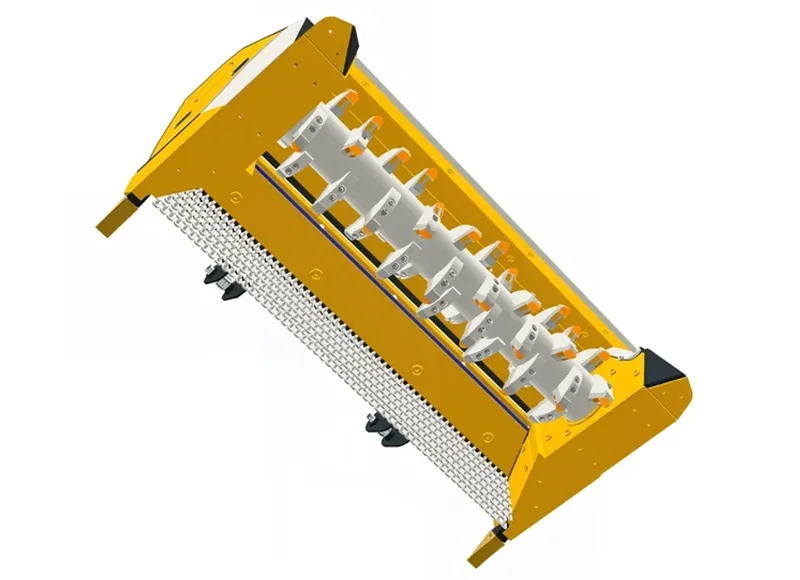
When operators ask about the “material system” of a PTO stone crusher, they are asking which steels, coatings, and wear parts make up the machine’s working surfaces. This matters enormously in European conditions where siliceous stones such as flint, granite, and quartzite are highly abrasive, and where wet clay soils accelerate corrosion on exposed metal surfaces between seasons. The material specification of a stone crusher for tractor directly determines both its operating cost and its service life.
Hardox Wear Plate in the PTO Stone Crusher Crushing Chamber
Hardox wear-resistant steel — manufactured by SSAB and widely specified in European mining and earthmoving equipment — is the material of choice for crushing chamber liners, rear door inner faces, and side-scraper components in high-performance tractor stone crusher designs. Its outstanding hardness (typically 400–600 HBW depending on grade) allows the material to withstand continuous abrasive contact with silica-bearing rock without the rapid surface fatigue seen in standard construction steel. The interchangeable Hardox protection panels used in the STCH-series PTO stone crusher machines can be replaced in the field when worn rather than requiring a full housing replacement, which dramatically reduces the total ownership cost over the machine’s working life. For agricultural stone crusher operations on rocky volcanic soil in Korea’s Jeju Island region, or on the flint-heavy soils of northern France and southern England, this replaceability is not a minor detail — it is what separates an economically viable stone crushing equipment from one that becomes unaffordable to maintain after a few seasons.
Fixed-Tooth Cutting Elements in the PTO Stone Crusher
The rotor teeth themselves — the primary impact elements in a stone crusher machine — are manufactured from high-alloy tool steel or from solid carbide composite, depending on the application intensity. Standard fixed teeth (designation STC/3 in the PSC/STCM PTO stone crusher nomenclature) are heat-treated alloy steel designed for general agricultural stone crushing where the dominant stones are 150–300 mm field stones. For denser or harder stone beds, high-density (HD) variants with enlarged cross-sections or carbide-tipped inserts provide greater resistance to fracture at the tooth root, where stress concentration is highest during field stone crusher impact. The number of teeth per rotor increases proportionally with machine width: a PSC 100 PTO stone crusher (1110 mm working width) carries 22 standard teeth plus 4 fixed-point scrapers, while a PSC 200 agricultural stone crusher (2070 mm working width) runs 42 teeth, maintaining consistent ground coverage density across the full cutting width. When evaluating a used tractor stone crusher for sale, inspecting tooth wear is the single most important diagnostic step before purchase.
Structural Steel Frame of the PTO Stone Crusher
The main chassis, rotor housing, and three-point linkage arms of European-specification stone crusher for tractor machines are generally fabricated from S355 structural steel (EN 10025-2) or its regional equivalents, a high-yield grade that combines good weldability with substantially greater tensile strength than standard S235 construction steel. This grade allows PTO stone crusher designers to achieve the required structural stiffness and impact resistance with less total steel mass — important because machine weight directly affects the tractor’s dynamic stability on sloping European farmland. The Thor 2.4 tractor stone crusher’s 2,300 kg working weight and the Thor 3.0’s 2,800 kg represent a balance between structural robustness and transport legality under European road traffic rules for agricultural machinery (typically governed by national implementations of EU Directive 167/2013 on agricultural vehicle type-approval).
| PTO Stone Crusher Component | Bahan | Function |
|---|---|---|
| Chamber liners | Hardox 400–600 | Abrasion resistance, replaceable |
| Rotor teeth (standard) | High-alloy tool steel | Impact fragmentation of field stones |
| Rotor teeth (HD) | Carbide-tipped composite | Hard rock — granite, basalt, quartzite |
| Main chassis frame | baja struktural S355 | Load-bearing rigidity under impact |
| Rotor shaft | Alloy steel, heat-treated | Torsional fatigue resistance |
| Side protection | Hardox or manganese steel | Side-wall wear in stone-dense soils |
| Gearbox housing | Cast iron or nodular iron | Vibration damping, oil containment |
5. PSC Series stone crushing equipment — Full Specification Comparison
For farms operating tractors in the 70–150 hp range — which represents the majority of European family-farm tractor fleets — the PSC series PTO stone crusher offers the most versatile entry into tractor stone crusher operation. Six models span working widths from 1,110 mm to 2,070 mm, with tractor power requirements scaling accordingly. This is the range most commonly specified as a small stone crusher machine by operators with compact or mid-sized tractors across Europe and Korea.
| PTO Stone Crusher Model | Traktor (hp) | PTO (rpm) | Work Width (mm) | Berat (kg) | Diameter Batu Maksimum (mm) | Kedalaman Maksimum (mm) |
|---|---|---|---|---|---|---|
| PSC 100 | 70–120 | 540–1000 | 1110 | 1230 | 150 | 150 |
| PSC 125 | 80–120 | 540–1000 | 1350 | 1280 | 150 | 150 |
| PSC 150 | 90–120 | 540–1000 | 1590 | 1440 | 150 | 150 |
| PSC 175 | 100–120 | 540–1000 | 1830 | 1570 | 150 | 150 |
| PSC 175 DT | 100–150 | 1000 | 1830 | 1600 | 150 | 150 |
| PSC 200 DT | 120–150 | 1000 | 2070 | 1750 | 150 | 150 |
All PSC field stone crusher models use a Category 2 three-point hitch, making them directly compatible with the dominant tractor population in European family farming and small-to-medium estate operations. The dual-transmission (DT) variants add a secondary belt or chain reduction stage, improving rotor torque delivery when the PTO stone crusher operates at 1000 RPM on heavier stone work. This range of agricultural stone crusher models is also the most popular for operators searching for a stone crusher for tractor near me in European agricultural districts.
6. Matching the Right PTO Stone Crusher to European Terrain Types
Europe’s agricultural landscape encompasses dozens of distinct soil-stone combinations, and no single stone crusher for tractor covers all of them optimally. The following overview maps the dominant European terrain categories to the most appropriate PTO stone crusher model tier from the available range.
Mediterranean Limestone Terraces
Characterised by shallow rendzina soils over hard calcareous bedrock, with frequent surface stones 50–200 mm. The PSC 125–175 tractor stone crusher range is well matched here — compact enough for terraced row spacing, powerful enough for limestone’s relative hardness. Many Spanish and Italian viticulture operations use this tier of PTO stone crusher specifically for annual inter-row clearance.
Northern European Glacial Gravel Flats
Sandy loam soils with dispersed rounded granite and flint pebbles, rarely exceeding 100 mm. The PSC 100–125 stone crushing equipment models perform efficiently and leave a smooth tilth. The Thor 2.4 PTO stone crusher is an option where working width needs to scale up for larger field parcels in Denmark, the Netherlands, or northern Germany.
Central European Basalt and Volcanic Uplands
Dense, hard basalt fragments in clay soils demand higher impact energy and HD tooth specifications. The STCM 150–225 stone crusher machine range with 1000 RPM PTO operation provides the crushing force required without excessive depth. This PTO stone crusher class is widely used in the Massif Central and Bohemian regions.
Balkan and Aegean Conglomerate Slopes
Mixed stone beds with angular fragments up to 300 mm in shallow red soils. The RockMaster Agricultural Stone Crusher, a heavy-duty field stone crusher capable of 500 mm stone diameter capacity, handles extreme stone concentrations that would stall lighter machines. This tractor stone crusher category is also relevant for the rocky highland farmland of South Korea’s Gangwon-do province.
7. Regulatory Environment for agricultural stone crusher Use: Europe and Korea
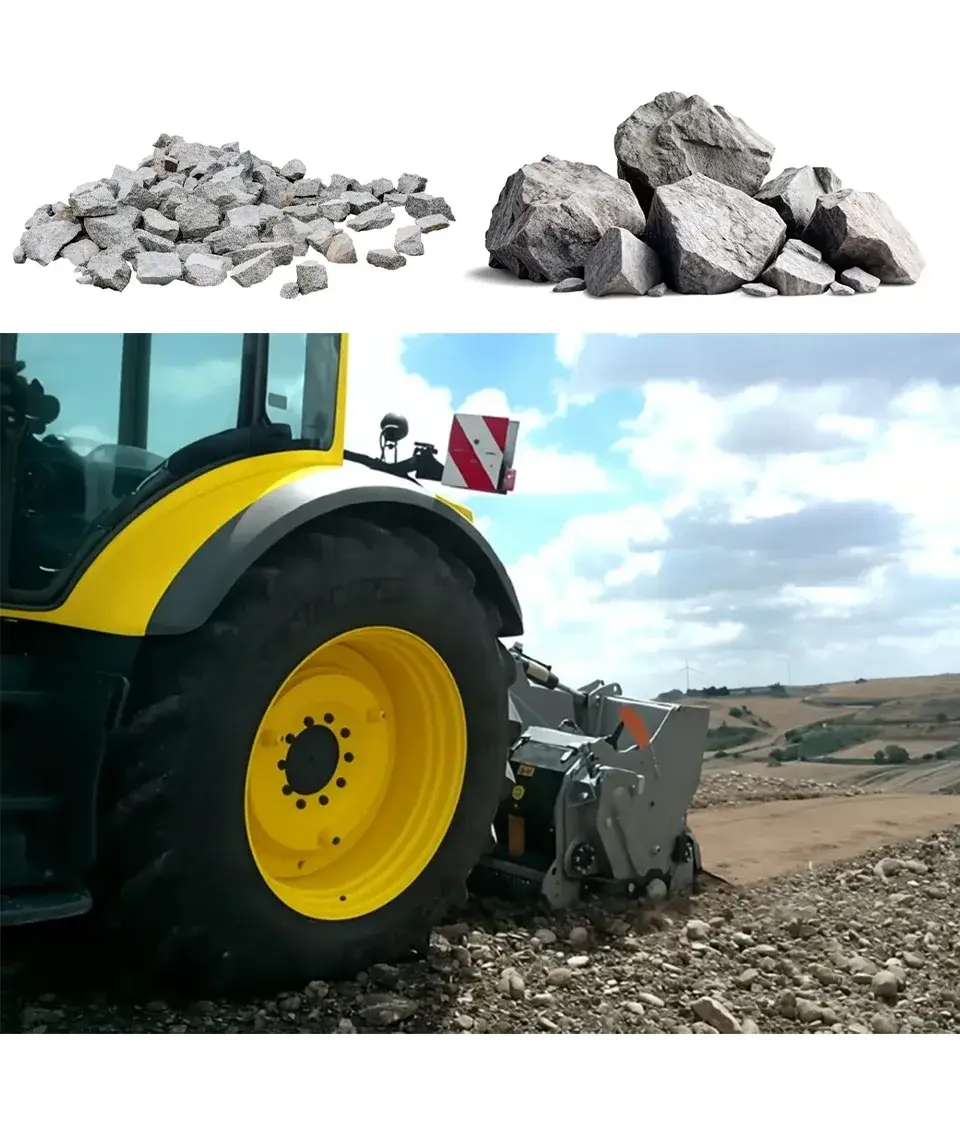
Every PTO stone crusher placed on the European market operates within a layered regulatory framework that covers machinery safety, vehicle type-approval, road transport, environmental compliance, and workplace health. Understanding where a stone crusher for tractor sits within these frameworks is important for buyers, importers, and operators who want to remain compliant and avoid liability exposure.
European Union: PTO Stone Crusher Safety Requirements
EU Machinery Regulation 2023/1230 replaces Machinery Directive 2006/42/EC and establishes the essential health and safety requirements for all tractor stone crusher machinery placed on the EU market. CE marking requires conformity assessment, a Declaration of Conformity, and a technical construction file. The guarding of PTO shafts and rotating rotor elements in a PTO stone crusher must comply with EN ISO 4254-7 (agricultural machinery safety — soil tillage implements) and EN 1553. For road transport of wide stone crushing equipment models (those exceeding 2.55 m transport width), Member State road traffic codes apply; in France, Germany, and Poland, PTO stone crusher models exceeding 3.0 m in working width must be folded or transported under an escort in many regions.
Germany (DE): SVLFG Guidelines for stone crusher machine Operation
Germany’s agricultural occupational safety body, the Sozialversicherung für Landwirtschaft, Forsten und Gartenbau (SVLFG), publishes specific guidelines for PTO stone crusher operation under DGUV regulations. Operators must ensure that bystanders maintain a minimum 50-metre exclusion zone when the field stone crusher rotor is in motion, that protective chains or guards are in place at the machine’s forward-facing opening, and that the PTO driveline meets the guarding requirements of DGUV Regel 113-015. Tractors operating a PTO stone crusher on public roads must comply with StVZO requirements for agricultural machinery transport.
France (FR): INRS Guidance on agricultural stone crusher Safety
In France, the Institut National de Recherche et de Sécurité (INRS) issues technical guidance on PTO stone crusher safety under the Labour Code (Code du travail), Articles R4312 et seq. stone crusher for tractor operators in France must carry out a risk assessment under EU Framework Directive 89/391/EEC before beginning land-clearing operations, and where the PTO stone crusher is used by employed labour, this assessment must be documented. Environmental regulations under the Loi sur l’Eau also apply when tractor stone crusher activity disturbs watercourse margins or terraced slopes adjacent to classified water bodies.
Italy (IT): INAIL and PTO Stone Crusher Risk Management
Italy’s national workplace insurance body INAIL has issued specific risk circulars on agricultural machinery accidents involving tractor-mounted stone crushing equipment implements. UNI EN ISO 4254-7 applies directly to PTO stone crusher implements in Italy as in other EU Member States. Italian farms operating a stone crusher machine on hillside terrain (common in Tuscany, Umbria, and Calabria) are additionally subject to regional agricultural landscape protection regulations that may restrict the depth to which soil can be mechanically disturbed on classified terraced slopes.
Spain (ES) and Portugal (PT): PTO Stone Crusher Regulatory Framework
The Iberian Peninsula has specific regulatory provisions for field stone crusher operation on sloping vineyard and olive grove terrain. Spain’s Real Decreto 1215/1997 on minimum safety requirements for work equipment requires employers to conduct documented safety inspections of PTO stone crusher attachments. Portugal’s Autoridade para as Condições do Trabalho (ACT) enforces similar requirements under Decreto-Lei n.º 50/2005. Both countries apply EU GAEC rules under the CAP Strategic Plan, which may restrict the timing and intensity of agricultural stone crusher soil disturbance operations in Natura 2000 zones and on erosion-sensitive slopes.
South Korea: PTO Stone Crusher Compliance under the Agricultural Mechanization Act
For operators in South Korea, stone crusher for tractor equipment including tractor-mounted implements must comply with the Agricultural Mechanization Promotion Act (농업기계화촉진법, Law No. 17828). The Rural Development Administration (RDA, 농촌진흥청) sets performance and safety standards for PTO stone crusher implements under its equipment examination system. tractor stone crusher units used in Korea’s predominantly mountainous farming regions — particularly the terraced fields of Gangwon-do, the volcanic soils of Jeju-do, and the stony upland paddies of North and South Gyeongsang — must be matched to tractors with MFWD capability to handle the 15–25° slope gradients common in these areas. The Korea Agricultural Machinery Industry Association (한국농기계공업협동조합) coordinates with the RDA on technical certification for imported PTO stone crusher implements.
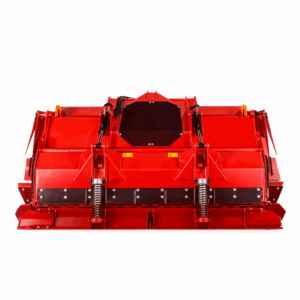
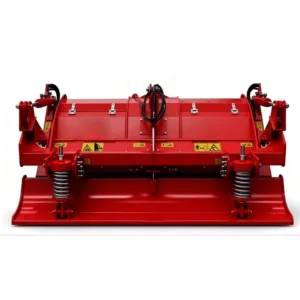
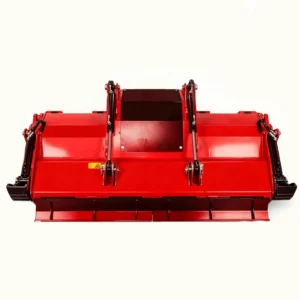
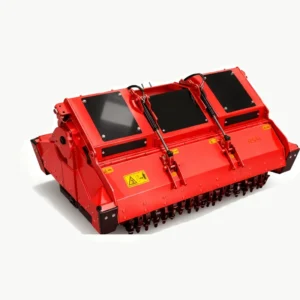
8. Stone crushing equipment Product Range
Select the right tractor stone crusher for your European terrain and farm scale
9. The PTO Drive System: Connecting Tractor Power to PTO Stone Crusher Performance
The phrase “tractor stone crusher” refers specifically to implements powered by the tractor’s power take-off shaft rather than by a separate engine or hydraulic motor. This PTO drive method has dominated agricultural stone crushing for decades because of its simplicity, reliability, and excellent power transfer efficiency — typically above 90% from engine crankshaft to rotor. A PTO stone crusher of equivalent output to a hydraulically driven machine can therefore be powered by a significantly smaller tractor, which makes the stone crushing equipment the financially preferred option across most European farm scales.
PTO speed selection is one of the more technically important decisions in PTO stone crusher field operation. The two standard European PTO speeds are 540 RPM (used on tractors from roughly 40–100 hp, defined under ISO 500-1) and 1000 RPM (used on higher-powered tractors, ISO 500-2). Most small stone crusher machine models in the PSC range accept either speed via a two-speed input shaft, while heavier PTO stone crusher machines designed for 150 hp and above are typically specified for 1000 RPM only. Operating a field stone crusher 1000 RPM machine at 540 RPM — a common field error — reduces rotor peripheral velocity proportionally, which cuts impact energy by nearly half and results in poor fragmentation of anything harder than soft limestone. No PTO stone crusher can compensate for an incorrectly matched PTO speed setting.
The cardan driveshaft connecting tractor PTO to agricultural stone crusher input must be selected to match the torque demand of the specific model and the terrain hardness. European standards EN 676 and EN 1152 govern the guarding and safety release design of agricultural PTO stone crusher driveshafts. Overrun clutches and shear-bolt torque limiters are specified in most stone crusher for tractor installation requirements to protect the gearbox in the event of sudden rotor blockage by an extremely large stone — a situation that occurs unpredictably even in well-surveyed fields. Skipping this protection device is the most common cause of gearbox damage in a PTO stone crusher during the first season of use.
tractor stone crusher Operating Speed and Field Coverage Rate
All models in the PSC, STCM, STCH, and Thor PTO stone crusher series are specified for a working speed of 3 km/h, which is typical for European field stone crushing in moderately stony soils. At 3 km/h, a Thor 2.4 stone crushing equipment (2.4 m working width) covers approximately 0.72 ha per hour — sufficient for most European smallholding preparation operations within a normal working day. The STCM 225 PTO stone crusher (2.3 m width) at the same speed covers 0.69 ha/hour, while the STCH 250 stone crusher machine (2.56 m width) reaches around 0.77 ha/hour. These figures assume no stoppage for headland turns, so a practical day rate of 4–5 ha represents a reasonable benchmark for European PTO stone crusher conditions.
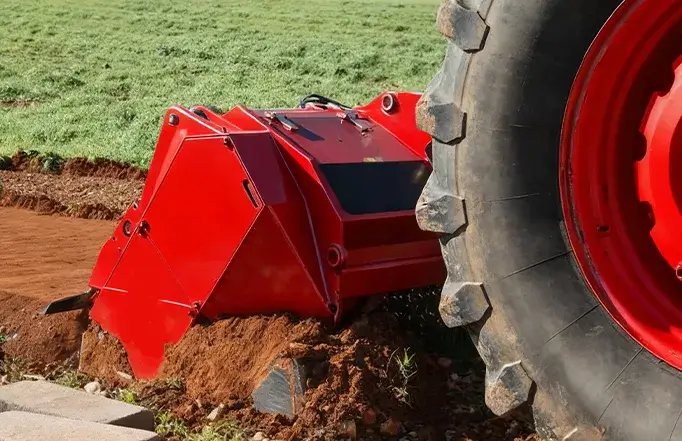
10. What Is a PTO Stone Crusher Used For? Real-World Applications
The question of what a agricultural stone crusher is used for goes beyond the obvious answer of “breaking stones.” In European farming practice, a PTO stone crusher is applied across a range of specific land management scenarios, each with distinct requirements for the machine’s output size, operating depth, and working width.
Land Conversion for Arable Farming
Converting rough pasture, scrubland, or post-orchard land to arable use requires removing or reducing surface and near-surface stones that would damage seed drills and combine headers. A stone crusher for tractor processes these obstructions in a single pass, leaving a prepared seed bed. This is the most common reason European farmers specify a PTO stone crusher for sale as their first stone management investment.
Vineyard and Orchard Establishment
In southern European viticulture regions, establishing a new vineyard on rocky limestone or slate soil requires a tractor stone crusher to clear surface stone before mechanical planting and irrigation installation. The compact PSC 100–150 agricultural stone crusher models are well-suited to the 1.8–2.4 m inter-row spacing typical of European wine appellations where a small stone crushing equipment is essential.
Road and Track Maintenance
Farm tracks and forest roads in mountainous European regions accumulate displaced stone from adjacent slopes. A tractor stone crusher mounted on a tractor can re-process this material in place, generating compactable sub-base aggregate without haulage costs. This stone crusher machine application is increasingly popular in the Massif Central, the Alps foothills, and the Scottish Highlands.
Post-Harvest Field Clearance in Korea
Particularly relevant in Korean agriculture, where stones are continuously worked upward through the soil by freeze-thaw cycling, the stone crusher for tractor is deployed post-harvest in grain and vegetable fields to allow the field to be re-prepared for the following crop. Agricultural stone crusher manufacturers increasingly offer models specifically recommended for Korean hillside use for this reason.
Stony Upland Pasture Improvement
In the upland grazing regions of Wales, Scotland, the Massif Central, and the Appennines, a field stone crusher reduces livestock injury risk, allows mowing and mechanical fertiliser spreading, and creates a surface that can be direct-drilled with grass seed after crushing — eliminating the need for a full reseeding tillage pass. A small field stone crusher on a 90–120 hp farm tractor is the standard equipment combination for this work.
11. How to Choose a agricultural stone crusher: A Practical Buyer’s Framework
For farmers and contractors searching for a agricultural stone crusher for tractor use — whether looking for a small stone crusher for tractor for a compact 80 hp farm tractor or a full-width agricultural stone crusher for a 250 hp estate machine — the tractor stone crusher selection process follows a consistent logic. The following framework walks through the key decision points in sequence.
Identify Your Dominant Stone Type and Maximum Size
Walk the field at depth and collect a sample of 20–30 representative stones. Measure the largest ones and classify by rock type if possible. This determines the maximum shredding diameter required in a tractor stone crusher and whether standard or HD teeth are needed. For stones above 300 mm, the RockMaster-class stone crusher for tractor is the minimum viable option.
Confirm Available Tractor Power and PTO Speed
Check the tractor’s PTO rated power (not engine power) and its available PTO speed (540, 1000, or 540/1000 economy). The stone crushing equipment’s minimum horsepower requirement must be met with a margin of at least 10–15% for uphill work on sloping European terrain. A field stone crusher operated below its rated power will not achieve the specified rotor velocity and will deliver poor fragmentation results.
Assess Field Geometry and Working Width Constraints
Choose a stone crusher machine whose total transport width fits within the tractor’s wheel track plus 200–400 mm, to avoid undue stress on the three-point linkage during turning. For very narrow plots, the PSC 100 agricultural stone crusher (1414 mm total width) or PSC 125 (1654 mm total width) are the entry points for European orchard and vineyard work.
Determine Required field stone crusher Output Size and Depth
If the crushed material will remain on the field surface as a seed-bed amendment, a 50–80 mm output size is optimal. If it needs to be fully incorporated during subsequent tillage, 20–40 mm or finer is preferred. All tractor stone crusher models in the range operate with adjustable counter-blade and skid height settings to control both of these output variables precisely.
Verify Regulatory Compliance for Your agricultural stone crusher
Confirm CE marking, check PTO driveshaft guarding compliance with EN 1152, and review any regional requirements for slope operation or proximity to watercourses. For Korean buyers, confirm RDA examination certification status of the stone crusher for tractor with the supplier before placing a final order.
12. Field stone crusher Maintenance and Tooth Wear Management
The operating economics of a tractor stone crusher depend almost entirely on how tooth wear is managed. Rotor teeth are consumable items — they wear progressively as they strike stone — and their condition directly determines both the agricultural stone crusher’s crushing efficiency and the risk of catastrophic structural failure if a worn tooth breaks loose. European operators working a stone crushing equipment 200–400 hours per season in siliceous soils should plan for tooth inspection every 50–80 hours and tooth replacement every 100–200 hours depending on stone hardness. In softer limestone terrains, tractor stone crusher tooth life extends considerably, sometimes exceeding 400 operating hours.
Tooth replacement on most stone crusher machine machines in this range follows a bolt-on/bolt-off principle — each tooth is secured by two high-tensile bolts to its rotor mounting seat. Worn teeth can be swapped in the field with basic hand tools within 60–90 minutes for a full stone crusher for tractor rotor replacement on a mid-width model. This replaceability is a key economic advantage of the fixed-tooth design over welded-tooth rotors used in some older field stone crusher designs, which require workshop grinding or complete rotor exchange when worn.
The gearbox oil level and condition in the field stone crusher should be checked before every seasonal start. agricultural stone crusher driveshaft grease nipples — present on the universal joints and telescopic sections — should be greased every 8 operating hours without exception; neglecting this is the most common cause of premature agricultural stone crusher driveshaft failure observed in European workshop repairs. A well-maintained stone crusher for tractor will typically provide 8–12 years of reliable service on a European farm operating 200–300 hours per season.
13. About Our tractor stone crusher Programme
Our tractor stone crusher programme focuses exclusively on high-performance tractor-driven stone crushing equipment suitable for the diverse terrain conditions encountered across Europe, Korea, and other technically demanding farming regions. Every stone crusher for tractor model in our range has been selected and configured for genuine field performance — not simply catalogue specification. We work directly with the engineering teams responsible for stone crushing equipment design to ensure that the products we supply are backed by accurate technical documentation, genuine spare parts availability, and practical guidance on installation and operation.
Editor: PXY