Technical Knowledge Series
Vibration Analysis in PTO Rock Crushers: Causes, Measurement, and Balancing Solutions
A practical guide for agricultural operators, land contractors, and equipment managers working with tractor-mounted Zapfwellen-Steinbrecher systems in Colombia and beyond.
2. What Is a PTO Stone Crusher and How Does Its Operating Mechanism Generate Vibration?
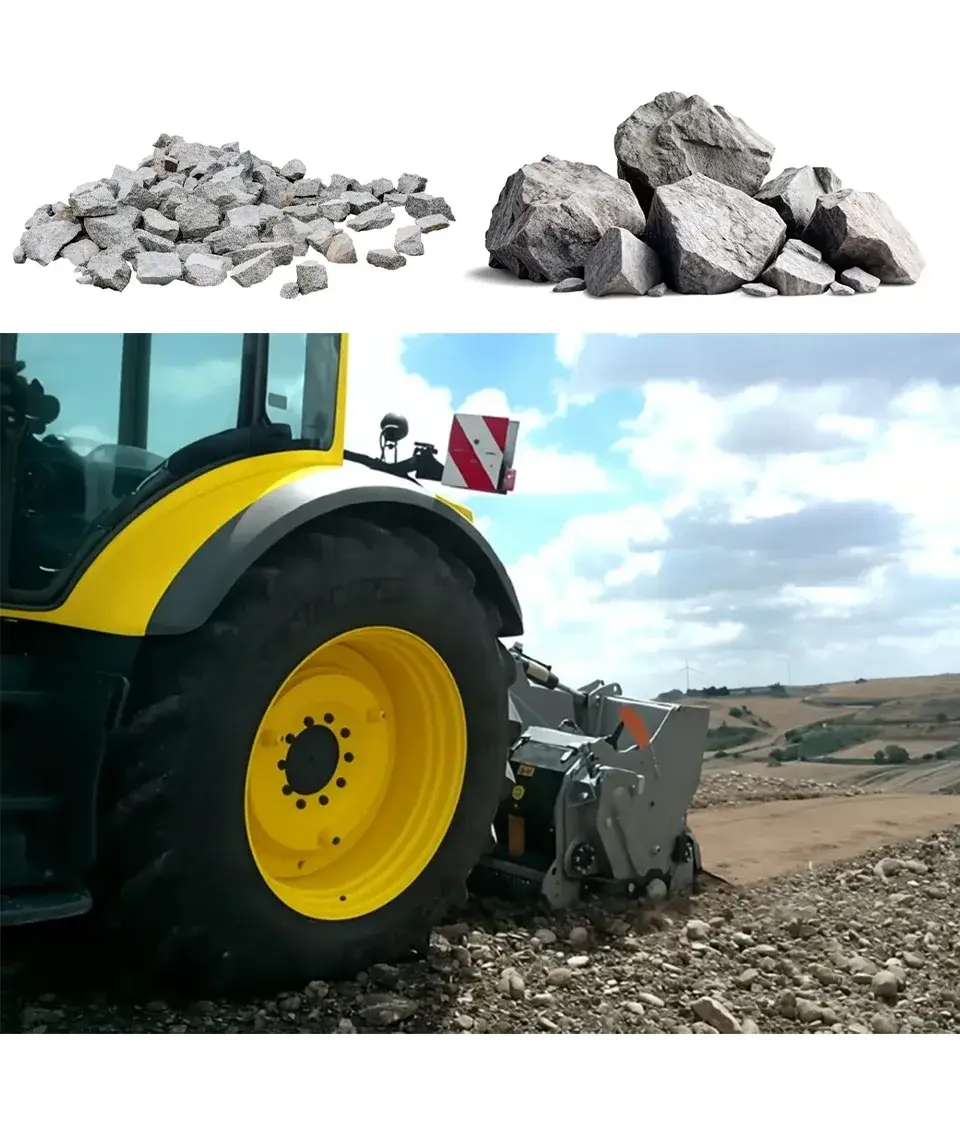
A Zapfwellen-Steinbrecher is a category of tractor-mounted implement that draws mechanical energy from the tractor’s PTO shaft — typically rotating at 540 or 1000 RPM — and uses that energy to spin a heavy horizontal rotor fitted with hardened crushing teeth or picks. As the tractor moves forward at a controlled working speed (generally 3–5 km/h for most models), the rotor engages surface and shallow-buried rocks, limestone outcrops, concrete fragments, and hard soil clods, reducing them to smaller particles that are deposited back into the worked surface. The stone crushing equipment does not transport material away from the site; it processes it in place, which is what distinguishes it from mobile jaw crushers or cone crushers used in quarrying operations.
The source of vibration in these machines is inherent to the working principle. The rotor — a heavy steel cylinder or drum carrying numerous individual tooth holders welded or bolted at intervals — must spin at high angular velocity to develop the tip speed necessary for effective stone fracturing. At 540 PTO RPM, with a gear ratio internal to the crusher’s gearbox typically multiplying this to 1,500–2,200 RPM at the rotor, tip speeds can exceed 25–30 m/s. At these speeds, even a small mass imbalance — a worn tooth on one side but not the other, a fragment of stone wedged in a tooth holder, a crack in the rotor drum — generates a centrifugal force proportional to the square of the angular velocity and the eccentricity. This is why what feels like a minor asymmetry at rest becomes a violent shaking force during operation. The agricultural stone crusher is fundamentally a high-speed rotating machine, and all the vibration physics that govern industrial turbines and grinding mills apply just as much here.
3. Action Modes — How Different Operating Conditions Affect Vibration Signature
Vibration in a stone crusher for tractor is not a single, uniform phenomenon. It manifests differently depending on which operating mode the machine is in, and understanding these modes is the first step toward correct diagnosis. There are three primary action modes that produce distinct vibration signatures:
Free-run mode (rotor spinning, no ground contact): This is the baseline condition. When the PTO is engaged and the rotor is spinning in the air without contact with soil or stone, any vibration present reflects the inherent mechanical balance of the rotor assembly, the condition of the rotor bearings, gear mesh frequencies from the internal gearbox, and driveshaft-related forces. A well-maintained machine should be nearly vibration-free in this condition. Vibration amplitude above approximately 2 mm/s (RMS velocity) in free-run is a clear indicator of rotor imbalance or bearing degradation that requires attention before field work resumes. The tractor stone crusher for sale market in Colombia increasingly sees buyers requesting vibration acceptance test data for used machines, reflecting growing awareness of this diagnostic value.
Light-contact mode (rotor engaging soft soil or fine gravel): As the machine is lowered to working depth in soft material, new vibration sources emerge: the intermittent contact between individual cutting teeth and the ground, the shock loading from each tooth impact, and the reaction forces transmitted back through the rotor into its bearings and the machine frame. These forces are cyclic at the tooth-pass frequency — the number of teeth passing a fixed point per second — which is simply the RPM multiplied by the number of teeth on the rotor, divided by 60. For a rotor with 80 picks spinning at 1,800 RPM, tooth-pass frequency is 2,400 Hz. A damaged tooth holder shifts the local mass and the contact force pattern, introducing a sub-harmonic component at once-per-revolution frequency.
Heavy-impact mode (rotor engaging embedded rock or concrete): The most demanding operating condition, where large rocks fracture under repeated impact from the rotor picks. Each fracture event generates a broadband vibration transient — a short-duration, high-amplitude shock — that excites the natural frequencies of the rotor, the frame, and connected tractor components. Repeated shock excitation in this mode accelerates fatigue crack propagation in welded joints and tooth holder attachment welds. The tractor mounted rock crusher platform must be designed to handle these transient loads without resonant amplification, which is why frame stiffness, damping characteristics, and rotor mass distribution all matter to the vibration engineer.
4. Structure Types — How Rotor Design Influences Vibration Characteristics
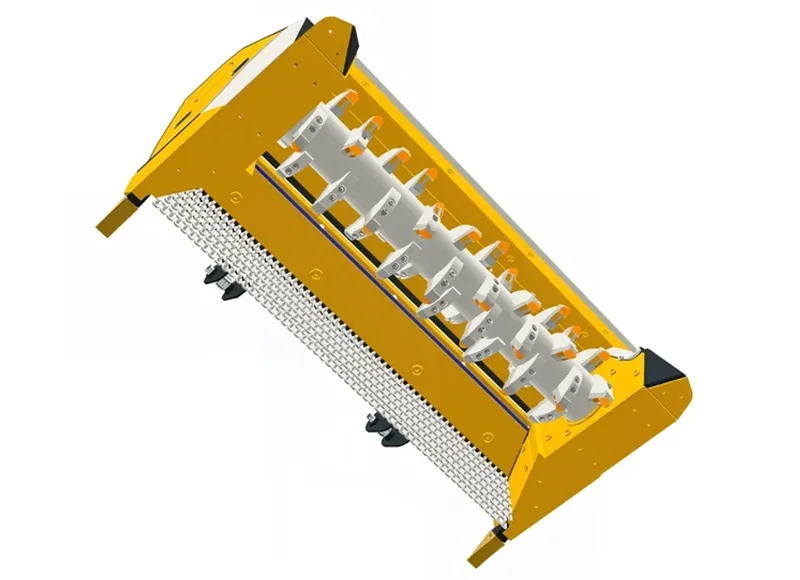
The structural type of the rotor in a stone crusher machine is arguably the most important design variable determining the machine’s vibration behavior. Three main rotor types are used across the range of PTO-driven stone crushing equipment:
Fixed-Tooth Drum Rotor
Pick-style cutting tools are welded or bolted into holders that are permanently attached to the drum surface. High rigidity, excellent energy transfer, but zero passive shock absorption. Any uneven tooth wear directly translates into mass imbalance. Used on heavy-duty models like the PSC 175 and PSC 200 in the high-power range (100–150 hp). The rotor diameter of 450 mm at 1000 PTO RPM, through a typical 3.5:1 gear ratio, delivers approximately 1,890 RPM at the rotor with a tip speed around 44.5 m/s.
Swing-Hammer Rotor
Hammer-type tools are mounted on pivot pins and can rotate freely when not under centrifugal tension. At operating speed the hammers fly outward under centrifugal force; on impact with a rock, they can swing back slightly before the centrifugal restoring force returns them. This built-in compliance reduces peak shock loads transmitted to the rotor shaft and bearings, improving longevity in very rocky soils. Vibration signature is generally smoother in heavy-rock conditions, though the increased complexity of hammer pivot wear adds a new failure mode to monitor.
Combination Rotor (Fixed + Swing)
Some designs place fixed cutting picks in the center of the rotor for primary crushing depth and swing hammers at the ends for lateral coverage and reduced frame loading. This is particularly relevant for the THOR 2.4 and THOR 3.0 series, where the 2,300–2,800 kg machine mass creates a large moment arm at the 3-point hitch. Vibration behavior in combination rotors requires analysis at both pick-pass and hammer-pass frequencies, as well as the intermodulation products where the two tool types interact with each other’s mass distribution.
5. Manufacturing Structure — Materials and Construction Quality as Vibration Risk Factors
The manufacturing quality of a stone crusher for tractor determines its baseline vibration characteristics and its resistance to vibration-induced deterioration over its service life. Several manufacturing aspects are directly relevant to vibration performance:
Rotor drum machining tolerances: A drum that is out-of-round by more than 0.5 mm on the bearing journal surfaces will generate a once-per-revolution vibration component even without any asymmetric wear on the cutting tools. Precision CNC turning of journal diameters to ±0.025 mm tolerance — as specified in high-quality stone crushing equipment — is the standard that keeps this manufacturing-sourced imbalance below the threshold of detection in field conditions. Cheaper machines with inadequate machining tolerances create a vibration problem before a single stone has been crushed.
Tooth holder weld quality: Each pick holder is a localized mass element attached to the rotor drum by fillet welds. If weld quality is inconsistent — variable penetration depth, lack of fusion at the weld root, or slag inclusion — two things happen simultaneously: the mass of each holder attachment point varies slightly from one position to the next, contributing to distributed imbalance; and the weld integrity under cyclic loading is compromised, creating a fatigue crack initiation site. The PSC Series design addresses this through standardized weld procedures and full-circumference weld inspection, but operators should visually inspect holder welds on any used unit before purchase — particularly on machines offered as used tractor stone crusher for sale in the Colombian market.
Frame rigidity and anti-resonance design: The outer frame, crushing chamber walls, and side covers of a portable stone crusher machine (in the sense that it mounts on a tractor and is thus transportable) must be stiff enough to avoid resonance at rotor operating frequencies. A frame natural frequency near 1,800 Hz is not a concern — but if the lowest bending mode of the frame falls near the once-per-revolution frequency (30 Hz at 1,800 RPM), every rotation of the rotor pumps energy into the frame resonance. Good designs either shift frame resonances well away from operating frequencies by adding mass or stiffness, or introduce deliberate damping through rubber isolation mounts or viscoelastic frame joints.
6. Material Systems — How Tooth and Frame Materials Affect Vibration Behavior
The material specification of a stone crusher machine has a direct bearing on how vibration develops and propagates through the machine over time. The two most material-critical components from a vibration standpoint are the cutting tools and the crushing chamber lining.
Cutting picks used on PTO rock crushers are typically manufactured from tungsten carbide-tipped alloy steel. The carbide tip provides the abrasion resistance needed to maintain a sharp cutting edge in contact with quartz-bearing granite or basalt, while the steel shank provides the toughness to absorb impact without brittle fracture. As carbide tips wear asymmetrically — faster on one side than the other due to directional rock texture or repeated contact at the same approach angle — the center of mass of each pick shifts laterally by a few millimeters. Across a rotor with 60–100 picks, this distributed asymmetric wear accumulates into a measurable imbalance. The THOR 2.4 and THOR 3.0 models, with their 2,300 and 2,800 kg weights respectively and rotor width of 2.4 m and 3.0 m, carry a proportionally larger rotor mass and thus are more sensitive to this effect than compact machines like the PSC 100 (working width 1,110 mm, weight 1,230 kg).
Crusher chamber internal liners made of Hardox 400 or equivalent abrasion-resistant steel serve a dual function: they absorb impact energy from rebounding stone fragments, and they provide a wear surface that can be replaced before the structural frame plate is affected. From a vibration perspective, worn or missing liner sections create asymmetric loading conditions within the crushing chamber, effectively changing the trajectory and energy of stone fragments in ways that introduce secondary impact excitation on the rotor at frequencies not related to the primary rotor speed.
7. Vibration Measurement — Practical Methods for Field Diagnostics
Measuring vibration on a working agricultural stone crusher does not require laboratory-grade instruments. Several practical approaches give operators and maintenance technicians reliable information for diagnostics:
| Measurement Method | What It Measures | Equipment Needed | Alarm Threshold (typical) |
|---|---|---|---|
| Hand-touch vibration check | Qualitative overall level | None (experience only) | Uncomfortable hand tingling = investigate |
| Smartphone vibration app | Overall RMS acceleration (g) | Smartphone + app (e.g., vibSensor) | > 0.5 g RMS on bearing housing = warn |
| Handheld vibration meter | Velocity (mm/s RMS), ISO 10816 zones | Portable vibration meter | Zone C (>11.2 mm/s) = restrict operation |
| Accelerometer + FFT analyzer | Full frequency spectrum, fault isolation | Accelerometer + data collector | Sideband growth >20 dB = bearing fault |
| Stroboscopic inspection | Visual rotor wobble, runout | Strobe light synchronized to RPM | Visible wobble >5 mm = stop machine |
For operators in Colombia’s agricultural departments — Antioquia, Cundinamarca, Boyacá, and the Andean crop zones where rocky soils make a stone crusher near me a practical necessity — basic vibration measurement capability is achievable with a quality handheld vibration meter. ISO 10816-3 provides the internationally recognized alarm zones for non-rotating parts of industrial machines: Zone A (newly commissioned, good condition), Zone B (acceptable for long-term continuous operation), Zone C (marginal, short-term operation only with monitoring), and Zone D (sufficiently severe to cause damage; machine must be stopped). While ISO 10816-3 was written primarily for industrial machinery, its velocity thresholds (4.5 / 11.2 / 28 mm/s RMS separating the zones) are applicable guidelines for stone crushing equipment bearing housings.
8. Our PTO Stone Crusher Product Range
Understanding vibration theory is most valuable when applied to real equipment. The following products in the Mulchers / Stone Crushers series each have specific structural and operating characteristics that make vibration monitoring approaches vary. Explore the full range at our products page.
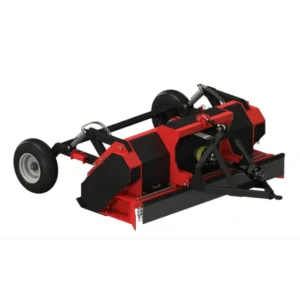
EP-Thor 2.4 + Kit Drawbar
2,300 kg · 2.4 m width · 180 cv
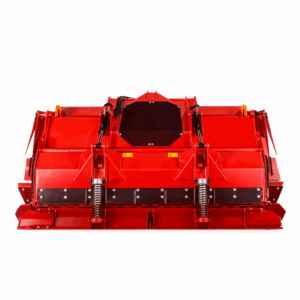
EP-RockMaster Agricultural
Heavy-duty agricultural rock crusher
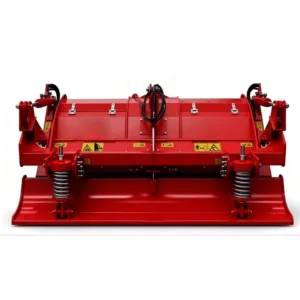
EP-PSC Series Models
PSC100–PSC200 · 70–150 hp · 450 mm rotor
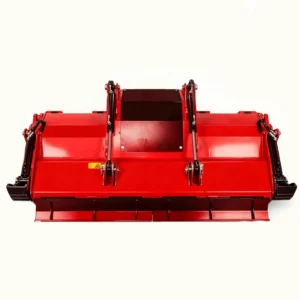
EP-Tractor Mounted Rock Crusher
3-point hitch · multi-terrain use
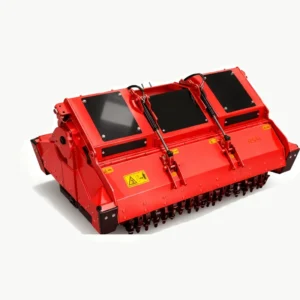
EP-Korea Agricultural Rock Crusher
Korean-engineered tractor rock crusher
PSC Series Vibration Risk Profile by Model
The PSC Models series spans working widths from 1,110 mm (PSC 100) to 2,070 mm (PSC 200), with rotor diameter fixed at 450 mm and maximum shredding diameter at 150 mm. Using the known specifications from the PSC Series, the following table maps each model to its key vibration risk profile parameters based on operating mass and rotor span:
| Model | Traktor PS | Zapfwelle (U/min) | Working Width (mm) | Weight (kg) | Rotor Dia. (mm) | Max Crush Dia. (mm) | Vibration Sensitivity |
|---|---|---|---|---|---|---|---|
| PSC 100 | 70–120 | 540–1000 | 1,110 | 1,230 | 450 | 150 | Low–Medium |
| PSC 125 | 80–120 | 540–1000 | 1,350 | 1,280 | 450 | 150 | Low–Medium |
| PSC 150 | 90–120 | 540–1000 | 1,590 | 1,440 | 450 | 150 | Medium |
| PSC 175 | 100–150 | 1000 | 1,830 | 1,600 | 450 | 150 | Medium–High |
| PSC 200 | 120–150 | 1000 | 2,070 | 1,750 | 450 | 150 | High (wider rotor span) |
| THOR 2.4 | 180 cv min. | 540/1000 | 2,400 | 2,300 | Heavy drum | High | High — regular balance check |
| THOR 3.0 | 230 cv min. | 540/1000 | 3,000 | 2,800 | Heavy drum | High | Highest — precision balance essential |
9. Root Causes of Excessive Vibration in PTO Stone Crushers — A Systematic Diagnosis Guide
When vibration on a stone crusher for tractor exceeds normal levels, a systematic diagnosis approach is far more efficient than replacing components at random. The following root causes account for the majority of field vibration complaints on pto stone crusher for sale equipment in agricultural and land-clearing applications:
Rotor Static and Dynamic Imbalance
Static imbalance (heavy spot in one axial plane) and dynamic imbalance (couple imbalance across two planes) are by far the most common vibration root cause. Uneven tooth wear, a broken or missing pick, or a tooth holder that has been repaired with an incorrect replacement mass are the most frequent triggers. For the small pto stone crusher models (PSC 100–PSC 150), acceptable residual imbalance is typically in the range of ISO 1940 Grade G6.3 — meaning for a 250 kg rotor spinning at 1,800 RPM, acceptable residual imbalance is around 84 g·mm. This is roughly equivalent to a 1-gram mass at 84 mm radius — remarkably little margin, which underscores why balanced pick replacement matters.
Bearing Deterioration
Rotor shaft bearings that are worn, corroded, or incorrectly preloaded generate vibration at characteristic bearing defect frequencies (BPFI, BPFO, BSF, FTF — inner race, outer race, ball spin, cage frequencies). These signals appear as sidebands around the rotor rotation frequency and its harmonics in a frequency spectrum plot. In high-contamination environments like stone crushing, sealing integrity is critical. The moment a seal lip allows grit-laden water ingress into a bearing, the surface fatigue process that generates these vibration signatures begins, typically weeks to months before bearing seizure.
Gearbox Gear Mesh Abnormalities
The gearbox connecting the PTO input shaft to the rotor shaft increases rotor speed via helical or spur gears running in an oil bath. Worn gear teeth, insufficient lubrication, or incorrect gear backlash generate vibration at gear mesh frequency (GMF = RPM × number of teeth) and its harmonics. For a 26-tooth gear at 1,800 RPM output, GMF is 780 Hz. Increases in GMF amplitude beyond baseline by more than 10 dB indicate progressive gear wear that, if unaddressed on a portable stone crusher machine, will lead to gear tooth fracture — an expensive and often instantaneous failure mode.
PTO Driveshaft Misalignment and Angular Velocity Variation
The PTO driveshaft connecting tractor and crusher uses universal joints (Cardan joints) that introduce a twice-per-revolution velocity variation when operated at significant angular offset. At the typical PTO shaft working angle of 10–15°, this produces a second-harmonic vibration component (2× PTO RPM) that is felt in the tractor cab and measured on the machine frame. Driveshaft misalignment from a bent slider tube or worn yoke bearings adds further components. Operating the tractor-crusher combination with the minimum possible PTO shaft angle — adjustable on some 3-point hitch models via top link length — minimizes this effect.
10. Balancing Solutions — Corrective Methods for Returning a PTO Stone Crusher to Specification
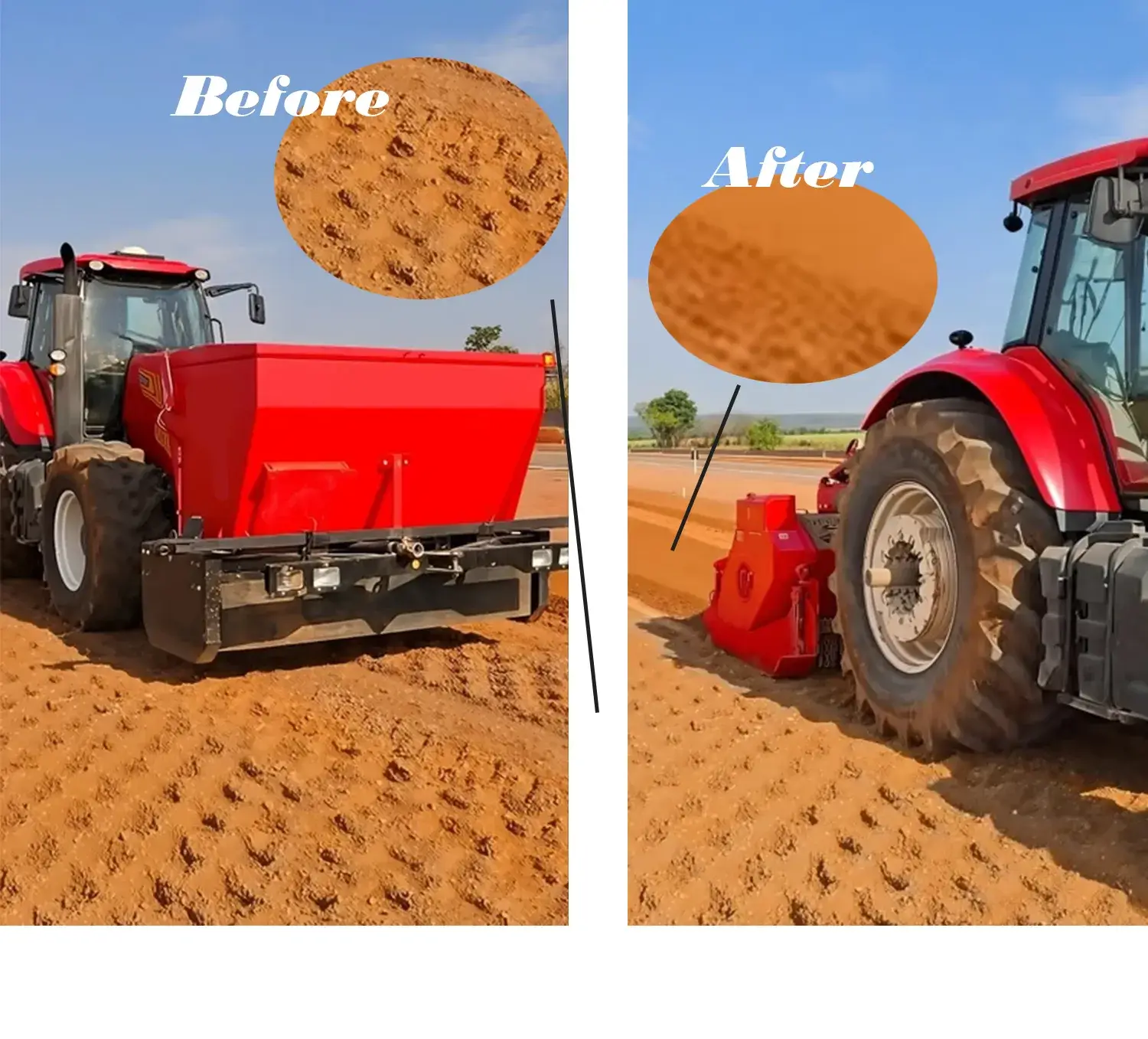
Once vibration root causes have been identified, the corrective actions fall into three categories: in-field remediation (quick fixes that get the machine back to acceptable operation until a full service can be performed), workshop balancing (removing and balancing the rotor on a dedicated balancing machine), and preventive replacement scheduling (changing picks and holders before imbalance develops). Each approach applies differently depending on the model size and the severity of the imbalance found.
Matched-set pick replacement: The simplest and most effective field remedy for pick-wear-induced imbalance is to replace picks in matched sets across the rotor, maintaining rotational symmetry. For a rotor with picks arranged in a helical pattern, this means replacing an equal number of picks on opposite sides of the centreline simultaneously, using picks from the same manufacturing batch to minimize mass variation. This approach is practical for the PSC 100 through PSC 175 models, where the rotor can typically be accessed after removing the crushing chamber cover with basic hand tools. Weight-matching picks within ±2 grams between symmetrically opposite positions on the rotor drum reduces residual imbalance to an acceptable level without a full workshop balance.
Workshop dynamic balancing: For the THOR 2.4 and THOR 3.0 models — with their 2,300–2,800 kg masses and wide rotors generating large imbalance moments — workshop dynamic balancing is the appropriate solution when vibration has exceeded acceptable limits. The rotor must be removed from the machine (requiring appropriate lifting equipment for a component that can weigh 400–600 kg alone) and placed on a soft-bearing or hard-bearing balancing machine. Correction planes are identified at the two ends of the rotor span, and balance correction weights (typically steel bars welded to the inner drum surface at specific angular positions) are added or removed until residual imbalance falls below ISO 1940 G6.3. Post-balance acceptance testing should confirm vibration amplitude below 4.5 mm/s (ISO 10816 Zone A) on a free-run test.
On-machine single-plane balancing (trim balance): For situations where removing the rotor is impractical in the field, single-plane vibration trim balancing can be performed by attaching temporary trial weights (steel bolts in threaded holes provided on some rotor end plates) and measuring the amplitude and phase change at once-per-revolution frequency after each weight addition. The vector relationship between trial weight position and vibration phase shift allows calculation of the correction weight mass and angle needed to bring once-per-revolution amplitude below threshold. This technique requires a vibration meter capable of synchronous phase measurement — a function available on most mid-range vibration data collectors.
11. Regulatory Framework — Occupational Vibration Standards and Machinery Safety Compliance
Vibration in agricultural machinery is not only a technical maintenance issue — it is also a worker health and safety concern governed by legislation in multiple jurisdictions. Operators who spend extended periods driving tractors coupled to vibrating Zapfwellen-Steinbrecher implements are exposed to whole-body vibration (WBV) transmitted through the tractor seat and chassis.
Colombia — Ministry of Labour and Resolution 2400/1979: Colombia’s foundational occupational health regulation (Resolution 2400 of 1979, the Industrial Safety and Hygiene Statute) includes provisions covering vibration exposure in the workplace. Although it predates the detailed frequency-weighted measurement methodology of modern standards, it establishes the general employer obligation to control mechanical hazards. The subsequent update framework (Decreto 1072 de 2015, which unifies occupational risk regulations) requires employers to conduct hazard identification and risk assessment for vibration sources. For contractors in Colombia operating stone crusher for tractor equipment on land clearing and road maintenance projects — particularly in departments like Boyacá, Nariño, and Cauca where surface rock is prevalent — vibration exposure assessment is an element of the mandatory Sistema de Gestión de Seguridad y Salud en el Trabajo (SG-SST).
European Union — Directive 2002/44/EC (Physical Agents — Vibration): The EU Physical Agents (Vibration) Directive sets daily exposure action values (EAV) of 0.5 m/s² and daily exposure limit values (ELV) of 1.15 m/s² for whole-body vibration (8-hour equivalent, frequency-weighted). Agricultural machinery operators consistently appear in exposure monitoring studies as a high-risk group, particularly those operating 3-point hitch implements on rough terrain. Tractor seat suspension systems that comply with EN 13490 (tractor seat vibration — laboratory method) reduce transmitted WBV, but cannot fully compensate for the impulsive vibration generated by a stone crusher machine engaging embedded rock. EU-market equipment must also comply with the Machinery Directive 2006/42/EC (now transitioning to EU Machinery Regulation 2023/1230), which requires machine designers to minimize vibration risks through design before relying on protective measures.
United States — OSHA and NIOSH Guidelines: While OSHA does not currently have an explicit regulatory standard for whole-body vibration in agriculture, NIOSH has published criteria for vibration exposure assessment. ISO 2631-1 (mechanical vibration and shock — evaluation of human exposure to whole-body vibration) is the internationally accepted measurement methodology referenced by OSHA guidance documents and safety professional practice in the US. For US-registered agricultural stone crusher equipment, the ASABE (American Society of Agricultural and Biological Engineers) publishes standards relevant to agricultural machinery design and safety.
ISO and ASABE Technical Standards Directly Applicable: ISO 1940-1 (balance quality requirements for rigid rotors) provides the G-grade classification used for specifying acceptable rotor imbalance. ISO 10816-3 (evaluation of machinery vibration by measurements on non-rotating parts) gives the alarm zone thresholds referenced in the measurement section above. ISO 2631-1 governs whole-body vibration measurement and evaluation for operator exposure assessment. ASABE EP542 covers operator exposure to whole-body vibration in agricultural machinery specifically.
12. Vibration-Focused Maintenance Schedule for PTO Stone Crushers
A vibration-focused maintenance schedule integrates routine wear-part inspection with vibration measurement checks to catch imbalance and component deterioration before they reach the alarm threshold. The following schedule is applicable to the full range of pto stone crusher for sale models described on this site, with intensity scaled to model size and operating conditions:
| Interval | Task | Applies To |
|---|---|---|
| Daily (pre-shift) | Visual check of all picks for obvious asymmetric wear or missing tips; check driveshaft yoke bolts; listen for bearing noise on free-run startup | All models |
| Every 50 hours | Measure vibration (overall velocity, mm/s RMS) on both bearing housings in free-run; record and trend; check gearbox oil level; inspect crushing chamber liner wear | PSC 150–PSC 200, THOR series |
| Every 100 hours | Replace worn picks in matched sets; check and re-torque all tooth holder bolts; grease rotor shaft bearings (if re-greaseable type); take gearbox oil sample for metal particle analysis | All models |
| Annual / seasonal | Full rotor dynamic balance check; replace rotor shaft bearing seals; disassemble and inspect gearbox; replace driveshaft universal joints if free-play exceeds 3° per joint; replace crushing chamber liners if thickness below minimum wear mark | All models — especially THOR 2.4/3.0 |
13. About Us
We specialize in the supply and technical support of professional-grade stone crushing equipment and tractor-mounted land management implements. Our product range — encompassing the PSC Series, THOR Series, RockMaster, and other agricultural stone crusher models — is engineered for reliable performance in demanding agricultural, land clearing, and road maintenance applications across Colombia, Latin America, and global export markets. Every unit we supply is backed by dimensional inspection, performance verification, and comprehensive technical documentation to support buyers making informed procurement decisions.
Frequently Asked Questions
Q1. What causes excessive vibration in a PTO stone crusher operating on rocky Colombian farmland?
Excessive vibration in a Zapfwellen-Steinbrecher on rocky terrain typically originates from one or more of these root causes: rotor imbalance from uneven pick wear (the most common cause), deteriorated rotor shaft bearings that allow journal wobble, worn or cracked gear teeth in the crusher’s internal gearbox, PTO driveshaft misalignment from bent components or excessive universal joint wear, or loose tooth holder bolts allowing individual picks to shift slightly in their sockets. In Colombia’s rocky Andean departments — where basalt and granite outcrops are embedded at shallow depth — pick wear is faster and more asymmetric than in softer soil profiles, making regular matched-set pick replacement the primary vibration control measure for agricultural stone crusher operators in those regions.
Q2. How do I measure vibration on my tractor stone crusher without specialized laboratory equipment in the field?
The most accessible field measurement method is a handheld vibration meter (available from industrial tools suppliers at reasonable cost) placed on the crusher’s bearing housing while the rotor is spinning in free-run mode. Record the overall velocity reading in mm/s RMS and compare against ISO 10816-3 zones: below 4.5 mm/s is Zone A (good), 4.5–11.2 mm/s is Zone B (acceptable but monitor), 11.2–28 mm/s is Zone C (investigate before continuing), above 28 mm/s is Zone D (stop immediately). Smartphone vibration apps placed on the machine frame provide a qualitative check — very high readings indicate a problem worth investigating with a proper meter — but are not a substitute for ISO-referenced measurements for maintenance decision-making on a tractor stone crusher.
Q3. Which PTO stone crusher model is best suited for small farms in Boyacá or Cundinamarca where the tractors are under 100 hp?
For small farms in Boyacá or Cundinamarca with tractors in the 70–100 hp range, the PSC 100 (70–120 hp, 1,110 mm working width, 1,230 kg) and PSC 125 (80–120 hp, 1,350 mm working width) are the most appropriate models. Both operate on 540 or 1000 RPM PTO and handle stone diameters up to 150 mm — typical of the mixed limestone-and-shale terrain in those highland departments. These compact small pto stone crusher units are sized to avoid overloading tractor hydraulics and 3-point hitch systems on standard category 2 tractors. Their lower rotor mass compared to the THOR series also means vibration levels from tolerable imbalance are lower, reducing the frequency of balancing interventions needed.
Q4. Where can I find a reliable supplier or quote for a tractor stone crusher for sale in Colombia or Latin America?
For buyers in Colombia and across Latin America looking for a reliable tractor stone crusher for sale, the most important supplier evaluation criteria are: availability of OEM spare parts (particularly cutting picks, bearing sets, and crusher chamber liners), provision of technical documentation in Spanish, demonstrated experience in the Colombian or South American agricultural market, and the ability to supply product technical data sheets for customs classification and SG-SST risk assessment purposes. Our product range is available for direct inquiry through the contact page, and we support both individual farm equipment purchases and multi-unit contractor orders with appropriate volume pricing and documentation packages. Visit the products page to compare models before requesting a quote.
Q5. What is crusher stone used for in Colombian agriculture and road construction projects?
Crusher stone produced by a Zapfwellen-Steinbrecher in the field is used directly as processed aggregate that remains where it was crushed — benefiting the soil surface. In agricultural applications, the primary use is land clearing for crop establishment: fieldstones that previously damaged tillage equipment, impeded seeding machinery, and created uneven soil surfaces are reduced to sub-150 mm fragments that can be incorporated into the soil profile or left as surface mulch. On rural roads and tracks, processed stone provides stable wearing course aggregate without the cost of quarrying, transport, and spreading. Colombian municipal road maintenance programs in mountainous departments often use stone crusher for tractor equipment for exactly this purpose, processing naturally occurring roadside rock and rubble into usable sub-base material.
Q6. How does the THOR 2.4 compare to the THOR 3.0 in terms of vibration levels and required tractor specifications?
The THOR 2.4 (2,300 kg, 2.4 m working width, 180 cv minimum) and THOR 3.0 (2,800 kg, 3.0 m working width, 230 cv minimum) are both high-capacity mulchers and stone crusher machines in the same series, with the 3.0 representing approximately a 22% increase in rotor span and mass. The wider rotor of the THOR 3.0 generates proportionally larger imbalance forces for any given pick wear asymmetry — the moment arm from the rotor centerline to an off-center mass is greater for a wider drum. In practical terms, this means the THOR 3.0 is more sensitive to pick wear imbalance and requires more frequent vibration monitoring and more precise workshop dynamic balancing when corrections are needed. Both require a tractor with adequate weight (typically 8,000–12,000 kg) to provide sufficient rear-axle downforce at the 3-point hitch for stable working depth control without rear-wheel lift.
Editor: PXY