Agricultural Machinery Guide
Is a PTO Stone Crusher the Right Tool for My Farm?
A practical, expert-written guide for farmers in Korea and worldwide — covering how a كسارة الحجارة PTO works, what your tractor needs to run one, which land types benefit most, and how to choose the right model from our range.
1. The Core Question: Do You Actually Need a Stone Crusher?
If you have ever broken a plough share on a buried rock, watched an irrigation pipe shatter against fieldstone, or tried to plant into soil that is more gravel than earth, you already know the problem. Stones in agricultural land are not just an inconvenience — they are a measurable productivity drain. They damage expensive precision seeding equipment, cause uneven seedbed preparation, reduce effective rooting depth, and in Korean highland farming regions like Gangwon-do and Gyeongbuk, where granite-derived soils and volcanic rock are common, they can make whole sections of otherwise productive land nearly unusable without intervention.
The traditional response is manual stone picking or rock raking — effective but time-consuming, costly in labour, and seasonal. A كسارة الحجارة PTO offers a fundamentally different approach: instead of collecting and removing stones, it crushes them in place, incorporating the fragmented material back into the soil surface. The result is a field cleared of obstacles in a single pass, with the crushed stone contributing drainage benefits and — in the long run — reducing the need for repeat clearing seasons. This guide walks through exactly how these machines work, what they are built from, which tractor power ranges they require, and how to judge whether the investment makes sense for your specific operation.
2. How a PTO Stone Crusher Works — The Action Mode Explained
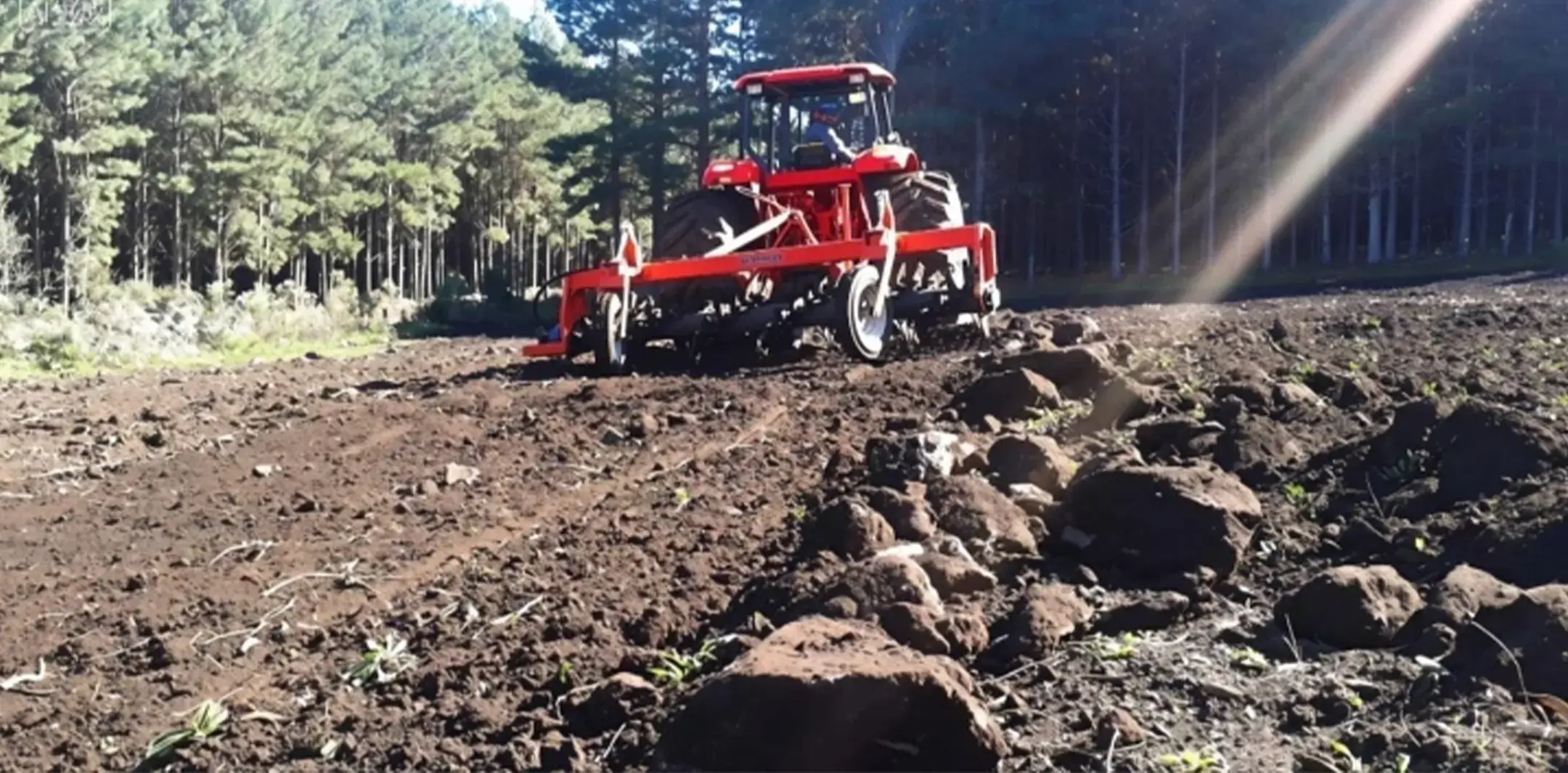
Understanding the operating principle helps you assess whether a stone crusher for tractor will actually solve your land management problem or whether a different tool — such as a rock picker or rock rake — would be more appropriate. A PTO stone crusher is a rotor-based impact machine. It mounts to the tractor’s three-point linkage (Category 2 for most models in our range) and is driven by the tractor’s power take-off shaft, which typically runs at 540 RPM or 1000 RPM depending on the model specification.
The central mechanical element is a hardened steel rotor carrying rows of fixed cutting teeth. As the PTO shaft spins the rotor at high speed inside the crushing chamber, the teeth strike stones protruding from or embedded just below the soil surface with enormous impact force. The stone fractures against the teeth and then again against adjustable counter-blades and internal Hardox wear plates inside the crushing hood. The resulting fragments — typically reduced to a maximum diameter of 150–300 mm depending on the machine model — are distributed back across the worked surface. The rotor’s rotation direction is typically such that material is thrown rearward and downward, meaning the machine advances forward while continuously processing the surface behind it.
This in-situ crushing action distinguishes a كسارة الحجارة PTO from rock pickers (which collect whole stones) and rock rakes (which aggregate stones into windrows for later collection). Stone crushers are most effective on stones with a diameter up to the machine’s rated maximum shredding diameter — for light models this is 150 mm, for heavy-duty units like the PSC-series STCM class it is 300 mm, and for the heaviest machines it reaches 500 mm. Attempting to crush stones significantly larger than the machine’s rated capacity risks tooth breakage, rotor shaft damage, and rapid gearbox wear, so accurate field assessment of stone size distribution is essential before selecting a model.
3. Manufacturing Structure — How a PTO Stone Crusher Is Built
The structural design of a tractor stone crusher reflects the extreme mechanical demands of continuous high-impact operation. The main chassis frame is welded from heavy-section structural steel plate, typically 8–12 mm in the side panels and thicker at the rotor bearing housings where shock loads concentrate. The frame’s primary function is to maintain the precise spatial relationship between the rotor and the counter-blade, because a small change in this clearance significantly affects both output fragment size and tooth wear rate.
The rotor itself is a solid forged steel cylinder machined to close dimensional tolerances and dynamically balanced to minimise vibration at operating speeds. Tooth mounting bosses are welded to the rotor body in a helical arrangement — this helix pattern ensures that not all teeth make ground contact simultaneously, which reduces peak torque demand on the PTO shaft and gearbox and smooths the load cycle. On the STCL-class compact models in our PSC range, rotor diameter is 450 mm; on the STCM class it rises to 550 mm; and on the heavy RSM machines it reaches 940 mm on the primary G/3 rotor.
The crushing hood — the sheet steel enclosure that surrounds the rotor — serves multiple functions simultaneously. It contains material during crushing, directs the output fragment trajectory, supports the counter-blade adjustment mechanism, and carries the replaceable Hardox wear plate lining on its inner surfaces. The rear door of the hood is typically hydraulically adjustable from the tractor cab on higher-specification models, allowing the operator to control output fragment size without stopping the machine. Protection chains hang from the rear of the hood to limit the forward projection of any fragments that escape the chamber, an important safety feature on machines operated near structures, vehicles, or other workers.
The gearbox assembly is the drivetrain component that converts the PTO shaft input — typically 540 or 1000 RPM — into the high-torque output needed to spin the heavy rotor. On belt-transmission models (standard on smaller machines), V-belts between the PTO input pulley and the rotor pulley provide a degree of shock absorption that protects both the gearbox and the tractor’s PTO output shaft. On reduction-gear transmission models (used on larger units), the gearbox is more compact and provides better power transfer efficiency for continuous high-torque applications. The gearbox is sealed and oil-lubricated, and its service life is directly determined by the quality of oil maintenance and the alignment of the PTO shaft during operation.
4. Material Systems — What a PTO Stone Crusher Is Made From
Material selection in a stone crusher machine is not cosmetic — every component operates in direct contact with highly abrasive material under repeated impact loading. The choices made in material specification determine how long each component lasts and, therefore, the true cost of ownership over the machine’s service life.
Rotor Teeth / Cutting Tools: The STC/3 fixed tooth design is standard across the STCL and STCM product classes. Each tooth consists of a heat-treated forged steel holder bolted to the rotor body, carrying a replaceable carbide-alloy tip. The carbide tip is what actually contacts the stone; its hardness (typically HRC 60–65) resists abrasive wear while the steel holder absorbs impact energy without brittle fracture. Alternative tooth types — STC/3/HD (heavy-duty) and STC/3/FP (flat-profile) — are available for different rock types and application intensities. Korean granite-derived soils, which produce hard, angular stones, benefit from the STC/3/HD specification.
Hardox Wear Plates: Internal counter-blades and crushing chamber liners are manufactured from Hardox 400 or Hardox 500 — Swedish-manufactured boron alloyed steel with Brinell hardness of 370–500 HB. These plates are bolt-on replaceable, and their specific hardness grade is chosen based on the balance between abrasion resistance and impact toughness needed for each application. Regular inspection of Hardox plate thickness is part of recommended maintenance practice, and replacement before through-wear occurs prevents damage to the structural housing behind them.
Rotor Bearings: Spherical roller bearings are used at the rotor shaft journals, selected for their ability to handle combined radial and axial loads under vibration-rich conditions. These bearings are grease-lubricated through zerk fittings at 50-hour service intervals. In Korean highland conditions — where ambient temperatures swing significantly between summer and winter operation — grease specification matters: an NLGI 2 lithium-complex grease with EP additives and adequate low-temperature flow characteristics (rated to at least −20°C) is required for year-round operation.
Frame and Hood: The main frame uses S355 structural steel plate throughout, with additional reinforcement at high-stress weld junctions. Hood panels are typically 4–6 mm structural steel, with the internal Hardox lining doing the wear work while the structural steel provides the housing integrity.
5. Is a PTO Stone Crusher Right for My Farm? A Practical Decision Framework
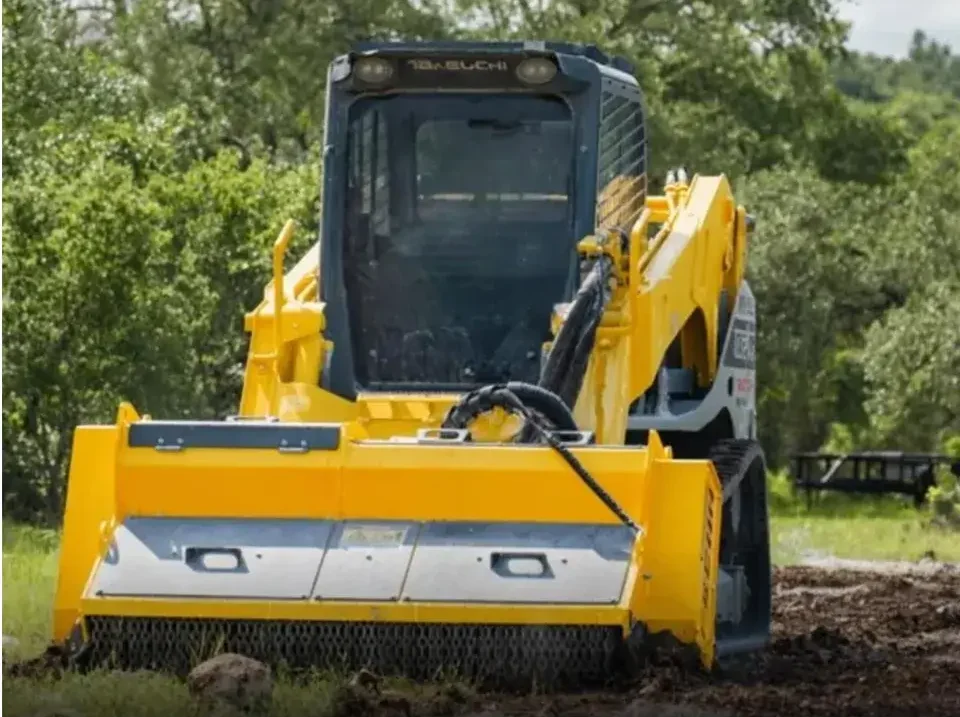
The answer depends on four variables: stone size and density on your land, your tractor’s available PTO power, the type of farming operation you run, and whether crushing or collecting stones better serves your long-term land management goals. Here is how to think through each factor.
Stone Size: If your land primarily has stones up to 150 mm in diameter — typical of many Korean highland vegetable farms and hillside paddy-edge zones — the compact STCL-class machines in our EP-PSC Models range are entirely adequate and require only 70–150 hp tractors. If you are regularly dealing with stones in the 150–300 mm range, the STCM class handles this with tractors from 80 to 220 hp. Stones larger than 300 mm — common on newly cleared forest land or river-adjacent fields in mountainous Korean regions — require the RSL or RSM class, which starts at 80–120 hp and scales up to 360 hp for very large-diameter stone.
Tractor Power: This is often the deciding factor in Korean farming contexts, where the average commercial farm tractor ranges from 65 to 130 hp. The Thor 2.4 + Kit Drawbar model requires a minimum of 180 cv and is built for high-output field crushing work, while compact PSC-class models start their useful range at 70–80 hp — accessible to most mid-size Korean farm tractors. Always match the crusher model to your tractor’s rated PTO output, not just engine power: PTO output is typically 85–90% of engine power after drivetrain losses.
Farming Type: Stone crushers are most economically justified in vegetable cultivation, fruit orchard floor preparation, highland grain cropping on rocky soils, and small construction site preparation. They are less suited to lowland paddy rice farming (where stones are not the primary problem) and to very heavy clay soils where stone movement by frost heave is not significant.
Crush vs. Collect: Crushing leaves material in place, which is ideal for fields that will be immediately cultivated or planted — the crushed stone becomes part of the soil tilth and improves drainage in the process. Collection (using a rock picker or rock rake) is better when you need completely stone-free soil for root vegetable production, or when you want to repurpose the collected stone for track or drainage construction.
6. Model-to-Tractor Power Matching Guide
The table below summarises the key specifications for our stone crusher product range, helping you identify which model fits your tractor and stone conditions. All data is drawn from the verified product specifications on this site.
| Model | Tractor Power (min.) | Working Width | Machine Weight | Working Speed | Linkage Cat. | Best Application |
|---|---|---|---|---|---|---|
| EP-Thor 2.4 + Kit Drawbar | 180 حصانًا | 2.4 متر | 2,300 kg | 3 km/h | 2 | High-output medium field work |
| EP-RockMaster Agricultural Stone Crusher | 80–220 hp | Up to 2.3 m | 1,850–3,800 kg | 3 km/h | 2 | Farmland & orchard stone clearing |
| EP-PSC Models (STCL class) | 70–150 hp | 1,110–2,070 mm | 1,230–1,750 kg | Variable | 2 | Orchards, vineyards, compact tractors |
| EP-Tractor-Mounted Rock Crusher | 80–220 hp | 1,340–2,304 mm | 1,850–3,840 kg | 3 km/h | 2 | General field stone preparation |
| Agricultural Rock Crusher for Korea | 70–190 hp | 1,000–2,200 mm | 1,600–2,650 kg | 3 km/h | 2 | Korean highland farms, mixed stone soil |
Note: All weight and dimension values are indicative ranges across model variants within each product family. Confirm exact specifications on the individual product pages.
7. When a Stone Crusher Is the Right Tool — and When It Isn’t
When a PTO Stone Crusher Is Right
A small pto stone crusher or full-size agricultural model makes clear economic sense when: stones are too embedded to rake but small enough to crush; you need a field ready for cultivation in the same season without a separate stone-removal operation; you are establishing a new orchard or vineyard on stony hillside land; you are preparing a rural road base or access track surface; or you have recurring annual frost heave bringing up new stones each spring. In all these cases, the crusher’s ability to complete the job in a single pass and leave nothing to haul away delivers genuine time and cost savings versus alternative approaches.
When a Different Tool May Be Better
A stone crusher is not the right solution when: your stones are primarily larger than the machine’s maximum rated shredding diameter and would require multiple passes at reduced forward speed; your soil is soft and wet enough that the rotor would dig excessively rather than crush; you are preparing ground for root vegetables like radish or potato where completely stone-free soil is agronomically required; or you need the collected stone material for other on-farm uses. In these situations, a rock picker or rock rake is likely a more cost-effective tool, and both are also available in our agricultural equipment range.
8. PTO Stone Crushers in Korean Agricultural Context
Korea’s agricultural landscape presents a specific and in many ways challenging environment for stone management. The country’s mountainous interior — covering approximately 70% of the land area — means that the majority of cultivated farmland sits on steep to moderately sloping terrain where granite, gneiss, and basalt parent materials continuously release stones through frost heave and erosion. The Gangwon-do highlands, the highland plateau regions of Gyeongbuk, and the reclaimed land of the southern coastal plains all present different stone management challenges that benefit from tractor-mounted stone crushing equipment.
Korean government agricultural policy supports the mechanisation of land preparation through the 농업기계화 촉진법 (Agricultural Mechanization Promotion Act), which funds the Rural Development Administration (RDA, 농촌진흥청) subsidy programme for approved agricultural machinery. PTO-driven stone crushers that carry RDA performance certification qualify for this subsidy stream, which can meaningfully offset the purchase cost for registered farmers. The Agricultural Tractor-Mounted Rock Crusher in Korea product in our range is specifically configured to meet the operational conditions and tractor horsepower profiles common in the Korean market.
From a safety compliance perspective, the Industrial Safety and Health Act (산업안전보건법) requires that all PTO-driven equipment operate with functional PTO shaft guards in place. The guard must cover the entire driveshaft from the tractor output to the machine input and must not contact the shaft during operation. This is a standard fitment on all machines in our range. Operators should also note that the Korea Occupational Safety and Health Agency (KOSHA) publishes specific guidance on safe operation distances for stone-crushing equipment due to the risk of material projection.
9. Legal and Regulatory Framework for Stone Crushing Equipment
Agricultural machinery including PTO stone crushers is subject to a range of national and regional regulations governing both safety and environmental compliance. Understanding the applicable framework protects operators from liability and ensures eligibility for subsidies and certifications.
Korea: The Agricultural Mechanization Promotion Act (농업기계화 촉진법) provides the primary framework for agricultural equipment subsidy and registration. Equipment must pass RDA performance evaluation to qualify. The Industrial Safety and Health Act (산업안전보건법) governs PTO shaft guarding requirements. The Soil Environment Conservation Act (토양환경보전법) is relevant where stone crushing activities on potentially contaminated land are concerned — crushing must not release contaminated material into the soil profile.
European Union: PTO-driven stone crushers are categorised as machinery under EU Machinery Directive 2006/42/EC (to be superseded by EU Machinery Regulation 2023/1230 effective January 2027). CE marking is required for commercial sale within the EU. PREN ISO 4254 provides the harmonised standard for agricultural machinery safety. Gearbox lubricants must meet REACH (Regulation EC No. 1907/2006) chemical safety requirements.
USA: OSHA 29 CFR Part 1928 (Agricultural Operations) and ASABE Standard S318 govern PTO-driven implements. The EPA regulates lubricant disposal — used gearbox oil from stone crusher maintenance is a regulated waste stream under 40 CFR Part 279 and must not be discharged to soil or watercourses.
Australia: The model Work Health and Safety Act 2011 applies to farm machinery operation. Safe Work Australia provides specific guidance on PTO shaft safety. Used oil management falls under the Product Stewardship (Oil) Act 2000.
10. Our Stone Crusher and Mulcher Range
Whether you need a small pto stone crusher for a compact tractor on a highland orchard or a full-size agricultural stone crusher for large-scale field preparation, the following models cover the primary tractor power and application combinations. Explore each product page for complete specifications and configuration options.
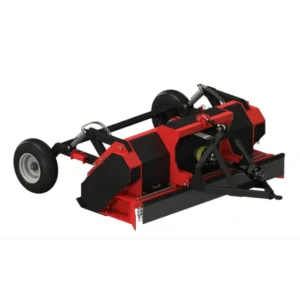
EP-Thor 2.4 + Kit Drawbar
Min. 180 cv · 2.4 m width · 2,300 kg
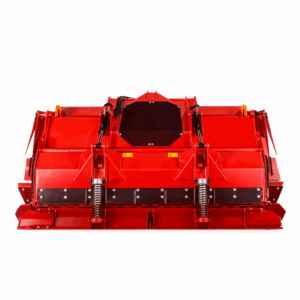
كسارة الحجارة الزراعية روك ماستر
80–220 hp · Farmland & orchards
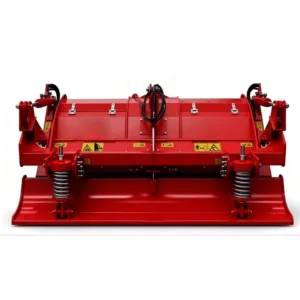
EP-PSC Models Stone Crusher
70–150 hp · Compact & orchard tractors
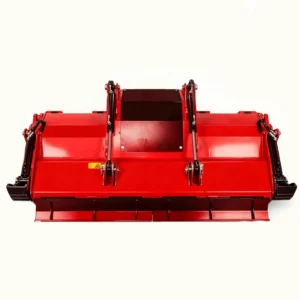
EP-Tractor-Mounted Rock Crusher
80–220 hp · General field work
11. About Us
We are a specialist supplier of professional-grade agricultural land preparation machinery — stone crushers, mulchers, rock pickers, rock rakes, and the full range of implements needed to bring stony, challenging land into productive agricultural use. Our technical team has deep hands-on knowledge of the machines we supply and can advise on selection, configuration, and maintenance planning for operators across Korea and international markets.
We understand that buying a tractor stone crusher for sale is a significant capital decision, and we take it seriously. Every recommendation we make is based on matching the machine’s genuine capabilities to the actual conditions on your farm — stone size distribution, tractor power, working width requirements, and seasonal operating pattern. We supply complete documentation for RDA subsidy applications where applicable, and can provide technical support in Korean for our customers in 한국 (Korea).
Frequently Asked Questions
Q1. What is the minimum tractor horsepower I need to run a small PTO stone crusher on my Korean highland vegetable farm?
The compact STCL-class machines in our PSC Models range begin their operating envelope at 70 hp, which aligns with the typical 65–80 hp tractors common on Korean highland vegetable farms. If your tractor is rated at 70 hp or above at the PTO shaft output, the STCL/ST 100 model is a compatible starting point. For farms with tractors in the 80–100 hp range, the STCL/ST 125 through STCL/ST 150 models open up and offer wider working widths for greater productivity per hour. Always verify your tractor’s PTO-rated output (not just engine power) before selecting a model, as there is typically a 10–15% difference between the two figures.
Q2. How do I get a quote for a tractor stone crusher for sale that qualifies for the Korean RDA agricultural machinery subsidy programme?
To qualify for the Rural Development Administration (농촌진흥청) equipment subsidy, the machine must carry RDA performance certification. Contact us through the inquiry form on this site with your tractor model, rated PTO output, and a brief description of your stone conditions (stone size estimate and approximate coverage density). We will confirm which models in our range are RDA-certified, provide a formal quotation with the information needed for the subsidy application, and advise on the documentation process.
Q3. What is crusher stone used for after a PTO stone crusher processes it in my field?
Crushed stone produced by an in-situ field crusher is mixed back into the upper soil profile during and immediately after the crushing pass. The fragmented material improves soil drainage by creating void spaces between particles, reduces the risk of farm implement damage from subsurface stones, and — over successive seasons — continues to break down further into mineral soil components. Unlike stone collected by a rock picker and hauled away, crushed stone stays on your field, which means you retain the mineral content in your soil budget rather than removing it. Some farmers use an additional cultivation pass after crushing to fully incorporate the material before seeding.
Q4. Where can I find a portable stone crusher machine supplier near me in Korea who can also provide after-sales maintenance support?
We supply stone crusher machines internationally and provide technical documentation, spare parts, and remote technical support to operators in Korea. For on-site maintenance, our technical team can advise on authorised service partners or provide detailed maintenance manuals in Korean for self-service. Contact us directly through the #contact page on this site — provide your location in Korea and we will advise on the most practical support arrangement for your region, whether that is Gangwon-do, Gyeongbuk, Gyeongnam, Jeolla, or the Gyeonggi corridor.
Q5. How often do the cutting teeth on a PTO stone crusher need to be replaced, and what does that cost for typical farming use in Korea?
Tooth replacement frequency depends heavily on the abrasiveness of the rock type you are crushing. Korean granite and gneiss-derived fieldstones are among the harder stone types, and operators working these materials consistently should expect to replace STC/3 carbide-tipped teeth every 80–150 operating hours on compact machines. STC/3/HD (heavy-duty) teeth last longer in hard rock but are specified for high-abrasion applications. We do not quote prices in this article, but tooth replacement is a routine maintenance cost that should be factored into your ownership economics. Contact us for a current spare-parts pricing schedule specific to your machine model.
Q6. What are the main differences between a PTO stone crusher and a stone crusher for sale as a standalone portable machine in the Korean construction market?
A PTO-driven agricultural stone crusher mounts directly to a farm tractor’s three-point linkage and draws power from the tractor’s PTO shaft — it has no independent engine and depends entirely on the tractor for both propulsion and rotor drive. This makes it compact, cost-effective for agricultural scale work, and easy to store when not in use. A standalone portable stone crusher machine — typically a jaw crusher or impact crusher on a trailer or self-propelled chassis — is an entirely different category of equipment: larger, heavier, capable of much higher throughput, and powered by a dedicated diesel engine. For agricultural field stone clearing and seedbed preparation, the PTO-driven crusher is almost always the correct choice. For quarry operations, demolition rubble processing, or construction aggregate production, a standalone crusher is required.
Q7. Which agricultural stone crusher model is most suitable for a 100 hp tractor on a mid-size Korean orchard farm with stones up to 200 mm diameter?
For a 100 hp tractor facing stones up to 200 mm diameter in a Korean orchard environment, the EP-PSC Models series in the STCM 150 or STCM 175 configuration is the natural fit. The STCM class handles stones up to 300 mm maximum shredding diameter and operates on 150–220 hp for the mid-to-large models — but the STCM/ST 125 starts at 80–110 hp and covers stones up to 300 mm, which gives you adequate headroom for 200 mm stone with a 100 hp tractor. Working width for this variant is 1,340 mm (approximately 1.3 m), which suits orchard inter-row widths common in Korean apple and pear cultivation. Contact us to confirm the precise model and configuration recommendation for your specific orchard row spacing.
Editor: PXY