One of the most common questions from Korean farmers, land developers, and agricultural contractors is deceptively simple: exactly how big a stone can a PTO stone crusher actually handle? The answer is not a single number — it depends on the model series, the rotor type fitted, the tractor horsepower available, and the specific field conditions. Getting this wrong is costly: a crusher that is undersized for the stones on site will stall, wear prematurely, and require constant operator intervention. Choosing a machine with far more capacity than necessary means purchasing a heavier, more expensive unit that demands tractor horsepower the farm cannot supply. This guide breaks down maximum feed size capacity across the full range of PTO rock crusher series, explains the mechanical reasons why different rotors and model sizes handle different stone diameters, and helps you match the right agricultural stone crusher to your specific land preparation or rock clearance application.
Whether you are clearing field stones from paddy terraces in Jeolla Province, breaking up surface basalt on highland pastures in Gangwon, or preparing rocky slopes for vineyard installation, understanding the feed size limits of your pto stone crusher is the single most important specification to confirm before purchase or rental. Read on for a model-by-model breakdown, a complete technical data table, and practical selection guidance.
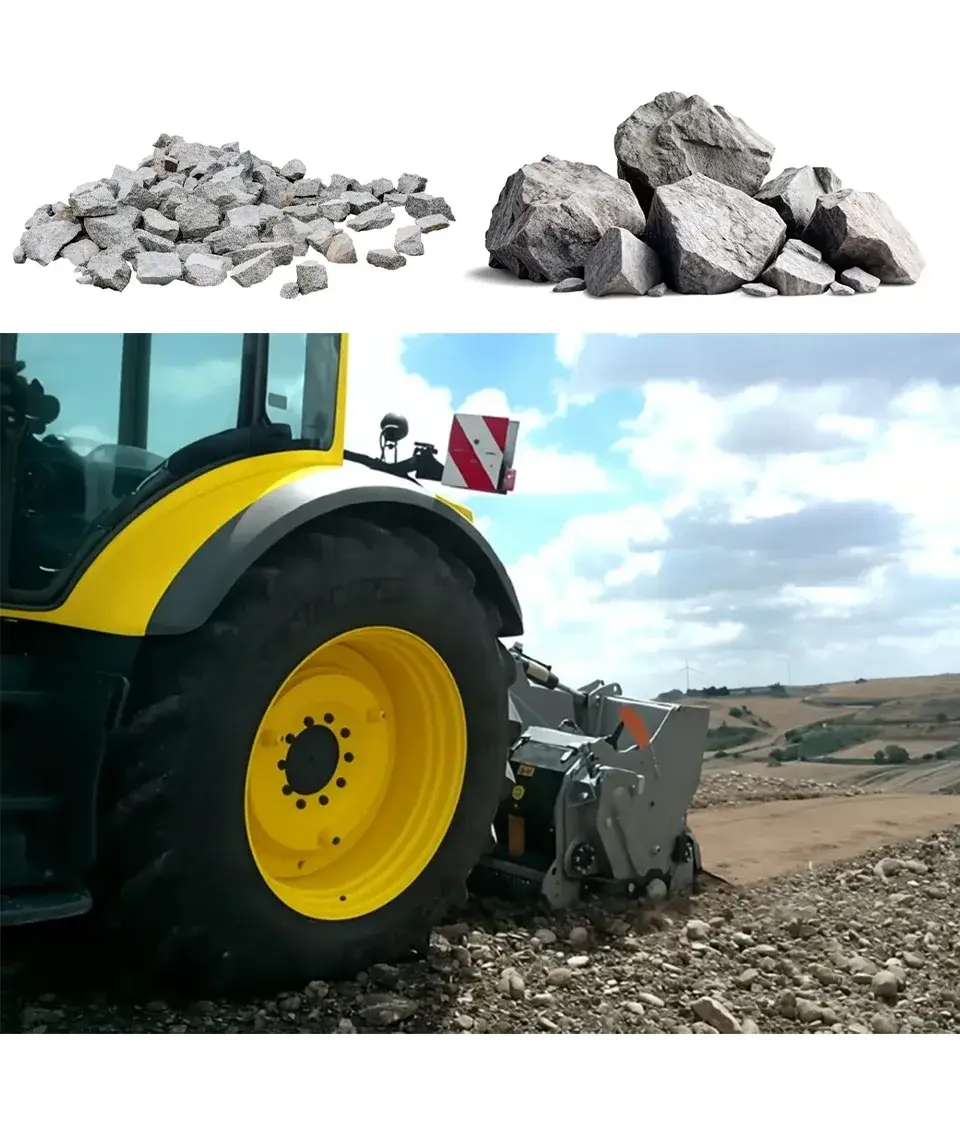
1. What Is a PTO Stone Crusher and How Does It Work?
A pto stone crusher is a tractor-mounted crushing and mulching implement that draws its rotational power directly from the tractor’s Power Take-Off (PTO) shaft, typically running at 540 RPM or 1000 RPM depending on the model. Unlike standalone jaw crushers or cone crushers that process material fed into a hopper, a PTO-driven rock crusher works directly on-site: the tractor drives over stones lying on or embedded in the ground, and the spinning rotor drum processes them in a single pass. The output is crushed stone fragments that remain on the soil surface or are incorporated into the topsoil layer, eliminating the need to collect and transport rock debris.
The rotor is the heart of every agricultural stone crusher. It is a heavy steel drum running the full working width of the machine, fitted with hardened steel teeth or picks arranged in a helical pattern. As the tractor advances at a controlled working speed (typically 2–5 km/h for most models), the rotor rotates at high speed and strikes each stone it encounters, shattering it against an anvil bar or the soil itself. The crushed fragments are projected rearward and downward inside the casing, and a rear flap or curtain controls the discharge. This action mechanism — impact rather than compression — is why pto stone crushers are categorized as horizontal shaft impact crushers adapted for direct field use.
The maximum stone size a given machine can process depends primarily on the rotor diameter, the number and geometry of the cutting tools, the mechanical power available from the tractor’s PTO, and the depth to which the machine is set. Understanding these four variables is the key to answering the question of feed size capacity with precision.
2. Action Mode: How Impact Energy Determines Maximum Stone Size
The crushing action of a PTO stone crusher is fundamentally an impact process, not a compression or grinding process. When a rotor tooth or pick strikes a stone, it delivers a concentrated impulse of kinetic energy to the stone’s surface. If that impulse exceeds the stone’s tensile fracture threshold, the stone shatters. The energy delivered per impact is proportional to the mass of the rotor tool and the square of its tip speed — so a larger rotor diameter moving at the same RPM delivers significantly more impact energy than a smaller diameter, because tip speed (peripheral velocity) is higher.
This is why larger, heavier rotor configurations in the STCM, STCH, RSM, and RSH series can handle considerably larger maximum stone diameters than the lighter STCL models. In the STCL series (designed for 70–150 hp tractors), the 450 mm rotor diameter limits maximum shredding diameter to 150 mm. Step up to the STCM series (80–280 hp) with its 550 mm rotor, and maximum shredding diameter doubles to 300 mm. Move to the heavy-duty STCH series with its 700 mm rotor and the upper limit rises to 500 mm. The RSH/HP series at the top of the range — powered by 360–500 hp tractors — runs a 1,115 mm G/3 rotor and handles stones up to 500 mm in diameter at working depths up to 500 mm.
For Korean farmers dealing with the basaltic and granite outcrops common in highland zones or the riverine gravel deposits on reclaimed agricultural land near the coast, this relationship between rotor size and stone capacity is the most critical specification to evaluate. A machine that looks appropriately sized based on working width alone may be fundamentally underpowered for the stone hardness and diameter found on a specific site.
3. Manufacturing Structure: Rotor Types and How They Affect Feed Capacity
Modern agricultural stone crushers are built around two primary rotor tool geometries, both of which directly influence the maximum stone size the machine can process. Understanding these rotor types is essential when evaluating any pto stone crusher for sale or comparing models from different series.
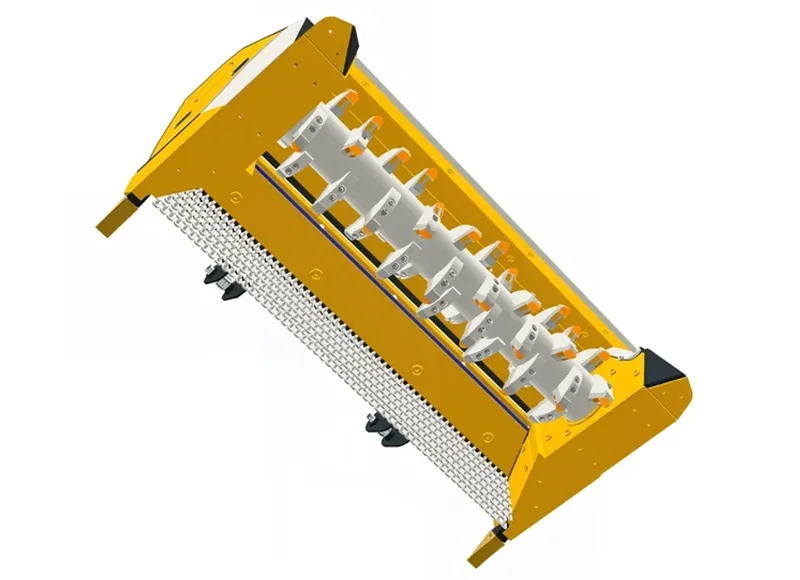
G/3 Rotor (Tooth-Type): The G/3 configuration uses fixed or swing-type hardened steel teeth with a triangular or asymmetric profile. These teeth are distributed helically around the rotor drum and are optimized for high-frequency impact on medium to large stones. The STC/3 tooth geometry — used across the STCL, STCM, STCH, and RSL–RSH series — is designed to resist breakage on first contact while transmitting maximum shear force into the stone. In the RSH series, the G/3 rotor carries 104 to 132 teeth (plus additional fixed-point tools), enabling the machine to deliver a very high rate of impacts per meter of forward travel, which is critical when crushing large, hard stones efficiently without stalling.
R Rotor (Pick-Type): The R/65 configuration uses rounded carbide-tipped picks similar to those used in road milling machines. These are positioned in a different pattern and excel at processing very large stones and reinforced ground where both rock and compacted gravel must be broken simultaneously. The RSL, RSM, and RSH series feature dual-rotor options where either the G/3 or the R rotor configuration can be selected to suit the site conditions. The RSH/HP 200 in R rotor configuration runs 138 standard picks plus 24 HD picks, providing enormous aggregate breaking capacity.
The housing and casing structure that surrounds the rotor is equally important. Heavy-duty welded steel side panels, wear-resistant liner plates inside the crushing chamber, and the rear discharge flap design all contribute to how efficiently the machine can process and discharge large-diameter stone fragments without blockage. On machines designed to handle stones larger than 300 mm, the internal geometry of the crushing chamber is engineered with significantly greater clearance to prevent jamming.
4. Material System: What Stone Types Can a PTO Rock Crusher Process?
Not all stones of the same diameter are equally difficult to crush. The material system — stone hardness, fracture toughness, abrasiveness, and shape — interacts with maximum feed size to determine what a given machine can realistically handle in field conditions. A machine rated for a 300 mm maximum shredding diameter on limestone may need to be derated on granite or quartzite of the same diameter because those materials have significantly higher fracture energy requirements.
The steel used for rotor teeth and picks is typically an austenitic or martensitic wear-resistant alloy, hardened to 50–60 HRC at the working surface. This hardness level allows the tool to impact stones up to approximately 7–8 on the Mohs scale — covering the full range of agricultural field stones including limestone (3–4 Mohs), sandstone (6–7), granite (6–7), and basalt (5.5–6). For Korean farmers working on volcanic basalt fields in Jeju Island or granite-derived soils in the central uplands, this material compatibility is important to confirm before selecting a specific model. Volcanic basalt in particular can have a dense, fine-grained structure that resists impact fracture more than its Mohs rating would suggest.
Tooth and pick service life is also directly influenced by stone abrasiveness. Highly siliceous stones (quartzite, silica-rich sandstone, flint) accelerate abrasive wear on rotor tools. For such materials, machines with HD (heavy-duty) or FP (flat-profile) tool variants should be specified — these appear as additional tool positions in the tooth count notation such as “STC/3 + C/3/SS” in the STCL series or “STC/3/FP” in the RSH series. Korean agricultural equipment distributors who stock these machines as tractor stone crusher for sale options can advise on the correct tool specification for local geological conditions.
5. Maximum Feed Size by Model Series — Complete Technical Reference Table
The table below summarizes the maximum shredding diameter, rotor diameter, PTO speed, maximum working depth, and tractor power range for each model series available across the PTO stone crusher product line. Use this as your primary reference when selecting a machine. All measurements are in millimetres (mm) unless stated. For full dimensional and tooth count specifications of each individual model within a series, refer to the individual product pages.
| Series | Tractor HP | PTO RPM | Max Stone Ø (mm) | Max Depth (mm) | Rotor Ø (mm) | Working Width Range (mm) |
|---|---|---|---|---|---|---|
| STCL Series | 70 – 150 | 540 / 1000 | 150 | 150 | 450 | 1110 – 2070 |
| STCM Series | 80 – 280 | 540 / 1000 | 300 | 200 | 550 | 1340 – 2304 |
| STCH Series | 280 – 400 | 1000 | 500 | 250 | 700 | 2080 – 2560 |
| RSL Series | 80 – 190 | 540 / 1000 | 300 | 150 – 280 | 595 (G/3) / 612 (R) | 1000 – 2200 |
| RSM / RSM-HP | 200 – 360 | 1000 | 500 | 400 | 940 (G/3) / 915 (R) | 2080 – 2320 |
| RSH / RSH-HP | 360 – 500 | 1000 | 500 | 500 | 1115 (G/3) / 1065 (R65) | 2107 – 2587 |
Maximum shredding diameter values are manufacturer-stated for favorable conditions. Actual field capacity depends on stone hardness, working speed, tractor PTO torque, and soil depth setting.
6. How to Match Maximum Stone Size to the Right Model Series
Selecting the correct agricultural stone crusher starts with a field survey. Before comparing specifications, walk the land and identify: the maximum diameter of stones present on the surface and embedded to the intended working depth; the approximate density of stones per square metre; the stone material type (limestone, basalt, granite, gravel); and the depth to which stones are embedded. With that information, the model selection becomes straightforward using the table above.
For typical Korean paddy field stone clearance or orchard preparation where surface rocks are generally under 150 mm in diameter, the STCL series (70–150 hp) is the appropriate starting point. These small pto stone crusher models are compact, work with smaller tractors commonly available on Korean family farms, and are effective for the rounded river gravel and weathered granite fragments typical of agricultural terraces. The STCL/ST 100 at 1,110 mm working width is suitable for inter-row work in orchards or vineyards, while wider models up to STCL/DT 200 (2,070 mm) cover open field applications efficiently.
When stone diameters on site range from 150 mm to 300 mm — which is typical for slope clearing, road shoulder preparation, or breaking up previously tilled rocky highland fields — the STCM or RSL series is the appropriate choice. Both handle up to 300 mm maximum diameter, with the RSL offering greater working depth flexibility (up to 280 mm) and the option to switch between G/3 tooth and R pick rotors. For operations in Korea’s volcanic highland zones or areas with dense, hard basalt boulders exceeding 300 mm, the STCH, RSM, or RSH series should be evaluated. These machines represent the heavy end of the pto stone crusher range and require 200–500 hp tractors — a significant but necessary investment when the alternative is manual rock removal.
One practical rule worth remembering: the stated maximum shredding diameter is for isolated stones in generally favorable soil conditions. In practice, when stones are densely packed or partially cemented in compacted soil, it is conservative practice to spec the next model size up. An STCM machine rated to 300 mm may struggle with frequent 280 mm granite blocks embedded in dense clay, while an RSL with its dual-rotor architecture would handle the same site with more margin to spare.
7. Available PTO Stone Crusher Models
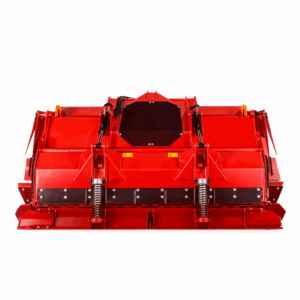
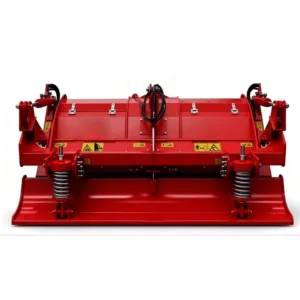
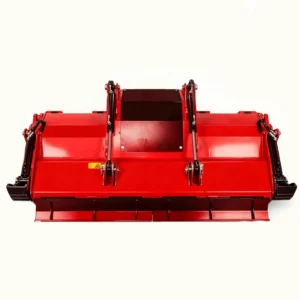
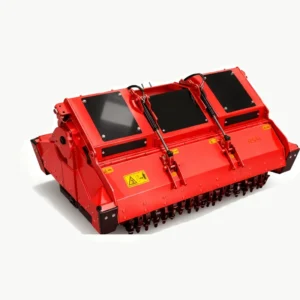
The following models are currently available across our stone crusher product range. Each is matched to a specific tractor power class and stone size capacity. Click the product link to view full technical data, dimensional drawings, and availability.
8. PTO Speed, Working Depth, and Their Relationship to Feed Size
Two operational parameters — PTO shaft speed and working depth setting — have a direct and often underappreciated effect on the maximum stone size the machine can handle in practice. Understanding both helps operators get closer to the rated maximum capacity rather than running conservatively well below it.
PTO Speed: Models like the STCL series are specified for 540–1000 RPM input. At 540 RPM, rotor tip speed is lower, meaning individual impact energy per tooth strike is reduced. Running at 1000 RPM significantly increases tip speed and therefore impact energy, allowing the machine to fracture harder and larger stones more reliably. When working near the upper end of the stated maximum shredding diameter — say, 140 mm stones on an STCL machine rated to 150 mm — running at 1000 RPM PTO is strongly preferable. Conversely, on lighter stone work where wear is a concern, 540 RPM reduces tool loading and extends tooth life.
Working Depth: Every model has a maximum working depth specification (150 mm for STCL, 200 mm for STCM, 250 mm for STCH, up to 500 mm for RSH). This is the depth below the original soil surface to which the rotor can penetrate. Setting the machine to its maximum working depth when processing large stones increases soil volume being processed simultaneously, which absorbs more PTO power. The practical implication is that operators targeting maximum stone size capacity should generally use shallower working depths unless the stones are deeply embedded. For surface stone clearance — the most common pto stone crusher use case in Korean field preparation — working at 50–80% of maximum depth while at full PTO speed provides the best balance of stone size capacity and tractor load.
Forward travel speed is the third adjustment available to the operator. The recommended working speed for most models is 3–5 km/h. Reducing to 2–3 km/h when encountering unexpectedly large stones gives the rotor more time to act on each stone before the machine passes over it, effectively increasing the number of impacts per stone and improving breakage probability on borderline-sized material.
9. Regulatory Framework: Korea and International Standards for Agricultural Machinery
Operators purchasing or importing a tractor stone crusher for use in Korea should be aware of the applicable regulatory and standards framework governing agricultural machinery safety, PTO power take-off systems, and equipment certifications. Compliance is not merely a formality — it affects liability, insurance coverage, and eligibility for agricultural machinery subsidy programmes administered by the Korean government.
Republic of Korea — Agricultural Mechanisation Promotion Act (농업기계화촉진법): This act governs the registration, testing, and performance verification of agricultural machinery used in Korea. PTO-driven equipment imported from overseas must undergo type approval testing at the National Institute of Agricultural Sciences (NIAS) or through a recognized test authority before qualifying for government subsidy under the Agricultural Machinery Purchase Support Programme. Stone crushers and mulchers are classified under the “special-purpose tillage machinery” category and are subject to safety inspection requirements covering PTO shaft guarding, rear discharge guards, and three-point linkage category compliance.
European Union — Machinery Directive 2006/42/EC and ISO 11684: European-origin pto stone crusher models sold in markets that reference EU standards are designed to comply with the Machinery Directive, which sets essential health and safety requirements for all machinery. ISO 11684 specifies the requirements for safety signs on agricultural machinery, and ISO 4254 covers general safety requirements for tractor-mounted agricultural equipment. CE marking on the machine indicates conformity with these standards.
PTO Shaft Safety — ISO 11684 and ASABE Standard 455: The PTO drive shaft connecting the tractor to the stone crusher must be guarded in accordance with ISO 11684-3 (guards for power transmission components) and the equivalent ASABE/ASAE S205 standard in North American contexts. A full shielding guard over the PTO shaft and the input gearbox cover is mandatory in all major markets. Operators in Korea should verify that imported machines include compliant PTO shaft guards before operation.
Other Markets (Japan, Australia, Southeast Asia): Japan requires agricultural machinery to comply with JIS B 9700 series safety standards for machinery, administered through the Japan Agricultural Machinery & Equipment inspection association (JA-MERA). Australia requires imported agricultural implements to comply with AS 4024.1 machinery safety standards and the WHS Regulations applicable in each state. In Southeast Asian markets including Indonesia, Thailand, and Vietnam, national standards for imported agricultural equipment broadly reference ISO standards, with some countries imposing additional import certification requirements.
10. Why Getting Feed Size Right Matters for Korean Land Development Projects
Korea’s topography means that a significant proportion of agricultural land is on hillsides, terraced slopes, or reclaimed coastal land with variable stone content. As the rural population ages and labour costs increase, the pto stone crusher has become an increasingly important piece of stone crushing equipment for preparing new fields, maintaining existing terraces, and clearing land for new orchards and vineyards. In the highlands of Gangwon Province where granitic stones are common, or on the volcanic soils of Jeju Island where basalt boulders dominate, matching the stone crusher to the actual stone size encountered is the difference between a productive season and a machine constantly being overloaded or underused.
Korean government agricultural subsidies under the Agricultural Mechanisation Promotion Act often cover 30–50% of the purchase cost of registered agricultural stone crushing equipment. To access these subsidies, the machine must be listed in the National Agricultural Machinery Catalogue maintained by NIAS. When evaluating a pto stone crusher for sale through a Korean agricultural machinery dealer, confirming catalogue registration status is an important step alongside the technical feed size verification.
From a purely practical standpoint, the post-crushing stone particle size also matters for subsequent field operations. Korean rice paddy and vegetable field regulations require that surface stone content above a defined threshold be removed or reduced before planting. A properly sized stone crusher that reduces 200 mm stones to fragments below 50 mm enables direct ploughing and seeding in the same season — a significant productivity gain compared to manual stone removal followed by a separate tillage operation.
11. About Us
We are a specialist supplier of PTO-driven stone crushing equipment and agricultural mulchers for professional agricultural and land development applications. Our product range covers the full spectrum from compact small pto stone crusher models designed for Korean family farm tractors through to heavy-duty field stone crusher series powered by high-horsepower commercial tractors. We source, import, and support stone crushing equipment that is backed by genuine technical data, field-tested performance verification, and after-sale parts and service support.
Our team has direct experience advising Korean farmers, agricultural contractors, land development companies, and municipal infrastructure projects on the correct selection of agricultural stone crushers and tractor-mounted rock crushers for specific field conditions. We understand the unique geological context of Korean agricultural land — from the basalt fields of Jeju to the granite terraces of the southern highlands — and our product recommendations reflect that knowledge. If you are evaluating a pto stone crusher for sale or comparing suppliers, we welcome your inquiry and are happy to discuss feed size requirements, tractor compatibility, and subsidy eligibility with your team.
Frequently Asked Questions
Q1. What is the maximum stone size a standard PTO stone crusher can handle in a Korean highland field?
The answer varies by model series. Entry-level STCL series machines handle stones up to 150 mm in diameter, which covers the majority of rounded field stones found in Korean orchard and vegetable field terraces. Mid-range STCM and RSL series models process stones up to 300 mm, suitable for the granite outcrops common in Gangwon highland zones. For the dense basalt boulders of volcanic areas, the STCH, RSM, or RSH series — handling up to 500 mm maximum diameter — would be appropriate. Always verify the maximum shredding diameter specification against a field sample before finalizing your model selection.
Q2. Which small pto stone crusher model is best for a 100 hp Korean tractor used for orchard preparation?
For a 100 hp tractor, the STCL/ST 150 or STCL/ST 175 models are the most appropriate match. The STCL/ST 150 requires 90–120 hp and offers 1,590 mm working width with a 150 mm maximum stone diameter. The STCL/ST 175 uses the same tractor range (100–120 hp) and extends working width to 1,830 mm. Both run at 540 or 1000 RPM PTO and weigh between 1,440 and 1,570 kg. For inter-row orchard work where working width must be kept narrow, the STCL/ST 100 or STCL/ST 125 with 1,110–1,350 mm working widths would be more practical in tight row spacings.
Q3. Where can I find a reliable tractor stone crusher supplier for agricultural operations in Korea?
Reliable suppliers for the Korean agricultural market should offer machines that are either listed in the NIAS National Agricultural Machinery Catalogue (for subsidy eligibility) or can document ISO/CE compliance for import purposes. Look for suppliers who can provide after-sales parts support and service training — rotor teeth and picks on stone crushers are consumables that will need periodic replacement, and supply chain reliability for those parts is a key factor in total cost of ownership. We supply directly to Korean agricultural machinery dealers and end users; contact us to discuss availability and the closest dealer network to your region.
Q4. How does the rotor diameter of an agricultural stone crusher affect the maximum feed size it can process?
Rotor diameter directly determines the peripheral velocity of the cutting tools at a given PTO RPM, and peripheral velocity determines the kinetic energy delivered per impact. A 550 mm rotor at 1000 RPM achieves a tip speed roughly 22% higher than a 450 mm rotor at the same RPM, delivering significantly more impact energy per tooth strike. This is why the STCM series (550 mm rotor) handles 300 mm stones while the STCL (450 mm rotor) is limited to 150 mm. Larger diameter also means greater crushing chamber clearance, allowing larger stone fragments to enter the rotor-anvil gap without jamming.
Q5. What is the difference between the G/3 and R rotor type on RSL and RSM agricultural stone crushers?
The G/3 rotor uses fixed or swing-type steel teeth optimized for high-frequency impact on medium-hardness stones. It is the standard configuration for most agricultural field stone work. The R rotor uses carbide-tipped round-shank picks (similar to road milling picks) arranged in a different pattern, providing superior penetration and breakage of very hard, abrasive stones and compacted gravel beds. On the RSL series, the R rotor has a diameter of 612 mm versus 595 mm for the G/3, and carries significantly more picks — the RSL/DT 225 R rotor has 154 picks plus 16 HD picks. The R rotor is the better choice for sites with predominantly hard basalt, quartzite, or flint in Korea.
Q6. Is there a used tractor stone crusher for sale option that still handles 300 mm stones reliably in field conditions?
Used machines in the STCM or RSL series can handle 300 mm stones if the rotor teeth are in serviceable condition and the machine has been properly maintained. The key inspection points on a used agricultural stone crusher are rotor tooth/pick wear (look for rounding of the cutting edge or loss of more than 30% of original tooth height), main bearing condition (check for play or rough rotation in the rotor shaft), and side plate and liner wear inside the crushing chamber. Machines with worn teeth but otherwise sound structure can often be restored to rated capacity with a tooth replacement service. A reputable seller of used stone crusher machines should provide maintenance history and allow rotor inspection before purchase.
Q7. What Korean agricultural machinery regulations should I check when importing a pto stone crusher for the first time?
The primary framework is the Agricultural Mechanisation Promotion Act (농업기계화촉진법), which governs type approval and safety testing. Imported PTO-driven implements must comply with Korean Industrial Standards (KS) for agricultural machinery where applicable, and should carry CE marking if sourced from the EU. For subsidy eligibility, registration in the NIAS National Agricultural Machinery Catalogue is required. You should also confirm PTO shaft guarding compliance with KS and ISO 11684-3 before operation. We recommend consulting a Korean customs broker with agricultural machinery experience and contacting the Rural Development Administration (RDA) for the most current list of registered machine models eligible for subsidy.
Q8. What working depth should I set on my pto stone crusher to maximize stone size capacity without overloading the tractor?
When working near the maximum stone size limit for your machine, set the working depth to 60–70% of the machine’s maximum depth specification. For an STCM model with 200 mm max depth, that means approximately 120–140 mm. This reduces the volume of soil the rotor must also process, allowing available PTO torque to be concentrated on stone fracture rather than soil resistance. Increase working speed slightly above 3 km/h only when stones are well isolated and smaller than 80% of the maximum diameter. Slow to 2–2.5 km/h when approaching the rated maximum stone size, and ensure the tractor’s engine RPM is maintained at full rated speed to keep PTO shaft speed constant.
Q9. When does it make sense to use a portable stone crusher machine instead of a PTO-mounted rock crusher for agricultural site clearance?
A portable stone crusher machine — typically a tracked jaw crusher or impact crusher on a self-contained unit — makes sense when stone volumes are extremely high (>200 t/ha), stones are deeply buried and cannot be reached by the working depth of a tractor stone crusher, the material needs to be sized to specific aggregate grades for construction use, or the site is too steep or irregular for tractor operation. For most Korean agricultural stone clearance work — surface stones, embedded rocks to 200–300 mm depth, coverage of 0.5–5 hectares — a PTO-driven field stone crusher on a farm tractor is more economical, faster to deploy, and does not require transporting a separate machine and prime mover to the site.
Editor: PXY