Agricultural Land Management — Greece & Korea
PTO Stone Crusher for Greek Olive and Citrus Orchards: Limestone and Schist Clearing on Terraced Land
A practical guide to understanding how tractor-mounted pto stone crusher equipment handles the specific geological and terrain challenges found in Mediterranean olive groves and citrus orchards — from the limestone outcroppings of the Peloponnese to the schist-heavy hillside terraces of Crete, Chios, and the Aegean interior.
1. Why Greek Orchard Terrain Demands Specialized Stone Crushing Equipment
Anyone who has worked terraced hillside orchards in the eastern Mediterranean understands one immediate truth: the land does not give itself up easily. Beneath every few centimeters of cultivated topsoil in a Greek olive or citrus grove lies a matrix of fractured limestone, compacted schist, and embedded fieldstone that has accumulated across centuries of erosion, terracing, and seismic activity. Conventional tillage equipment breaks against these materials. Manual removal is slow and costly. And the narrow inter-row spacing of mature olive groves — often just 4 to 6 meters between canopy lines — makes large, cumbersome stone crushing equipment unusable without damaging root systems or retaining walls.
This is precisely where a compact, tractor-mounted pto stone crusher changes the economics of orchard rehabilitation. By drawing power directly from the tractor’s Power Take-Off (PTO) shaft and processing stone in a single pass — crushing rather than collecting — it eliminates the hauling cycle entirely. Material that would otherwise require multiple machine passes and significant labor is reduced to sub-50 mm fragments that work back into the soil profile, improving drainage and root-zone aeration in the process. For Korean farmers and investors evaluating land preparation technology applicable to their own terraced upland orchards — where volcanic basalt and granite-derived soils present analogous clearance challenges — understanding how this class of equipment performs in one of the world’s most demanding orchard environments provides a highly relevant technical reference.
2. Action Mechanism: How a PTO Stone Crusher Processes Limestone and Schist
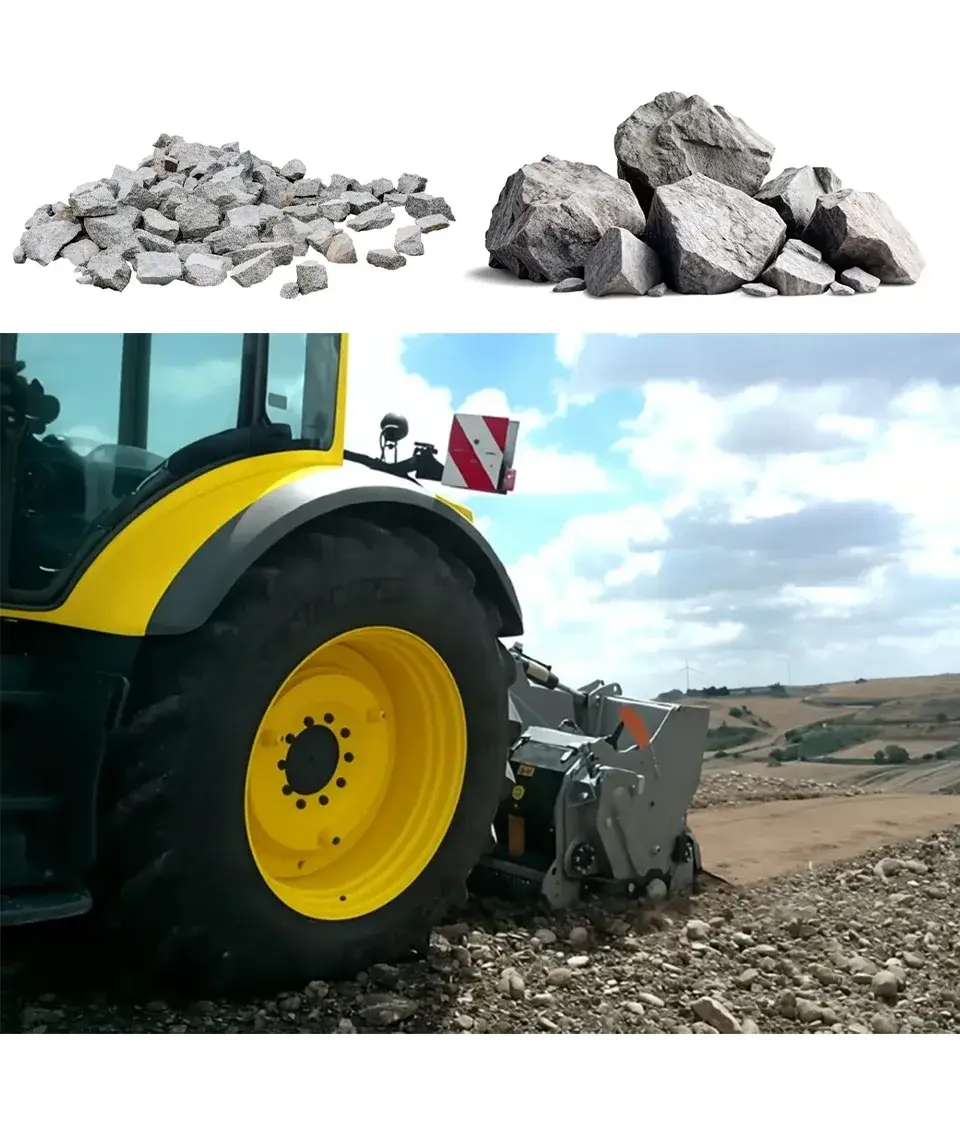
The operating principle of a pto stone crusher is rooted in high-speed impact rather than shear or compression. When the tractor’s PTO shaft — typically engaged at 540 or 1000 RPM — transmits rotational energy to the machine’s internal gearbox and then to the rotor drum, a sequence of events happens with remarkable speed. The rotor, studded with hardened fixed teeth or swinging hammer assemblies, spins at high velocity inside a reinforced crushing chamber. As the tractor advances at a controlled field speed of 2–5 km/h, stones entering the chamber are struck repeatedly by the rotating teeth and thrown against internal counter-blades and Hardox-lined chamber walls. Each impact reduces fragment size; material that remains oversized circulates within the chamber until it passes beneath the adjustable counter-blade gap and exits through the rear discharge.
Limestone behaves differently in this process than schist. Limestone — the dominant rock type across the Peloponnese, Crete, and much of mainland Greece — is relatively brittle and high in calcium carbonate. When impacted by the rotor teeth, it fractures predictably along natural cleavage planes, producing relatively uniform crushed fragments. These fragments, once returned to the soil, slowly weather and contribute calcium and magnesium to the root zone — a minor but genuine agronomic benefit for pH-sensitive citrus trees. Schist, by contrast, is a metamorphic rock that tends to split into thin, plate-like slabs rather than rounded fragments. Processing schist requires more passes of the rotor over the same surface area to achieve consistent size reduction, and rotor geometry — specifically the tooth pattern arrangement in a chevron or spiral configuration — plays a significant role in how effectively these plates are engaged and fragmented.
For very hard embedded boulders — those partially surfaced by erosion on terraced rows — the agricultural stone crusher’s working depth capacity becomes the deciding specification. Models capable of penetrating 150 to 300 mm into the soil surface can engage the tops of embedded rocks and progressively reduce them across multiple passes, whereas shallow-working units will simply ride over partially exposed material. This is why selecting the correct model from the available pto stone crusher for sale range is not merely a matter of working width — rotor depth, tooth type, and input power must all be matched to the specific stone density encountered in the target orchard.
3. Manufacturing Structure: What a Commercial-Grade Agricultural Stone Crusher Is Built From
The structural integrity of a stone crusher for tractor attachment is not incidental — it is the entire engineering challenge. Every time the rotor impacts a limestone outcrop or a buried schist slab, the impact energy travels back through the rotor shaft, bearings, gearbox, and frame. Machines that are not purpose-built for this load cycle develop fatigue cracks at weld seams, experience premature bearing failure, or suffer gearbox damage within the first season of heavy orchard use. Understanding the manufacturing architecture of a quality agricultural stone crusher helps buyers evaluate units beyond their surface appearance.
The chassis and outer housing of a properly engineered tractor stone crusher is fabricated from thick-gauge structural steel — typically S355 or S460 grade — with fully welded seams that are stress-relieved after fabrication to reduce the risk of cracking under repeated impact. The crushing chamber’s interior side walls and floor are lined with replaceable Hardox 400 or Hardox 500 wear plates. Hardox is a proprietary abrasion-resistant steel produced by SSAB that maintains its hardness properties even after cutting, bending, and welding — making it the practical standard for stone crusher internal surfaces. When the liners eventually wear thin (after hundreds of hours of stone processing), they can be bolted out and replaced without rebuilding the entire machine.
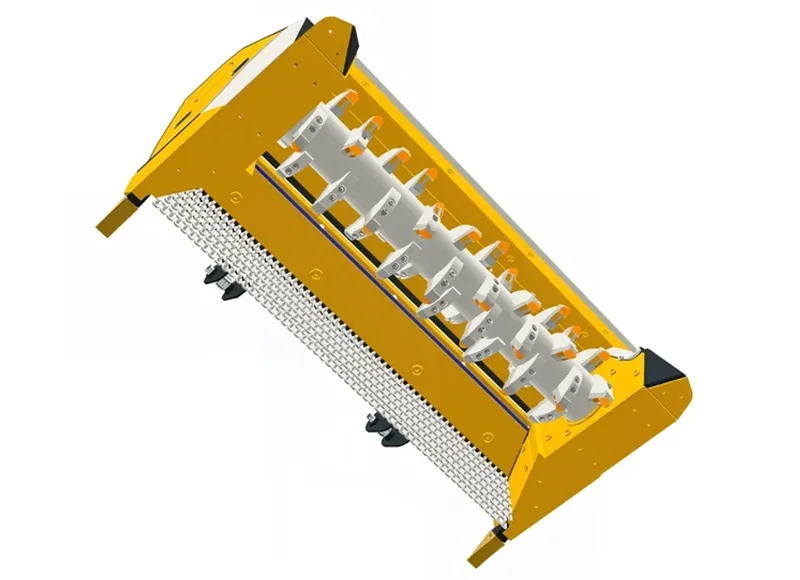
The rotor itself is the most mechanically complex component. On fixed-tooth models, tungsten carbide-tipped teeth are held in forged steel tool holders that bolt directly onto the rotor drum body. The key advantage of a fixed-tooth configuration is energy transfer efficiency: there is no movement in the tooth holder, so all rotor kinetic energy is transmitted directly to the stone at impact, making fixed-tooth units generally more effective on very hard material like compact limestone. On hammer (swinging) rotor configurations, the hammers pivot on pins under impact, offering some protection against non-crushable foreign objects — a relevant consideration in old terraced orchards where wrought-iron anchors, old irrigation hardware, or concrete fragments may be buried. The gearbox transmitting PTO input to rotor speed is typically a multi-stage gear unit (not belt-driven) in commercial units, housed in a cast iron or welded steel casing with oil-bath lubrication and filtered breather vents to prevent dust ingestion — a critical detail for stone crushing environments where airborne particulate is constant.
4. Material System: Teeth, Liners, and Frame Alloys in a Heavy Duty Stone Crusher
The material system of a quality stone crusher machine is a hierarchy of hardness decisions, each component selected to balance wear resistance against fracture toughness. At the impact point — the tooth tip — the hardest available material is needed: cemented tungsten carbide (WC-Co), which achieves 70–90 HRC on the Rockwell hardness scale. Tungsten carbide inserts are pressed into tooth body blanks made from medium-carbon alloy steel and held by interference fit plus brazing. The carbide resists abrasive wear from siliceous rock constituents (present even in primarily carbonate limestones as chert nodules) while the tougher steel blank absorbs the bending and tensile stresses that would crack a fully carbide tooth body on impact with a large embedded boulder.
Moving outward from the tooth to the tool holder, the material softens strategically. Tool holders are typically cast from austenitic manganese steel (Hadfield steel, ~12% Mn) or chromium-molybdenum alloy steel, both of which work-harden on impact — meaning they actually become harder at the surface as the machine operates, while retaining a tough, crack-resistant core. The rotor drum body itself uses S355 structural steel for mass and momentum, relying on its physical weight to maintain rotational energy during heavy-stone encounters. Chamber liners, as noted above, use Hardox wear plate. The external housing — the part that operators touch and that must resist branch impacts and tool contact during maintenance — uses standard S235 or S275 structural steel with an epoxy-primer and polyurethane topcoat paint system. For Korean buyers evaluating pto stone crusher for sale options, requesting mill certificates for the Hardox liner material and the tungsten carbide tooth specification is a reasonable due-diligence step before committing to a long-term procurement relationship.
5. Our Stone Crusher Product Range for Orchard and Agricultural Applications
The following product series represent the core of our mulchers and stone crushers range, covering tractors from compact orchard units to large field machines. Each has been selected or developed to address the specific soil preparation, land clearing, and stone management needs of professional growers and land developers — including operations in Korean upland and hillside agricultural zones.
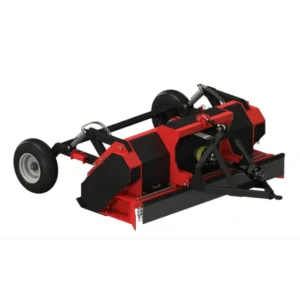
EP-Thor 2.4 + 套件牵引杆
Working width 2.4 m. Min. engine power 180 cv. Weight 2,300 kg. Category 2 linkage. Working speed 3 km/h. Two control valves required. Ideal for wide inter-row field crushing with drawbar mobility option.
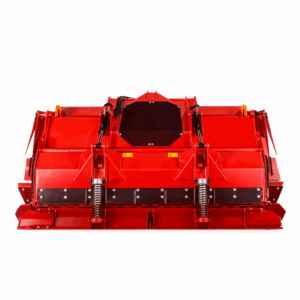
EP-RockMaster 农业用石料破碎机
A heavy-duty agricultural stone crusher designed for high-volume limestone and mixed-rock land clearing. Robust fixed-tooth rotor system, Hardox-lined crushing chamber, sealed gearbox. Well-suited to both Korean basalt-heavy farmland and Mediterranean limestone terraces.
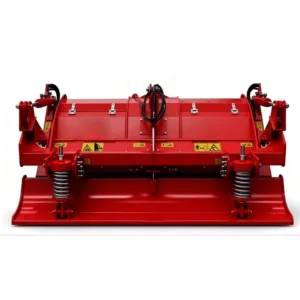
EP-PSC型石料破碎机
The PSC series covers a broad tractor power range from 70 to 220 hp (STCL to STCM configurations), with working widths from 1,110 mm to 2,304 mm. PTO input at 540 or 1,000 RPM. Maximum stone shredding diameter up to 300 mm. Maximum working depth 200 mm. A highly versatile stone crusher for tractor applications in orchards, vineyards, and open field land reclamation.
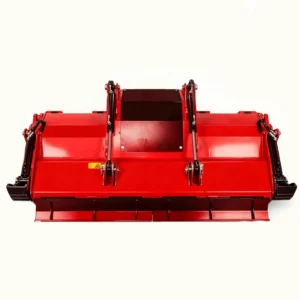
EP型拖拉机式岩石破碎机
A standard 3-point hitch tractor stone crusher optimized for medium-scale orchard and land clearing operations. Thick-gauge steel housing, replaceable hardened steel hammer system, heavy-duty sealed gearbox. Handles fieldstone, limestone rubble, and demolition debris in a single working pass.
6. PSC Series Key Technical Specifications
Reference data for the PSC (STCL/STCM) model range applicable to Greek orchard and Korean upland applications. PTO input speed: 540–1,000 RPM. Rotor diameter: 450–550 mm.
| 模型 | 拖拉机(马力) | Working Width (mm) | Max Stone Ø (mm) | Max Depth (mm) | 重量(公斤) | Teeth |
|---|---|---|---|---|---|---|
| STCL/ST 100 | 70–120 | 1,110 | 150 | 150 | 1,230 | 22+4 |
| STCL/ST 125 | 80–120 | 1,350 | 150 | 150 | 1,280 | 26+4 |
| STCM/ST 125 | 80–110 | 1,340 | 300 | 200 | 1,850 | 26+4 |
| STCM 150 | 150–220 | 1,584 | 300 | 200 | 3,000 | 32+4 |
| STCM 200 | 170–220 | 2,064 | 300 | 200 | 3,550 | 42+4 |
| STCM 225 | 180–220 | 2,304 | 300 | 200 | 3,800 | 48+4 |
| STCH 200 | 280–400 | 2,080 | 500 | 250 | 4,850 | 50+4+4 |
| Korea EP 200–360 hp | 200–360 | — | 500 | — | — | — |
7. Operating a Stone Crusher on Narrow Terraced Rows: Practical Technique
Terraced olive and citrus orchards present a combination of access, gradient, and obstacle challenges that make standard open-field stone crushing technique insufficient. A few key adaptations are necessary. First, the tractor must be matched to the terrace width. On traditional Greek olive terraces — many of which were hand-built during the Ottoman era and are only 3 to 5 meters wide — a tractor with an overall track width under 2 meters and a compact three-point-hitch stone crusher with a working width of 1.2 to 1.6 meters (equivalent to STCL/ST 125 through STCM/ST 125 models in the PSC series) offers the best combination of coverage and maneuverability. Wider machines may require partial removal of terrace retaining wall capping stones to achieve turning access at row ends.
Second, approach angle to embedded boulders matters. The natural instinct on steep ground is to attack outcroppings directly at full working depth. In practice, a more effective technique is to make an initial pass at reduced depth (50–80 mm) to remove loose surface stone and expose the embedded rock, followed by a second pass at full depth targeting the now-visible obstruction. This two-pass approach reduces peak impact loads on the rotor and gearbox, extending component life between the maintenance intervals that responsible operation of a small pto stone crusher demands. Third, PTO speed selection affects surface texture of the output: at 540 RPM, the rotor moves more slowly, producing coarser fragment output but with lower fuel consumption and reduced dust. At 1,000 RPM, fragmentation is finer and more complete, which is preferable when producing a seedbed or preparing the surface for cover crop establishment under tree canopies.
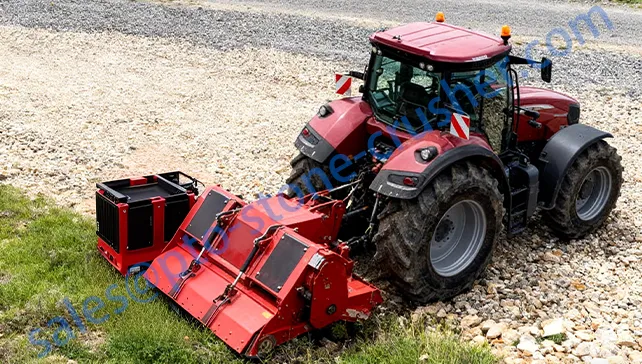
8. Agronomic Benefits of In-Field Stone Crushing vs. Stone Removal
The traditional approach to stone management in Greek orchards has been manual or mechanized collection followed by perimeter dumping or walling. This remains appropriate for very large boulders exceeding 500 mm diameter. However, for the mass of medium and small stones (50–300 mm) that constitute the majority of the surface and near-surface stone load in established groves, in-field crushing offers several agronomic advantages that stone removal cannot replicate. Crushed limestone fragments mixed back into the topsoil profile act as a slow-release calcium carbonate source. As the fragments weather under Mediterranean rainfall and root acid exudation, they buffer soil pH and provide calcium to citrus root zones — particularly beneficial for navel orange and Clementine varieties grown on Chios and Lesbos that are prone to blossom-end rot under calcium-deficient conditions.
Beyond chemistry, the physical effect on soil structure is significant. A surface layer of crushed stone fragments in the 10–40 mm range creates a natural mulch effect: it reduces evaporative water loss from the topsoil surface during the dry Mediterranean summer, moderates soil temperature fluctuations beneath mature olive trees, and provides some mechanical protection against raindrop impact-driven surface erosion on sloped terraces. In Korean highland orchard contexts — particularly in Gyeongnam, Jeollabuk-do, and Gangwon-do regions where apple, pear, and specialty fruit trees are grown on hillside land with significant surface stone loads — these same physical benefits apply equally to basalt and granite-derived stone fragments returned to the soil after crushing.
9. Regulatory Framework for Stone Crushers and Agricultural Machinery
European Union / Greece: PTO-driven agricultural machinery sold and operated in Greece must comply with the EU Machinery Directive 2006/42/EC. All stone crusher machines marketed within the EU must carry a CE marking supported by a Declaration of Conformity, a Technical File, and — where relevant — a third-party notified body assessment for Annex IV machine categories. For tractor-mounted PTO equipment specifically, ISO 5674 governs PTO shaft guard requirements, and EN ISO 4254-1 covers the general safety requirements for agricultural machinery. In Greece, environmental regulations may apply to stone crushing operations near protected agricultural land or heritage terraces: operators should consult with local agricultural directorates (ΥΠΑΑΤ — Υπουργείο Αγροτικής Ανάπτυξης και Τροφίμων) before operating stone crushing equipment on land subject to agri-environment scheme restrictions.
Republic of Korea (대한민국): Agricultural machinery imported into and operated in South Korea falls under the oversight of the Rural Development Administration (RDA, 농촌진흥청) and must comply with the Agricultural Mechanization Promotion Act (농업기계화촉진법). Imported stone crushing machines require RDA safety certification testing before domestic commercial distribution. The Korean Industrial Standards (KS) system — particularly KS B 6370 and related machinery standards — provides the technical framework for agricultural machine safety evaluation. Additionally, the Act on Prevention of and Countermeasures Against Disasters (재해구호법 관련) may apply to site preparation operations on steep hillside land where stone crushing could affect slope stability. Operators in Korea are also advised to consult the Farmland Management Guidelines issued by local-level Agricultural Technology Centers (농업기술센터) when using stone crushing equipment on nationally registered farmland.
Other Key Markets: In Turkey (a significant Mediterranean agricultural market with comparable limestone and schist terrain to Greece), the Turkish Standards Institution (TSE) and the Ministry of Agriculture and Forestry (Tarım ve Orman Bakanlığı) regulate agricultural machinery. In Italy, a major producer of orchard-applicable stone crushers, Directive 2006/42/EC applies along with INAIL occupational safety regulations specific to stone-working machinery. In Australia, AS/NZS 4600 (Cold-formed steel structures) informs the fabrication standards relevant to agricultural equipment housings, and agricultural machinery PTO safety is governed by AS 4560. These compliance frameworks collectively confirm that tractor stone crusher equipment for export markets requires proper documentation, which buyers should always request alongside technical specifications and warranty terms.
10. How to Select the Right Stone Crusher for Your Orchard or Land Project
Choosing between the available small pto stone crusher and large field models requires answering five questions about your specific land conditions. These guide the model selection process more reliably than any general recommendation.
1. What is your available tractor power?
Tractor horsepower is the primary matching parameter. Use at least 90% of the manufacturer’s minimum rated power to avoid overloading the tractor PTO shaft. Undersized tractors stall on hard limestone and risk PTO drivetrain damage.
2. What is the maximum stone diameter you expect?
Stones exceeding the machine’s rated maximum shredding diameter must be pre-split by ripper or hydraulic breaker before the stone crusher processes them. Attempting to crush oversized material damages the rotor and counter-blade system.
3. How wide are your working rows?
Working width should be no more than 70–75% of the available inter-row clearance to allow for slight tracking deviations without striking tree trunks or terrace walls on each pass.
4. What stone density and hardness are present?
Limestone-dominant soils favor fixed-tooth rotors (STCL, STCM configurations). Mixed stone fields with occasional metallic foreign objects favor swinging hammer or combination rotor designs for protection against damage.
5. What is the required output fragment size?
If the crushed material must support cover crop establishment or irrigation system installation, finer output (less than 30 mm) requires higher PTO speed (1,000 RPM) and reduced working ground speed (1.5–2 km/h).
If your land project involves conditions not clearly matched to any of the above — particularly unusual stone morphology, extreme gradient, or specific depth requirements — contact our technical team directly for a site-specific recommendation. We supply pto stone crusher for sale with full pre-sale technical support and post-sale spare parts supply to both European and Korean customers.
11. 关于我们
We specialize in the supply and technical support of professional agricultural stone crushing equipment, mulchers, and land preparation machinery to commercial growers, land developers, and government land reclamation programs worldwide. Our product range covers the full tractor power spectrum from compact 70 hp orchard units to 500 hp heavy-field machines, with rotor configurations, working widths, and tooth systems matched to the specific geological conditions of each customer’s land. We serve clients across Europe — including Greece, Italy, Spain, and Portugal — as well as growing markets in South Korea, Southeast Asia, and the Middle East. Our technical support team includes agronomists and mechanical engineers with direct field experience in Mediterranean orchard rehabilitation and Korean upland farmland development. All machines are supplied with full CE documentation for EU market compliance and RDA-compatible technical packages for Korean import certification. Whether you are looking for a small pto stone crusher for a single hillside terrace or a large tractor stone crusher for sale to cover hundreds of hectares, we have the equipment and the expertise to match your requirement.
常见问题解答
Q1. How does a pto stone crusher handle very hard limestone outcroppings in Greek terraced olive orchards?
Q2. Which tractor stone crusher model is most suitable for narrow terrace rows in a Korean hillside orchard near Gyeongnam?
Q3. What is the best agricultural stone crusher for preparing citrus orchard land on schist-dominated soil in Crete?
Q4. What is crusher stone used for after it has been processed by a pto stone crusher in a Greek orchard?
Q5. How does a small pto stone crusher differ from a full-size stone crushing machine in terms of operating cost for Korean agricultural buyers?
Q6. When should a Greek olive grove owner consider renting versus buying a stone crusher for tractor land preparation?
Q7. What safety precautions apply when operating a stone crusher machine near workers in a Korean orchard management setting?
Q8. Which stone crusher models are available for sale with CE certification suitable for import and use in EU-registered Greek agricultural enterprises?
编辑:PXY