Horticultural Knowledge Guide · The Netherlands & Belgium
PTO Stone Crusher for Dutch and Belgian Horticulture
From Zeeland’s reclaimed polders and the Veluwe’s sandy heathlands to Flemish Ardennes’ flinty hillside plots — precision stone management for Europe’s most intensive horticultural regions.
Introduction
1. Stone Management in the Heart of European Horticulture
The Netherlands and Belgium together form one of the most productive and technologically sophisticated horticultural zones in the world. Dutch greenhouse vegetable production generates annual revenues exceeding €10 billion, while the Flemish strawberry, chicory, and witloof sectors command significant export premiums to European and global markets. Behind this productivity lies an intense focus on soil preparation — and in the open-field horticultural zones of both countries, stone management is a recurring necessity that determines whether precision cultivation systems can function at their designed efficiency.
The Netherlands presents a geologically diverse stone challenge. The coastal and river delta provinces — Zeeland, South Holland, and Flevoland — are almost entirely marine clay and peat, with minimal stone content. But the inland provinces of Gelderland, Overijssel, and the Veluwe region contain glacially deposited sands, gravels, and Scandinavian erratic cobbles brought south during the Saalian glaciation. Here, open-field vegetable growers, flower bulb producers, and asparagus cultivators routinely encounter stones that damage precision cultivation equipment and disrupt the uniformly fine tilth their crops demand.
Belgium’s horticultural stone challenge is concentrated in the Ardennes foothills of Namur, Luxembourg, and Liège provinces, where thin soils overlay Devonian shale and quartzite. Even in Flanders, the sandy loam soils of the Waasland and the Hageland contain sufficient flint nodules and cobble inclusions to warrant annual stone management in intensively cultivated plots. For both Dutch and Belgian horticulturists, a PTO stone crusher provides a compact, precision-oriented solution for in-situ stone reduction — compatible with the medium-horsepower tractors prevalent on European horticultural holdings.
Action Mode
2. How PTO Stone Crushers Operate in a Horticultural Context
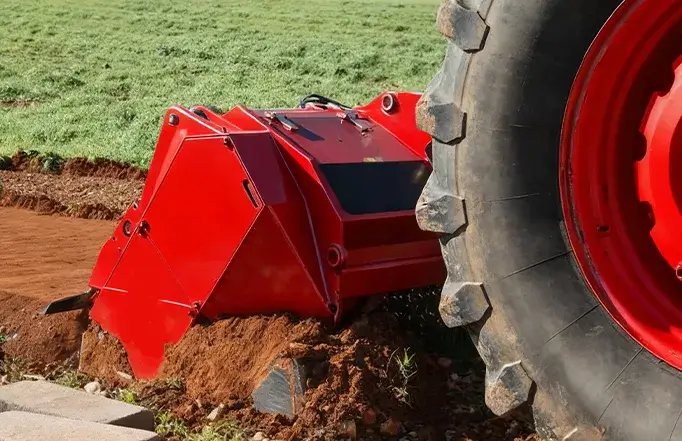
In horticultural land preparation, the objectives of stone crushing differ somewhat from broad-acre pastoral or reclamation work. Rather than simply reducing stones to prevent equipment damage, horticultural operators aim to produce a uniformly fine, stone-free seedbed or transplanting zone to the precise depth required by their crop system. This precision requirement influences every aspect of how the machine is operated.
PTO engagement transfers rotational power from the tractor’s Power Take-Off shaft — operating at 540 RPM for smaller horticultural models or 1000 RPM for mid-range machines — through an input gearbox to the horizontal rotor. In horticultural applications, the PSC Series compact crusher is particularly well matched: its rotor diameter of 450 mm and working widths from 1110 mm to 2070 mm cover both individual vegetable rows and broader bed systems. The maximum working depth of 150 mm aligns with the root zone requirements of most horticultural crops, including tulip and hyacinth bulbs, leek, asparagus, and brassica transplants.
The key operational characteristic for Dutch and Belgian horticulture is the evenness of the finished surface. After the rotor passes, the levelling skids and rear-mounted drag blade smooth the crushed aggregate flush with the surrounding soil surface. This leaves a seedbed that can immediately receive precision air seeders or mechanical transplanting equipment without additional passes — a significant time saving during the short spring preparation windows that horticultural scheduling demands.
Forward speed in horticultural work is typically at the lower end of the operational range — 2–3 km/h — to ensure thorough size reduction of flint nodules and quartz pebbles. Operating at the correct speed also minimises the risk of “stone throw” — the projection of fragments outside the working width — which can damage greenhouse infrastructure, irrigation headers, and other permanent installations that are often present close to the working area on Dutch and Belgian horticultural holdings.
| Application | 工作速度 | Depth Setting | Typical Crop |
|---|---|---|---|
| Bulb bed preparation | 2–2.5 km/h | 120–150 mm | Tulip, hyacinth, daffodil |
| Vegetable seedbed | 2.5–3.5 km/h | 80–120 mm | Leek, carrot, onion, brassica |
| Soft fruit row prep | 2–3 km/h | 100–150 mm | Strawberry, raspberry |
| Asparagus crown planting | 2–2.5 km/h | 150 mm | Asparagus (Limburg, Kempen) |
Construction
3. Manufacturing Structure: Precision-Built for European Horticultural Standards
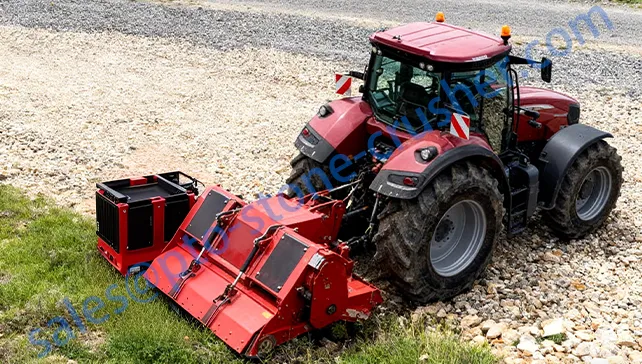
The compact horticultural stone crusher sits in a different design category from the large reclamation machines used in pastoral or prairie applications. Dutch and Belgian horticultural tractors are predominantly in the 70–150 hp range — compact, manoeuvrable, and designed for operation on narrow field rows and headlands. The stone crusher must therefore be lightweight enough not to exceed the tractor’s rear linkage lift capacity, yet robust enough to handle the flint and quartzite stones found in Gelderland and Flemish Ardennes soils.
The PSC Series compact crusher achieves this balance with a machine weight of 1,230 kg at the smallest 1110 mm working width, rising to 1,750 kg at the 2070 mm version. The frame is constructed from laser-cut and press-braked structural steel, giving precise dimensional tolerances that ensure consistent depth control across the full working width. In the flat polder landscapes of Holland and Zeeland, where field gradients are negligible, this dimensional precision translates directly into a uniform finished tilth.
The gearbox on horticultural models is sealed and positioned at the top centre of the machine, away from ground-level mud and stone splash. Input shaft connections accept both 540 RPM and 1000 RPM PTO drives depending on model configuration, with an internal gear ratio selected to deliver the correct rotor speed for each. Overload protection is provided by a cam-clutch on the input shaft — important in horticultural contexts where flint nodules, concrete pieces from former greenhouse foundations, and embedded brick fragments can create sudden shock loads.
The Category 2 three-point linkage mount is standard across all models, with transport lock options enabling safe road transport between plots. In the Dutch context, where horticultural operations often span multiple plots connected by public roads, the ability to lock the machine securely for transport is a practical requirement that affects daily operational logistics.
Materials
4. Material System: Balancing Hardness, Precision, and Replaceability
In European horticulture, the stone type that causes the most cutting tooth wear is flint — a microcrystalline silica rock formed as nodules in chalk and found extensively in the sandy loam soils of South Holland, Utrecht, and Flemish Brabant. Flint has a Mohs hardness of 7 and an extremely sharp fracture morphology. When struck by a fast-moving hammer tooth, flint fragments into razor-edged pieces that abrade the tooth surface rapidly. This makes flint among the most demanding of European agricultural stones for cutting tool material selection.
For flint-bearing horticultural soils, the preferred cutting tooth configuration is a fixed-tooth cutter with a tungsten carbide insert tip. The carbide resists the abrasive attack of high-silica flint far better than hardened steel alone. Each tooth is individually bolted into a machined holder on the rotor body, permitting replacement of individual worn teeth without removing adjacent ones — particularly useful in horticulture where operations often stop and restart multiple times per day as operators move between plots or crops.
The internal chamber of the PSC Series crusher is lined with replaceable Hardox 400 wear plates. At 400 BHN hardness, these plates resist the abrasive impact of flint fragments recirculating inside the chamber during secondary crushing. Replacement intervals in flint-bearing soils are approximately 600–800 operational hours — equivalent to roughly 3–5 seasons of intensive horticultural use before the first chamber plate replacement is needed.
The counter-blade material is austenitic manganese steel, as in heavier machines. However, in the compact horticultural context, the counter-blade gap adjustment is typically mechanical rather than hydraulic — the operator sets the clearance between the rotor tooth tip and the counter-blade to control output particle size. For fine vegetable seedbed preparation, a tighter gap setting produces smaller maximum aggregate size. For bulb plots where larger aggregate beneath the bulb can aid drainage, a slightly wider gap setting is appropriate.
| Part | Material | Suitable for Flint? | Replacement Interval |
|---|---|---|---|
| Cutting teeth | WC-tipped / Hardened steel | WC preferred for flint | 100–300 hrs (WC) / 60–100 hrs (steel) |
| Counter-blade | Austenitic Mn steel | Yes (work-hardens) | 300–500 hrs (reversible) |
| Chamber lining | Hardox 400 | Yes | 600–800 hrs |
| Main housing | S355 laser-cut plate | N/A | Machine lifetime |
Regulations
5. EU Machinery Directive, Gearbox Standards, and Compliance for Dutch and Belgian Operators
Stone crushers sold into the European Union market — including those used in Dutch and Belgian horticulture — must comply with the EU Machinery Directive 2006/42/EC (and its successor Machinery Regulation (EU) 2023/1230, which will fully apply from January 2027). Under the Machinery Directive, manufacturers must perform a conformity assessment, prepare a technical file demonstrating compliance with Essential Health and Safety Requirements (EHSRs), and affix the CE mark to the machine. The CE mark is the operator’s primary assurance that the machine has been assessed against the full range of applicable safety requirements.
For PTO-driven machines specifically, the harmonised standard EN ISO 4254-7 (Agricultural machinery — Safety — Part 7: Combine harvesters, forage harvesters and cotton pickers) is complemented by EN ISO 11684 for safety signs and the more broadly applicable EN ISO 4254-1 (Agricultural machinery — Safety — General requirements). The PTO driveline guard requirements under these standards specify that guards must prevent contact with rotating shafts throughout the full range of operating angles, and must be retained independently of operator action during operation.
In the Netherlands, the ARBO wet (Working Conditions Act, Act of 18 March 1999) and associated Arbeidsomstandighedenbesluit impose duties on employers regarding the safety of work equipment, including agricultural machinery. Under the Arbeidsomstandighedenbesluit Artikel 7.18, all work equipment must be inspected, maintained, and repaired by competent persons, and specific safety checks — including PTO guard integrity — are required before initial use and periodically thereafter. The Dutch Rijksdienst voor Ondernemend Nederland (RVO) also administers grants and subsidies for safe and sustainable agricultural equipment under the Subsidieregeling Verbetering Luchtvaart en Veiligheid frameworks, which can partially offset investment costs in new stone crushing equipment meeting current emission and safety standards.
In Belgium, the Code du bien-être au travail (Code on Well-Being at Work) — specifically Title VI relating to work equipment — implements the European Framework Directive 89/655/EEC. Operators using stone crushers as employers must conduct a risk analysis per EDPB guidance, maintain records of equipment inspections, and ensure all operators receive documented training before using PTO-driven implements.
Belgian operators in the Walloon Region (Région wallonne) should note that stone crushing operations near watercourses fall under the Décret sur l’eau (Water Decree of 27 May 2004) and may require notification to the Direction générale opérationnelle Agriculture, Ressources naturelles et Environnement (DGO3) for activities within 10 metres of any classified waterway. In Flanders, similar provisions exist under the Omgevingsvergunning (environmental permit) framework administered by the Vlaamse Overheid.
Regional Insight
6. Adapting Stone Crusher Use to Dutch Polder and Belgian Ardennes Conditions
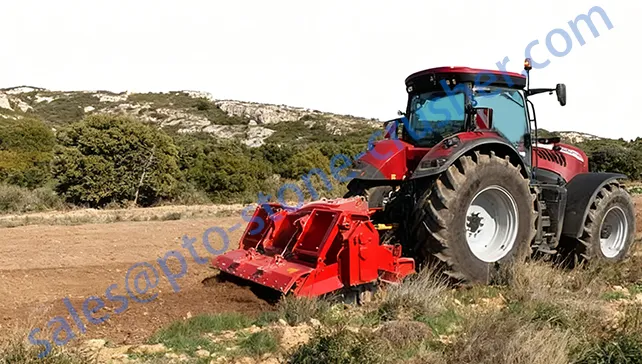
The low-lying polder landscape of the Netherlands presents a paradox for stone crushing: much of the most intensively managed horticultural land — the bulb fields of the Bollenstreek, the vegetable growing areas of Westland — has very low stone content due to its marine clay or sand origin. Here, stone crusher use is targeted specifically at fields adjacent to former building plots or farmyards where demolition debris (brick, concrete, tile) has been incorporated into the soil. The PSC Series compact crusher is ideal for this application, processing concrete fragments and brick at moderate working depths without requiring the heavy-duty construction of a large reclamation machine.
For the Veluwe region’s sandy heathland reclamations — where large erratic boulders of Scandinavian granite and gneiss were deposited by Saalian ice sheets — a heavier machine capable of handling 200–300 mm stones is more appropriate. The Tractor-Mounted Rock Crusher with fixed-tooth cutter design and a 300 mm maximum shredding diameter is well matched to these conditions.
Belgian Ardennes horticulture presents its own specific challenge: the Devonian shale and quartzite bedrock is highly angular when fractured, creating sharp flaky fragments that wear cutting teeth aggressively. In this context, tungsten carbide tipped teeth are strongly preferred over standard steel configurations. Additionally, the steep terrain of the Ardennes foothills requires that depth control systems be particularly responsive — hydraulically adjustable skid shoes are a practical advantage when working across varying gradients within a single plot.
Product Selection
7. Recommended Models for Dutch and Belgian Horticultural Operations
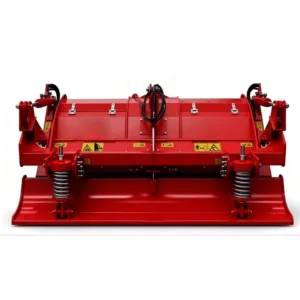
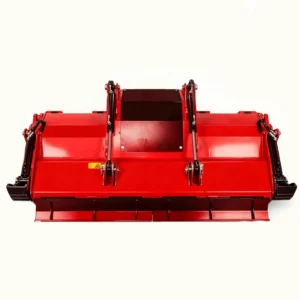
PSC Series Field Stone Crusher
Purpose-built for compact European horticultural tractors. Six models from 1110–2070 mm working width, 70–150 hp. Ideal for flint-bearing vegetable and bulb fields. Max stone 150 mm, depth 150 mm.
CE-marked · Cat. 2 linkage · PTO 540–1000 RPM
拖拉机式岩石破碎机
For the Veluwe and Ardennes where larger erratic stones require greater crushing force. Max stone 300 mm, working depth 280 mm. 80–190 hp tractors.
Fixed-tooth cutter · High impact efficiency
FAQ
常见问题解答
Q1. Which PTO stone crusher model works best for tulip and hyacinth bulb field preparation in the Dutch Bollenstreek sandy soils?
The PSC Series compact crusher at 1110–1590 mm working width is the most practical choice for Bollenstreek bulb operations. It provides precise 150 mm depth control, which aligns well with bulb planting depths, and its compact width suits the long narrow plot structure typical in that region. If you’re dealing with scattered flint in the subsoil, specify tungsten carbide tipped teeth for longer service intervals.
Q2. Does a stone crusher for tractor in Dutch horticulture need CE marking under the EU Machinery Directive to be legally operated?
Yes. Under EU Machinery Directive 2006/42/EC (applicable until the new EU Machinery Regulation 2023/1230 takes full effect in 2027), all stone crushing implements placed on the EU market must bear a CE mark attesting to conformity with the Essential Health and Safety Requirements. Operators and employers have a duty under the ARBO wet to use only compliant, CE-marked machinery in the workplace.
Q3. How does a stone crusher handle concrete and brick demolition debris mixed into polder farm soil in the Westland greenhouse area?
The PSC Series compact crusher handles concrete and brick fragments at 150 mm diameter and below effectively. Concrete at typical building demolition fragment sizes (50–100 mm) is crushed readily. Reinforced concrete with exposed rebar requires careful inspection — steel rod longer than about 30 mm can wrap around the rotor and should be manually removed before crushing operations. Brick fragments crush readily and can improve drainage in the heavy clay soils underlying many Westland plots.
Q4. What is the typical service interval for cutting teeth on a PTO stone crusher used in Belgian Ardennes flint and quartzite soil conditions?
In Ardennes quartzite and Devonian shale conditions, standard hardened steel teeth typically need inspection after 60–80 operational hours and often replacement within 100 hours. Tungsten carbide tipped teeth last 200–350 hours in similar conditions. Given the remoteness of some Ardennes horticultural plots from machinery dealers, carrying a full set of spare teeth in the tractor during renovation season is strongly advised.
Q5. What tractor horsepower is needed for a PTO stone crusher to prepare asparagus growing beds in the Kempen region of Belgium?
For asparagus preparation in the sandy loam and sandy soils of the Kempen, where stone content is moderate and stones are typically small to medium flint pebbles, a 70–100 hp compact tractor with a PSC 100 or PSC 125 model is adequate. The 150 mm working depth of these models covers the asparagus crown planting depth of 120–140 mm, and their low weight preserves the soil structure important for asparagus perennial root development.
Q6. How do Dutch ARBO-wet employer obligations apply to seasonal workers operating a PTO stone crusher on a Netherlands horticultural holding?
Under ARBO wet and the Arbeidsomstandighedenbesluit, employers must provide documented training for all workers on the safe operation of work equipment before first use. For PTO stone crushers, this includes instruction on safe PTO engagement and disengagement, the hazards of working near rotating driveline components, emergency stop procedures, and the specific risks of stone projection. Training records must be kept and made available for inspection by the Inspectie SZW (Netherlands Labour Authority).
Q7. Does stone crusher use on sandy Flemish soils cause wind erosion risk in the Belgium coastal dune polders?
Stone crushing on very sandy soils does disturb the soil surface and can temporarily reduce aggregate stability. On Flemish coastal sandy plots, conducting stone crushing operations in autumn or early spring — before the main wind-prone dry summer period — reduces the risk. Immediate incorporation of plant residues or organic matter after crushing, or overseeding with a cover crop, helps re-establish surface stability quickly.
Q8. What is the difference between using a stone crusher machine versus a stone picker for Belgian strawberry field preparation?
A stone crusher processes stones in-situ, reducing them to aggregate that remains in the field and can improve drainage. A stone picker removes and collects stones for relocation. For strawberry production, in-situ crushing is generally preferred because it avoids the compaction caused by multiple loader and trailer passes through narrow strawberry rows, and the resulting fine aggregate provides a well-structured bed for the precision transplanting equipment used in strawberry production.
编辑:PXY