Technical Field Guide — Agricultural Stone Crushing
Kan een aftakas-steenbreker nat of met klei bedekt gesteente verwerken zonder te verstoppen?
A comprehensive technical guide covering rotor action mechanics, machine design, material systems, clay behaviour under high-speed impact, and real-world operating tips — with specific relevance to Korean paddy conversion fields, monsoon-season clearance, and wet-season farm preparation globally.
1. The Question Every Operator Eventually Asks
Anyone who has spent time clearing rocky farmland knows that conditions are rarely ideal. Rain arrives before the schedule allows, irrigation cycles saturate the soil profile, and in regions like South Korea’s Jeolla and Chungcheong provinces — where paddy conversion projects require stone clearance in clay-dominant soils — wet-weather fieldwork is simply unavoidable. The natural concern is whether a PTO-steenbreker will keep functioning effectively when the rock it encounters is coated in wet clay or embedded in saturated soil, or whether operators should expect the machine to clog, bog down, or deliver inconsistent results.
The short, practical answer is that a properly engineered agricultural stone crusher handles moderate clay and wet conditions far better than most operators expect — but the outcome is heavily influenced by rotor design, tooth geometry, chamber architecture, and operating speed. This guide breaks down each technical dimension so that farmers, contractors, and equipment buyers can understand exactly what happens inside the crushing chamber when wet, clay-covered stone enters the machine, and which design features separate machines that manage these conditions from those that struggle.
We draw on specifications from the PSC/STCL, STCM, STCH, RockMaster, and tractor-mounted rock crusher platforms to illustrate how different model configurations handle clay-contaminated workloads across a range of tractor power classes.
2. How Clay and Moisture Affect the Crushing Process
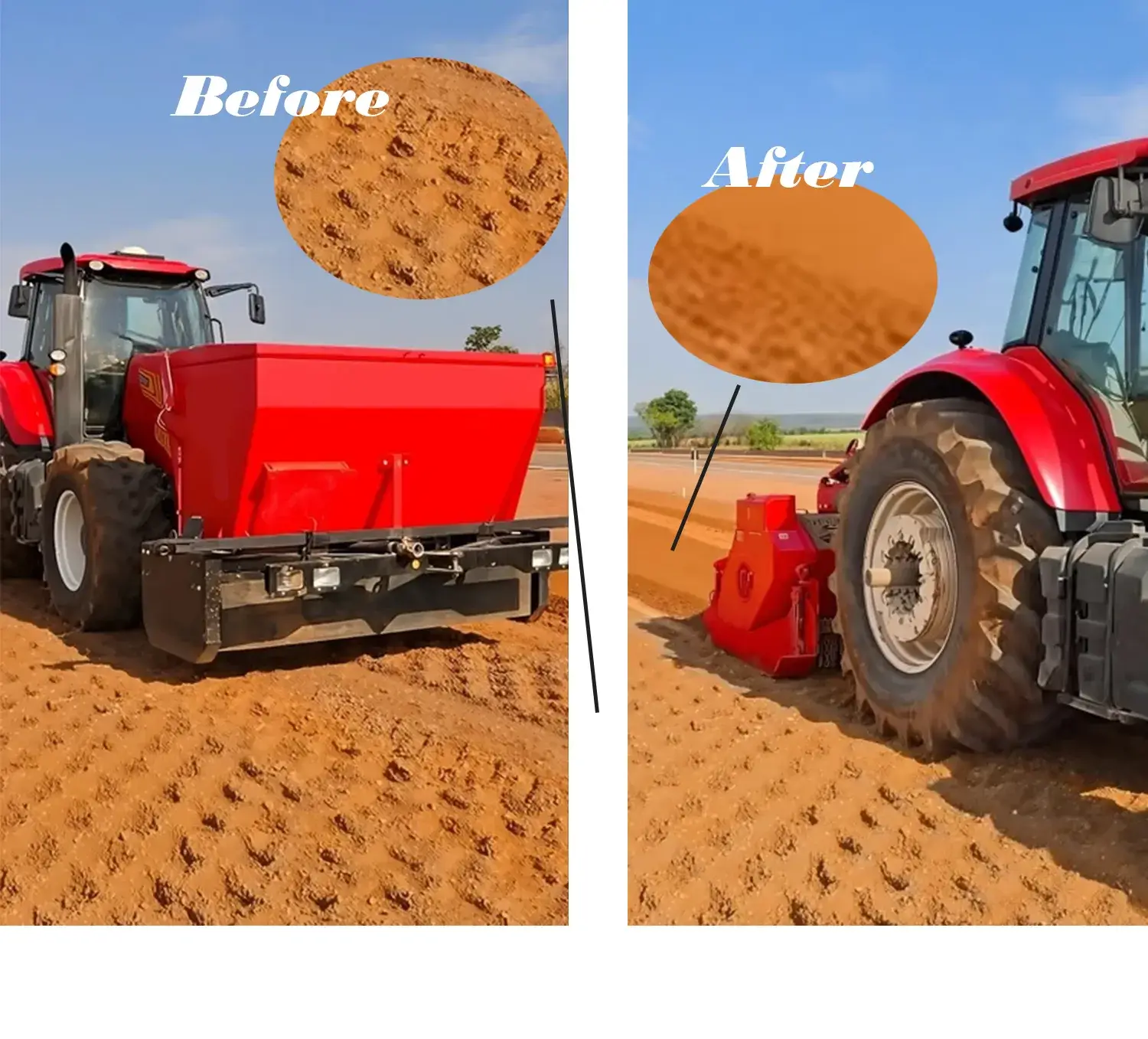
Before examining machine design, it helps to understand what wet clay actually does inside a stone crusher. Clay is cohesive — when wet, it behaves plastically, meaning it deforms under pressure rather than fracturing. This has two competing effects inside a crushing chamber. On one hand, clay wrapping around stone surfaces reduces the direct metal-on-rock contact that creates efficient fragmentation. On the other hand, wet clay is far less hard than the stone itself and does not significantly increase wear on teeth or counter-blades. The real challenge with clay is accumulation: if the machine’s internal geometry allows clay to build up in corners, around tooth holders, or behind the counter-blade, the effective rotor clearance shrinks over time, reducing throughput and potentially causing binding.
Clay content varies enormously by field. In Korea’s grain belt — particularly the reclaimed tidal flatlands of the western coast (Seohae-an) and the alluvial plains of the Nakdong and Han river deltas — clay content of 40–60% by volume is common. These soils can become extremely plastic during wet weather, and stones embedded in them arrive at the rotor coated in clay several centimetres thick. In contrast, volcanic red-clay soils in Jeju Island tend to have clay layers that dry and crack in dry weather, behaving almost like fragmented rock — which actually processes cleanly through a stone crusher without significant clogging risk.
The relationship between clay moisture content and machine behaviour is not linear. Slightly moist clay (just below field capacity) tends to break apart under rotor impact and exit with the crushed stone without accumulating. Fully saturated clay, especially smectite-type (swelling) clays common in rice paddy soils, is the most problematic — it sticks tenaciously to steel surfaces and can bridge across narrow gaps. Machine design features that address saturated clay conditions are therefore the most meaningful differentiators when evaluating stone crushing equipment for wet-season use.
3. Action Method: What Happens Inside the Chamber at 1000 RPM
A PTO stone crusher operates by spinning a rotor drum at high RPM — typically 1000 RPM for mid-range and heavy models — while the tractor advances at 3–5 km/h. The teeth mounted on the rotor strike incoming material with enormous kinetic energy. The key insight relevant to wet-clay performance is that this impact energy is not just mechanical force — it is also a shockwave event. When a forged-steel tooth traveling at rotor tip speed (approximately 28 m/s at 1000 RPM on a 550 mm diameter rotor) strikes a clay-coated stone, the instantaneous impact acceleration exceeds what the clay’s cohesive strength can sustain. The clay envelope shatters or is stripped from the stone surface before the stone itself undergoes fracturing. This is why many operators are surprised to find that light-to-moderate clay coating does not significantly impair crushing efficiency — the stripping of the clay coating and the fragmentation of the stone underneath happen in a single impact event.
Where problems do emerge is in the period between impacts — the transit time between the rotor and the counter-blade, and the dwell time in the rear section of the crushing chamber. If the chamber’s internal clearances are too tight and the clay content is high enough, wet clay can smear across internal surfaces and reduce the effective working volume. Well-designed machines address this with larger rotor-to-housing clearances, steeply angled internal hood surfaces that prevent clay bridging, and rear exit apertures sized generously enough to allow the mixed clay-gravel output to exit freely without restriction.
Operating speed also matters. Working at the upper end of the recommended speed range — 5 km/h rather than 3 km/h — increases the volume of material entering the chamber per unit time, which paradoxically tends to reduce clay accumulation by keeping material moving through rather than dwelling. However, faster forward speed reduces the number of rotor impacts per square metre, which can leave larger stone fragments uncrushed. For high-clay conditions, the recommended approach is moderate forward speed combined with slightly widened counter-blade gap, trading some output fineness for improved clay evacuation and consistent throughput.
4. Manufacturing Structure: Design Features That Resist Clogging
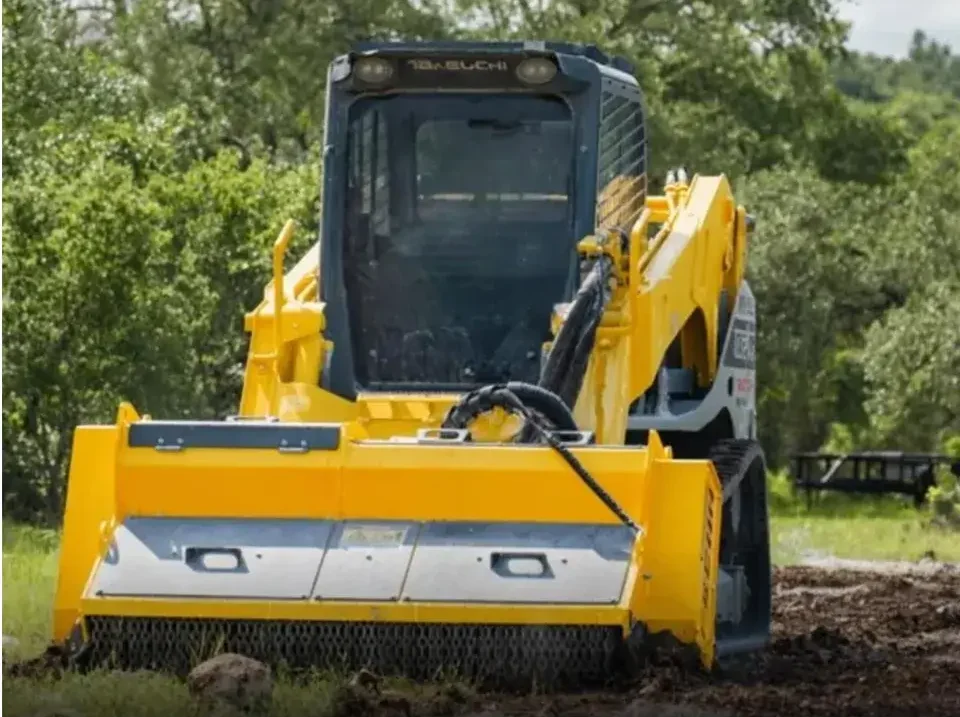
The structural layout of a stone crusher machine has a direct bearing on its clay tolerance. Several specific design elements distinguish machines that perform well in wet conditions from those that do not. The first is the crushing chamber geometry. An enclosed, fully sealed housing — as found on the STCM-150 and above, as well as the tractor-mounted rock crusher platforms — prevents mud ingress from outside the chamber while also containing the material being processed. This might seem counterintuitive since “enclosed” sounds like it would trap clay, but the enclosed design actually directs all material flow through a single controlled exit path (the rear aperture), rather than allowing wet clay to accumulate in external recesses and re-enter the rotor zone.
The second critical feature is the hydraulically adjustable counter-blade. On models including the STCM-175 and heavier, the operator can adjust the gap between the rotor and the counter-blade remotely from the tractor cab while the machine is running. In clay-heavy conditions, opening the counter-blade gap by just 10–15 mm dramatically reduces the risk of clay compaction between the rotor teeth and the anvil plate. This adjustment takes seconds and can be changed multiple times across a single field pass as conditions vary — for instance, when transitioning from a dry hilltop zone to a wet drainage channel zone within the same paddock.
The third design element is the protection chain system at the rear exit. Heavy-duty bolt-on protection chains (rather than solid fixed guards) at the rear aperture serve as kinetic energy absorbers but also as flexible curtains that allow large volumes of mixed clay-gravel material to exit the chamber without restriction. Fixed rear guards tend to create a dam effect in high-clay-volume conditions, especially when output material is wet and heavy. The chain curtain system maintains consistent exit flow even when processing dense, clay-rich material.
Finally, the tooth holder design affects clay clearance around the rotor surface. Tooth holders fabricated from forged steel with a streamlined cross-section allow wet clay to flow past the holder body rather than accumulating behind it. Boxy or flat-faced tooth holders create leading-edge clay accumulation that can, over time, increase effective rotor diameter and reduce working clearance. This is a detail that is rarely discussed in equipment specifications but has real practical significance on Korean paddy conversion sites or any consistently wet working environment.
5. Material System: Tooth Types and Wear Steel Behaviour in Clay
The material science of wear components takes on a specific character in wet-clay conditions. Standard abrasive wear — the gradual material loss from repeated rock-on-metal contact — is actually reduced in clay-covered rock situations because the clay film acts as a lubricant layer, reducing direct metal-stone contact at the initial impact moment. However, the same clay film can cause localized corrosion on steel surfaces where it is allowed to dry and remain for extended periods, particularly in agricultural environments with high organic acid content from decomposing crop residue.
The STC/3 tooth — the standard configuration on PSC/STCL and STCM series machines — is a fixed forged-steel tooth with a tungsten carbide tip insert. In clay-heavy conditions, the carbide tip’s primary advantage is not hardness but geometry: the sharp carbide point penetrates the clay-stone composite faster than a broad blunt tooth, reducing the rotational energy required per impact event and allowing the rotor to maintain speed more consistently when encountering dense material. This translates directly to more stable PTO shaft load, which reduces shock loading on the tractor drivetrain — a practical benefit on tractors operating at near-maximum PTO output.
The STC/3/HD (heavy duty) variant, appropriate for hard stones embedded in dense clay, has a thicker tooth body that resists bending forces when the tooth must both penetrate the clay matrix and simultaneously fracture a hard stone. If the machine is being used primarily for clay-covered limestone or sandstone (common in Korea’s Gyeonggi and Gangwon provinces), the STC/3/HD tooth is the better starting point. The STC/3/FP (field preparation) tooth has a broader profile designed for finishing passes where the objective is homogeneous seedbed texture — not ideal for clay-heavy primary clearing but useful for secondary passes once the bulk of clay-covered stones have been processed.
The Hardox wear-steel lining of the crushing chamber — particularly the internal hood plates and the counter-blade — performs well in wet conditions because Hardox steel has been formulated with corrosion-mitigation alloying elements alongside its primary hardness characteristics. Regular inspection and re-greasing of the rear seal areas after wet-season use is advisable, particularly where pH-active soils (rice paddy soils can be slightly acidic) may accelerate surface oxidation on uncoated mild steel components.
6. Model Comparison: Wet-Clay Performance Characteristics
The table below summarises key specifications from the stone crusher product range that are directly relevant to wet and clay-covered rock processing. All specifications are drawn from published product data.
| Model / Series | HP-bereik | Rotor Ø (mm) | Max Stone Ø (mm) | Maximale diepte (mm) | Enclosed Housing | Hydraulic Counter-Blade | Clay Tolerance |
|---|---|---|---|---|---|---|---|
| PSC / STCL Series | 70–150 | 450 | 150 | 150 | Partial | Adjustable | Good for light clay |
| STCM Series (150–225) | 80–280 | 550 | 300 | 200 | Full (excl. 125) | Hydraulic (excl. 125) | Very good, mid-range clay |
| RockMaster / RSL Series | 80–190 | 595–612 | 300 | 150–280 | Full | Adjustable | Good, flexible rotor options |
| STCH Series | 280–400 | 700 | 500 | 250 | Full | Hydraulic | Excellent, heavy clay + rock |
| THOR 2.4 (Drawbar) | 180 min. | — | — | — | Ja | 2 control valves | Good, drawbar flexibility |
7. Gearbox Considerations and Regulatory Standards Across Key Markets
Wet operating conditions put additional demands on the gearbox and PTO driveline components of a stone crusher. Moisture infiltration into the gearbox oil — whether from condensation, rain exposure, or high-humidity environments common in Korea’s summer monsoon season (June through August) — accelerates gear and bearing wear by contaminating the lubricant with water and by promoting corrosion on gear tooth flanks. Professional-grade machines use fully sealed gearbox housings with labyrinth shaft seals that prevent water ingress during field operation. Confirming that the gearbox sealing standard meets IP54 or equivalent (protection against splashing water from any direction) is a practical specification checkpoint when purchasing stone crushing equipment for use in wet climates.
In South Korea, agricultural machinery gearboxes and PTO-driven implements fall under the scope of the Agricultural Mechanization Promotion Act (농업기계화촉진법) and associated technical standards administered by the Rural Development Administration (농촌진흥청, RDA). The RDA publishes Korea Agricultural Machinery Standards (KAMS) which include specifications for PTO shaft connection, implement weight limits relative to tractor category, and basic safety guarding requirements. Stone crushers imported into Korea for commercial use by agricultural contractors are subject to import declaration and may require a type approval examination by the National Institute of Agricultural Sciences (NIAS/농업과학원) for certain categories of implements. Buyers and distributors should confirm current KAMS compliance requirements before import, as these have been updated periodically to align with international ISO standards.
In the European Union, gearboxes used in PTO-driven agricultural implements must comply with the Machinery Directive 2006/42/EC and specifically reference ISO 11684 (agricultural machinery safety — symbols) and EN ISO 4254-7 (agricultural machinery — safety — soil tillage machines) for machines used in soil preparation. CE marking requires a full technical file including risk assessment documentation, and the gearbox must be rated for the maximum torque input it will receive from the tractor PTO at rated speed. The torque limiter (overload protection) built into the PTO shaft assembly is considered part of the safety chain and must be documented in the technical file.
In the United States, ASABE (American Society of Agricultural and Biological Engineers) standards govern PTO shaft dimensions (ASABE S203), PTO-driven implement connection (ASABE S318), and agricultural implement safety (ASABE EP455). These standards are technically voluntary but are widely adopted by equipment manufacturers as the de facto compliance baseline. For Korean buyers sourcing equipment for export markets including North America, confirming ASABE-aligned PTO shaft compatibility alongside CE certification gives the broadest market coverage. ISO 6336 (gear load capacity) and ISO 5673 (PTO drives for agricultural equipment) provide the underlying technical framework referenced across all major markets.
8. Wet Season Operations: When to Work and When to Wait
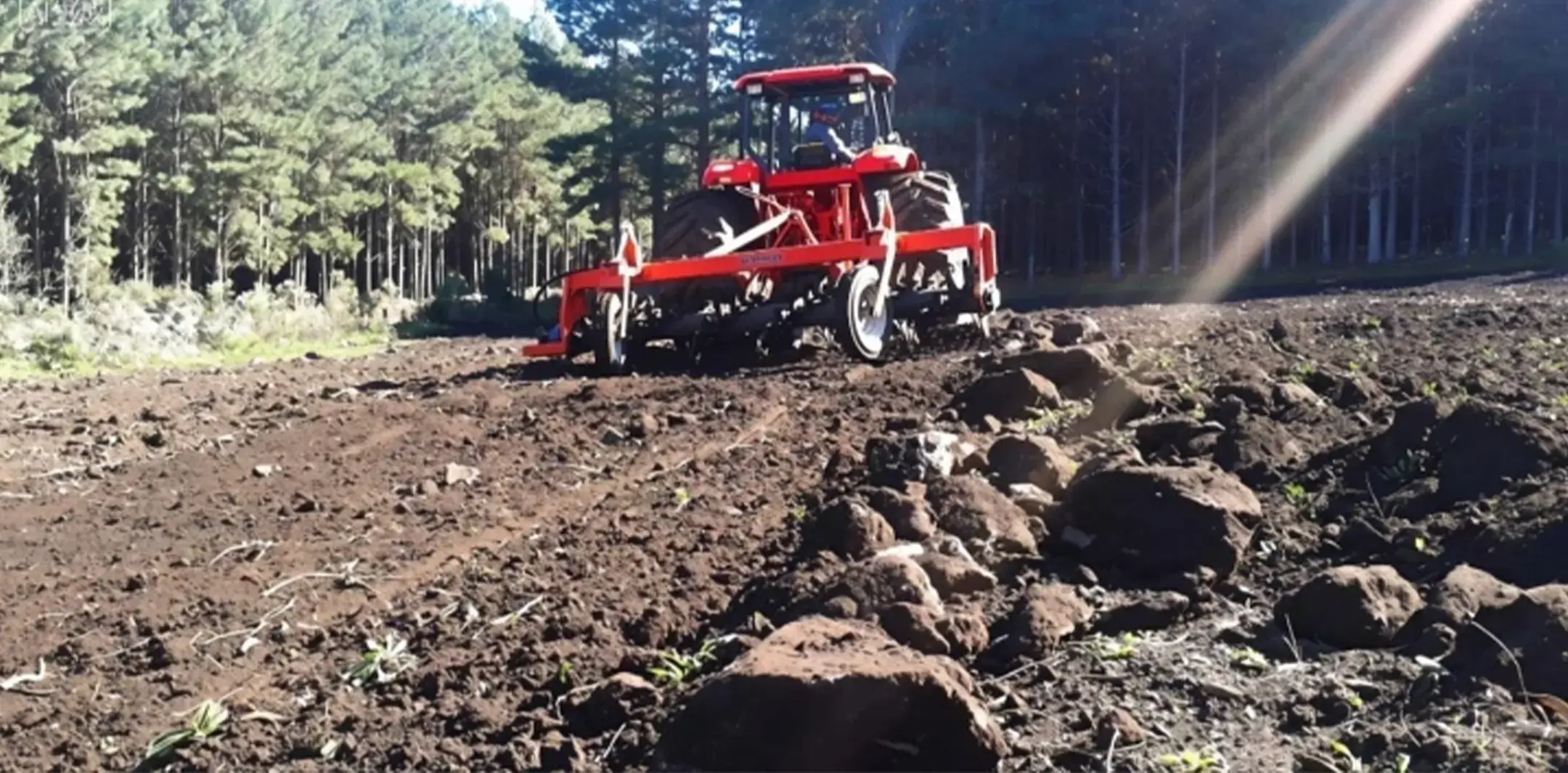
One of the most important decisions in wet-season stone crushing is not about the machine itself but about field access timing. Even the most capable agricultural stone crusher produces suboptimal results — and risks soil structural damage — if operated when the soil is at or above field capacity moisture content. The practical test is the “wheel track” assessment: if tractor wheel tracks penetrate deeper than 5 cm and the soil does not spring back after the tractor passes, the ground is too wet for stone crushing operations. At this moisture level, the tractor will smear the clay rather than allowing the rotor to engage stone cleanly, and the resulting output will be a clay-stone paste that is difficult to incorporate into the seedbed.
In Korean agricultural practice, the ideal window for stone clearing on paddy conversion fields is typically the period between the autumn harvest (late September to October) and the first hard frosts (mid-November in most central regions). Soils have dried sufficiently after the summer monsoon season, stubble has been incorporated or removed, and the field is firm enough to support tractor traffic without excessive rutting. Spring clearing — February through March before the first planting cycle — is the second-best window, working on soils that have been freeze-thaw cycled over winter, which naturally breaks up clay aggregates and makes them easier to process.
If stone crushing must occur during or shortly after significant rainfall — for example, on scheduled infrastructure projects or reclamation timelines that cannot shift — the recommended practice is to reduce forward speed to the minimum (approximately 3 km/h), select the most open counter-blade setting available, and increase inspection frequency. Checking for clay accumulation on the rotor every 30–45 minutes of operation and clearing any build-up before it compacts is far less costly than a full machine jam that requires removing teeth for access. The stone crusher for tractor platforms with hydraulic rear hood adjustment allow the operator to lift the rear hood slightly while the machine is running, which can assist in clearing clay accumulations without fully stopping the rotor.
9. Diagnosing and Resolving Clay Clogging in the Field
Symptom: PTO Load Spikes
Sudden increases in PTO torque load, visible as engine RPM drop, typically indicate partial clay blockage reducing effective rotor clearance. Response: reduce forward speed, open counter-blade gap, allow self-clearing before resuming normal speed.
Symptom: Uneven Output Material
Large uncrushed stones mixed with fine clay paste indicates the rotor is contacting clay layers without reaching embedded stone. Increase working depth by 10–20 mm to penetrate the clay surface layer and access stone directly.
Symptom: Vibration During Operation
Asymmetric clay build-up on one side of the rotor creates rotational imbalance that appears as vibration through the three-point linkage and tractor cab. Stop, disengage PTO, and remove clay build-up from rotor teeth and holders before restarting.
Symptom: Rear Exit Blockage
The rear output aperture can become restricted if wet clay-stone mix accumulates behind the protection chains. On models with hydraulic rear hood, briefly opening the hood while the rotor spins clears the exit path. On fixed-guard models, stop completely before clearing.
In genuinely extreme conditions — saturated smectite clay with stone content below 20% by volume — it may be more efficient to allow the field to dry for 48–72 hours before operating the pto stone crusher, even if this means adjusting the operational schedule. The cost of that delay is almost always lower than the cost of extended machine cleaning time, accelerated tooth wear from clay-induced abrasion cycling, and potential gearbox seal damage from sustained pressure fluctuations.
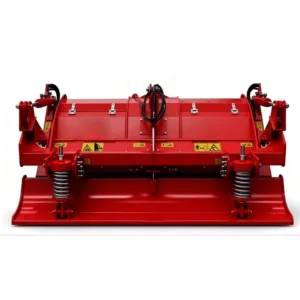
10. Stone Crusher Products Suited for Varied Soil Conditions
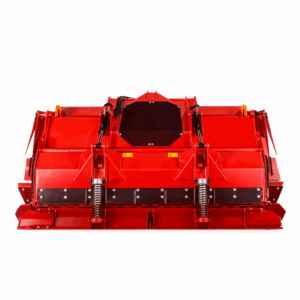
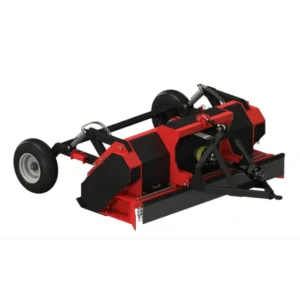
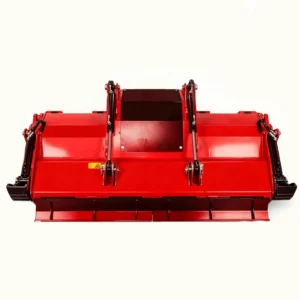
11. Post-Operation Maintenance After Working in Wet or Clay Conditions
Maintenance following wet-season operations is more important than maintenance after dry-season use, and the consequences of skipping post-work care are more severe. When clay-contaminated material is allowed to dry inside the crushing chamber overnight, it hardens to a cement-like consistency that is difficult to remove without mechanical tools. A residue of dry clay on rotor teeth and holders increases the effective rotor mass asymmetrically, creating vibration on the next start-up that can damage bearings and gearbox mountings if allowed to persist.
The correct end-of-day procedure after wet clay work is straightforward but must be completed before the machine is parked. First, with the PTO still engaged at reduced speed, make two or three passes over dry or bare ground (a farm track or headland) to allow the rotor’s own action to clear residual clay from teeth and the chamber interior. Second, after disengaging the PTO and allowing the rotor to fully stop, use a pressure washer or hose to flush the interior of the crushing chamber from the rear aperture. Particular attention should be given to the area directly behind the rotor and the surfaces of the counter-blade. Third, check the PTO shaft universal joints for clay ingress around the guard seals, and apply fresh grease to the cross-joints if any water contamination is visible.
For extended storage after a wet-season campaign — say, over the winter months between October and February in Korea — drain and replace the gearbox oil regardless of operating hours, as wet-condition use accelerates moisture contamination of the gear oil to a degree that regular interval-based oil changes do not account for. Apply a corrosion-inhibiting spray to all unpainted internal steel surfaces, and store the machine in a covered, ventilated location. These steps add perhaps 90 minutes to end-of-season decommissioning but will extend the service life of the machine by years.
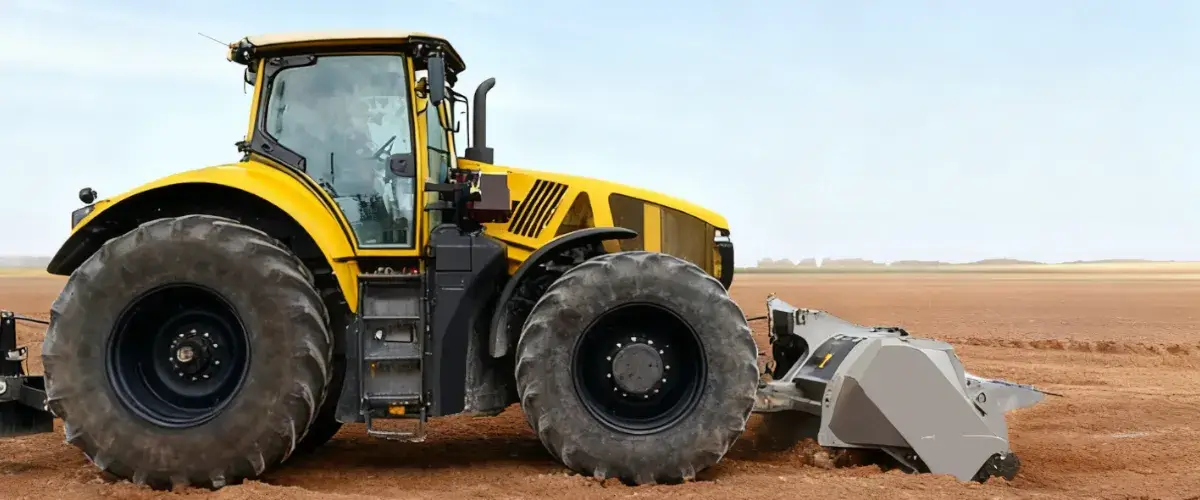
12. Korean Agricultural Context: Paddy Conversion and Monsoon-Season Clearing
South Korea presents a specific and well-defined use case for PTO stone crusher operation in wet and clay-heavy conditions. The national policy direction under the Ministry of Agriculture, Food and Rural Affairs (농림축산식품부) toward diversified crop production on former rice paddies has created significant demand for land reclamation machinery capable of operating on saturated, high-clay soils. Former paddy fields — especially those under continuous flooded rice cultivation for decades — have accumulated distinct clay hardpan layers at 20–30 cm depth (known as the “plough pan” or 작반층), and subsoil stone content is frequently higher than it appears from surface inspection because stones have been systematically pushed down into the plough pan by decades of puddling operations.
For Korean agricultural contractors undertaking paddy conversion work — transitioning fields from rice to vegetables, soybeans, or orchard cultivation — the stone crusher for tractor approach is increasingly recognised as the most efficient first-pass intervention. It simultaneously fragments the plough pan, processes embedded stones, and produces a loosened, mixed-depth profile that conventional subsoiling cannot achieve in a single pass. The STCM-175 or STCM-200 platform (160–220 HP range) is particularly well-matched to Korean mid-size tractor fleets (New Holland, John Deere, LS Tractor 150–200 HP range) that are common in the Honam plain and Gyeonggi-do commercial farming zones.
Korean equipment buyers and importers evaluating stone crushing equipment should confirm that the supplier can provide Rural Development Administration (RDA) type approval support documentation, Korean-language operating manuals, and confirmation of spare parts availability through a Korea-based distributor network. Lead time for wear parts — particularly teeth and counter-blade plates — is the most common operational bottleneck on Korean farms using imported equipment, and establishing a local parts inventory before the seasonal clearing campaign is essential for maintaining uptime. If you are a Korean agricultural machinery distributor or contractor seeking a supplier quote, the contact form below can connect you directly.
Veelgestelde vragen
Q1. Can a PTO stone crusher actually handle wet clay-covered rock in Korean paddy conversion fields without clogging up?
Q2. What is the best PTO stone crusher model for wet-season farmland clearing in South Korea’s Jeolla Province rice belt?
Q3. Where can I find an agricultural stone crusher for sale with Korean RDA type approval documentation available for import?
Q4. How does clay moisture content affect the clogging risk in a tractor stone crusher and what operating adjustments help most?
Q5. Which tooth type — STC/3, STC/3/HD, or STC/3/FP — works best for processing clay-covered limestone on Korean agricultural land?
Q6. What gearbox standards and safety regulations apply to imported stone crusher equipment used by Korean agricultural contractors?
Q7. When is the best time of year to run a PTO stone crusher on former paddy fields in Korea to avoid monsoon-season clogging problems?
Redacteur: PXY