Maintenance Guide
Jadual Penyelenggaraan Penghancur Batu PTO: Minyak Kotak Gear, Pemeriksaan Gigi dan Selang Servis Bearing
A practical, field-tested guide for agricultural stone crusher operators in Korea and worldwide — covering every critical service interval from first use through seasonal overhaul.
A pto penghancur batu is one of the most mechanically demanding implements you can attach to a tractor. Every pass across a rocky field subjects the gearbox, rotor bearings, and crushing teeth to concussive forces that would quickly overwhelm a poorly maintained machine. Unlike a tillage tool that only moves soil, a stone crusher must absorb unpredictable impact loads at high rotational speeds — which means even small lapses in lubrication or wear inspection can result in expensive downtime, especially during the short seasonal windows available to Korean farmers preparing paddy edges, highland vegetable plots, and orchard floors.
This guide draws on the engineering specifications of the penghancur batu pertanian models available on this site — including the EP-Thor 2.4 Kit Drawbar, the RockMaster Agricultural Stone Crusher, the EP-PSC Models series, the Tractor-Mounted Rock Crusher, and the Agricultural Tractor-Mounted Rock Crusher for Korea — and translates those specifications into a clear, actionable maintenance calendar. Whether you are running a compact 80 hp tractor or a 220 hp unit, the intervals and procedures described here apply to the core mechanical systems shared across the entire pto penghancur batu product range.
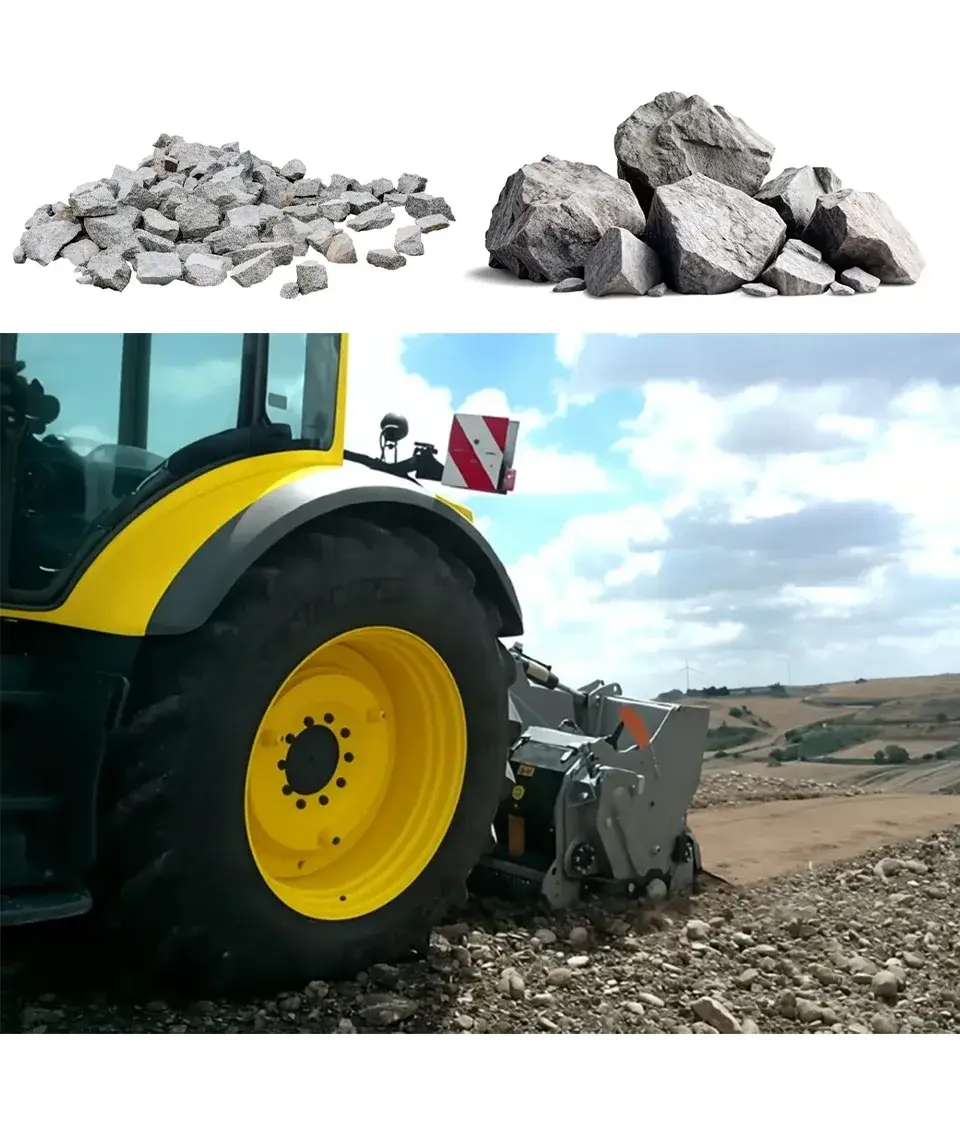
1. How a PTO Stone Crusher Actually Operates
Understanding the working principle is the starting point for any sensible maintenance plan. When the tractor’s power take-off (PTO) shaft — typically running at 540 RPM or 1000 RPM depending on the model — drives the input shaft of the stone crusher gearbox, a reduction gear or belt transmission multiplies torque and delivers it to a heavy steel rotor. On fixed-tooth models, the rotor carries hardened steel cutting teeth arranged in helical rows. As the rotor spins inside the crushing chamber, the teeth strike stones with tremendous force, fracturing them against counter-blades and wear plates.
The rotor diameter varies significantly across models. Compact field-crusher variants in the STCL class run rotors around 450 mm in diameter, while medium-duty platforms like the STCM series step up to 550 mm. The heavier RSL and RSM machines designed for larger tractors use rotors in the 595–940 mm range. Rotor tip speed — the product of diameter and angular velocity — determines both crushing efficiency and the mechanical stress placed on every bearing, shaft seal, and gearbox component. This is why maintenance intervals cannot be guessed: they must be calibrated to the specific operating speed and load cycle of each machine.
The gearbox sitting between the PTO shaft and the rotor is the single highest-value serviceable component in the drivetrain. It converts the moderate-torque, high-speed PTO input into the higher-torque, lower-speed rotor drive, and it does so continuously while absorbing the backlash and shock loads generated by stone contact. Gearbox oil quality and level are therefore the most critical single maintenance variable. A gearbox running on degraded oil or at a low oil level will overheat within hours under field-duty conditions, and the repair cost will far exceed any time saved by skipping an oil check.
2. Manufacturing Structure and Material Systems
The durability of an penghancur batu pertanian depends almost entirely on the material choices made in its construction, and those choices directly determine which components wear fastest and at what intervals they need attention. Modern stone crushers in the product line on this site use a combination of structural low-alloy steel for the main frame, Hardox wear-resistant steel for internal counter-blades, wear plates, and side protections, and heat-treated forged steel for tooth holders and rotor shaft journals.
Main Frame: High-strength structural steel, typically S355 grade or equivalent, welded and reinforced at stress concentration points around the gearbox mount, rotor bearing housings, and three-point linkage attachment. The frame’s integrity should be visually inspected at each service interval for cracking at welds, particularly near the bearing flanges and linkage pins.
Crushing Chamber Internals: Hardox 400 or Hardox 500 steel is used for counter-blades and internal wear plates. These grades offer a Brinell hardness of 370–500 HB, giving dramatically longer service life compared to standard structural steel under continuous abrasive contact. Counter-blades are designed as bolt-on replaceable components specifically because they will wear faster than the rotor itself. Hydraulically adjustable counter-blades (standard on STCM and larger models) allow the clearance between the rotor and the counter-blade to be optimised from the tractor cab, which affects both particle output size and wear rate.
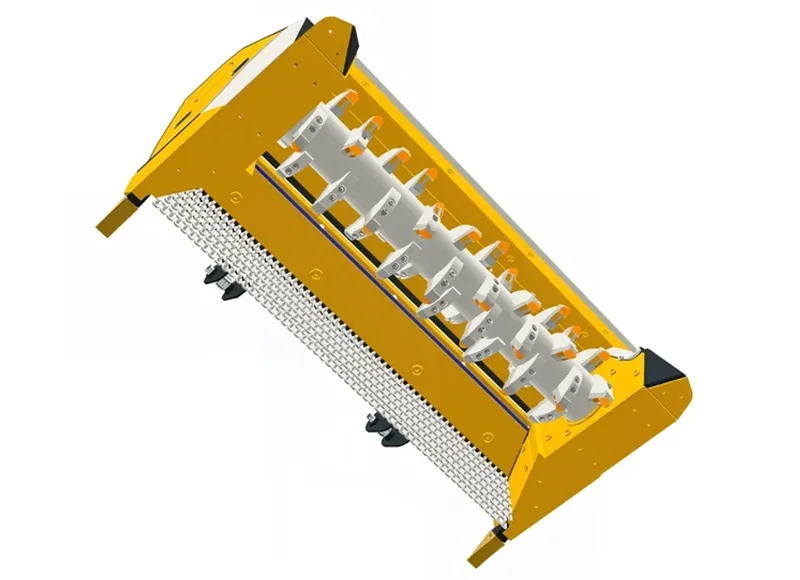
Rotor Teeth / Picks: The standard STC/3 tooth design used across the PSC and STCM-class models consists of a heat-treated steel tooth holder with a replaceable carbide-tipped insert. The holder is bolted to the rotor, and the carbide tip is the first component to wear. Some models offer STC/3/HD (heavy-duty) or STC/3/FP (flat-profile) variants for different rock types. Tooth condition is the highest-frequency inspection item in any maintenance schedule. A worn tooth transfers its load to the holder, which then begins to deflect, increasing stress on the rotor shaft and bearings.
Rotor Bearings: Spherical roller bearings are universally used at the rotor shaft journals due to their capacity to handle both radial loads and the axial shock loads introduced by non-uniform stone contact. These are grease-lubricated and shielded from contamination by labyrinth seals. Bearing service life in stone crushers is highly sensitive to contamination — fine silica dust generated during crushing is one of the most abrasive contaminants for bearing raceways, which is why maintaining seal integrity and greasing at correct intervals is not optional.
3. Master Maintenance Schedule — Service Interval Overview
The table below consolidates the recommended service intervals for all major systems. Intervals are expressed in operating hours; where seasonal considerations in Korean agricultural conditions differ from the standard schedule, a note is included.
| System / Component | Service Action | Interval (Hours) | Seasonal Note (Korea) |
|---|---|---|---|
| Gearbox oil | Check level | Every 8 h (daily) | Check before each work session during spring preparation |
| Gearbox oil | First oil change | 50 h (break-in) | Critical — do not skip on new or rebuilt gearboxes |
| Gearbox oil | Full oil change | 200–250 h or annually | Change at end of harvest season before winter storage |
| Memotong gigi | Visual wear inspection | Every 8 h (daily) | Increase frequency on basalt/granite-dominant soils |
| Memotong gigi | Torque check on tooth bolts | Every 50 h | After any large rock impact event, check immediately |
| Memotong gigi | Carbide tip / full tooth replacement | 100–300 h (condition-based) | Replace when tip height loss exceeds 20% of new dimension |
| Galas rotor | Grease injection | Every 50 h | Use NLGI 2 lithium-complex grease rated for high shock loads |
| Galas rotor | Seal and play inspection | Every 200 h or seasonally | Perform pre-season before spring work begins |
| PTO shaft / drive coupling | Lubricate crosses and yokes | Every 50 h | Inspect for play and protective guard integrity at same time |
| Counter-blade clearance | Check and adjust | Every 50 h | Hydraulic models allow cab adjustment; manual models require stopped machine |
| Protection chains | Inspect for wear, tension, missing links | Every 50 h | Chains protect the tractor and bystanders — never skip this check |
| Wear plates (Hardox) | Thickness measurement | Every 200 h | Replace when residual thickness reaches 50% of new |
| Frame welds / bolted joints | Visual inspection, torque check | Every 100 h | Pay attention to bearing housing flanges and linkage pins |
| Full machine inspection | Pre-storage overhaul | Annually (off-season) | Replace all consumables before end-of-year storage |
4. Tooth Inspection and Replacement: What to Look For and When to Act
Cutting teeth are the consumable components in a penghancur batu traktor. They are designed to wear — the question is only how quickly and how evenly. Asymmetric wear patterns, where some teeth wear faster than others, indicate problems that go beyond normal abrasion: uneven rotor loading, incorrect counter-blade clearance, operating in excessively hard material beyond the machine’s rating, or running at PTO speeds outside the specified range. Catching these patterns early prevents damage from propagating to the more expensive tooth holders and rotor body.
The standard STC/3 tooth geometry consists of a symmetrical double-tipped carbide insert in a forged steel holder. On the PSC Models series (corresponding to the STCM-class specification), the rotor carries between 26+4 and 48+4 teeth depending on working width, with tooth counts reflecting the helical row arrangement designed to produce a uniform cut. Each tooth on a STCM 150-class machine covers approximately 50 mm of working width, meaning a total working width of 1,584 mm is served by 36 teeth in active contact with the ground per revolution.
Daily Visual Inspection: At the start or end of each working day, rotate the rotor slowly (machine off, implement disconnected from PTO) and inspect every tooth for: carbide tip loss or cracking; unusual flat wear on one face only; holder rotation (a loose holder will show a worn shoulder); missing bolts or fractured bolt threads. Any tooth showing more than 20% height reduction from the original tip profile should be flagged for replacement at the next scheduled service stop.
Torque Check at 50 Hours: Tooth-holder bolts are subject to continuous vibration-induced loosening. At 50-hour intervals, check all tooth-holder fasteners against the specified torque value. On STCM-class machines, tooth bolts are typically M20 or M22 class 10.9 fasteners with torque specifications in the 280–420 Nm range. Using a calibrated torque wrench is important — over-torquing is as damaging as under-torquing, as it can initiate fatigue cracking in the rotor boss.
Replacement Strategy: When replacing teeth, it is strongly recommended to replace in matched sets across the full rotor width rather than replacing individual worn teeth. An imbalanced rotor — where new, taller teeth are mixed with worn teeth — creates uneven loading that puts asymmetric stress on the rotor shaft and bearings. This is especially important on wider machines in the RockMaster and Tractor-Mounted Rock Crusher classes where rotor mass is high and imbalance effects are amplified.
5. Bearing Service Intervals: Greasing, Contamination Control, and End-of-Life Signs
Rotor shaft bearings in a penghancur batu pto untuk dijual or in active service are operating in one of the worst possible environments for bearing life: high radial shock loads, continuous vibration, airborne silica dust, and frequent water exposure from wet field conditions. In Korea specifically, the combination of humid summer storage conditions and the hard volcanic-origin soils found in highland agricultural regions (Gangwon-do, North Jeolla, and parts of Gyeongbuk) creates a challenging environment for rotor bearing seals.
Greasing at 50-Hour Intervals: Rotor bearings require fresh grease injected through their zerk fittings every 50 operating hours. The correct grease type is NLGI Grade 2, lithium-complex base with EP additives and a temperature rating of at least −20°C to +120°C. In Korean winter storage conditions, where temperatures can drop to −15°C in highland areas, using a grease with adequate low-temperature fluidity prevents the first-start issue where cold, stiffened grease fails to circulate before the bearing reaches operating temperature.
Over-greasing Warning: More grease is not better. Injecting excessive grease into a sealed bearing housing pressurises the labyrinth seal from inside, forcing it open and creating a path for dust ingress. The correct technique is to inject grease slowly until fresh grease appears at the lip seal — then stop. On machines operating in particularly dusty conditions (dry summer fieldwork), consider a grease purge: inject fresh grease until the old, contaminated grease is fully displaced from the bearing cavity.
Bearing End-of-Life Indicators: Symptoms of approaching bearing failure include: elevated housing temperature (more than 30–40°C above ambient, detectable with an infrared thermometer); audible rumbling or knocking during rotor spin-up; visible axial play at the rotor shaft end (more than 0.5 mm axial float indicates raceway wear); and metal flake contamination in gearbox oil, which can appear when inner race wear releases particles into the shared lubrication circuit on some designs. When any of these indicators appear, plan bearing replacement at the next available opportunity — bearings that are allowed to run to catastrophic failure typically also damage the shaft journal, the housing bore, and sometimes the rotor itself.
6. PTO Shaft and Driveline Maintenance
The PTO shaft connecting the tractor to the penghancur batu untuk traktor is a safety-critical component that is frequently neglected in routine maintenance. The driveshaft’s Cardan joints (universal joints) must be greased at every 50-hour interval alongside the rotor bearings. A dry universal joint will develop increased play and imbalance, transferring shock loads into the tractor’s PTO output shaft and into the crusher gearbox input, accelerating wear on both ends of the drivetrain simultaneously.
The overrun clutch or torque limiter installed in the driveline — present on all properly specified penghancur batu pto kecil and full-size models — must be tested for correct release torque at each seasonal service. If the torque limiter does not release at the design torque, it cannot protect the gearbox from the overload peaks generated by large stone strikes. A seized torque limiter that never releases provides essentially no protection and will eventually allow a single large rock event to break a gear or shaft. Test the limiter by temporarily exceeding the release torque with a controlled load, and replace it if the slip torque is outside the ±15% band specified by the manufacturer.
The PTO shaft protective guard — the plastic or metal tube that surrounds the spinning driveshaft — must be intact and must not contact the shaft during operation. In Korea, tractor-mounted stone crushers fall under the Agricultural Mechanization Promotion Act (농업기계화 촉진법) provisions that require all PTO-driven implements to be equipped with functional shaft guards as a condition of legal operation. Regular inspection of guard integrity is therefore both a maintenance requirement and a legal compliance item.
7. Legal and Regulatory Requirements for Stone Crushing Equipment
Understanding the regulatory framework applicable to PTO stone crushers and their gearboxes is increasingly important as equipment becomes subject to inspection regimes and operator liability frameworks across major agricultural markets.
Korea (대한민국): Agricultural machinery including PTO-driven stone crushers is governed by the Agricultural Mechanization Promotion Act (농업기계화 촉진법, Act No. 17908). Under this act, agricultural machinery sold in Korea must be registered with the Rural Development Administration (농촌진흥청, RDA), and machinery undergoing government subsidy procurement must pass performance evaluation testing. The Industrial Safety and Health Act (산업안전보건법) covers machinery used in agricultural workplaces and mandates PTO shaft guarding, overload protection devices, and operator safety documentation. The Korea Industrial Standards (KS) for agricultural machinery, including KS B ISO 4254 for tractor and machinery safety, apply to stone crushers sold and operated in Korea.
European Union: Stone crushers sold in EU member states must comply with Machinery Directive 2006/42/EC (to be superseded by EU Machinery Regulation 2023/1230 from January 2027). CE marking requires a technical file demonstrating conformity with relevant harmonised standards, including EN ISO 4254 for agricultural machinery safety and EN ISO 11684 for safety signs. Gearbox oil management and bearing maintenance procedures must be documented in the operator manual as part of the CE conformity assessment process.
United States: OSHA 29 CFR Part 1928 (Occupational Safety and Health Standards for Agriculture) covers machinery operation. ASABE Standard S318 addresses PTO-driven equipment. Stone crushers used on worksites classified as construction are additionally subject to OSHA 29 CFR Part 1926 construction standards. The EPA requires that lubricating oils used in field equipment be managed as regulated waste when discarded — used gear oil cannot be dumped on the ground.
Australia: Agricultural machinery is regulated under state-level work health and safety legislation harmonised with the model WHS Act 2011. AS 1418 series standards cover plant and equipment safety. Used oil disposal in Australia is governed by the Product Stewardship (Oil) Act 2000, which funds the national used-oil collection network.
Brazil: ABNT NBR standards and NR-31 (Norma Regulamentadora de Segurança e Saúde no Trabalho na Agricultura) govern agricultural machinery operation. The Brazilian MAPA (Ministry of Agriculture) requires that PTO-driven equipment sold commercially include appropriate safety documentation in Portuguese.
8. Pre-Storage and Pre-Season Preparation Procedures
In Korea and other temperate-climate markets, pto stone crushers typically sit idle for four to six months over winter. The pre-storage procedure directly determines how much time and cost is spent bringing the machine back into service the following spring, and whether bearing rust, seized fasteners, and degraded gearbox oil add hours to the first work day of the season.
Pre-Storage Checklist (Autumn): Change gearbox oil — do not store a machine on oil that has absorbed water and acid combustion by-products from a full work season. Grease all bearings until fresh grease purges at the seals, displacing any moisture-contaminated grease from the summer season. Inspect and replace worn teeth, holders, and counter-blade sections so the machine is ready for immediate work the following spring without a parts-wait delay. Wash the entire machine with a pressure washer, paying particular attention to the crushing chamber interior, then coat exposed steel surfaces with a penetrating rust inhibitor spray. Store under cover if possible; in Korean winter conditions, stored outdoor equipment is exposed to freeze-thaw cycling that accelerates corrosion in crevices and at fastener threads.
Pre-Season Checklist (Spring): Check gearbox oil level and clarity — if the oil appears milky or foamy, water has entered the housing during storage and the oil must be changed before the first use. Check bearing grease — a hand rotation of the rotor should feel smooth and even; roughness or stiffness at any point indicates a corroded bearing that needs attention. Test the PTO torque limiter release. Inspect the PTO shaft guard for winter damage. Check that all tooth-holder bolts are at specified torque — freeze-thaw can cause differential thermal contraction that loosens previously-secured fasteners. Confirm hydraulic hose integrity if the model uses hydraulic counter-blade adjustment.
9. Our Stone Crusher and Mulcher Product Range
The maintenance principles outlined in this guide apply across our full range of stone crusher for sale models. Explore the product line to find the right penghancur batu pertanian for your tractor and field conditions:
EP-Thor 2.4 + Kit Palang Serut
180 cv min · 2.4 m width · 2,300 kg
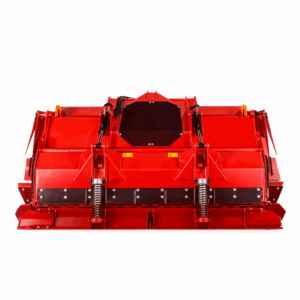
Penghancur Batu Pertanian RockMaster
Medium-duty agricultural rock crushing
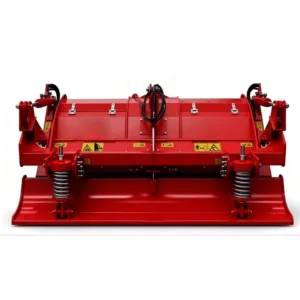
Penghancur Batu Model EP-PSC
STCL class · 70–150 hp range · orchard & vineyard
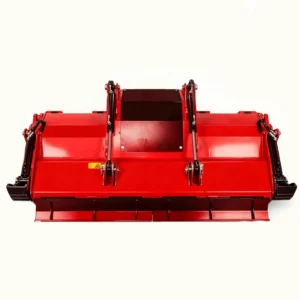
Penghancur Batu yang Dipasang pada Traktor EP
Heavy-duty tractor-mounted field crushing
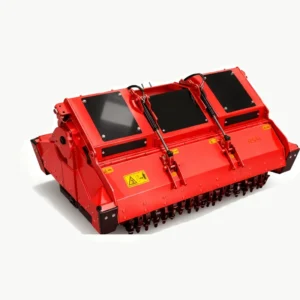
Agricultural Rock Crusher for Korea
Specifically configured for Korean farming conditions
10. Tentang Kami
We specialise in the supply of professional-grade agricultural machinery — stone crushers, mulchers, rock rakes, rock pickers, and the full range of equipment needed for land preparation and field-clearing operations. Our team has extensive practical knowledge of the equipment we supply and can advise on machine selection, maintenance planning, and parts procurement for operators across Korea and export markets worldwide.
Every product in our range is selected for its engineering quality, parts availability, and suitability for real-world farming conditions — not just controlled test environments. We understand that a penghancur batu traktor that spends three weeks waiting for a gearbox seal is not a working asset, which is why we emphasise the kind of preventive maintenance documented in this guide. Properly maintained equipment delivers more productive hours per season, lower total cost of ownership, and a higher resale value when the time comes to upgrade.
Soalan Lazim
Q1. How often should I change the gearbox oil on my agricultural stone crusher operating in Korean highland conditions?
For Korean highland operations — where soil silica content is high and seasonal use is concentrated — you should change gearbox oil after the first 50 hours on a new machine (break-in change), then every 200–250 hours or at the end of each main work season. Given Korea’s typical spring (March–May) and autumn (September–October) stone-crushing windows, a practical schedule is one oil change at the end of spring work and one at the end of autumn before winter storage. Always use an EP-additive ISO VG 220 gear oil matching the OEM specification in your operator manual.
Q2. What are the symptoms of worn cutting teeth on a PTO stone crusher and when exactly should I replace them?
The clearest visual symptom of worn teeth is a reduction in tip height — when the carbide insert has worn down so that the holder begins to contact the stone before the tip, the crushing action becomes less efficient and the holder starts to take damage. Other symptoms include increased vibration during operation, a change in the characteristic sound of the machine (dull thudding instead of clean strikes), and uneven particle output with more oversized stones passing through. Replace teeth when tip height loss exceeds approximately 20% of the original dimension, or immediately if a tooth is cracked, missing its carbide tip, or showing any sign of holder rotation or deformation.
Q3. Which grease type is best for rotor bearings on a small PTO stone crusher used in Korean rice field preparation?
For rotor bearings on any stone crusher — including compact models used in Korean rice paddy edge preparation — the recommended grease is NLGI Grade 2 lithium-complex with EP (extreme pressure) additives and a temperature rating covering at least −20°C to +120°C. In Korea’s winter storage conditions, the low-temperature minimum is particularly important. Avoid multi-purpose lithium greases without EP additives: the shock-load environment in a stone crusher rotor bearing quickly exhausts the base-oil film of lower-specification greases. Grease at every 50 operating hours, and purge old grease completely at the pre-season service.
Q4. What does a universal joint do on a PTO stone crusher driveshaft and how often should it be serviced in heavy field use?
The universal joints (Cardan joints) in the PTO driveshaft allow the shaft to transmit torque across an angular offset between the tractor’s PTO output and the stone crusher’s gearbox input. In heavy stone-crusher applications, these joints absorb both the continuous rotational torque and the shock peaks generated by large-stone impacts. Service them by injecting grease through each cross’s zerk fitting every 50 operating hours — the same interval as rotor bearings. Inspect for play (axial and radial movement in the cross bearing cups) at each greasing event, and replace crosses showing more than 0.5 mm of cup movement before the cup fractures and drops the driveshaft.
Q5. What are the specific legal requirements for operating a PTO stone crusher on a Korean farm according to current agricultural machinery regulations?
In Korea, PTO-driven stone crushers must comply with the Agricultural Mechanization Promotion Act (농업기계화 촉진법) and, where workers are involved, the Industrial Safety and Health Act (산업안전보건법). Practically, this means the PTO shaft guard must be installed and functional, the machine must carry operator safety markings in Korean (KS A 3501 safety colour standards), and the machine must not exceed the rated PTO power input for the attached tractor. For machines acquired through government subsidy programmes under the Rural Development Administration, performance certification through the relevant RDA evaluation centre is required. Consult with a local agricultural machinery dealer or the RDA regional office for the current subsidy registration status of specific models.
Q6. How do I correctly adjust the counter-blade clearance on my stone crusher machine to balance crushing efficiency with wear rate?
Counter-blade clearance — the gap between the rotating rotor teeth and the fixed counter-blade — directly controls output particle size and the rate at which both the counter-blade and the rotor teeth wear. A tighter gap produces finer material and faster wear; a wider gap produces larger output fragments with slower component wear. On hydraulically-adjusted models (STCM and larger), adjust clearance from the tractor cab while operating, listening for changes in machine noise to find the optimal setting for the stone type and desired output. On manually adjusted models, always stop the tractor and disconnect the PTO before reaching into the crushing chamber for any adjustment. As a starting point for most field applications, a counter-blade tip clearance of 5–15 mm from the rotor tooth tip in the rearward position covers the majority of agricultural stone-crushing tasks.
Q7. What is the working principle of a pto stone crusher and how does it differ from a jaw crusher or impact crusher used in construction?
A PTO stone crusher uses a high-speed rotating rotor carrying fixed cutting teeth to fracture stones by impact, essentially shattering each stone through a combination of direct impact with the tooth and secondary impact against the counter-blade and crushing chamber walls. The output is mixed back into the soil surface. A jaw crusher, by contrast, crushes material between two reciprocating jaw plates — a much slower, higher-force process better suited to large feed material and quarry-scale throughput. An impact crusher uses high-speed hammers on a rotor, similar in principle to a PTO stone crusher but typically much larger and designed for standalone operation rather than three-point tractor mounting. The PTO stone crusher’s key advantage is its ability to process fieldstones in situ without removing them from the field — something neither jaw nor impact crushers are designed for.
Q8. How do I know whether my tractor has enough horsepower to safely operate the stone crusher I am considering buying for my Korean farm?
Each stone crusher model has a minimum tractor horsepower requirement that must be met for safe, efficient operation — exceeding the machine’s tractor horsepower range is also not recommended because overpowered tractors can overload the gearbox beyond its rated input torque. As a guide from our product range: compact STCL-class machines (PSC Models) require 70–150 hp; mid-range STCM-class models require 80–220 hp; the Thor 2.4 requires a minimum of 180 cv; heavier STCH-class machines start at 280 hp. Match your tractor’s PTO power output (not engine power) to the crusher’s specification, allowing a 15–20% margin to avoid sustained peak-load conditions that shorten gearbox life. Contact us with your tractor model and we will confirm which stone crusher fits your power rating.
Editor: PXY