Field Maintenance Guide — Korea Agricultural Machinery
Cara Membuka Sumbatan Penghancur Batu PTO yang Tersumbat dengan Selamat — Tanpa Merosakkan Rotor
A practical, step-by-step technical guide for farmers, contractors, and land managers operating tractor stone crushers in Korea and across the Asia-Pacific region.
Published by Agricultural Equipment Technical Team • Topics: pto penghancur batu, Rotor maintenance, Stone crusher jam, Agricultural stone crusher Korea, Tractor stone crusher service
2. Why Rotor Jams Happen — and Why the Recovery Procedure Matters
A jammed rotor is probably the single most disruptive field failure any operator of a pto penghancur batu will face. One moment the machine is running smoothly, processing surface fieldstone or subsoil rock; the next, the crushing chamber goes quiet, the tractor engine labours, and everything comes to a hard stop. The instinct of many operators — particularly those running aggressive schedules during short seasonal windows — is to simply try to power through the obstruction. That decision, made in haste, is responsible for a disproportionate share of rotor-shaft bending incidents, tooth-holder fractures, and gearbox damage claims across Korean and regional markets.
Understanding why a blockage develops and applying the correct clearance technique is not just about getting back to work faster. It is about protecting a machine that may represent a significant capital investment. A penghancur batu traktor like the EP THOR 2.4 (rated up to 180 cv, weighing 2,300 kg) or the STCM-series units (rated from 80 to 280 hp with rotor diameters of 550 mm) are precision-engineered assemblies. The rotor, anvil system, tooth holders, and the PTO driveshaft must all stay within their design load envelopes. Forcing rotation against a locked rotor violates every one of those envelopes simultaneously.
This guide walks through the entire process: from the moment you recognize a jam, through safe shutdown, obstruction assessment, mechanical clearance, restart verification, and preventive measures to reduce jam frequency. It applies broadly across the pto penghancur batu product range and is especially relevant for operators in Korea’s rocky upland farming districts (Gangwon-do, North Chungcheong highlands), where stone density in agricultural soils is among the highest in East Asia.
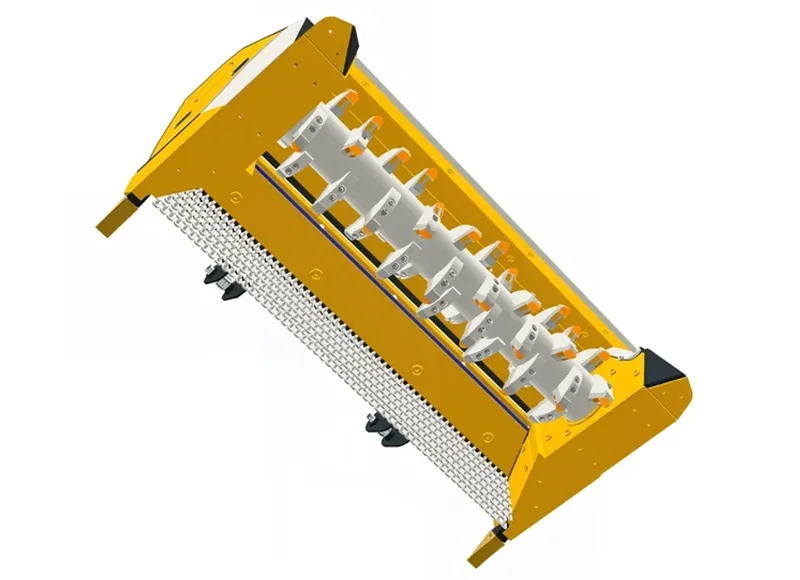
3. Action Mode: How a PTO Stone Crusher Actually Processes Rock
Understanding the mechanical sequence is the foundation for diagnosing any jam correctly.
Step 1 — PTO Power Transmission
Torque originates at the tractor PTO shaft, typically running at 540 RPM or 1,000 RPM depending on the model. This rotation feeds directly into the machine gearbox, which steps up speed and redirects drive to the main rotor shaft. On models like the PSC series (PSC 100 through PSC 200), the gearbox is sealed against dust and debris infiltration — a design feature that also means the gearbox itself cannot internally absorb a jam safely. All overload must be handled by the slip-clutch and the operator.
Step 2 — High-Velocity Rotor Impact
At the core of every penghancur batu pertanian, the rotor drum spins at high velocity. Carbide-tipped tooth holders mounted on the rotor strike exposed rocks with percussive force, fracturing them into fragments. On the STCM series, the rotor diameter is 550 mm; on the STCL/PSC series, 450 mm. The kinetic energy stored in these rotating assemblies is considerable — which is precisely why a jam that arrests that rotation so abruptly can propagate damaging stress backward through the driveline.
Step 3 — Counter-Blade Grinding
Fragmented material is thrown against the adjustable counter-blade (anvil). On the STCM and STCL range, this counter-blade is either fixed-weld Hardox steel or hydraulically adjustable, allowing operators to regulate output fragment size remotely from the cab. A jammed stone is most often wedged between a tooth and this counter-blade. Recognizing this geometry is key to clearing the blockage without distorting the anvil mounting bracket or snapping a tooth holder during extraction.
Step 4 — Rear Gate Discharge
Processed aggregate exits through the rear door, which can be raised or lowered hydraulically to control material flow and leveling. A partial blockage at the discharge gate, separate from a full rotor jam, is a far less serious event but is often confused with a rotor lock. Knowing the difference saves time: a gate clog can often be cleared in under five minutes; a full rotor jam requires the full safe procedure described later in this guide.
4. Recognizing a Jam Before It Becomes a Failure
Most full rotor jams do not arrive without warning. The sequence of precursor signals is consistent enough across pto penghancur batu models that an attentive operator can usually catch the problem in its early stages — when it is still a slowdown rather than a full lock.
The first indication is usually an abrupt change in engine sound. The tractor begins to labour, RPM drops audibly, and the seat vibration pattern changes from smooth to intermittent thudding. This happens because the rotor has encountered a stone that is too large, too hard, or awkwardly oriented to be processed at normal speed. The slip-clutch on the PTO driveshaft is designed to absorb a brief overload and allow the rotor to momentarily decelerate without stalling the tractor; if the obstruction is not dislodged within a few rotor revolutions, the clutch heats rapidly and the system locks.
Korean operators working in the basalt-dominant highland soils of Jeollanam-do or the granite-heavy fields of Gyeonggi-do will encounter particularly dense stone types. Basalt field boulders in that range often present irregularly shaped flat planes — exactly the geometry most likely to wedge horizontally between the rotor tooth and the counter-blade rather than shatter cleanly on first impact. Slowing the forward travel speed by 30–40% when entering visibly stonier ground sections gives the rotor time to deliver additional impact cycles and reduces jam frequency significantly.
Key Warning Signals to Watch For:
- Sudden drop in tractor PTO RPM under consistent throttle
- Irregular or asymmetric vibration through the three-point linkage
- Reduction or cessation of stone discharge from the rear gate
- Burning smell from the PTO slip-clutch area
- Smoke from the gearbox breather under prolonged overload
- Complete machine silence with PTO still engaged (full rotor lock)
5. Manufacturing Structure: What’s Inside the Crushing Chamber
A working knowledge of the internal architecture informs every step of the safe clearance procedure.
| Komponen | Material / Spec | Role in Jam |
|---|---|---|
| Rotor drum (STCM) | φ550 mm forged steel | Primary rotating assembly; most at-risk of bending under forced extraction |
| Rotor drum (PSC / STCL) | φ450 mm forged steel | Lighter series; jam clearance is generally faster due to smaller chamber volume |
| Tooth holders (STC/3 type) | Heat-treated forged alloy, bolted | Most common jam point; a wedged stone exerts lateral bending on the holder shank |
| Counter-blade / anvil (fixed) | Hardox® wear-resistant steel, welded | Wedge point for flat stones; must never be pried against during clearance |
| Counter-blade (hydraulic, STCM/STCH) | Adjustable Hardox® plate, hydraulic ram | Can be retracted from cab to create clearance gap before manual extraction attempt |
| Protection chains | Hardened link chains, bolted rows | May trap large fragments against the rotor; inspect chain tension after every jam |
| Sealed gearbox (PSC/STCL) | Cast iron housing, oil-bath lubrication | Cannot absorb rotor lock; overload bypasses to PTO slip-clutch then drives backward |
| Frame / chassis | S136 hardened steel, reinforced | Structural integrity preserved only if correct clearance procedure is followed |
6. Material System: What the Machine Is Made Of and Why It Matters for Jam Recovery
The material stack used in quality penghancur batu pertanian designs is not arbitrary. Each alloy selection reflects a specific trade-off between hardness, toughness, and repairability — and those trade-offs directly affect how the machine responds during and after a jam event.
The rotor drum and associated shaft are produced from forged medium-carbon alloy steel, typically normalized and stress-relieved after machining. This gives the rotor meaningful resistance to bending fatigue under the cyclic impact loads of normal crushing operation. The critical point for operators: forged steel of this type has a finite plastic deformation zone before it transitions to brittle fracture. That means if the rotor shaft is forced to rotate against a wedged stone — especially by engaging the tractor PTO at full throttle — the shaft can absorb some of that energy through microscopic plastic deformation without visible external damage. The damage is real, however; it accumulates and manifests later as premature bearing failure or unexpected shaft fracture under normal working loads. This is why the safe clearance procedure demands full shutdown before any extraction attempt.
Tooth holders are forged from heat-treated alloy steel and are generally the most vulnerable individual component during a jam. The bolted interface to the rotor drum provides the intentional “sacrificial” attachment point: holder bolts can fail under extreme overload before the rotor shaft itself does. Operators should treat any bent or fractured tooth holder discovered after a jam as a sentinel event: inspect all adjacent holders and verify the rotor shaft for run-out before resuming work. Replacement tooth holders (STC/3, STC/3/HD, STC/3/FP types on the STCM series) are interchangeable in the field with basic tooling — M20 fasteners, torque wrench, and a holder-alignment template.
The Hardox®-steel counter-blades and wear liners used on the STCM and STCH models deserve a specific mention. Hardox® is an abrasion-resistant structural steel (nominal 400–500 HBW hardness range), chosen precisely because it resists the continuous abrasive contact with crushed aggregate. It does not, however, resist lateral bending forces well when thin sections are stressed perpendicular to the plate face. Never use the counter-blade as a pry point during jam clearance. The risk of snapping a counter-blade mounting bracket — with the stored energy then released suddenly — creates a far more dangerous and expensive situation than the original jam.
7. The Step-by-Step Safe Clearance Procedure
This sequence applies to the full range of PTO stone crushers from the compact PSC-100 through the heavy STCM-225. Variations for hydraulic counter-blade models are noted inline.
Disengage PTO Immediately — Do Not Try to Power Through
The moment you sense rotor resistance — RPM drop, unusual vibration, machine silence — disengage the PTO. On most tractors this is a single lever or button pull. Do not increase throttle, do not try short bursts of power. Every additional rotation attempt under obstruction applies additional bending stress to the rotor shaft and tooth holders. Time from jam detection to PTO disengagement should be under three seconds.
Complete Tractor Shutdown and Apply Park Brake
After PTO disengagement, shut the tractor engine fully. Apply the park brake and chock the rear wheels if on any gradient. Lower the three-point linkage until the crusher rests on the ground or a level surface. Wait a minimum of three minutes before approaching the machine. This allows any remaining rotor inertia to dissipate completely, the slip-clutch to cool, and residual hydraulic pressure in the top-link circuit to equalize. Approaching a crusher that has not fully de-energized is the leading cause of operator injury during jam clearance in Korea’s agricultural machinery accident records.
Put on PPE — Non-Negotiable Before Opening the Machine
Heavy gloves, safety glasses or a face shield, steel-toe boots, and ideally a hard hat if working under a raised machine. Stone fragments dislodged during clearance can move unpredictably. The internal space is confined and any slip can put a hand against a tooth edge. Korea’s Occupational Safety and Health Act (산업안전보건법, OSHA 2019 revision) mandates PPE use during all maintenance and repair activities on powered agricultural implements. Farms participating in the Rural Development Administration (농촌진흥청, RDA) safety programs are subject to audit on this requirement.
Raise the Rear Door and Inspect the Chamber
Manually raise or hydraulically open the rear discharge door to gain visual access to the crushing chamber. Use a flashlight. You are looking to identify: the specific location of the jammed stone (rotor-to-anvil gap vs. chain zone vs. side plate), whether any tooth holders appear visibly bent or fractured, whether the stone has created secondary cascade jamming of smaller material behind it, and whether the protection chain links have been deformed by the overload event. Take photographs if possible — they are useful for warranty or repair documentation.
Retract the Hydraulic Counter-Blade (Where Available)
On models equipped with a hydraulically adjustable counter-blade — including the STCM and STCH series — this is the single most effective first step once the tractor is safely shut down. Retracting the anvil away from the rotor widens the crushing gap significantly, often releasing a wedged stone by gravity alone without any manual intervention. Start the tractor (without engaging PTO), retract the counter-blade to its maximum open position via the cab control, then shut down again before re-entering the crushing chamber. If the stone drops free, proceed directly to Step 7.
Manual Stone Extraction — Tools and Technique
If counter-blade retraction does not free the stone, manual extraction is required. Use a heavy pry bar (minimum 1.2 m) positioned against the jammed stone itself — never against a tooth, tooth holder, or the counter-blade. The leverage goal is to rock the stone out of the wedge geometry, not to force the rotor. A second operator — standing clear of the discharge opening — can use a long hook tool to pull material away as it loosens. On the PSC-100 and PSC-125 (smaller chamber, 1,110–1,350 mm working width), access is tighter; a curved extraction hook reaching around from the side may be necessary. Remove all extracted stone and debris from the chamber before closing the door.
Rotate the Rotor Manually to Check for Free Movement
Before starting the tractor, attempt to rotate the rotor by hand using the PTO shaft end (with a properly sized bar through the driveshaft yoke) or via a rotor-turning tool if supplied with the machine. The rotor should rotate through a full 360° with moderate consistent effort and without any catching, grinding, or hard spots. Any resistance indicates remaining obstruction material or a bent tooth holder that is now contacting the chamber wall. Resolve these before restarting. Attempting to start a machine where the rotor does not turn freely by hand is a leading cause of secondary driveline damage.
Controlled Restart and Observation Period
Close and latch the rear door. Start the tractor, allow it to reach operating temperature, then engage PTO at a reduced RPM (if your tractor has variable PTO speed, use 540 RPM initially even on a 1,000 RPM-rated machine). Observe for 30–60 seconds at idle PTO speed before advancing to working RPM. Listen for any abnormal vibration, knocking, or bearing noise. Monitor tractor hydraulic oil temperature if the machine uses a hydraulic counter-blade. A normal restart should feel and sound identical to a cold-start at the beginning of the day. If anything feels different, stop and inspect again.
8. Regulatory Framework: Agricultural Machinery Safety Standards in Korea and Globally
Operating and maintaining a pto penghancur batu is subject to an increasingly well-defined body of regulation across all major markets. Korean operators, in particular, are navigating an evolving framework that has strengthened considerably since 2020.
Korea (농업기계화 촉진법 — Act on the Promotion of Agricultural Mechanization): Under the Act on the Promotion of Agricultural Mechanization (revised 2021) and its subordinate regulations enforced by the Rural Development Administration (RDA, 농촌진흥청), all tractor-mounted implements sold in Korea must bear a domestic safety approval or equivalently recognized international certification. The Occupational Safety and Health Act (산업안전보건법, 2020 revision) imposes explicit duties on owners of agricultural machinery to provide documented maintenance procedures, train operators in safe use, and maintain accident records for implements rated above a certain horsepower threshold. Fatality incidents involving PTO-driven equipment trigger automatic RDA reporting requirements. Jam clearance procedures performed without PTO disengagement and full shutdown have appeared in RDA accident investigation summaries as a recurring contributing factor in serious injury cases.
European Union (Machinery Directive 2006/42/EC and EN ISO 11684): CE-marked stone crushers sold in EU member states must comply with the Machinery Directive 2006/42/EC, which mandates comprehensive risk assessment documentation, guard integrity requirements, and emergency stop provisions for all PTO-powered attachments. EN ISO 11684 series standards govern the pictorial safety sign requirements on agricultural machinery. Jam clearance procedures must be explicitly described in the operator manual supplied with any CE-marked machine, and machines must be designed so that the crushing chamber cannot be accessed while the PTO is engaged (physical interlock or guard requirement). Both the STCL and STCM series carry CE marking as part of their standard certification.
United States (OSHA 29 CFR 1910.147 — Control of Hazardous Energy / Lockout-Tagout): For commercial and contractor applications in the United States, OSHA’s Control of Hazardous Energy standard mandates formal lockout-tagout procedures before any servicing or clearing of jammed agricultural machinery. The PTO shaft connection point is specifically classified as a hazardous energy source requiring positive isolation. Non-compliance during a jam-clearing incident that results in injury carries significant civil and criminal penalty risk. Many U.S. state cooperative extensions publish OSHA-aligned jam clearance procedures for PTO stone crusher equipment as part of farm safety curricula.
Australia (AS 1318 / Work Health and Safety Regulations): Australian states apply Work Health and Safety regulations (WHS, model law harmonized across most jurisdictions as of 2012) to PTO-powered agricultural implements. WHS requires that operators of stone crushing equipment on commercial properties maintain a Safe Work Method Statement (SWMS) that includes specific procedures for jam clearance. The Australian standard AS 1318 covers safety colour coding for hazard identification on machinery — relevant when inspecting the crush chamber for damaged guards or worn warning labels after a jam event.
ISO 11684 (Global): The ISO 11684 series on safety signs for agricultural machinery is referenced globally and applies across all markets for the safety symbols affixed to penghancur batu pto kecil and heavy-duty models alike. Operators should verify that all safety decals in the crushing chamber area and on the PTO shaft guard remain legible after every jam event. Replace faded or damaged labels immediately.
9. Preventive Operating Practices That Reduce Jam Frequency
The best jam clearance is the one you never have to perform. Experienced operators of penghancur batu traktor equipment develop a set of habits that, taken together, dramatically reduce the incidence of full rotor lock-ups without compromising productivity.
Speed management is the single highest-impact variable. Every PTO stone crusher has a rated working speed, and manufacturers publish this figure deliberately. The THOR 2.4 (working speed 3 km/h, tractor requirement minimum 180 cv, working width 2.4 m) and the STCM series (typical working width 1,824–2,304 mm across models) are both rated at steady low-speed operation. Exceeding that speed, even briefly, feeds material into the crushing chamber faster than the rotor teeth can process it. The result is material piling up ahead of the rotor, and the next stone the rotor encounters is likely to be hitting against already-compressed material rather than free air — exactly the geometry that causes jams. Reduce speed to 2–2.5 km/h in visibly rocky sections.
Pre-field stone survey prevents most serious jams. Walk the field perimeter and center transect before running the machine. Mark any surface boulders larger than the rated maximum shredding diameter with a visible flag or spray paint. For PSC-series machines (max shredding diameter 150 mm), anything approaching 15 cm should be marked for manual removal first. For STCM and STCH models (rated up to 300 mm and 500 mm respectively), the threshold is higher, but stones in the 200–300 mm range on an STCM still warrant consideration at high forward speeds. Korean mountain-area farms with visible outcrops of granite or schist deserve particular attention.
Slip-clutch maintenance is non-negotiable for jam prevention. The PTO driveshaft slip-clutch is the primary machine self-protection device. If the clutch is worn, corroded, or improperly set, it may not slip at the correct torque threshold — meaning the machine either slips too easily (losing productivity) or not enough (leaving the rotor and gearbox unprotected during a jam). Check and re-set clutch torque according to the manufacturer specification at the start of each season and after any major jam event. A calibrated torque wrench and the correct clutch-setting procedure from the operator manual are required. Do not estimate clutch torque by “feel.”
Tooth and liner inspection after every working day catches the pre-failure warning signs early. A tooth approaching end-of-life has a smaller effective radius, which means it delivers less impact energy per strike. The result: stones that a fresh tooth set would fracture on first contact instead bounce and potentially wedge. On the PSC-100, a full tooth set inspection and replacement where needed takes roughly 45 minutes with basic tooling. It is time very well spent compared to a rotor jam in the middle of a working day.
10. Our PTO Stone Crusher Product Range
Each model in our penghancur batu untuk traktor range is engineered with jam-resistance and field serviceability as design priorities. View the full product catalogue.
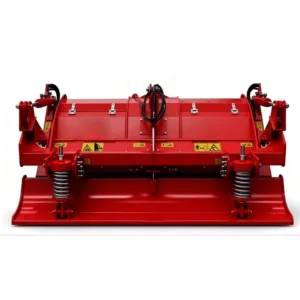
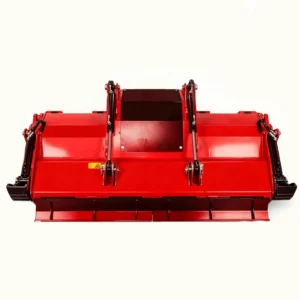
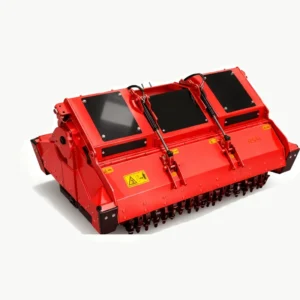
PSC Series Quick Reference — Working Widths and Tractor Requirements
Use this table to confirm the correct working parameters before field operations. Exceeding tractor HP minimums and PTO RPM specifications increases jam risk significantly.
| Model | Traktor (hp) | PTO (rpm) | Lebar Kerja (mm) | Total Width (mm) | Berat (kg) | Rotor φ (mm) | Max Crush (mm) |
|---|---|---|---|---|---|---|---|
| PSC 100 | 70–120 | 540–1000 | 1,110 | 1,414 | 1,230 | 450 | 150 |
| PSC 125 | 80–120 | 540–1000 | 1,350 | 1,654 | 1,280 | 450 | 150 |
| PSC 150 | 90–120 | 540–1000 | 1,590 | 1,894 | 1,440 | 450 | 150 |
| PSC 175 | 100–120 | 540–1000 | 1,830 | 2,134 | 1,570 | 450 | 150 |
| PSC 175 DT | 100–150 | 1000 | 1,830 | 2,134 | 1,600 | 450 | 150 |
| PSC 200 | 120–150 | 1000 | 2,070 | 2,374 | 1,750 | 450 | 150 |
11. The Five Most Damaging Mistakes During Jam Clearance
These errors appear repeatedly in field reports from Korean and regional operators. Each one is avoidable with knowledge and discipline.
Mistake 1
Applying full throttle to power through a jam
This is the most common and most costly error. The rotor shaft experiences bending moments beyond its design envelope, causing hidden fatigue damage that leads to unexpected failure weeks or months later.
Mistake 2
Entering the chamber before confirming PTO disengagement
Even with the engine off, a stored-spring slip-clutch can release energy unexpectedly. Full PTO disengagement and engine shutdown are mandatory before any chamber entry. This is a life-safety, not just machinery-safety, requirement.
Mistake 3
Using the counter-blade as a pry point
Hardox® steel plates are not designed to resist lateral bending loads applied by a long pry bar. Snapping a counter-blade bracket creates secondary damage and a safety hazard from the sudden energy release.
Mistake 4
Restarting without hand-testing rotor freedom
Starting the PTO on a rotor that still has material wedged at a secondary location amplifies the jam and compounds damage. The hand-rotation test before restart takes two minutes and prevents hours of secondary repair work.
Mistake 5
Ignoring post-jam tooth and bearing inspection
A jam that felt minor often leaves a bent tooth holder that is now slightly off-axis. Running with that holder puts the rotor out of balance dynamically. Rotor imbalance destroys bearings rapidly — a far more expensive repair than replacing a single tooth holder.
12. About Us
We are a specialist manufacturer and supplier of pto penghancur batu equipment, mesin penghancur batu mudah alih solutions, and a full range of agricultural land-management implements. With more than 50 years of cumulative engineering experience across our manufacturing base, we serve farmers, contractors, and land developers across Korea, Asia-Pacific, Europe, and North America. Every machine we produce — from the compact PSC-100 suited to smallholder operations in Gangwon-do to the heavy THOR series and STCM-225 units used in large-scale land development — is built to ISO 9001:2015 quality management standards, carries CE Machinery Safety Certification, and is backed by SGS-verified production quality.
Soalan Lazim
Q1. How do I safely clear a jammed PTO stone crusher rotor on a Korean rocky hillside farm without breaking any teeth?
The critical first step is disengaging the PTO immediately and shutting down the tractor fully before any manual intervention. Once the machine has de-energized (wait at least three minutes), raise the rear discharge door to inspect the jam location. On models with a hydraulic counter-blade like the STCM series, retract the anvil from the cab first — this alone often releases the wedged stone. If manual extraction is needed, use a long pry bar applied against the stone itself, never against a tooth holder or the counter-blade. After clearing, hand-rotate the rotor through a full 360° to confirm freedom of movement before restarting.
Q2. What is the safest PTO stone crusher for sale suited to Korean smallholder farms with basalt-heavy soil conditions?
For Korean smallholder operations dealing with dense basalt fieldstone — particularly common in volcanic-soil areas of Jeju Island and highland Gangwon-do — the PSC-125 or PSC-150 models (80–120 hp tractor requirement, working widths of 1,350–1,590 mm, max shredding diameter 150 mm) offer a good balance of throughput and maneuverability. The sealed gearbox and dual-row protection chains on these models provide the durability needed for high-density stone conditions. For larger operations or fields with rocks exceeding 150 mm, the STCM-series with its 300 mm max shredding diameter is the appropriate choice.
Q3. How often should tooth holders on a pto stone crusher be inspected after working in granite-heavy Korean farmland?
In granite-heavy conditions, tooth wear accelerates compared to softer limestone or sandstone soils. A daily inspection at the end of each working shift is strongly recommended, with a full torque check on all tooth holder mounting bolts every 50 hours of operation. Replace any holder where the carbide tip has worn below the manufacturer’s minimum gauge, or where the shank shows any visible distortion. Running a rotor with even one significantly undersized tooth creates dynamic imbalance that stresses the main bearings cumulatively.
Q4. Where can I find a reliable pto stone crusher supplier for an agricultural contractor operating across Korea and Japan?
Our facility — based in Ansan-si, Gyeonggi-do, Korea — serves contractors operating across Korea and the broader East Asia region. We maintain regional distribution and after-sales support networks capable of supplying spare parts and technical assistance to both Korean and Japanese-market operators. Contact our export sales team through the website contact form with your machine model, the specific parts or service requirement, and your preferred shipping terms. We provide documentation for customs clearance across Korean, Japanese, and ASEAN markets.
Q5. What does a universal agricultural stone crusher typically process and what is it used for in Korean land preparation?
In Korean agricultural contexts, a penghancur batu untuk traktor primarily processes surface fieldstones and shallow subsoil rocks during seedbed preparation, land reclamation from abandoned orchard or hillside plots, and rural road base construction. The machine reduces rocks up to its rated maximum shredding diameter into angular aggregate, which is left in place to consolidate into the soil or used directly as road base material. In Jeollanam-do and North Chungcheong Province, where upland farming conversion is active, small and mid-range pto penghancur batu units are used extensively for initial land clearing before rice paddy or upland crop establishment.
Q6. When should I replace the PTO slip-clutch on my stone crusher and how does a worn clutch lead to more frequent jams?
Replace or re-calibrate the PTO driveshaft slip-clutch at every 200 operating hours, at the start of each season, and immediately after any serious jam event. A worn clutch that slips at too low a torque causes the rotor to lose speed prematurely when hitting moderately hard stone, reducing crushing efficiency and increasing the time each stone spends in the crushing gap — which in turn increases the probability of wedging. Conversely, a seized or over-tightened clutch provides no overload protection, sending all shock load directly to the rotor shaft and gearbox during a hard jam impact. Both failure modes are preventable with scheduled clutch maintenance.
Q7. Which small pto stone crusher model is best for orchard and vineyard lane clearing between tree rows in the Korean peninsula?
The PSC-100 (working width 1,110 mm, total width 1,414 mm, tractor requirement 70–120 hp) is specifically designed for the type of narrow-passage work found in orchard and vineyard lane clearing. Its compact dimensions allow navigation between established tree rows while still delivering the 150 mm maximum shredding capability needed for typical orchard lane fieldstone. The gearbox mounting on this model positions the machine body low to the ground — important for maintaining safe clearance under low-hanging fruit tree branches. An adjustable 3-point hitch extension allows matching to various tractor types without additional adaptation hardware.
Q8. What are the legal obligations of a Korean farm operator when a pto stone crusher causes a serious injury during a jam-clearing attempt?
Under Korea’s Occupational Safety and Health Act, farm operators employing workers must report serious injuries (defined as injuries requiring in-patient hospital treatment) to the Korea Occupational Safety and Health Agency (코샤, KOSHA) within 24 hours. Failure to report, or evidence that the injury resulted from a lack of documented safe work procedures, exposes the operator to administrative fines and potential criminal liability. The Act also requires post-incident investigation, corrective action implementation, and retraining of all workers who operate the relevant equipment. Maintaining a documented jam-clearance procedure — and training operators in it — is both a legal requirement and a genuine protection for all parties involved.
Editor: PXY