Panduan Peralatan Pertanian
Bolehkah Mana-mana Traktor Menjalankan Penghancur Batu PTO, atau Adakah Terdapat Keperluan Keserasian?
A practical, in-depth look at power, linkage, gearbox, and mechanical factors that determine whether your tractor is the right match for a PTO stone crusher — and what to do when it isn’t.
1. The Short Answer
No — not every tractor is a suitable match for a PTO stone crusher. While the concept of attaching an implement to a tractor’s Power Take-Off shaft sounds straightforward, the reality is that stone crushers are among the most mechanically demanding implements you can connect to a farm tractor. They place sustained, high-torque loads on drivetrains, gearboxes, and hydraulic systems in ways that most light implements simply don’t. Before purchasing a stone crusher for tractor use, there are several critical compatibility factors that must align: engine horsepower output, PTO shaft speed in RPM, three-point hitch linkage category, tractor weight and stability, hydraulic flow capacity, and overall structural compatibility between tractor and implement. This guide walks through each of those factors in detail so you can make a confident, well-informed decision.
Whether you’re managing rocky farmland in Korea’s mountainous Gangwon Province, clearing land in the Gyeongbuk highlands, or preparing construction access roads in Jeolla’s agricultural belt, understanding these compatibility requirements isn’t optional — it’s the foundation of safe and productive operation. An undersized or mismatched tractor doesn’t just perform poorly; it can cause catastrophic drivetrain damage, create hazardous working conditions, and void warranty coverage on both the tractor and the implement.
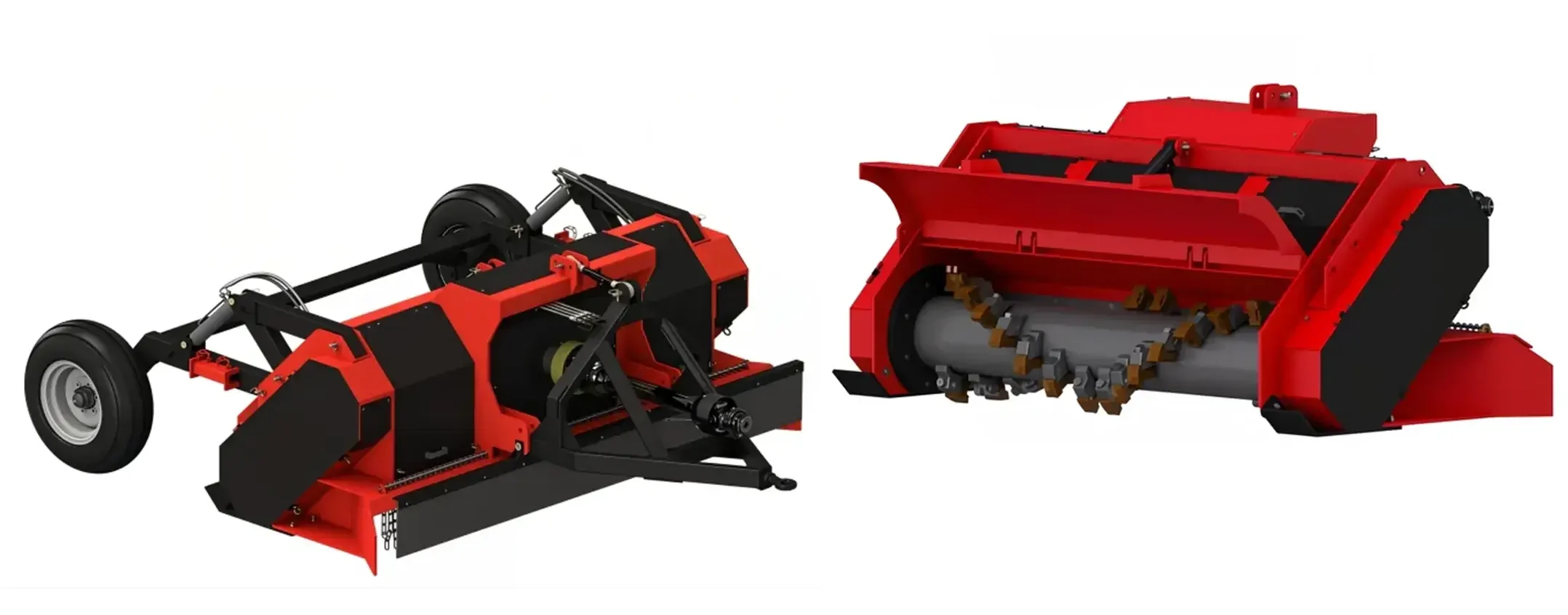
2. How a PTO Stone Crusher Actually Works — Understanding the Action Mode
Before diving into compatibility specifics, it helps to understand the action mode of a typical agricultural stone crusher. Unlike a jaw crusher or impact crusher that works by bringing two surfaces together, a PTO-driven stone crusher uses a high-speed rotor fitted with hardened steel hammers, picks, or fixed teeth. That rotor is driven directly by the tractor’s PTO shaft, typically spinning at 540 RPM or 1000 RPM depending on the model and the power class of the tractor. As the tractor moves forward at a controlled working speed — usually 2 to 5 km/h — the rotor engages with surface rock and sub-surface stone simultaneously, fracturing and grinding material against a fixed counter-blade or crushing grid inside the machine’s housing.
The crushing action is essentially rotary impact: kinetic energy stored in the spinning rotor mass is transferred violently into stone on contact. This means the rotor needs to maintain a consistent RPM under load, which places a very real demand on tractor PTO horsepower. Unlike a mower or spreader, a stone crusher cannot simply stall momentarily and then recover — rotor deceleration under heavy stone contact can shock the entire driveline, which is why gearbox design, driveline protection (torque limiters, shear bolts, or cam clutches), and tractor output characteristics all matter enormously.
Understanding this action mode is also important for field planning. Because the crusher works by forward motion combined with rotor rotation, the working speed directly determines the depth of processing and the fraction size of the output material. Faster passes leave larger fragments; slower, more deliberate passes produce finer results. Agricultural stone crusher operation on Korean farmland typically targets passes of 3–5 km/h for field preparation, while road base consolidation work may use slower, deeper passes.
3. Horsepower Requirements: The First and Most Critical Check
Engine horsepower is the first number you need to verify before any other compatibility consideration. PTO stone crushers are divided into distinct power classes, and matching the machine to the tractor’s actual sustained PTO output — not the engine’s peak rated horsepower — is essential. A tractor rated at 120 hp may only deliver 90–100 hp at the PTO under field conditions, and a stone crusher requiring 120 hp minimum will be consistently overloaded, leading to overheating, PTO clutch slip, and premature drivetrain wear.
As a general framework, light-duty models designed for compact tractors in orchard, vineyard, or small-plot applications typically begin at 70–100 hp. Mid-range agricultural stone crushers for field preparation and pasture clearing are matched to tractors from 100–220 hp. Heavy-duty versions designed for large-scale land reclamation or rocky terrain with stones up to 300 mm in diameter require tractors in the 220–280 hp range. The most powerful series, designed for working large embedded boulders, are matched to 280 hp and above.
| Tractor Power Class | Suitable Crusher Type | Max Stone Diameter | Typical Working Width |
|---|---|---|---|
| 70–100 kuasa kuda | Light-duty, compact field use | Up to 150 mm | 1,100–1,600 mm |
| 100–180 hp | Mid-range agricultural (e.g. PSC, RockMaster models) | Up to 300 mm | 1,500–2,300 mm |
| 180–230 hp | Heavy field crusher (e.g. THOR 2.4, THOR 3.0) | Up to 400 mm | 2,400–3,000 mm |
| 280 hp and above | Industrial-grade land reclamation | Up to 500 mm | 2,000–2,600 mm |
It’s worth noting that continuous PTO load during stone crushing is fundamentally different from intermittent load during mowing or tilling. Always consult the manufacturer’s minimum and maximum HP recommendations rather than assuming the midpoint of a range is acceptable for the heaviest applications.
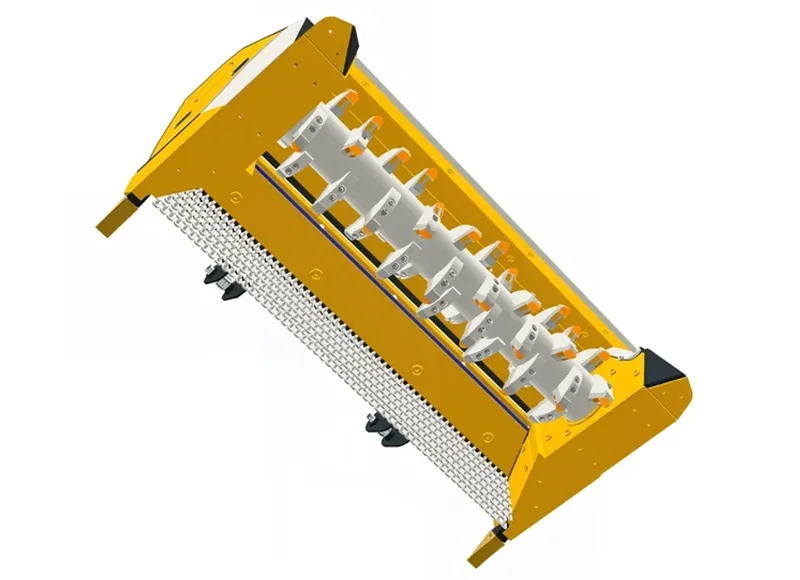
4. PTO Shaft Speed: 540 RPM vs. 1000 RPM — Does It Matter?
Yes, PTO shaft speed is a hard compatibility requirement that cannot be approximated or worked around without specific adapter equipment. Modern tractors in the 100 hp and above range almost universally offer a 1000 RPM PTO output, which is what the majority of mid-to-high-powered stone crushers require for correct rotor speed. Smaller tractors — particularly compact utility tractors under 80 hp — may only offer 540 RPM PTO output. Running a 1000 RPM-spec crusher at 540 RPM will result in approximately half the rotor tip speed, dramatically reducing crushing efficiency and potentially causing the machine to stall on hard material.
Some entry-level field stone crushers offer dual-speed compatibility (540 or 1000 RPM) through an internal transmission ratio selection, which provides flexibility for operators working with a range of tractor types. However, even dual-speed machines typically achieve their rated working width and maximum stone size specifications only when operated at 1000 RPM. Running these machines at 540 RPM usually requires reducing working width and maximum stone size to stay within safe operational parameters.
A secondary factor to verify is the PTO shaft spline configuration. The most common standard in Korea and internationally is the 6-spline 1-3/8 inch shaft for 540 RPM tractors and the 21-spline 1-3/8 inch shaft for 1000 RPM operation. Verify that the crusher’s input shaft coupler matches the tractor’s output shaft before connecting the driveline. Adapter couplers exist but should only be used as specified by the manufacturer — improper adapters can introduce driveline misalignment and create serious safety hazards.
5. Three-Point Linkage Category: Why Category Matters for Heavy Implements
Three-point hitches are standardized by the ISO 730 international standard and are divided into categories based on the physical dimensions of the hitch pins, lift capacity, and the working loads they are designed to handle. Stone crushers, being among the heaviest rear-mounted implements, nearly universally specify Category II or Category III linkage. Category I is generally limited to lighter compact utility equipment and is rarely suitable for stone crushing machines that weigh 1,200 kg or more.
Category II linkage is the standard for mid-range agricultural tractors (roughly 50–180 hp) and uses 28.7 mm hitch pins with a lower link spread of approximately 820 mm. Most of the stone crusher models in the 100–220 hp power range are designed specifically for Category II hitches. Category III linkage, used on larger tractors above 130–150 hp and typically above 180 hp, uses 37.4 mm pins with a wider lower link spread. High-power stone crushers designed for 280 hp and above tractors require Category III or Category III/II compatibility.
Key Linkage Compatibility Checklist
✔ Confirm the hitch category (I, II, or III) printed in your tractor’s operator manual matches the crusher’s requirement.
✔ Verify the tractor’s rear lift capacity (in kg at the lower link ball ends) meets or exceeds the crusher’s listed weight.
✔ Check if the implement requires a stabilizer chain or sway bar kit — stone crushers generate significant lateral force and side-loading the lower links without stabilization causes rapid link wear.
✔ For drawbar-equipped models (like the THOR 2.4 + Kit Drawbar), ensure the tractor has a compatible drawbar pin diameter and appropriate drawbar load rating.
In the Korean agricultural sector, many mid-sized tractors from 80–130 hp are equipped with Category II hitches and have proven well-matched to PSC-series and RockMaster-class stone crushers. However, anyone upgrading from a lighter tractor to a full-width 2.4-meter or 3.0-meter crushing platform must ensure the tractor’s rear axle, hitch frame, and lift cylinder capacity are genuinely suited to the increased implement weight.
6. Gearbox and Driveline Considerations: The Heart of the Compatibility Question
The gearbox is arguably the most mechanically critical component in the compatibility discussion. Stone crushers place unique demands on both the implement’s internal gearbox and the tractor’s PTO drivetrain, and understanding these demands is important for safe long-term operation. The implement gearbox on a quality PTO stone crusher is not a simple reduction drive — it is a precision transmission unit designed to accept tractor PTO torque, manage shock loads from rotor-stone impact, and deliver sustained power to the crushing rotor with minimal heat buildup and maximum component life.
Most reputable stone crusher gearboxes are oil-bath lubricated, meaning the gear assembly is fully immersed in a sealed reservoir of gear oil rather than relying on splash lubrication or greased bearings alone. This matters for high-duty-cycle applications where the gearbox may operate for four, six, or eight continuous hours. Heat is the primary enemy of gearbox longevity: gear oil provides both lubrication and thermal management, and oil-bath designs maintain both functions under sustained load far more reliably than alternative configurations.
Another critical gearbox feature is the input torque limiter or overload protection device. When the crushing rotor strikes an exceptionally hard or large embedded rock, the rotational energy can reverse instantaneously back through the driveline. Without protection, this shock can shear the tractor’s PTO shaft, damage the gearbox input bearing, or crack the gearbox housing itself. Quality stone crushers incorporate a shear bolt coupling, slip clutch, or cam-and-ball overload limiter at the PTO input shaft. For tractors operating in Korean highland regions where subsurface granite and basalt outcroppings are common, confirming the presence and correct rating of this protection device is not optional.
From a tractor perspective, it’s equally important to verify that the tractor’s PTO clutch and drivetrain are rated for the sustained torque of stone crushing. Many Korean-market compact and utility tractors are designed primarily for rotary tillage and light implement work; their PTO clutches may be rated for intermittent heavy loads but not the sustained peak-load cycle of active stone crushing. Consult your tractor dealer or technical manual for PTO continuous-duty torque ratings before committing to a stone crusher purchase.
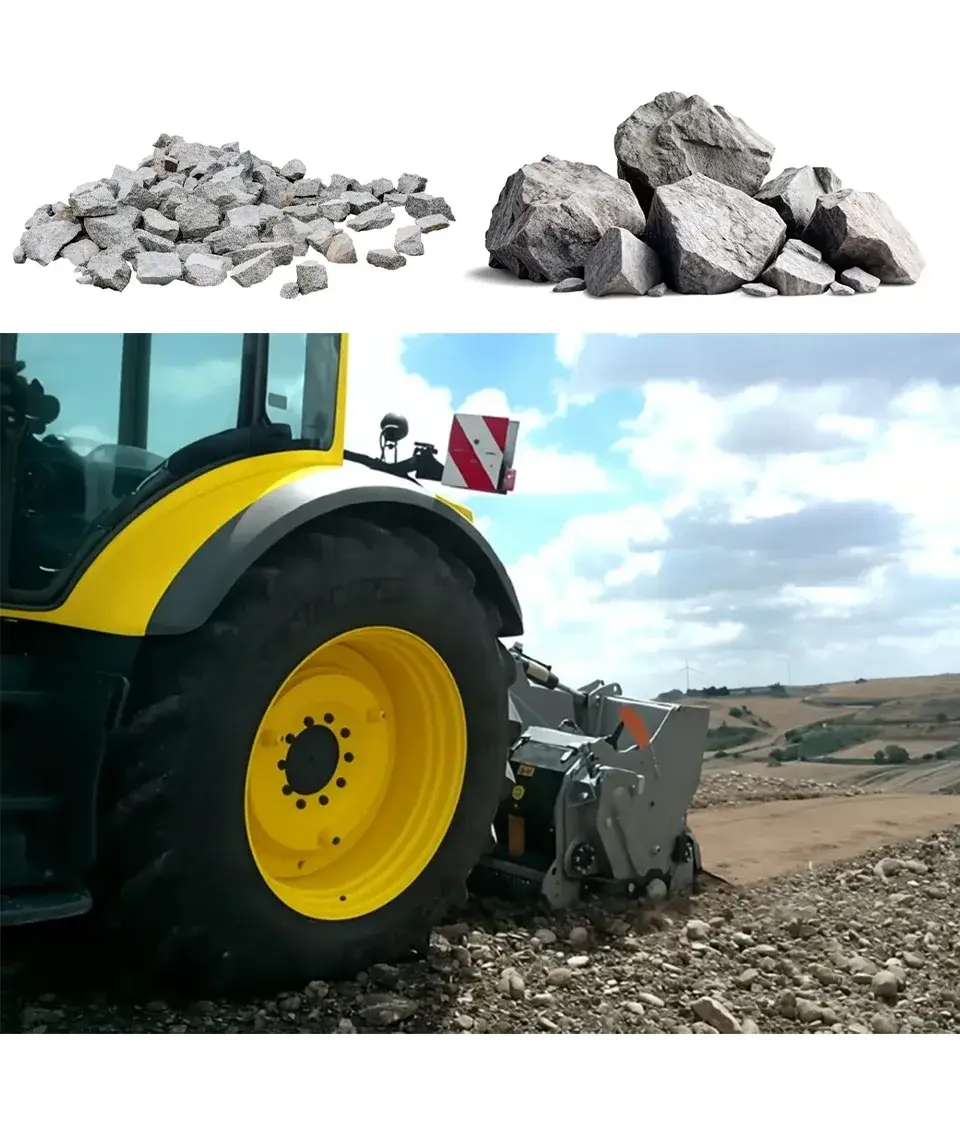
7. Manufacturing Structure: What Goes Into a Well-Built Stone Crusher
Understanding how a PTO stone crusher is manufactured gives valuable insight into its operational reliability and its demands on the tractor. High-quality stone crushers are built around a welded heavy-gauge steel mainframe that serves as both the implement chassis and the working housing. The mainframe must simultaneously absorb impact forces from the rotor striking stone, manage the dynamic loads of the three-point hitch attachment points, and protect internal components from external rock ejection. Weak mainframe welds or undersized structural members are among the most common failure points on lower-quality machines and can present real safety hazards in the field.
The rotor assembly — the central working component — is typically fabricated from a precision-turned steel drum or tubular core. Hammers, picks, or fixed teeth are bolted or welded to the rotor body in a helical or staggered pattern that balances the mass of the spinning assembly. Rotor imbalance is a significant issue: even a small asymmetry in hammer wear or replacement can generate vibration loads that propagate back through the entire drivetrain, accelerating bearing wear and causing operator fatigue. Quality manufacturers dynamically balance their rotors after assembly and design hammer mounting systems that maintain balance even as individual components wear.
The crushing chamber — the internal working space between the rotor and the rear gate or counter-blade — is lined with hardened steel or abrasion-resistant plate (such as Hardox-grade steel) to manage the extremely high wear rates generated by continuous rock-on-steel contact. Replaceable liners extend service life significantly and are a practical necessity for high-use applications. The rear adjustable counter-blade or crushing grid controls the final fragment size of processed material, and its adjustment mechanism (hydraulic or manual) affects both the quality of the finished surface and the power demand placed on the tractor during operation.
8. Material System: Hammers, Teeth, Picks, and What They’re Made From
The material system of a PTO stone crusher — meaning the selection of rotor tooth or hammer type and the metallurgical specification of those wear parts — is closely tied to the compatibility question because it determines the realistic operating duty cycle and the power demanded from the tractor. Different material systems are optimized for different stone types, and choosing the wrong configuration for your local geology is a form of incompatibility that can be just as damaging as mismatching horsepower.
Swinging hammers, often made from high-manganese or boron-alloy steel, are well-suited to mixed soil and stone conditions where embedded rocks are present but not continuous. The swinging action allows the hammer to deflect momentarily when striking a very hard or large stone, reducing shock transmission to the rotor and gearbox. However, this deflection also means reduced cutting depth at the point of contact, which can be a limitation in dense rock formations. For Korean highland and volcanic soil regions where subsurface basalt or granite layers are common, fixed-tooth or pick-style rotor configurations generally outperform swinging hammers.
Fixed teeth made from tungsten carbide-tipped or hardox-grade steel provide maximum aggressive cutting action and are the preferred choice for heavy rock processing. The tradeoff is higher shock transmission to the tractor drivetrain, which makes the gearbox protection device (torque limiter or shear bolt) even more critical. Fixed-tooth machines also tend to require higher minimum horsepower to maintain rotor speed under heavy material contact.
In terms of specific materials, the housing and mainframe of well-engineered machines use steel plate in the 8–15 mm range for side walls and 20–30 mm for the rotor chamber floor and counter-blade mount areas. Rotor teeth or hammer tips are typically cast from chrome-carbide alloy or cemented tungsten carbide to achieve hardness values in the 55–65 HRC range — hard enough to crush granite and basalt without fracturing under repeated impact. Understanding the material system of a specific crusher model helps explain its weight, its power demand, and its maintenance intervals.
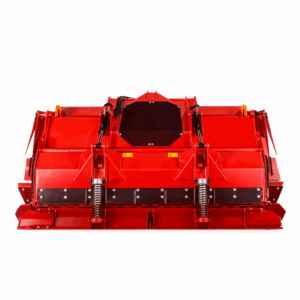
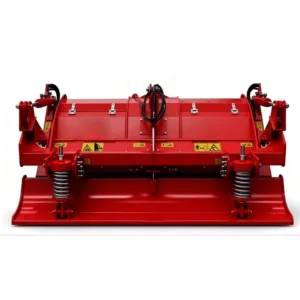
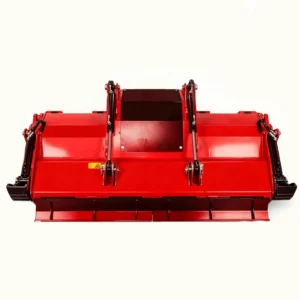
9. Our PTO Stone Crusher Product Range
Each model in the range is engineered with specific tractor compatibility parameters. Matching the right model to your tractor’s actual specifications is the first step toward productive, reliable operation.
10. Hydraulic Flow and Control Valve Requirements
Many modern stone crusher models incorporate hydraulic functions — most commonly a hydraulically adjustable counter-blade or crushing grid, hydraulic depth control skids, or in some cases, a hydraulically engaged rotor brake for safe shutdown after use. These hydraulic functions require the tractor to supply pressurized hydraulic oil through one or more pairs of remote hydraulic couplers, commonly referred to as control valves or auxiliary spools.
The number of control valves required varies by model: simpler single-circuit machines may need only one control valve pair, while machines with multiple independent hydraulic circuits (counter-blade adjustment plus depth control, for example) require two. Always verify that your tractor has the required number of usable remote hydraulic outlets and that its hydraulic pump delivers sufficient oil flow — minimum flow rates for stone crusher hydraulics are typically in the 40–60 liters per minute range at operating pressure. Tractors with undersized or heavily loaded hydraulic systems may experience sluggish response or excessive hydraulic oil temperature during extended operation.
Hydraulic pressure requirements should also be confirmed. Most tractor hydraulic systems operate at 180–200 bar standard working pressure, which is compatible with typical implement hydraulic circuits. However, some high-force functions — particularly counter-blade adjustment on heavy-duty models — may require 200 bar minimum. Check both the tractor’s maximum working pressure and the implement’s minimum pressure requirement before connecting hydraulic lines.
11. Tractor Weight, Ballasting, and Stability
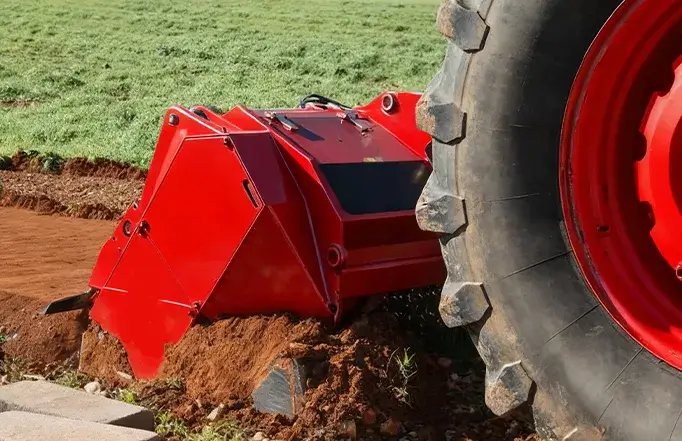
Stone crushers are dense, heavy implements — a 2,300 kg machine attached to the three-point hitch creates significant rear weight bias on the tractor. For tractors at the lower end of the horsepower recommendation, front-end weight ballasting may be required to maintain adequate front axle steering load and prevent the tractor from becoming tail-heavy to the point of instability on uneven or sloped terrain. Korean farmland — particularly in the terraced rice paddy landscapes of southern regions or the hillside orchards of the eastern coast — often involves operating on gradient terrain that amplifies this stability concern.
As a guideline, front ballast equivalent to approximately 20% of the rear-mounted implement’s weight is a reasonable starting point, though the exact requirement depends on tractor wheelbase, center of gravity, and tire type. Many four-wheel-drive tractors handle rear-loaded implements more safely than two-wheel-drive equivalents because the front drive axle maintains traction and steering even under rear-heavy weight distribution.
Ground pressure is a related consideration for soil preservation. A tractor operating a stone crusher makes multiple passes over worked ground, and high tire ground pressure can cause soil compaction that counteracts the benefit of the stone-clearing operation. Wide-footprint agricultural tires or dual-tire configurations help distribute weight more effectively. Some Korean agricultural cooperatives and provincial land management authorities have begun factoring soil compaction protocols into their guidance for heavy implement operations, so checking with your local agricultural extension office (농업기술원) before undertaking large-scale stone crusher operations is good practice.
12. Regional Regulatory Framework: Korea, the EU, and International Standards
Agricultural equipment safety and gearbox design are subject to regulatory frameworks that vary by country and region. Understanding these frameworks is important both for compliance and for understanding why quality stone crushers are designed the way they are.
| Region / Country | Key Standard / Regulation | Relevance to Stone Crushers |
|---|---|---|
| Korea (Republic of Korea) | Agricultural Mechanization Act (농업기계화 촉진법); KS R ISO 11684 (safety signs); RDA implement certification | Implements sold commercially in Korea must meet Rural Development Administration (농촌진흥청) performance and safety verification requirements. PTO shaft guards are mandatory under Korean agricultural machinery safety rules. |
| European Union | EU Machinery Directive 2006/42/EC; EN ISO 4254-1 (agricultural machinery general safety); EN ISO 5674 (PTO shaft guards) | CE marking is required for all agricultural implements sold in EU member states. PTO driveline guards must cover the entire shaft from tractor output to implement input. Risk assessment and technical construction files are mandatory for manufacturers. |
| United States / North America | ASABE S207 (PTO shaft dimensions); OSHA 1928.57 (agricultural field equipment guarding); ANSI/ASABE AD5674 | While there is no federal CE-equivalent for farm implements in the US, PTO guarding regulations under OSHA apply in commercial agricultural operations. Torque limiter design is guided by ASABE standards. |
| Japan | JIS B 1551 (PTO shaft specifications); Agricultural Machinery Safety Act (農業機械の安全に関する法律) | Japanese-standard PTO shafts and hitch dimensions are shared with Korean standards in many cases, making Japan-spec machinery often compatible with Korean tractors. Noise and vibration limits apply to operator-zone machinery. |
| ISO (International) | ISO 730 (three-point hitch); ISO 500 (PTO shaft dimensions and speeds); ISO 11684 (safety signs) | ISO 500 is the foundational standard defining 540 RPM and 1000 RPM PTO shaft spline configurations worldwide, ensuring cross-market implement compatibility when both tractor and implement carry ISO compliance markings. |
For Korean operators specifically, the Rural Development Administration (RDA / 농촌진흥청) provides agricultural machinery performance testing and certification through its Agricultural Machinery Research Division. Implements that have passed RDA testing typically carry a Korean Agricultural Machinery Certification mark, which provides assurance that safety and performance standards were independently verified under Korean field conditions. When evaluating stone crusher suppliers, confirming the availability of RDA documentation or equivalent certification is a reasonable due diligence step for commercial operations.
13. Common Compatibility Mistakes and How to Avoid Them
Several recurring patterns tend to create problems when operators pair tractors and stone crushers without careful advance verification. The most common mistake is relying on total engine horsepower rather than verified PTO output power. Engine horsepower figures are measured under laboratory conditions; real PTO output under field load, accounting for drivetrain loss, accessory draw, and the tractor’s power management system, can be meaningfully lower. If a crusher requires 150 hp at the PTO, a tractor with a 150 hp engine may actually fall short.
A second common error is ignoring the stone hardness of the specific site. A stone crusher that is perfectly rated for soft limestone country can be severely overloaded when used on a site with dense basalt or granite cobble. Material hardness directly affects the power demanded from the tractor during the crushing stroke; when selecting a model for Korean highland applications with hard volcanic rock, using a crusher sized for the upper end of the tractor’s power range — not the lower end — is generally the safer approach.
Third, operators sometimes overlook the time-in-field duty cycle. Running a stone crusher for ten minutes to clear a small patch near a gateway is a very different demand from running it for six continuous hours clearing a full hectare field. Continuous duty significantly increases gearbox oil temperature, PTO clutch wear rate, and hydraulic system load. If your application involves extended continuous operation, verifying that both the implement and the tractor’s PTO system are rated for continuous — not just intermittent — heavy duty is essential before committing to a purchase decision.
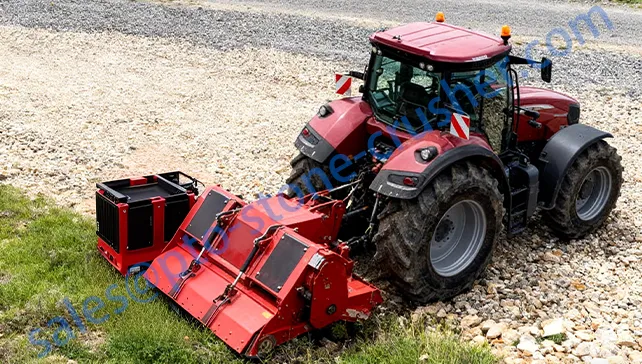
14. Quick Selection Guide: Matching Your Tractor to the Right Model
To cut through the complexity, here is a practical step-by-step guide for identifying a compatible stone crusher for your tractor. Following these steps in sequence prevents the most common mismatches.
Check your tractor’s rated PTO horsepower output.
Find this number in the tractor’s technical specification sheet, not just the engine nameplate. It should appear as “PTO horsepower” or “power at PTO shaft.” Use this number — not the engine’s peak power — as your starting point for crusher selection.
Confirm PTO speed (540 or 1000 RPM).
Check whether your tractor offers 540 RPM, 1000 RPM, or both. If both are available, determine which speed is associated with your tractor’s maximum PTO torque output — this is usually the 1000 RPM setting on higher-powered tractors.
Identify your three-point hitch category and rear lift capacity.
Locate the hitch category (I, II, or III) and the tractor’s published rear lift capacity in kilograms. Choose a crusher whose weight does not exceed 85% of the tractor’s published maximum rear lift capacity, leaving a safety margin for dynamic loading during operation.
Count available remote hydraulic control valves.
Note how many remote hydraulic outlet pairs your tractor has available (not in use by other implements). Cross-reference this with the crusher model’s hydraulic circuit requirements. Some simpler models need zero hydraulic circuits; others need one or two.
Match to the right product and get a final verification.
With your HP, RPM, linkage category, and hydraulic data in hand, use the product specifications to select a matching model. For final confirmation before purchase, contact a specialist to review your specific tractor make, model, and year — minor configuration differences between tractor variants can matter.
Soalan Lazim
Editor: PXY