PTO Stone Crusher for County Road Maintenance: Rural Contractor Case Study
A practical look at how rural contractors and municipal road crews in Colombia and across Latin America are using PTO stone crusher equipment to bring gravel surfaces back into trafficable condition — without hauling in imported aggregate or renting large-format crushing plant. This case study covers equipment selection, operating method, regulatory context, and results from field deployments on unpaved county road networks.
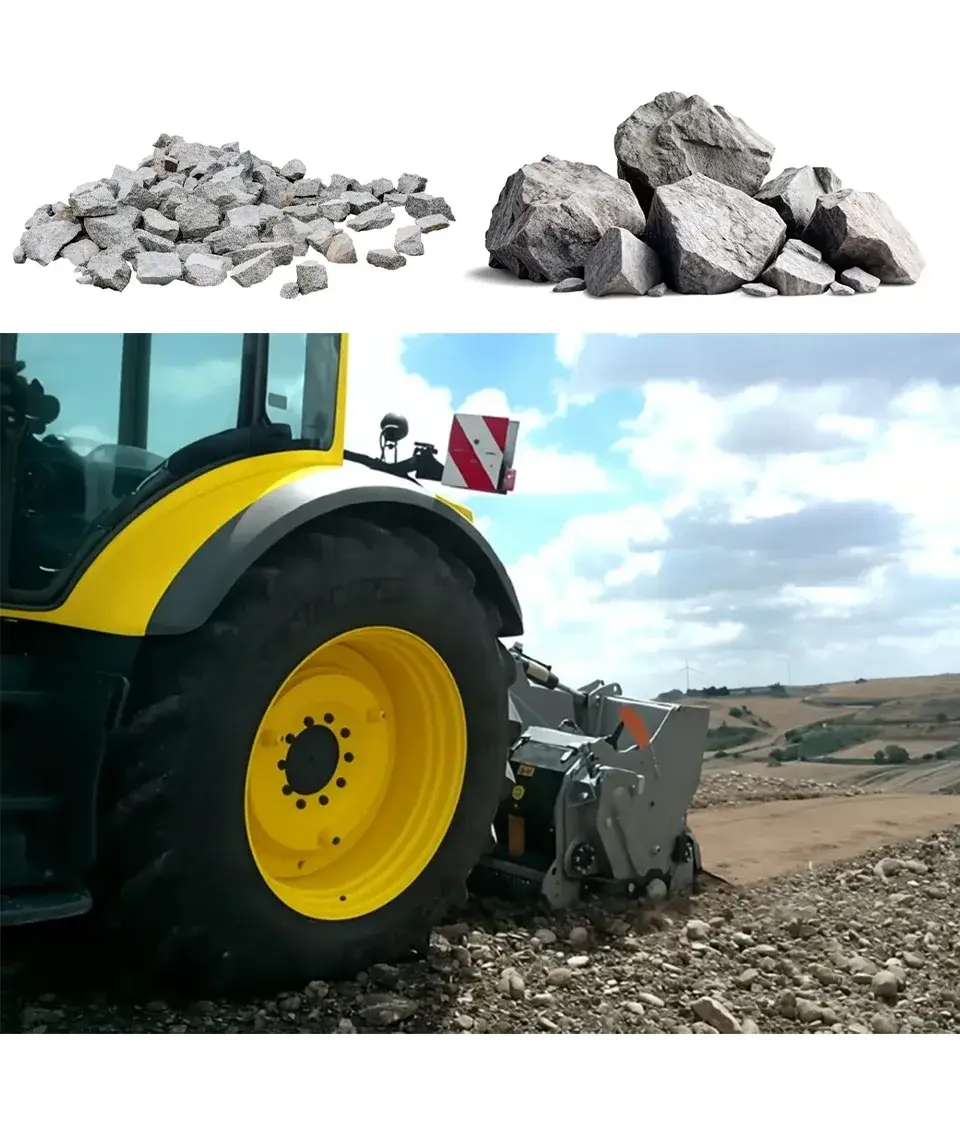
1. The Rural Road Maintenance Problem — Why Stone Crushing Makes Sense
In Colombia’s secondary and tertiary road network — the roughly 142,000 kilometres of unpaved municipal and departmental roads that connect rural farms, agro-industrial facilities, and small communities to main arterials — surface deterioration is a persistent and costly problem. Seasonal rain on the Andean slopes, the Llanos, and the Pacific lowlands progressively washes fines from gravel road surfaces, leaving behind a layer of coarse stones, exposed bedrock, and eroded channels that reduces vehicle speed, increases fuel consumption, and accelerates damage to trucks and agricultural equipment. Traditionally, the solution involved grading by motor grader followed by importing fresh compacted aggregate — a cycle that ties up departmental road budgets and creates logistical bottlenecks where access for aggregate trucks is itself compromised by the road condition being repaired.
A PTO stone crusher takes a fundamentally different approach: rather than removing or covering the existing stone material, it processes it in place. The machine is mounted on a farm tractor via the three-point linkage, driven by the tractor’s power take-off (PTO) shaft, and passes over the road surface crushing the exposed rock fragments into smaller, well-graded pieces. Those fragments remain on the road where they compact into a stable wearing course. The result is a road surface that — depending on the original stone type and grading — can match or exceed the performance of imported aggregate, at a fraction of the haulage cost. For rural contractors serving municipal road authorities (alcaldías) in Boyacá, Antioquia, Nariño, and the coffee-growing departments of Colombia, this process has become one of the most cost-effective road maintenance tools available.
The concept is not new in European and North American contexts, where tractor-mounted rock crusher equipment has been used on farm lanes and rural roads for over two decades. What is changing is the availability of well-engineered equipment at price points accessible to individual contractors and small municipal fleet operators in Latin American markets, combined with growing local expertise in matching machine specifications to local stone types and tractor horsepower constraints. This case study documents a representative deployment to give potential users a realistic picture of what to expect.
2. Action Mode — How a PTO Stone Crusher Operates on a Road Surface
The operating mode of a tractor-mounted PTO stone crusher on a road surface differs from its use in agricultural field preparation in several important respects. In agricultural applications, the machine typically works in a single pass over a field, crushing stones to a depth of 100–200 mm in loose, workable soil. Road surface applications are shallower — usually 50–150 mm — and the working medium is already somewhat compacted from traffic, which affects how the machine engages with material.
The tractor approaches the road at a working speed of approximately 2–4 km/h, with the crusher lowered to the working depth via the three-point linkage. The rotor — a steel drum fitted with tungsten carbide or hardened steel cutting teeth — spins at high speed driven by the PTO shaft at 540 or 1000 RPM depending on the model. As the tractor moves forward, the rotor contacts the stone surface, fracturing exposed rocks and incorporating them into the granular matrix of the road base. A rear-mounted grading blade or apron levels and redistributes the processed material as the machine passes. The result, in a single working pass, is a level, stone-reduced surface ready for a compaction pass by a roller or vibrating plate compactor.
Working speed is a critical variable. Too fast, and the machine skips over larger stones without fully processing them, leaving surface irregularities. Too slow, and the rotor over-processes the material into dust-sized particles that blow away rather than compacting. For most Latin American road applications involving sedimentary or volcanic rock types common in the Andes — limestone, basalt, andesite, shale — a forward speed of 2–3 km/h at 1000 PTO RPM gives well-graded output in the 10–50 mm range, well suited for compaction into a stable road wearing course.
3. Structural Type — Machine Configurations for Road Work
Within the range of PTO stone crusher machines suitable for road maintenance applications, there are several structural categories that determine how the equipment handles the specific demands of road surface work versus open-field use. Understanding these structural differences helps contractors match the machine to their road network conditions rather than simply buying the largest or cheapest unit available.
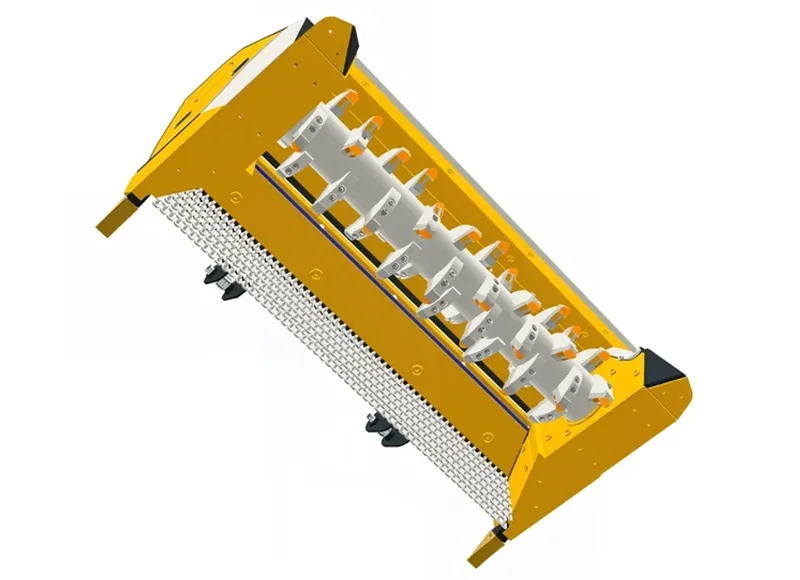
The fixed-tooth rotor design — used in the PSC series — mounts hardened steel or tungsten carbide-tipped teeth in fixed positions on the rotor drum. As the rotor spins, the teeth strike the stone surface at high velocity, fracturing rock through direct impact. Fixed-tooth rotors produce a relatively consistent particle size distribution because the gap between the tooth tip and the counter-blade determines the maximum output size. This makes them well suited for road applications where achieving a target grading curve is important for compaction performance.
The free-swinging hammer (flail) design uses pivoting hammers that swing outward by centrifugal force during operation. On impact with a large stone, a flail hammer can deflect slightly, which reduces the risk of shock damage to the gearbox and rotor shaft in highly variable stone-size conditions. However, this flexibility means less dimensional control over output particle size. Flail-type crushers are often preferred for roadside brush mulching combined with light stone crushing, but for dedicated road base preparation, fixed-tooth designs are generally preferred by experienced operators.
A third configuration relevant to road work is the dual-rotor or combination machine, exemplified by the RSL series, which uses two different rotor diameters to first break larger stones and then re-crush the output to a finer grading. These machines are heavier and require higher PTO horsepower, but they achieve more consistent output on highly variable stone surfaces — a common condition on roads where both small surface gravel and larger embedded rocks are present within the same 200-metre section.
4. Manufacturing Construction — What Makes a Road-Grade PTO Crusher Different
Not every PTO stone crusher is built to withstand the repeated shock loading of road surface crushing. Agricultural field crushers may be designed for softer ground conditions where large embedded boulders are infrequent; road maintenance machines regularly encounter highly variable stone concentrations, previously compacted sub-base material, and occasional impacts with steel culvert edges or embedded rebar in repaired sections. The manufacturing construction of a machine intended for road work needs to account for these conditions in every major component.
The frame and outer housing of road-capable models are typically fabricated from structural steel plate, with wear zones lined with Hardox® or equivalent abrasion-resistant steel. Hardox 400 or 450 grades — with Brinell hardness values of 370–470 HBW — are used for internal wear plates, the rear hood, and rotor side shields. These materials last significantly longer under repeated stone impact than standard mild steel, reducing the frequency of wear-part replacement and keeping operating costs predictable over a multi-season maintenance contract.
The rotor shaft and bearing assemblies are dimensioned for the impact loads of hard-rock crushing. In quality machines, the rotor shaft is machined from high-alloy steel — commonly equivalent to 42CrMo4 — and heat-treated to the required strength and toughness profile. Rotor bearings are typically heavy-duty self-aligning spherical roller bearings in sealed housings with extended re-lubrication intervals. The tooth holders — the machined steel blocks that clamp the cutting teeth to the rotor — are often made from forged alloy steel and are designed as bolt-on replaceable items, so a worn or damaged holder can be exchanged without removing the entire rotor from the machine.
The gearbox or belt transmission connecting the PTO shaft to the rotor includes a torque-limiting device — either a shear bolt coupling, friction overload clutch, or hydraulic slip coupling — to protect the rotor shaft, PTO shaft, and tractor gearbox in the event of a sudden large-stone impact or seizure. Machines without adequate torque protection are a false economy: a single unexpected shaft failure can cost more in repairs than the price differential between a basic and a properly engineered model.
5. Material System — Cutting Teeth, Wear Parts, and Stone Types
The material system of a PTO stone crusher — meaning the cutting teeth, tooth holders, counter-blades, and internal wear protections — is the consumable heart of the machine. Getting the material system right for the specific stone types encountered on a road network is one of the most important factors in achieving acceptable operating cost per kilometre of road maintained. Selecting the wrong tooth type for the local geology will result in either premature tooth wear (high replacement cost) or insufficient crushing performance (poor output quality).
For the PSC series and equivalent machines, the standard tooth configuration uses STC/3 fixed carbide-tipped teeth. These teeth are a three-armed hardened steel body with a tungsten carbide insert at the tip. They offer good general-purpose performance on mixed stone types — suitable for limestone, soft sandstone, and weathered basalt of the kind found on Andean road surfaces. For harder materials like fresh basalt, granite, or quartzite, STC/3/HD (Heavy Duty) variants are available with more aggressive carbide tip geometry and higher-grade binder alloy in the carbide insert. For road base work where the objective is achieving a specific output grading rather than maximum throughput, STC/3/FP (Fine Processing) teeth can be specified to produce smaller, more uniform fragments.
The counter-blade — the hardened steel element against which stones are crushed as the rotor forces them — is a critical wear part whose adjustment directly affects output particle size and machine throughput. On road crusher applications, operators typically set the counter-blade gap slightly larger than for agricultural field work, allowing some oversized fragments to pass without being re-ground, which preserves tooth life and increases working speed. The counter-blade itself is made from Hardox plate and is reversible or replaceable when the working edge wears below the functional thickness.
6. PSC Series Technical Specifications — Road Maintenance Equipment Selection Guide
The table below provides the full technical specification for the PSC series PTO stone crusher models referenced in this case study. All models use a 450 mm diameter rotor and are suitable for road surface crushing of stones up to 150 mm diameter to a working depth of 150 mm. Tractor PTO compatibility at 540 or 1000 RPM is confirmed for all models in the series. This data should be used alongside site-specific assessments of available tractor horsepower, road surface width, and required working output when selecting a model for a specific road maintenance contract.
| Parameter | PSC 100 | PSC 125 | PSC 150 | PSC 175 (ST) | PSC 175 (DT) | PSC 200 |
|---|---|---|---|---|---|---|
| Tractor Power (hp) | 70–120 | 80–120 | 90–120 | 100–120 | 100–150 | 120–150 |
| PTO Speed (rpm) | 540–1000 | 540–1000 | 540–1000 | 540–1000 | 1000 | 1000 |
| Working Width (mm) | 1110 | 1350 | 1590 | 1830 | 1830 | 2070 |
| Total Width (mm) | 1414 | 1654 | 1894 | 2134 | 2134 | 2374 |
| Machine Weight (kg) | 1230 | 1280 | 1440 | 1570 | 1600 | 1750 |
| Rotor Diameter (mm) | 450 | 450 | 450 | 450 | 450 | 450 |
| Max Shredding Diameter (mm) | 150 | 150 | 150 | 150 | 150 | 150 |
| Max Working Depth (mm) | 150 | 150 | 150 | 150 | 150 | 150 |
| Three-Point Linkage | Cat. II | Cat. II | Cat. II | Cat. II | Cat. II | Cat. II |
Note: ST = single transmission; DT = dual transmission. Working width refers to the effective crushing width per pass. Total width includes side guards and hydraulic connections. Road maintenance applications typically use the PSC 150 or PSC 175 DT given the road widths typical of secondary municipal routes in Colombia (4–6 m travel lanes).
7. Case Study: Secondary Road Rehabilitation in a Rural Colombian Municipality
The following scenario is representative of deployments documented from rural road maintenance contracts in the Andean departments of Colombia, drawing on real-world operational patterns to illustrate typical outcomes. The scenario involves a rural contractor operating under a short-term maintenance contract with a Colombian municipal road authority (alcaldía municipal) for the periodic rehabilitation of approximately 28 kilometres of unpaved secondary road connecting rural farms to a main highway. The road surface was a mix of natural gravel and locally quarried crushed stone, with significant deterioration from heavy agricultural traffic during harvest season.
The contractor operated a single 120 hp four-wheel-drive tractor, which is the most common tractor configuration in Colombia’s highland farming regions. The available machine was the PSC 150 PTO stone crusher, with a 1590 mm working width, 1440 kg operating weight, and PTO speed compatibility at 540–1000 RPM. The 1590 mm working width required three overlapping passes to cover a typical 4.5 m road travel lane — a working pattern that added approximately 15–18% to total operating time compared to a two-pass coverage with a wider machine, but kept within the tractor’s three-point hitch capacity.
Pre-work inspection identified two dominant stone types: local limestone (moderate hardness, relatively easy to crush) and isolated outcrops of andesite (significantly harder). For the andesite sections, forward speed was reduced to 1.5–2 km/h and the PTO was maintained at full 1000 RPM. The counter-blade gap was tightened slightly to ensure the harder material was processed to sub-50 mm size in a single pass rather than requiring re-working. Total productivity over the 18-day maintenance period was approximately 1.6 km/day of completed and compacted road surface — a rate that covered the full 28 km contract within the planned time despite two weather delays. Post-completion traffic counts showed no significant surface deterioration over the following three dry-season months, with the compressed, locally sourced aggregate performing equivalently to imported material in rutting resistance tests conducted by the municipal road authority.
8. Tractor Matching — Getting the Most from Your PTO Stone Crusher
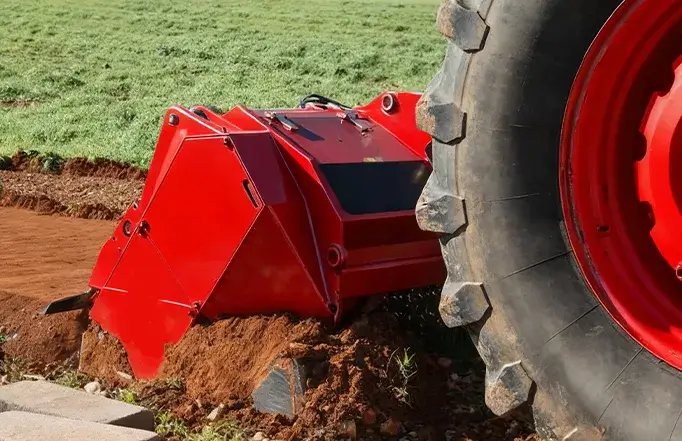
The performance of any tractor-mounted rock crusher is only as good as the tractor-machine match. Selecting a crusher that exceeds the tractor’s continuous PTO output rating is a common mistake, particularly when the stated tractor horsepower is the engine’s peak output rather than its rated PTO output at the flywheel. In practice, a 120 hp tractor may have a continuous PTO-available power of 85–95 hp depending on the transmission efficiency, hydraulic pump load, and cooling demand on hot days. For road work in Colombia’s tropical highland zones, where ambient temperatures regularly reach 28–35°C at lower altitudes, derated PTO power is a real consideration.
For the PSC 100 and PSC 125 models (requiring 70–120 hp tractors), modern 80–100 hp four-wheel-drive tractors widely available in Colombia — including locally distributed New Holland, John Deere, and Massey Ferguson models in the 70–100 hp range — are sufficient for light road surface crushing on limestone and soft sedimentary rock. For the PSC 150, PSC 175 DT, and PSC 200 models, a tractor in the 100–150 hp range with confirmed 90+ hp continuous PTO output should be specified. Attempting to run a PSC 200 on a borderline 100 hp tractor results in frequent slip-clutch engagement, reduced throughput, and premature wear on both the machine’s torque limiter and the tractor’s clutch assembly.
The three-point linkage category is also a practical constraint. All PSC series models specify Category II three-point linkage, which is standard on tractors above approximately 75 hp. However, the rear axle weight capacity of the tractor also matters — at 1440–1750 kg, these machines represent a significant rear-axle load that affects tractor front axle traction and steering response on sloped road sections. Operating on cross-slope gradients above 15% with a heavy rear-mounted crusher requires additional caution, and on narrow mountain roads in Cundinamarca, Boyacá, and Nariño departments, operators should plan their passes to avoid steep cross-fall conditions where possible.
9. Available PTO Stone Crusher Models for Road and Agricultural Applications
Beyond the PSC series, several additional PTO stone crusher configurations are available for road maintenance and land preparation tasks at different power levels and working widths. The table below gives an overview of the models available across the product range.
EP Thor 2.4 + Kit Drawbar
180 cv min. | Working width: 2.4 m | Weight: 2,300 kg. Drawbar-pull configuration for high-output road and field crushing.
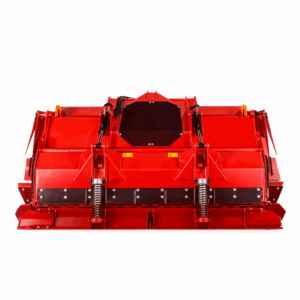
EP RockMaster Agricultural Stone Crusher
Agricultural-focused crusher suited to pasture renovation and farmland clearing with adjustable working depth.
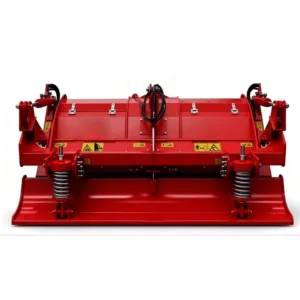
EP PSC Series Field Stone Crusher
70–150 hp tractor range. Compact and versatile for rural roads, narrow farm lanes, and orchard access tracks. Six working widths from 1110 mm to 2070 mm.
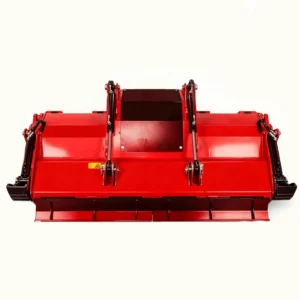
EP Tractor-Mounted Rock Crusher
Heavy-duty three-point hitch model for large-stone surface conditions. Higher tractor horsepower range for demanding secondary road and field applications.
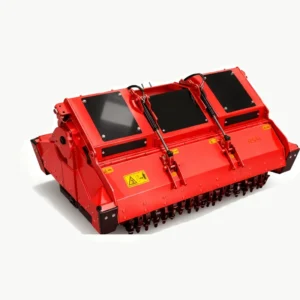
EP Agricultural Rock Crusher (Korea Series)
Designed for Asian and export markets. Suitable for paddy field border tracks, rural lane maintenance, and orchard terrace access roads.
10. Regulatory Framework — Operating PTO Stone Crushers on Public Roads
Using a PTO stone crusher on a public road — rather than on private agricultural land — introduces a set of regulatory obligations that rural contractors need to understand before beginning work. These obligations vary by country and by whether the equipment is performing the crushing in a stationary or moving mode on the public road surface. Contractors working in Colombia and across Latin America should verify applicable requirements with their municipal road authority before mobilising equipment to a public road site.
Colombia (Ministerio de Transporte / INVIAS): Under Decree 1079 of 2015 (Decreto Único Reglamentario del Sector Transporte) and INVIAS Manuals of Road Design and Maintenance, road maintenance activities on public roads require prior authorization from the relevant road authority — INVIAS for national roads, departmental secretaries for departmental roads, and alcaldías for municipal tertiary roads. Contractors must implement a temporary traffic management plan (Plan de Manejo de Tráfico, PMT) per INVIAS Resolution 003600 of 2014, including signage, flaggers, and buffer zones when machinery is operating on the public carriageway. Failure to implement an approved PMT exposes the contractor to fines under the Código Nacional de Tránsito Terrestre (Law 769 of 2002). Equipment crossing public roads under its own power or being towed must comply with vehicle dimension limits under Resolution 4100 of 2004.
European Union: In EU member states, work equipment operating on public roads must comply with Directive 2006/42/EC on machinery safety, including requirements for noise emission labelling and vibration exposure assessment for operators. Agricultural machinery on public roads in most EU jurisdictions requires reflective marking, slow-moving vehicle triangles, and road travel authorisation above certain widths — typically 3 m. For mounted stone crushers, transport position must reduce working width to within the road travel limit.
United States: In the US, state Departments of Transportation issue permits for oversized agricultural equipment movements on public roads. OSHA 29 CFR 1910.147 (lockout/tagout) governs safe maintenance and attachment/detachment of PTO-driven implements. Several US states also regulate road crushing operations under their pavement management programs, requiring crushed aggregate to meet minimum gradation and PI (plasticity index) specifications for road base material. Contractors in US markets should verify state DOT aggregate quality requirements before using in-place crushed stone as road base without additional testing.
International Standards (ISO): ISO 4254-1 covers general safety requirements for agricultural machinery. For stone crushers specifically, ISO 11684 series standards address safety signs and hazard pictograms required on powered equipment. CE-marked equipment sold in the EU market will have been assessed against these standards as part of the machinery directive compliance process.
11. Maintenance, Operating Cost, and Tooth Replacement
One of the most frequent questions from contractors evaluating a PTO stone crusher purchase for road maintenance is: what does it actually cost to run per kilometre? The answer depends heavily on the stone hardness, working depth, and speed — but some general parameters from field experience in the Latin American market give useful reference points. For limestone or soft andesite road surfaces (Mohs hardness 3–5), tungsten carbide-tipped teeth on a PSC 150 or equivalent machine typically last 80–120 operating hours before replacement is needed. For harder volcanic rock (Mohs hardness 6–7), tooth life may be closer to 40–60 hours. At an average working speed of 2.5 km/h covering 1.8 lane-widths per pass, 80 hours of rotor time corresponds to roughly 100–120 km of road surface processed.
Tooth replacement is a straightforward workshop task requiring basic tools — usually a torque wrench and a punch to drive out the worn carbide tip from the tooth holder. Maintaining a stock of replacement tips at the work site means replacement can be done in the field without returning to a workshop, minimising downtime during a road maintenance campaign. The full rotor tooth set for a PSC 150 typically consists of 26–32 main teeth plus 4 counter-blade protection teeth; replacing the full set at once is more efficient than replacing individual teeth as they wear, since the rotor must be cleaned and inspected anyway during a full replacement.
Gearbox and belt transmission maintenance is the other significant operating cost item. The transmission belts (on PSC series models using belt drive) should be inspected at each daily pre-work check and replaced before breaking, as a broken drive belt under working load can cause secondary damage to the belt housing and PTO shaft yoke. Oil changes in the intermediate gearbox should follow the manufacturer’s schedule — typically every 250–300 operating hours for standard gear oil, with the first change at 50 hours for a new machine to flush manufacturing residues from the gear housing.
12. About Us
We are a specialist supplier of professional agricultural and land management equipment, with a dedicated product range focused on PTO-driven stone crushers, mulchers, and soil preparation machinery. Our technical team has direct application experience across diverse stone types and tractor configurations, enabling us to provide equipment recommendations grounded in actual field outcomes rather than catalog specifications alone.
We supply the complete PSC series and associated stone crusher and mulcher product lines to agricultural contractors, municipal road authorities, and individual farm operators across Colombia, Latin America, and international export markets. Our pre-sale technical consultation process helps buyers select the correct model for their specific tractor horsepower, stone type, and application type — whether that is road surface maintenance, pasture renovation, or land clearing for new agricultural development.
Soalan Lazim
Q1. What is the best PTO stone crusher model for rural road maintenance in Colombia on a 100 hp tractor?
For a 100 hp tractor working on Colombian rural secondary roads, the PSC 150 or PSC 175 (single transmission) models are the most practical choices. The PSC 150 offers a 1590 mm working width within the tractor’s confirmed PTO output capacity, and handles limestone and soft andesite — the most common road surface stone types in Andean Colombia — efficiently at 2–3 km/h working speed. The PSC 175 ST requires the tractor to operate closer to its rated power limit but provides slightly better one-pass coverage on 4–5 m wide road lanes. Both models mount on Category II three-point linkage, which is standard on most 100 hp tractors available in Colombia.
Q2. How does a tractor-mounted rock crusher differ from a traditional road grader for unpaved road maintenance in Latin America?
A motor grader reshapes and redistributes existing surface material without crushing it — it can level washboard surfaces and fill potholes, but large embedded stones remain in the surface and will reappear as fines wash away in subsequent rain. A tractor-mounted rock crusher processes the stone material in place, reducing rock fragments to a smaller, more uniformly graded size that compacts into a stable surface matrix. The result is a road that resists rutting better than a graded surface and requires less frequent maintenance. Graders require specialist operators and represent a much higher equipment investment; a PTO crusher can be operated by any experienced tractor driver and mounted on a farm tractor already owned by the contractor or municipal road department.
Q3. How often do the tungsten carbide teeth on a PTO stone crusher need replacing when used for county road maintenance work?
Tooth replacement frequency depends primarily on the hardness of the stone being crushed. For soft to medium-hard sedimentary rock (limestone, sandstone, soft shale) typical of many Andean road surfaces, tungsten carbide-tipped teeth last 80–120 operating hours. For harder igneous rock such as basalt or andesite, expect 40–70 hours between replacements. Operating at lower working speeds and slightly larger counter-blade gaps — as recommended for road applications — extends tooth life compared to deep agricultural field work. Keeping a full spare tooth set on site allows efficient batch replacement during scheduled maintenance stops, minimising unplanned downtime during a road maintenance contract period.
Q4. What tractor horsepower is needed to run a PTO stone crusher for gravel road base preparation in the Colombian highlands?
For the PSC series, minimum tractor power ranges from 70 hp (PSC 100) to 120–150 hp (PSC 200). For road base preparation work in Colombian highland conditions — where ambient temperature is moderate (15–22°C at altitude) but terrain is often sloped — we recommend using a tractor whose rated PTO output is at least 10–15% above the machine’s stated minimum. For PSC 150 road work, a 120 hp four-wheel-drive tractor is the practical starting point. At higher altitudes above 2,500 m, engine power derate due to lower air density should also be factored in — a turbocharged tractor loses approximately 3–5% power per 1,000 m of altitude gain above sea level.
Q5. Which PTO stone crusher model is most suitable for narrow farm lane and driveway maintenance in rural Colombia?
The PSC 100 with its 1110 mm working width and 1414 mm total machine width is the most suitable model for narrow access lanes, farm driveways, and orchard access tracks — typical of coffee finca access roads in Antioquia, Caldas, Risaralda, and Quindío. The compact total width of 1414 mm allows the machine to work safely on 2.5–3 m wide access tracks without the outer guards contacting road edge vegetation or embankments. It is compatible with tractors from 70 hp upward, meaning it can be used with smaller farm tractors that are more manoeuvrable on narrow terrain.
Q6. What are the safety and regulatory requirements for operating a PTO stone crusher on a public road in Colombia?
In Colombia, operating machinery on a public road requires prior authorization from the relevant road authority (INVIAS for national roads, departmental secretaries or alcaldías for secondary and tertiary roads). A Traffic Management Plan (Plan de Manejo de Tráfico, PMT) must be prepared and approved per INVIAS Resolution 003600 of 2014. The PMT specifies signage placement, buffer zones, and flagger positions to protect both the equipment operator and road users during the work. The contractor’s liability and public works insurance must also cover road surface work operations. Failure to comply exposes the contractor to fines under Law 769 of 2002 and potential suspension of the maintenance contract.
Q7. When is a dual-transmission PTO stone crusher needed instead of a single-transmission model for road maintenance?
The dual-transmission (DT) configuration uses two power transmission belts or gearboxes operating in parallel to deliver PTO power to the rotor, allowing a wider working width to be driven effectively with the same tractor PTO shaft. For road work, the DT configuration becomes relevant on the PSC 175 DT and wider models where the rotor length exceeds what a single central PTO shaft can drive uniformly at the required rotor speed. In practice, single-transmission models are adequate for PSC 100 through PSC 150 on most road maintenance applications; the DT versions of PSC 175 and above become necessary on harder stone types where maximum consistent torque delivery across the full rotor width is needed to avoid uneven output particle size from one side to the other.
Q8. What type of stone can a PTO stone crusher process, and are there stone types it cannot handle on rural road surfaces in Colombia?
The PSC series can handle limestone, sandstone, weathered basalt, shale, alluvial gravel, and most sedimentary rock types found on Andean road surfaces up to 150 mm diameter. Fresh, unweathered granite, quartzite, and siliceous volcanic rock above Mohs hardness 7 — occasionally found in Colombian coastal and Amazonian geological zones — will cause very rapid tooth wear and may exceed the machine’s designed crushing capacity. In these situations, a higher-specification machine in the STCM or RSL series (designed for stones up to 300 mm diameter) is more appropriate, though it will require a tractor in the 150–220 hp range. For most Colombian highland road maintenance scenarios involving sedimentary and volcanic sedimentary rock, the PSC series is fully adequate.
Editor: PXY