Agricultural Knowledge Series · Poland
PTO Stone Crusher for Polish Agriculture: Glacial Boulder and Gravel Clearing in Masuria and Greater Poland
A practical field guide to understanding how a pto stone crusher works, what it is made of, and why Polish farmers in glacially-deposited terrain increasingly rely on tractor stone crusher technology to reclaim productive cropland.
Polish Farmland Focus
B2B Agricultural Buyers
1. Why Stone Clearing Matters in Masuria and Greater Poland
Poland’s agricultural landscape is shaped in no small part by its glacial inheritance. Across the Masurian Lake District in the northeast and the broad lowland farmland of Greater Poland (Wielkopolska), centuries of post-glacial deposition have left significant quantities of erratic boulders, angular gravel, cobble layers, and mixed-stone soils within the root zone of arable fields. Every spring thaw pushes additional material toward the surface through frost heave, while deep tillage with a subsoiler or plough frequently exposes buried stones that were not visible in previous seasons. For a grain or oilseed rape farmer in Warmia-Masuria, or for a potato grower near Poznan, these rocks are not just an inconvenience — they cause direct financial harm through broken plough shares, bent seed coulters, damaged combine headers, and reduced germination in stony patches. The pto stone crusher offers a decisive solution to this recurring challenge: instead of collecting and removing stones, the machine pulverises them in-situ and returns the fine crushed aggregate into the seedbed, improving both drainage and soil workability. Understanding how this agricultural stone crusher category operates, what it is built from, and how to match it to a specific tractor and field type is the purpose of this article.
2. Action Mechanism: How a PTO Stone Crusher Breaks Down Glacial Rock
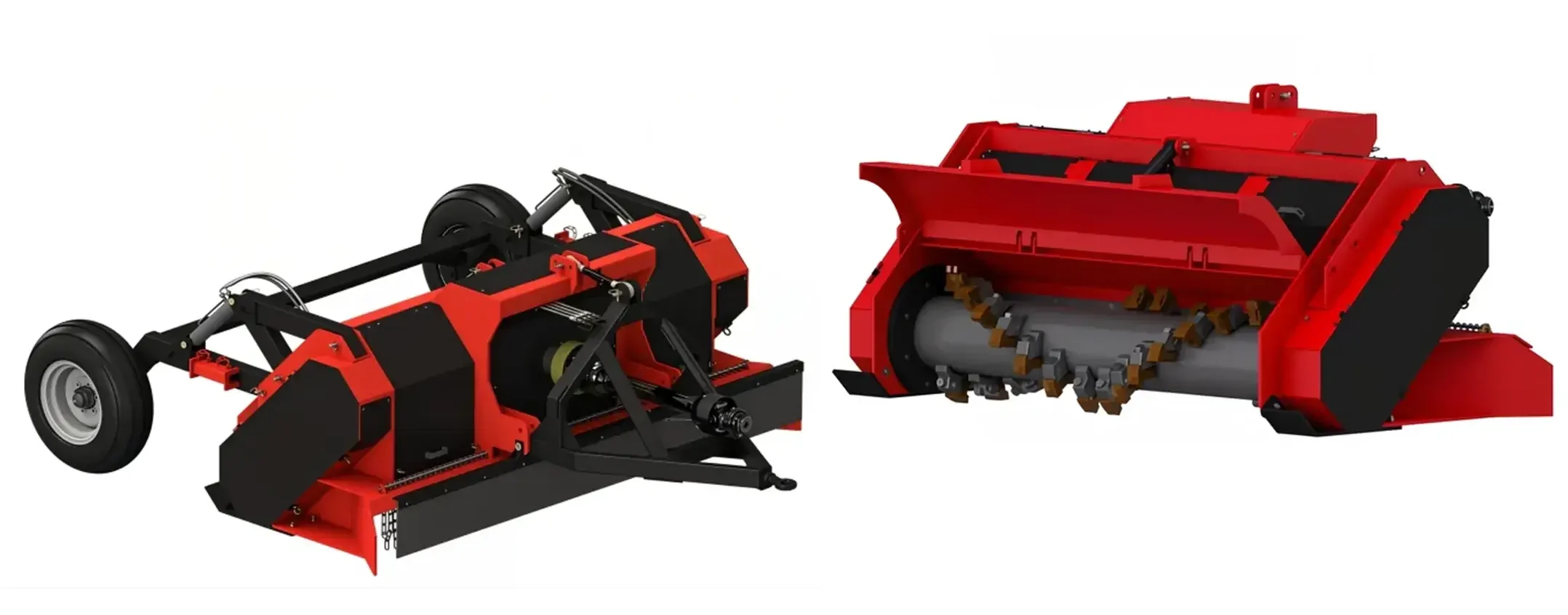
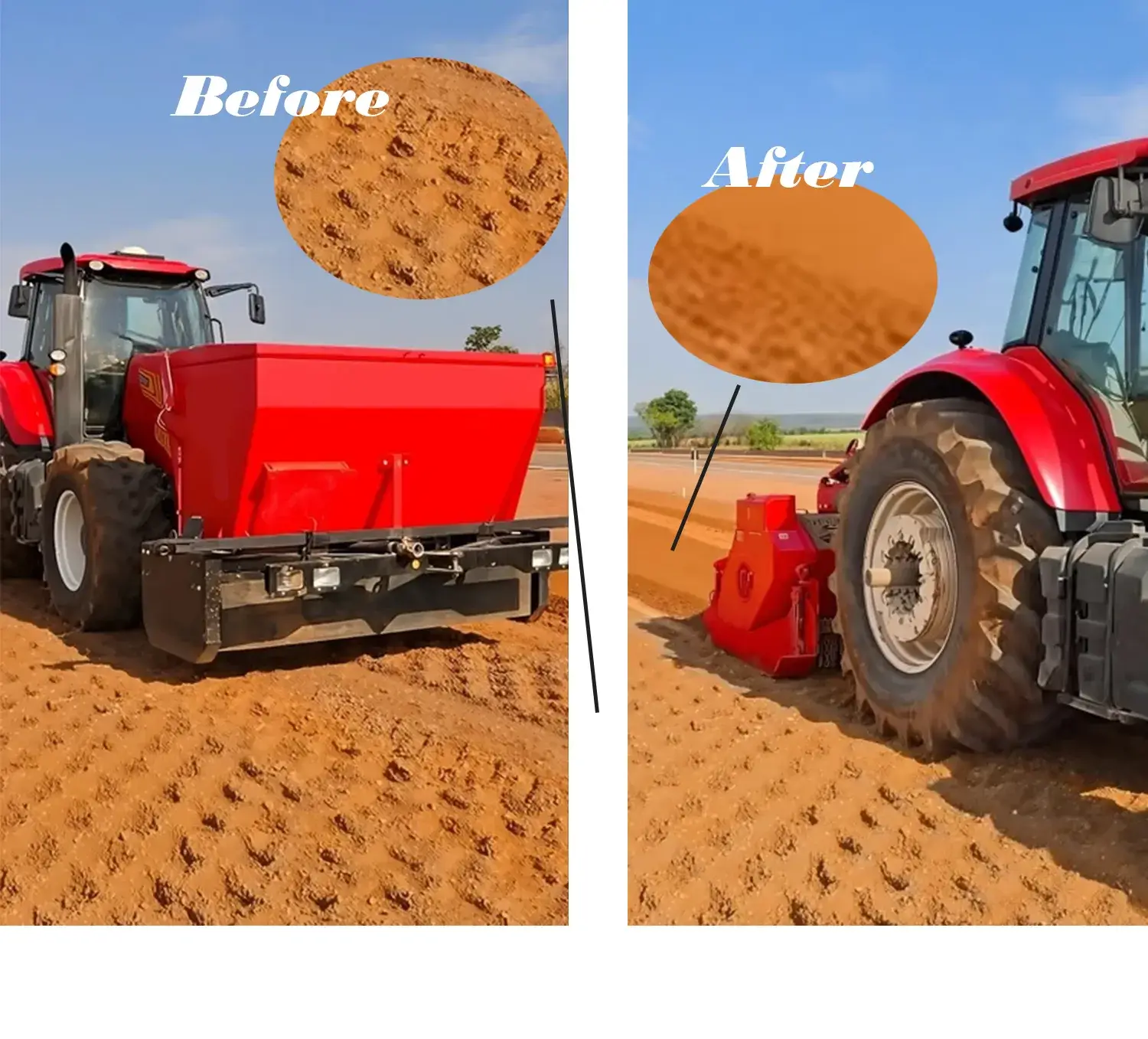
The operating principle of a tractor stone crusher is fundamentally rotary impact. Power from the tractor is transferred through the power take-off (PTO) shaft — typically running at 540 RPM or 1000 RPM depending on the model — to a heavy rotor housed within a reinforced steel chamber. The rotor carries a set of cutting tools, commonly referred to as picks, fixed teeth, or swing hammers depending on the design family chosen. As the tractor advances at a controlled working speed of approximately 3 km/h, the spinning rotor contacts the soil surface and any stones within the working depth, which ranges from 150 mm on lighter models up to 500 mm on the heaviest series. The high peripheral velocity of the rotor tips generates enough kinetic energy to fracture even relatively hard glacial erratics — granite boulders, flint nodules, and quartzite cobbles that are common in Polish post-glacial soils — breaking them into fragments small enough to pass through the rear stone retention grid and remain within the cultivated layer. Fine crushed stone then integrates with soil aggregates, improving the bearing capacity of the seedbed and facilitating root penetration by cereal crops.
What distinguishes a pto stone crusher from a conventional rotary tiller is the mass and geometry of the rotor, the hardness-grade tooling attached to it, and the robust containment structure that prevents high-velocity fragments from becoming projectiles. The rear protection flap — typically made from a combination of heavy rubber curtain and steel chain sections — forces crushed material back into the soil while absorbing impact from larger ejected fragments. Front skids and rear depth wheels allow the operator to precisely set working depth from the tractor cab, ensuring consistent penetration across undulating or sloping terrain, which is characteristic of many drumlin and kame fields in Masuria. For Polish agricultural stone crusher users, the ability to process irregularly shaped boulders up to 300 mm diameter on mid-range STCM-series models, or 500 mm diameter on heavy RSH-series machines, without stopping means entire field sections can be reclaimed in a single pass.
3. Manufacturing Structure: What Is Inside a Tractor Stone Crusher
The structural anatomy of a stone crusher for tractor attachment is considerably more complex than it appears from the outside. Starting from the PTO connection point, the input torque is routed through a shear-bolt or slip-clutch overload protection coupling — a mandatory safety device that protects the tractor gearbox and PTO shaft when an oversized obstacle such as embedded reinforced concrete, a buried metal object, or an exceptionally large boulder is encountered. From the coupling, power passes into a bevel gear multiplier or belt-and-pulley drive system that accelerates the rotor to its operating speed. The EP-Thor 2.4, for instance, requires a minimum tractor engine power of 180 cv and operates at a working speed of approximately 3 km/h, reflecting the high torque demand of processing dense stone concentrations across its 2.4 m working width. This machine measures 1546 mm in length, 2481 mm in width, and 1212 mm in height, with an overall operating weight of 2300 kg.
The main chassis frame is manufactured from laser-cut and robot-welded heavy-section steel plate, typically S355 structural grade or equivalent, configured as a stressed-skin box section to resist the severe torsional and bending loads generated during rotor engagement with embedded rocks. The rotor shaft runs in sealed tapered-roller bearings mounted in heavy-walled housings that are replaceable in the field without specialist tooling. The upper hood and side plates incorporate wear-liner inserts in the highest-impact zones around the rotor, allowing cost-effective maintenance without replacing the entire structural shell. Three-point linkage attachment follows ISO 730 Category II standards, making the machine compatible with the vast majority of European agricultural tractors operating across Polish farms. The Kit Drawbar option available on the Thor 2.4 extends attachment versatility, allowing the crusher to be towed at road speed between fields without removing it from the tractor — a practical benefit for farms whose arable blocks are distributed across multiple locations, a common land tenure pattern in both Masuria and Wielkopolska.
4. Material System: Steel Grades, Tooling Alloys, and Wear Management
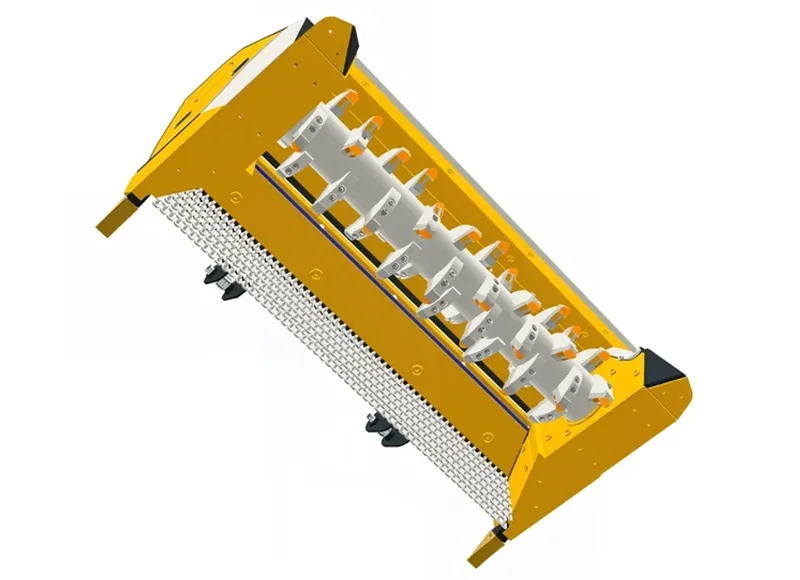
The longevity and total cost of ownership of any small pto stone crusher or large agricultural stone crusher is determined primarily by the quality and specification of the materials used throughout the wear circuit — the path from initial stone contact through rotor impact to final dispersal of crushed fragments. The cutting tools themselves are manufactured from high-chromium white cast iron or boron-alloyed through-hardened steel, achieving surface hardness values in the range of 58 to 65 HRC. For agricultural stone crusher applications involving hard Scandinavian-origin erratics such as granites, gneisses, and quartzites frequently found in Masurian soils, carbide-tipped picks offer significantly extended service life compared to standard forged-steel tools, though at a higher initial equipment cost. The selection between carbide-tipped and standard tooling is therefore an economic calculation that Polish farmers should make based on the hardness and abrasiveness of their specific field geology.
The rotor body itself is fabricated from thick-wall steel tube or solid-forged billet, statically and dynamically balanced to minimise vibration transmission to the tractor front axle and cab. Side deflector plates and the rear stone guard are manufactured from abrasion-resistant Hardox 400 or Hardox 500 steel, selected for their combination of high hardness, reasonable toughness, and good weldability. Replacement tooling is designed to be exchangeable without specialist equipment — most models use bolted or quick-change holders that a farm mechanic can replace in the field using standard hand tools. The gearbox oil seals and PTO shaft seals are selected from high-nitrile or fluoro-elastomer grades appropriate for continuous operation in sandy, gritty, and wet field conditions typical of spring work in Polish post-glacial soils. Understanding the material specification of a pto stone crusher for sale is important for B2B buyers, as it directly predicts maintenance intervals, spare parts availability, and eventual resale value.
5. Model Selection Guide: Matching the Crusher to Tractor Power and Field Conditions
The table below summarises key specifications across the main series of PTO stone crushers available, based on data from the PSC series and the STCM, STCH, RSL product families, to help Polish farmers and contractors match equipment to tractor power and field stone conditions.
| Series / Model | Tractor Power (hp) | PTO Speed (rpm) | Жұмыс ені (мм) | Max Stone Dia. (mm) | Максималды тереңдік (мм) | Салмағы (кг) |
|---|---|---|---|---|---|---|
| EP-Thor 2.4 + Kit Drawbar | 180 cv min. | — | 2400 | — | — | 2300 |
| STCL/ST 125 | 80–120 | 540–1000 | 1350 | 150 | 150 | 1280 |
| STCM/ST 125 | 80–110 | 540 or 1000 | 1340 | 300 | 200 | 1850 |
| STCM 200 | 170–220 | 1000 | 2064 | 300 | 200 | 3550 |
| STCH 225 | 280–400 | 1000 | 2320 | 500 | 250 | 5050 |
| RSL/ST 150 | 100–120 | 540 | 1480 | 300 | 150–280 | 1960 |
| RSM 225 | 220–300 | 1000 | 2320 | 500 | 400 | 5490 |
| RSH/HP 225 | 360–500 | 1000 | 2347 | 500 | 500 | 7450 |
Note: Rotor diameter, tool count, and PTO speed vary by sub-variant. Always verify compatibility with tractor hydraulic output and PTO shaft spline type before purchase. Values sourced from product technical data sheets.
6. The Polish Glacial Soil Challenge: Masuria vs. Greater Poland
The specific nature of the stone problem differs meaningfully between Masuria and Greater Poland, and this influences which type of stone crusher machine is most appropriate for each region. In the Masurian Lake District, the glacial till deposits are characterised by a high proportion of large erratic boulders — some exceeding 600 to 800 mm in their longest dimension — along with abundant angular flint and quartzite gravel. These were deposited by the Scandinavian ice sheet during the Weichselian glacial maximum and have been partially concentrated by millennia of frost heave and agricultural disturbance. Fields here tend to have irregular stone distributions, with dense accumulations around morainic ridges and lighter concentrations on outwash plains. For this terrain, a heavier agricultural stone crusher with a maximum stone diameter capacity of at least 300 to 500 mm is advisable, such as the STCM 200 or STCH series, matched to tractors producing 170 hp or above — a power class well-represented in the John Deere, Fendt, and New Holland ranges widely used on Polish commercial farms.
In contrast, the stone content of Greater Poland’s soils tends to be dominated by smaller gravel and flint of 20 to 120 mm diameter, distributed more uniformly through the plough layer as a result of the flatter topography and longer post-glacial agricultural history of the Poznan basin. Here, a small pto stone crusher such as the STCL or RSL series, suitable for tractors in the 80 to 120 hp range, can be economically effective, since the primary problem is gravel rather than large boulders. The lower capital investment of these lighter models also suits the smaller average farm size characteristic of the Greater Poland region compared to the larger commercial holdings common in Warmia-Masuria. For farms operating across both terrain types, or for agricultural contractors serving multiple clients with varying field conditions, a mid-range model such as the EP-RockMaster or the EP-PSC Models series offers the best balance between versatility, power requirement, and acquisition cost.
7. Rotor Tooling Systems: Fixed Teeth, Swing Hammers, and Carbide Picks
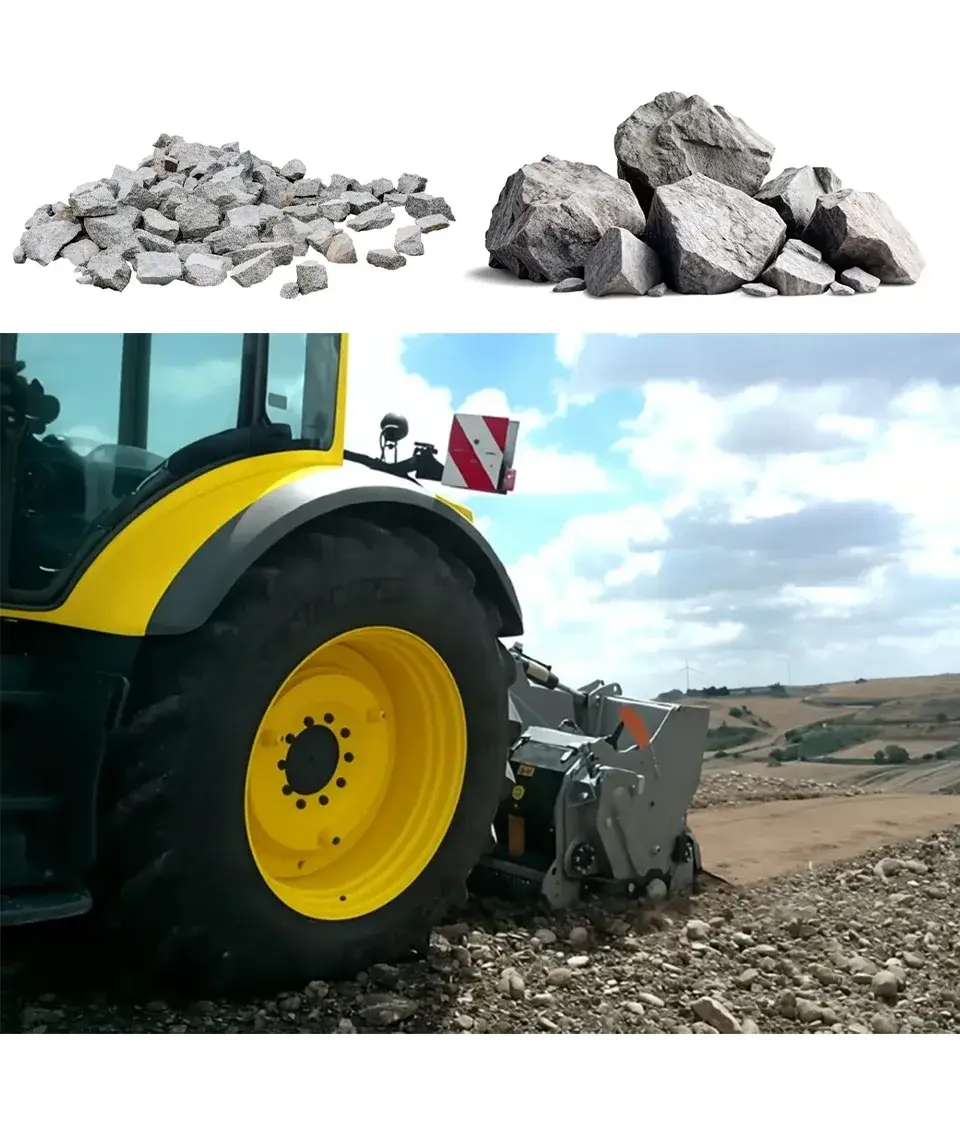
One of the most consequential technical decisions when selecting a pto stone crusher for Polish conditions is the choice of rotor tooling configuration. Three principal tooling types are in commercial use across the stone crushing equipment sector. Fixed-teeth rotors use bolted or press-fit hardened steel teeth arranged in a helical pattern around the rotor drum. They deliver high impact energy per tooth and are effective against hard granite boulders, but the teeth are subject to immediate failure if they contact very large buried stones or reinforced concrete fragments. This makes fixed-tooth rotors best suited to fields where previous passes have already removed oversized material or where maximum stone size is reliably below 200 mm. Swing-hammer rotors use freely-pivoting hammer elements that can deflect rearward when they encounter an obstacle too hard to break, transmitting a reduced impact to the rotor shaft and reducing catastrophic damage risk. They are more tolerant of variable and unpredictable stone concentrations — conditions very common in previously uncultivated or first-pass Masurian fields. Carbide-tipped picks combine a tough alloy steel shank with a tungsten carbide insert that delivers extreme wear resistance and are the best choice for high-silica quartz gravel. Polish pto stone crusher operators typically select between these configurations based on field geology, soil moisture, and the specific stone-crushing challenge of each field block.
8. Featured PTO Stone Crusher Models for Polish Agricultural Conditions
The following products from our Mulchers / Stone Crushers series are well-suited to the stone-clearing requirements of Masuria and Greater Poland. Each has been selected based on tractor compatibility, working width, and stone processing capacity relevant to Polish field conditions.
EP-Thor 2.4 + Kit Drawbar
Heavy-duty pto stone crusher, 2.4 m working width, 180 cv minimum tractor power, weight 2300 kg. Ideal for larger Masurian farms with high boulder concentrations. Kit Drawbar enables road-speed transport between scattered field blocks.
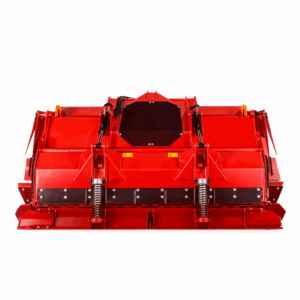
EP-RockMaster ауылшаруашылық тас ұсатқышы
Versatile agricultural stone crusher designed for mixed gravel and medium boulder applications. Suitable for the transitional terrain between Greater Poland’s lowlands and the more stony Kuyavia region. Competitive cost-per-hectare for contractor use.
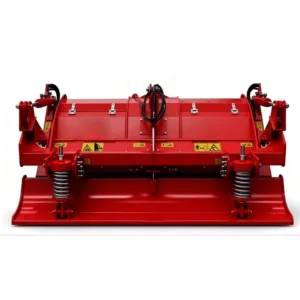
EP-PTO Stone Crusher PSC Models
The PSC Models series covers the STCL range from 70 to 150 hp tractors, making it accessible to small and medium farms. Working widths from 1110 to 2070 mm, max stone diameter 150 mm, max working depth 150 mm. Ideal first-pass treatment for gravel soils in Wielkopolska.
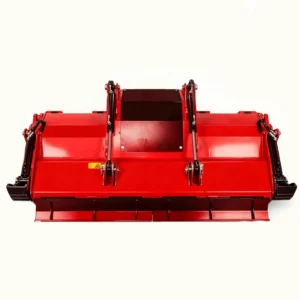
EP-тракторға орнатылған тас ұсатқыш
A purpose-built tractor stone crusher for medium-intensity stone conditions. Category II three-point linkage, compatible with 100 to 220 hp tractors. Delivers a consistent fine-crushed seedbed in a single pass through stony Polish cereal and root crop fields.
9. Operational Requirements: Tractor Matching, PTO Speed, and Working Speed
Successfully deploying a pto stone crusher in Polish field conditions requires careful matching of the machine to the available tractor. The most common mistake made by first-time buyers is under-powering the crusher — attempting to run a 2.4 m working-width machine on a tractor that cannot sustain the required PTO torque through a full-depth pass in dense stone concentrations. PTO power should exceed the machine’s rated minimum by at least 15 to 20 percent to maintain rotor speed under load, since drops in rotor RPM directly reduce crushing efficiency and can cause stone jamming in the rotor housing. For the STCM series operating at 1000 RPM PTO, Polish farmers should verify that their tractor’s 1000 RPM output shaft is a 1-3/8 inch 21-spline configuration, the standard across European tractors, as the alternative 1-1/4 inch 6-spline shaft requires an adapter. Working speed — the forward speed of the tractor during crushing — should typically be maintained at 2.5 to 3.5 km/h for dense stone layers and may be increased to 4 to 5 km/h on lighter gravel concentrations. Overloading the machine by working too fast through thick stone layers generates excessive heat in the gearbox and accelerates tool wear, adding to the operational cost per hectare that operators evaluating stone crusher for sale options need to factor into their business case.
Field access and headland management are also relevant in the Polish context. Many Masurian farms feature irregular field shapes bounded by drainage ditches, tree lines, and field roads. The Kit Drawbar option on the Thor 2.4 and similar transport configurations on other models allows the machine to be raised to transport position without detaching from the tractor, reducing transition time between headlands and improving daily output hectares. For contractors operating across multiple farms, this mobility feature materially improves the economics of each job, contributing to a shorter payback period on the stone crusher machine investment.
10. Regulatory Compliance and Safety Standards: Poland, EU, and Korea
Agricultural stone crushers sold and operated within the European Union — including Poland — are subject to a defined regulatory framework. The principal legislation is the EU Machinery Directive 2006/42/EC, which is being superseded by EU Machinery Regulation 2023/1230 applicable from 20 January 2027. Both require that all agricultural machinery, including tractor stone crushers, carries valid CE marking, is accompanied by an EC Declaration of Conformity, and includes a user instruction manual in the official language of the country of sale. For Polish buyers, the instruction manual must therefore be available in Polish. The CE marking confirms that the machine has been assessed against essential health and safety requirements, including guards for rotating components, PTO shaft protection tubes, and emergency stop provisions.
In Poland, agricultural machinery operation is additionally regulated under the Act on Occupational Health and Safety in Agriculture administered through the Agricultural Social Insurance Fund (KRUS). Operators are required to have received appropriate equipment training before independent operation. KRUS statistics consistently identify farm machinery as a leading source of agricultural accidents in Poland, making the safety features of a stone crusher — particularly the full-width rear guard, emergency PTO disconnect, and rotor engagement control — practically and legally significant for farm insurance purposes. ISO 11684 (safety signs for agricultural machinery) and EN ISO 4254-7 (soil preparation equipment) provide the harmonised standard baseline for CE-assessed stone crushing equipment. For South Korean buyers, machinery safety under the Industrial Safety and Health Act (산업안전보건법) and the Safety Certification Scheme (안전인증) has partial equivalence to CE requirements, and CE-certified stone crushing equipment may qualify for a simplified approval pathway when imported into Korea. Polish operators working near water bodies — which is common in Masuria — should also consult the Water Law Act (Prawo Wodne), which restricts heavy machinery operation within riparian buffer zones, typically 5 to 30 m from watercourse banks. Stone crushing within these buffers may require a permit from the relevant Regional Water Management Board (Regionalny Zarząd Gospodarki Wodnej). Under Poland’s Act on the Protection of Agricultural and Forest Land, first-time conversion of grassland or woodland to arable use also requires regulatory approval even when stone clearing is the precondition for that conversion.
11. Seasonal Planning: When to Use a Stone Crusher in the Polish Farming Calendar
Timing the pto stone crusher pass correctly within the Polish farming calendar significantly affects both machine performance and agronomic outcomes. The optimal window for stone crushing in Poland is generally late spring — April through early June — when soils have dried sufficiently after the winter frost period to support the machine weight without excessive compaction from the crusher itself and from the drive tractor. Early spring crushing in March is often problematic because high soil moisture causes freshly crushed stone fragments to embed deeply in soft soil, occasionally burying material that was intended to stay near the surface for later removal or further fragmentation. In contrast, late summer or autumn crushing between August and September, after cereal harvest, offers another practical window — particularly for preparing fields for the following spring’s root crop rotation. Polish potato farmers in Greater Poland frequently use their agricultural stone crusher in August after winter wheat harvest to clear gravel accumulations exposed or concentrated by the previous season’s ploughing and harvesting equipment. Harvest-time operation also benefits from the firmer soil conditions left by the combine, reducing the risk of deep rut formation under the crusher’s operational weight. For Korean buyers with analogous spring soil-freezing conditions, the same seasonal logic applies: the post-thaw window in early May through June is typically optimal for deploying a pto stone crusher on stony paddy conversion fields or upland arable ground.
12. About Our PTO Stone Crusher Range
We are a professional agricultural machinery manufacturer and supplier specialising in pto stone crusher systems, tractor stone crushers, and related stone-clearing and soil preparation equipment for global B2B buyers. Our product development approach is grounded in the practical requirements of real farm and contracting operations — from the gravel-laden potato fields of Greater Poland to the boulder-strewn morainic terrain of Masuria, and from the rocky paddocks of Korea to the limestone-rich agricultural land of southern Europe. Every stone crusher machine in our range is engineered to the ISO and EN harmonised standards that underpin CE certification, ensuring that our customers in the EU, Korea, and wider global markets receive equipment that meets both their performance expectations and their regulatory compliance requirements. We maintain a full inventory of genuine spare parts, including rotor tools, wear liners, PTO couplings, and bearing assemblies, enabling fast field-level maintenance that minimises downtime during the critical spring and autumn crushing seasons. For procurement teams evaluating a new agricultural stone crusher, used tractor stone crusher for sale options in their fleet, or replacement parts for existing stone crushing equipment, our technical team is available to provide application-specific recommendations backed by field data from comparable soil conditions worldwide.
Frequently Asked Questions
Q1. What is the best pto stone crusher for clearing glacial boulders on a Masurian farm in Poland?
For Masurian fields with dense boulder concentrations and stone diameters up to 300 to 500 mm, the STCM or STCH series offers the most effective combination of rotor diameter, working depth, and stone-processing capacity. The EP-Thor 2.4 is also widely used by contractors working the larger morainic fields in Warmia-Masuria. The right choice depends on tractor power available: STCM suits 100 to 220 hp tractors, while STCH requires 280 to 400 hp.
Q2. How does a pto stone crusher work when it hits a large embedded granite erratic in an agricultural field?
The high-speed rotor contacts the stone surface and delivers repeated high-energy impacts, fracturing the material along natural grain boundaries. Large erratics exceeding the machine’s rated maximum stone diameter should be removed manually or by a rock picker before the crusher pass to avoid rotor damage and overload coupling activation.
Q3. Where can I find a reliable tractor stone crusher for sale near me in the Greater Poland region for a potato farm?
Our global distribution network includes dealers serving the Polish market. Buyers in Greater Poland can request a quote directly through our contact page. Our team will confirm the nearest stocking point, delivery lead time, and available models suited to the 80 to 120 hp tractors common in the Poznan and Konin agricultural areas.
Q4. What is crusher stone used for after an agricultural stone crusher has processed the soil in a field?
After in-situ crushing, fine aggregate is incorporated into the topsoil, improving drainage and bearing capacity which benefits cereal root development. The crushed material does not need to be collected or hauled away — it becomes part of the amended seedbed. This is fundamentally different from the excavation approach where stone must be removed and disposed of at additional cost.
Q5. Which pto stone crusher models carry valid CE marking and EU Machinery Directive compliance for the Polish market?
All stone crusher machines in our current range carry CE marking and are supplied with an EC Declaration of Conformity. Polish-language instruction manuals are available on request, as required under Directive 2006/42/EC. Technical documentation supporting CE assessment is available for review by institutional buyers and agricultural cooperatives.
Q6. When should I schedule an agricultural stone crusher pass in the Polish farming calendar for cereal and oilseed rape fields?
The optimal windows are late April through June for spring cultivation, and August through September after cereal harvest in preparation for the next spring crop. Avoid operating in waterlogged conditions as this accelerates tool wear and increases soil compaction. For oilseed rape, stone clearing before autumn drilling significantly reduces header losses during combine harvesting the following July.
Q7. How does a used tractor stone crusher for sale compare to a new agricultural stone crusher for a Polish contracting business?
A used machine can offer a lower entry cost but carries uncertainty around rotor condition, tooling wear, and bearing life. For contracting businesses where uptime is critical during the short Polish spring window, the warranty coverage and known tooling baseline of a new stone crusher machine generally provides a better return on investment over a three to five year horizon.
Q8. What is the difference between a stone crusher for tractor use and a portable stone crusher machine used in Polish quarry or construction applications?
An agricultural tractor stone crusher is specifically designed for in-field use — it operates at shallow depth within the topsoil, processes stones in-situ without collection, and is powered via PTO connection to a standard farm tractor. A portable stone crusher machine for quarry use is typically a self-contained diesel-powered unit, processes much larger feed material at much higher throughput, and is regulated under Polish industrial machinery legislation rather than the agricultural safety framework. They are not interchangeable categories despite the shared term.
Editor: PXY