Agricultural Knowledge Series
PTO Rock Crusher for Indian Farmers: Breaking Laterite, Basalt, and Trap Rock in Maharashtra and Karnataka
A practical, in-depth guide to understanding how a tractor pto stone crusher works, what it is made of, and why it is transforming rocky farmland across India’s Deccan Plateau.
1. Why Rocky Soil Is Still the Biggest Barrier to Farming in Maharashtra and Karnataka
Across the Deccan Plateau, farmers in Maharashtra and Karnataka have wrestled for generations with laterite, basalt, and trap rock formations that make cultivation either impossibly slow or outright destructive to conventional tillage equipment. Laterite — the reddish-brown iron-rich rock that characterises much of the Konkan coast and inland Maharashtra districts — sits just centimetres below the topsoil in many areas. Basalt, which underlies vast stretches of Vidarbha and Marathwada, forms near-impenetrable slabs. Trap rock, the colloquial term for dark volcanic formations from Nashik down through Bijapur, regularly damages plough blades, disc harrows, and rotavators within a single season. Every one of these rock types responds well to a properly specified pto stone crusher — provided the correct model is selected for the geology at hand.
The conventional approach — manual breaking, explosive blasting, or farming around the rocks — is neither economical nor scalable. Labour costs have tripled in a decade. Explosives require permits that small landholders cannot easily obtain. Abandoning rocky ground means permanently foregoing land that is otherwise fertile once the stone burden is removed. This is precisely the gap that a modern pto stone crusher fills. A tractor stone crusher mounts to the rear three-point hitch, receives power through the PTO shaft, and processes surface and subsurface rock directly in the field. The crushed material stays on site, blending back into the soil profile and improving its drainage and mineral content at the same time. A quality stone crusher turns a liability into an asset in a single operating season — something no other single piece of stone crushing equipment delivers as efficiently.
This guide examines in detail how a pto stone crusher operates mechanically, the materials used in its construction, how farmers in India’s rocky belt can match the right stone crusher machine to their specific geology, and what regulatory and safety standards apply in India, South Korea, and internationally. Whether you are searching for an agricultural stone crusher to reclaim laterite-heavy plots in Raigad district or evaluating a small pto stone crusher for basalt-riddled orchards in Karnataka’s Tumkur region, this article provides the technical foundation for an informed purchase decision. For the full product range, visit our stone crusher for sale catalogue.
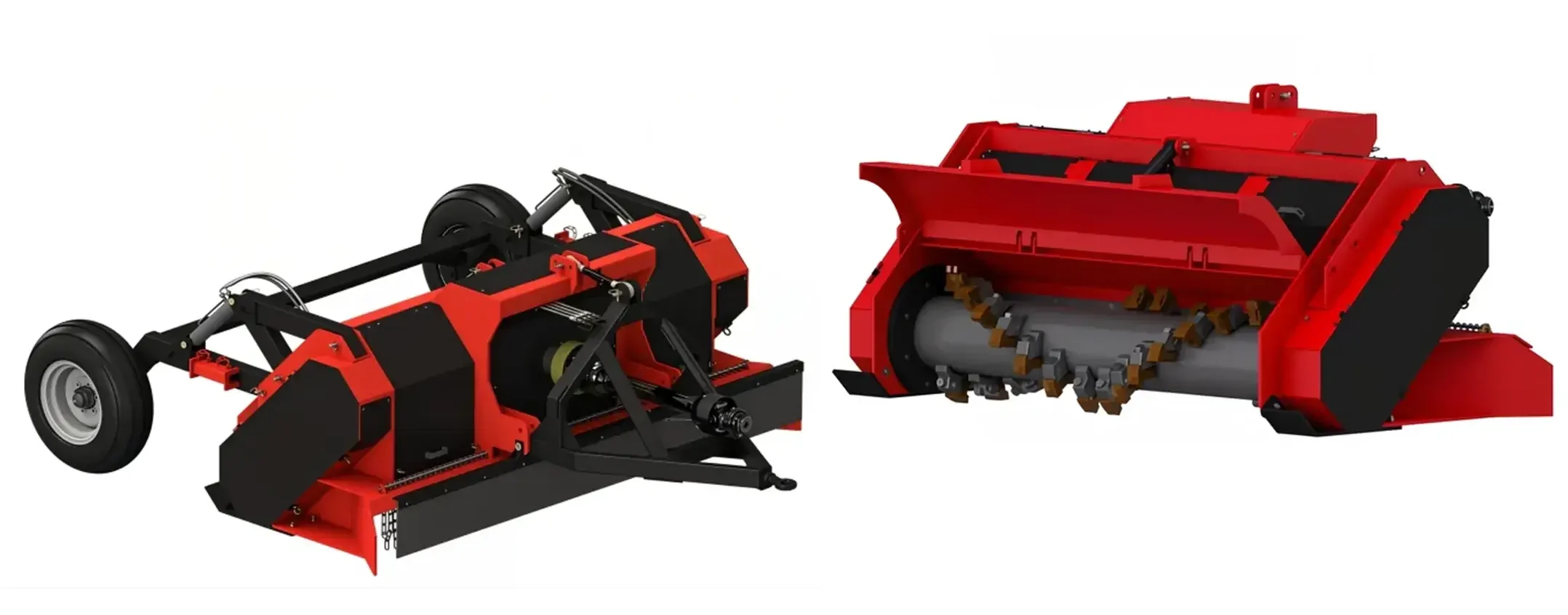
2. Action Method: How a PTO Stone Crusher Operates
Understanding exactly how a machine works helps farmers calibrate expectations, match it to the correct tractor, and operate it safely and productively. A pto stone crusher is a tractor-mounted attachment that connects to the rear three-point linkage — Category 2 for most mid-size agricultural tractors — and receives its drive power through the PTO shaft at either 540 RPM or 1000 RPM. The PTO shaft transmits rotary energy through the machine’s sealed oil-bath gearbox and drives a high-speed rotor inside the crushing chamber. Every stone crusher in the range uses this fundamental principle: rotational energy from the tractor’s engine, converted by the machine’s internal transmission into repeated high-speed impact blows against rock.
The rotor is the operational core of any stone crusher. Mounted on the rotor drum are multiple hammers, picks, or combination-type crushing tools arranged symmetrically around the drum’s circumference. As the rotor spins — typically at speeds generating 600–1,200 surface metres per minute depending on rotor diameter and RPM — these tools deliver continuous high-energy strikes against rock surfaces. The pto stone crusher’s impact mechanism shatters brittle materials like basalt and laterite, which have relatively low tensile strength compared to their compressive strength, meaning they fracture predictably under repeated blows. Trap rock, being slightly more granular and less homogeneous, needs slightly more working passes in the pto stone crusher but responds to the same mechanism. The key advantage of a pto stone crusher over a portable stone crusher machine or static stone crusher machine is precisely this in-situ processing — the stone crusher comes to the rock, not the other way around.
The front shear bar — a hardened steel fixed blade bolted across the front of the pto stone crusher working chamber — provides the first mechanical contact with stones as the tractor advances. It guides material into the rotor zone and pre-fractures larger pieces before the rotating tools complete the size reduction. A rear grill or containment grid controls the exit particle size: only fragments smaller than the grill’s opening diameter can exit the crusher chamber, ensuring that oversized pieces recirculate inside until they reach the required granulometry. This dual-stage action means a well-matched stone crusher delivers consistently sized output — typically fragments between 15 mm and 150 mm depending on the series and grill setting selected by the operator.
The tractor carrying the stone crusher advances at roughly 2–5 km/h, with the crushing head lowered by the three-point linkage to the required working depth. Most stone crusher models offer adjustable working depth from ground contact to 150 mm, 200 mm, or even 280–400 mm below surface. On laterite-rich terrain in Maharashtra, where rock sheets typically sit 80–120 mm below surface, a small pto stone crusher from the STCL series can clear entire plots in two passes. On harder Vidarbha basalt, the heavier STCM-class pto stone crusher at 200 mm working depth is the right tool. The crushed material stays in the field — unlike quarrying or removal methods — and the stone crusher operator simply follows the tractor at walking pace, allowing the machine to do the work systematically across the plot.
3. Manufactured Structure: How a PTO Stone Crusher Is Built
The structural integrity of a pto stone crusher determines how long it survives in the punishing conditions of agricultural rock-breaking. These machines endure continuous impact forces that would compromise lesser fabrications within hours. The design philosophy behind professional-grade stone crushing equipment centres on controlled energy absorption — transferring impact forces from stone-to-tool into the housing frame and then into the tractor’s linkage, rather than allowing concentrated stress points to crack the structure over time. A stone crusher built to a high structural standard will survive thousands of operating hours on Indian basalt; one built to a lower standard will show fatigue cracks within the first season. Knowing the key structural elements of a pto stone crusher helps buyers distinguish genuinely durable equipment from lower-quality alternatives when comparing tractor stone crusher products.
Main Housing Frame
The pto stone crusher outer housing is fabricated from thick-gauge structural steel plate, typically 10–20 mm depending on the model’s rated stone diameter. All structural joints are robot-welded and stress-relieved. Internal surfaces facing the rotating tools are lined with replaceable Hardox wear plates, bolted in place so they can be swapped without dismantling the entire pto stone crusher casing.
Rotor Assembly
The stone crusher rotor drum is precision-machined, dynamically balanced, and mounted on heavy-duty tapered roller bearings at both ends. The drum body is manufactured from quenched-and-tempered alloy steel to handle torsional loads during hard-rock crushing. Tool sockets are machined directly into the drum at precise angular intervals to maintain rotor balance after tool replacement.
Gearbox and Drive Train
The pto stone crusher gearbox is sealed in an oil-bath enclosure to exclude the fine abrasive dust generated during field rock-breaking — a critical design feature for Indian operating conditions where laterite fields generate high dust loads. On dual-transmission (DT) models, a gearbox is mounted on both sides of the crusher rotor, distributing torque evenly and reducing individual component stress during continuous basalt crushing operations.
Depth Control System
Working depth on a pto stone crusher is controlled through the tractor’s three-point linkage position combined with mechanical depth-limiting skids or rollers mounted at the sides of the housing. The skids ride the soil surface as a reference datum, keeping the pto stone crusher at the set depth regardless of ground undulation. On heavier pto stone crusher models, hydraulic depth adjustment cylinders allow on-the-fly depth changes from the tractor cab.
Three-point linkage compatibility is standardised to Category 2 on the majority of agricultural stone crusher models suited to 70–230 hp tractors. This ensures direct compatibility with the Indian tractor fleet — Mahindra, TAFE, Sonalika, John Deere India, and New Holland India all produce Category 2 linkage tractors in the relevant power range — without the need for adapters or custom fabrication. The linkage attachment points on a quality stone crusher are through-bolted using high-tensile Grade 10.9 hardware, and the PTO shaft connection includes a cam clutch or friction clutch torque limiter that protects both the gearbox and the tractor’s PTO drivetrain from overload when encountering unexpectedly large embedded boulders.
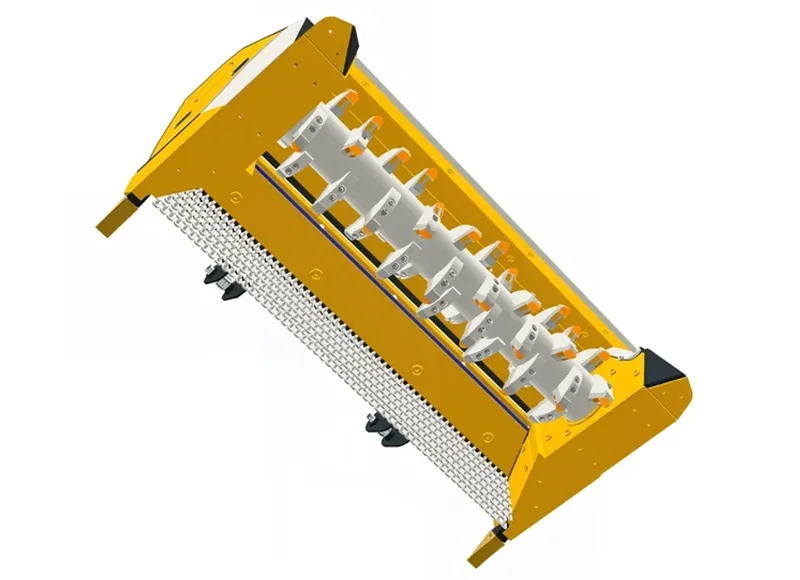
4. Material System: What a PTO Stone Crusher Is Made Of
The longevity and cost-per-hour of any pto stone crusher in the field comes down to one word: materials. The wrong steel grade on a hammer tool will wear out in 20 operating hours when crushing basalt. The right grade will last 200 hours in the same material. Understanding the material system helps buyers evaluate what they are actually getting when comparing stone crusher products at different price points, and helps operators plan maintenance schedules intelligently. This is particularly relevant when sourcing a pto stone crusher for sale in India or Korea, where after-sales spare parts supply must also be considered alongside initial purchase cost.
| Component | Typical Material | Relevance for Basalt / Laterite Operations |
|---|---|---|
| Housing panels | S355 structural steel, 10–20 mm | Absorbs torsional loads from uneven basalt slabs without permanent deformation |
| Internal wear liners | Hardox 450 or 500, 8–12 mm | Resists abrasive silica-rich laterite that destroys mild steel in hours of operation |
| Rotor drum body | 42CrMo4 quenched alloy steel | High toughness essential for repeated impact from hard volcanic trap rock formations |
| Hammers / STC/3-type tools | Wear-resistant alloy steel, HRC 52–60 | High hardness maintains cutting edge geometry on abrasive laterite over extended operation |
| Picks / R/65-type tools | Tungsten carbide tip, steel shank | Carbide inserts essential for RSL/RSM-class pto stone crusher when processing basalt over 300 mm diameter |
| Front shear bar | Boron steel or Hardox 600 | Highest hardness grade — takes the primary impact of every stone entering the crusher chamber |
| Rear containment grill | Hardox bars or cast manganese steel | Must withstand constant impact from recirculating fragments inside the crushing chamber |
| Gearbox housing | Cast iron or forged steel, oil-bath sealed | Oil-bath sealing blocks dust ingress from dry laterite fields in Maharashtra’s hot season |
| Bearings | Heavy-duty tapered roller, sealed | Handles both radial and axial loads from crushing angled trap rock seams in the field |
The material system is what separates an industrial-grade stone crusher from budget alternatives. When evaluating a pto stone crusher for sale, asking specifically about the Hardox grade of wear liners, the HRC hardness rating of the hammer tools, and whether the gearbox is splash-lubricated or pressure-lubricated gives a far clearer picture of durability than marketing materials alone. For Indian conditions — where laterite’s silica and iron oxide content is particularly abrasive and basalt’s compressive strength demands consistent tool geometry — these material details translate directly into real-world cost per hectare cleared. A pto stone crusher with the correct material specification for your rock type will return its purchase cost over significantly fewer operating seasons than a cheaper but incorrectly specified machine.
5. Understanding the Rocks: Laterite, Basalt, and Trap Rock
Not all rocks behave identically under a pto stone crusher rotor. Matching the pto stone crusher model to the specific geology makes a significant difference in both productivity and tool wear costs. Each of the three principal rock types found on Indian farmland responds somewhat differently during pto stone crusher operation, and choosing the correct machine series for each saves time, fuel, and maintenance expense.
Laterite
Found across coastal Maharashtra (Ratnagiri, Sindhudurg, Raigad), Goa, and Karnataka’s Western Ghats belt. Laterite ranges from unconsolidated nodular gravel to hard solid sheets with compressive strengths of 20–50 MPa. STCL-class stone crusher models (70–150 hp tractors, max shredding diameter 150 mm) handle most laterite formations comfortably. The high iron oxide and silica content is highly abrasive — use Hardox-lined stone crushing equipment and inspect STC/3 hammer tools every 50 operating hours in heavy laterite fields.
Basalt
The defining geology of the Deccan Traps — covering Marathwada, Vidarbha, north Karnataka, and western Andhra Pradesh. Basalt’s compressive strength is 100–300 MPa, making it one of the hardest common agricultural rocks. For heavy basalt, STCM-class stone crusher models (80–220 hp, max shredding diameter 300 mm, working depth 200 mm) are the minimum. Where basalt slabs exceed 300 mm, RSL or RSM class pto stone crusher equipment with tungsten carbide picks and rotor diameters of 595–940 mm is the right specification. The pto stone crusher must be capable of handling the rock diameter and depth combination present in each specific field before purchase.
Trap Rock
The colloquial term in Maharashtra and Karnataka for dark, dense volcanic or intrusive rock including dolerite, gabbro, and fine-grained basalt. Trap rock compressive strength ranges 80–250 MPa. Impact-type tools in a pto stone crusher (hammer type) perform well on fine-grained trap rock, while coarser formations benefit from the combination G/3 and R-type rotor configurations found on RSL-class pto stone crusher models. Reduce forward operating speed to 2–3 km/h in dense trap rock to ensure adequate tool contact time and complete size reduction.
6. Recommended PTO Stone Crusher Models for Indian Conditions
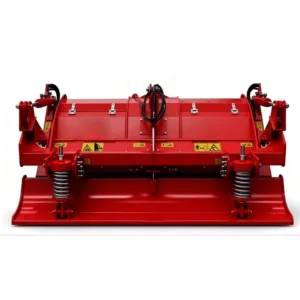
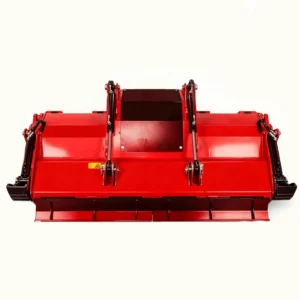
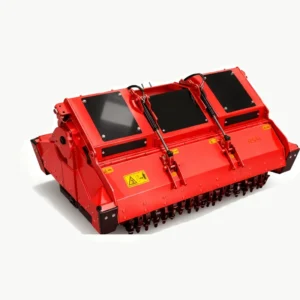
Each pto stone crusher in this range is designed for specific tractor horsepower and rock hardness profiles. Select your stone crusher based on your geology and tractor fleet.
7. PTO Stone Crusher Series Technical Comparison
Key parameters for matching the correct stone crusher series to Indian agricultural and hard-rock land reclamation applications.
| სერია | ტრაქტორი HP | PTO (rpm) | Max Stone Dia (mm) | Working Depth (mm) | Rotor Dia (mm) | Best Rock Type |
|---|---|---|---|---|---|---|
| STCL | 70–150 | 540–1000 | 150 | 150 | 450 | Laterite, light basalt |
| STCM | 80–280 | 1000 | 300 | 200 | 550 | Basalt, hard laterite, trap rock |
| STCH | 280–400 | 1000 | 500 | 250 | 700 | Heavy basalt, large trap rock |
| RSL | 80–190 | 540–1000 | 300 | 150–280 | 595 / 612 | Mixed rock reclamation |
| RSM | 200–360 | 1000 | 500 | 400 | 940 / 915 | Deep basalt, land reclamation |
| თორი 2.4 | min. 180 | — | — | — | — | Hard rock, 2,400 mm width |
8. Regulatory Standards and Legal Framework
Agricultural stone crushing equipment — whether described as a pto stone crusher, tractor stone crusher, or stone crusher machine — is subject to a growing framework of technical safety standards, equipment certification requirements, and environmental regulations across markets. Understanding these obligations helps buyers procure compliant equipment and avoid customs delays, insurance gaps, or liability exposure from non-conforming stone crusher machinery.
India — CMVR, BIS, and Agricultural Equipment Standards
In India, a tractor-mounted pto stone crusher that does not travel independently on public roads falls outside the Central Motor Vehicles Rules (CMVR), but is subject to Bureau of Indian Standards (BIS) requirements under IS 9851 (series) covering agricultural machinery safety. The Indian Council of Agricultural Research (ICAR) publishes performance and safety test protocols for agricultural machinery through the All India Coordinated Research Project on Farm Implements and Machinery (AICRP on FIM). Farm stone crushing equipment imported into India must comply with the Quality Control Order for agricultural machinery under the Foreign Trade (Development and Regulation) Act. Buyers sourcing a used tractor stone crusher for sale in India should confirm whether the pto stone crusher unit has an ICAR test report and whether it complies with current Quality Control Orders, as non-certified stone crusher machinery may face restrictions on resale and use.
South Korea — Agricultural Machinery Law
In South Korea, agricultural machinery is governed by the Agricultural Machinery Industrialisation Promotion Act (농업기계화촉진법) administered by the Ministry of Agriculture, Food and Rural Affairs (MAFRA). Stone crushing and land preparation equipment above a defined power threshold must be registered with the Rural Development Administration (RDA) and meet the safety and performance standards in the KS (Korean Standards) agricultural machinery series. Imported pto stone crusher equipment for agricultural use in Korea is subject to customs tariff classification under HS code 8432 (soil working machinery), typically 0% under KORUS and Korea-EU FTA provisions. Korean importers of tractor stone crusher for sale equipment should obtain Korean-language operating documentation and confirm RDA performance test eligibility for subsidy applications under the Agricultural Machinery Loan Subsidy Programme.
European Union — Machinery Directive 2006/42/EC
Stone crusher equipment manufactured in or imported into the EU is subject to the Machinery Directive 2006/42/EC, requiring CE marking, a Declaration of Conformity, and a technical file covering risk assessment and test records. The directive specifically addresses soil working machinery and requires guards over all exposed rotating parts including the machine PTO shaft, emergency stop provisions, and noise/vibration documentation per EN ISO 4254. From 2027, the EU Machinery Regulation 2023/1230/EU replaces the directive with stricter digital documentation requirements. While CE marking is not mandatory in India or Korea, it is widely regarded as a quality indicator and is increasingly requested by institutional buyers of stone crusher equipment in both markets.
ISO Standards Applicable to PTO Stone Crusher Equipment
ISO 11684 covers safety signs on agricultural and forestry machinery. ISO 4254-7 covers safety requirements for rotary cultivators, power-driven harrows, and similar stone crushing equipment. ISO 9001 Quality Management System certification, held by professional pto stone crusher manufacturers, provides baseline assurance of consistent production quality and traceability. When evaluating a pto stone crusher for sale, confirming ISO 9001 certification and an available CE Declaration of Conformity gives a measurable indication of engineering standard — regardless of where the pto stone crusher is manufactured.
9. Field Operating Tips for Maharashtra and Karnataka
Practical guidance for operators running a stone crusher on Indian Deccan geology
Control Forward Speed
In dense basalt, run the stone crusher at 2–3 km/h. Higher speeds reduce the number of tool strikes per unit area, leaving fragments too large, and cause load spikes that stress the stone crusher gearbox. Use the lowest gear that keeps the engine and PTO at rated speed continuously.
Overlap Each Pass by 100 mm
On laterite and trap rock, overlap each operating pass by approximately 100 mm to ensure no strips of unprocessed rock are left between runs. This is especially important on sloped terrain where the pto stone crusher working depth varies slightly with ground undulation during each pass.
Inspect Tools Every 50 Hours
Laterite’s silica and iron oxide content is highly abrasive. Inspect every hammer tool and pick tip every 50 operating hours and replace any showing more than 30% wear. Running worn tools through a pto stone crusher reduces crushing efficiency and increases fuel consumption per hectare cleared.
Monitor Gearbox Temperature
In Maharashtra’s hot pre-monsoon season, ambient temperatures above 40°C can push the pto stone crusher gearbox oil into the thermal degradation range during extended operations. Take 15-minute breaks every 2 hours of continuous crusher work and check the gearbox for abnormal heat accumulation.
Survey Before the First Pass
In converted scrubland or formerly irrigated plots in Karnataka, buried metal (irrigation pipes, rods, fittings) can damage the pto stone crusher rotor. Walk the field or use a metal detector before the first crusher pass. The PTO torque limiter protects the stone crusher in severe cases, but prevention avoids downtime entirely.
Seasonal Timing
The best window for stone crusher operations in Maharashtra and Karnataka is November through February. Ground moisture is low enough that crushed fragments stay loose. Avoid peak pre-monsoon heat (42–45°C) without a sealed cab tractor, as it stresses both the operator and the gearbox lubricants during extended fieldwork.
10. About Us
We are a professional manufacturer and supplier of stone crushing equipment, agricultural mulchers, rock rakes, rock pickers, and full-range land preparation machinery. Our production facilities have achieved ISO 9001 Quality Management System Certification, Grade A certification for the Integration of Informatization and Industrialization, and SGS Verified Manufacturer status — providing customers in India, South Korea, and global markets with independently verified product quality assurance.
Our engineering team brings together decades of experience in agricultural machinery design, with specific focus on the material science of wear-resistant components that determines real-world cost-per-hectare of any stone crusher operation. Every critical component in our product range — housing panels, rotor drums, hammer tools, picks, shear bars, and gearbox housings — is specified, tested, and validated against actual field conditions rather than laboratory simulations alone. We maintain extensive stocks of spare parts and consumable wear components for all models in our range, enabling rapid field repair and minimising downtime during critical land clearance seasons.
ხშირად დასმული კითხვები
Common questions from farmers and operators in India, Korea, and international markets about pto stone crusher equipment
Q1. What is the best pto stone crusher for breaking laterite on small farm plots in coastal Maharashtra under 5 acres?
For small plots under 5 acres in coastal Maharashtra with laterite formations up to 150 mm in diameter, the STCL series stone crusher is the most cost-effective choice. It requires a tractor of 70–150 hp — within the range of most mid-size tractors already operating in the region — and can clear laterite ground in two passes at a working depth of 100–150 mm. The STCL stone crusher working width of 1,110–1,830 mm suits plot dimensions and access paths typical of smaller farm holdings in Raigad and Ratnagiri. Contact us for a specific pto stone crusher model recommendation based on your tractor’s PTO rating and rock burden.
Q2. How do I get a quote for an agricultural stone crusher supplier who ships to Karnataka with technical support?
To get a quote for pto stone crusher equipment delivered to Karnataka, use the contact form on our website or reach us through the contact section of this page. Please share your tractor’s make, model, and HP rating; the area you need to process; the type and approximate size of rocks present; and your delivery destination. Our team will recommend the correct series, calculate shipping to your nearest port, and provide a complete cost breakdown including spare parts and consumable tool kits for the first season of stone crusher operation.
Q3. Which tractor stone crusher model is best suited for breaking hard basalt formations in Vidarbha region up to 300 mm diameter?
For basalt formations up to 300 mm in diameter in Vidarbha, the STCM series stone crusher — specifically STCM 150 or STCM 175 with a tractor of 150–220 hp — is the appropriate choice. The STCM stone crusher is rated for a maximum shredding diameter of 300 mm and working depth of 200 mm, with a 550 mm rotor and PTO input at 1000 RPM. Where Vidarbha basalt formations are larger and sit deeper, the RSL series stone crusher (working depth 150–280 mm) or RSM series stone crusher (working depth 400 mm) is the right specification.
Q4. Where can I find a stone crusher near me in Karnataka for a field demonstration before purchasing or renting the equipment?
Finding a local pto stone crusher demonstration unit or authorised dealer in Karnataka is best done through our official distributor network. Contact us with your district and we will connect you with the nearest dealer who can arrange a field demonstration on your land type. A field demonstration is always recommended before purchase when dealing with site-specific geology like the mixed trap rock and basalt formations common in Tumkur, Chitradurga, and Bellary districts of Karnataka. Seeing the specific stone crusher model process your own rock type is the most reliable basis for final model selection.
Q5. What is crusher stone used for after a PTO stone crusher has processed a basalt-heavy field in Maharashtra?
After processing by a pto stone crusher, the crushed material remains in the field and serves several agronomic purposes. Finely crushed basalt improves drainage in the clay-heavy black cotton soils of Marathwada and Vidarbha. The mineral content of basalt — silicon, calcium, and micronutrients — weathers slowly into plant-available forms, acting as a natural slow-release mineral amendment. Crushed fragments also improve the soil’s load-bearing capacity, reducing compaction from subsequent tractor passes. The net result of stone crusher processing is a more workable, better-draining, mineralogically richer soil profile.
Q6. How do I verify that a pto stone crusher for sale meets Indian BIS standards and ICAR certification requirements before buying?
When evaluating a pto stone crusher for compliance with Indian standards, ask the supplier for the BIS test report under current Quality Control Orders, the ICAR performance test report from an authorised test centre such as CIAE Bhopal, the ISO 9001 certificate, and a CE Declaration of Conformity for European-origin pto stone crusher models. Cross-check claimed certifications on the BIS India portal (bis.gov.in). For imported pto stone crusher equipment, also request the HS code classification confirmation to avoid customs clearance delays at Indian ports.
Q7. When is the best time of year to use a portable stone crusher machine for land clearance in Maharashtra before the Kharif season?
The ideal window for running a pto stone crusher or portable stone crusher machine ahead of Maharashtra’s Kharif season is February through April. The soil is dry enough that crushed fragments remain loose rather than compacting, yet there is adequate lead time before June–July sowing to disc-harrow the crusher-processed ground and incorporate organic matter. Avoid starting pto stone crusher operations after mid-May due to extreme pre-monsoon temperatures that stress the tractor and pto stone crusher lubricants. The post-Rabi March window also suits a second crusher pass on plots where the first run missed fragments exposed by subsequent tillage.
Q8. What are the key differences between a small PTO stone crusher and a heavy-duty stone crushing machine for large farms in Karnataka?
A small pto stone crusher (STCL/STCM class, 70–150 hp) handles stones up to 150–300 mm diameter and working depths to 200 mm — suited for farms with moderate rock burdens where the primary goal is soil preparation for tillage. A heavy-duty stone crushing machine (RSM/STCH class, 200–400 hp) handles stones up to 500 mm diameter and working depths to 400 mm, used for full-scale land reclamation where rocky terrain needs to be brought into agricultural production for the first time. For Karnataka farms above 50 acres with significant basalt coverage, the economics of the larger-class pto stone crusher usually justify its higher acquisition cost through significantly greater output per hour.
Q9. How does the pto stone crusher working depth compare across different series, and which depth is right for trap rock in north Karnataka?
Working depth ranges from 150 mm (STCL pto stone crusher) to 200 mm (STCM), 250–280 mm (STCH and RSL dual-depth configurations), and up to 400 mm on the RSM pto stone crusher. For trap rock in north Karnataka — typically extending 150–250 mm below surface — the STCM or RSL/DT pto stone crusher at 200–280 mm working depth is most practical. Where trap rock extends deeper than 250 mm, two crusher passes at increasing depth (150 mm first, then 250 mm) is more effective than a single deep pass, as the first-pass fragments are displaced before the rotor attacks the lower layer.
რედაქტორი: PXY