Agricultural Knowledge Series
PTO Stone Crusher for French Vineyards:
Crushing Limestone and Galets Roulés Without Damaging Vine Rows
How the right pto stone crusher protects your vines, improves soil, and handles the toughest field stones in France’s most iconic wine regions
1. Why French Vineyards Present a Unique Stone Crushing Challenge
France’s vine-growing regions are as geologically diverse as they are historically rich. From the chalk-laced subsoils of Champagne to the celebrated galets roulés — those smooth, rounded river pebbles blanketing the Châteauneuf-du-Pape appellation — and from the hard limestone ridges of Burgundy to the schist-covered slopes of Alsace, the stone problem in French vineyards takes many forms and demands nuanced solutions. For any winegrower or vineyard contractor who has tried managing these materials with conventional tillage equipment, the damage potential is obvious: broken tines, bent shares, and worst of all, fractured vine roots that never recover fully.
The right pto stone crusher changes this equation entirely. Rather than displacing stones to field edges where they accumulate into obstacles, or leaving them to damage harvesting and spraying equipment on future passes, a tractor-mounted pto stone crusher pulverizes surface and near-surface rock into small-diameter fragments that integrate directly into the soil profile. The result is a safer, more workable inter-row floor that reduces equipment wear, supports better drainage, and in limestone-dominant soils, actively improves soil pH equilibrium — a genuine agronomic benefit rather than just a maintenance task.
This article covers the mechanical principles behind a pto stone crusher, its structural engineering, material specification, regulatory compliance across France and key export markets, and the specific models best suited for narrow vineyard inter-row operations. Whether you are a Korean agricultural machinery importer, a French winegrowing estate manager, or an international equipment dealer evaluating the stone crusher for sale market, this guide provides the depth you need to make a well-informed decision.
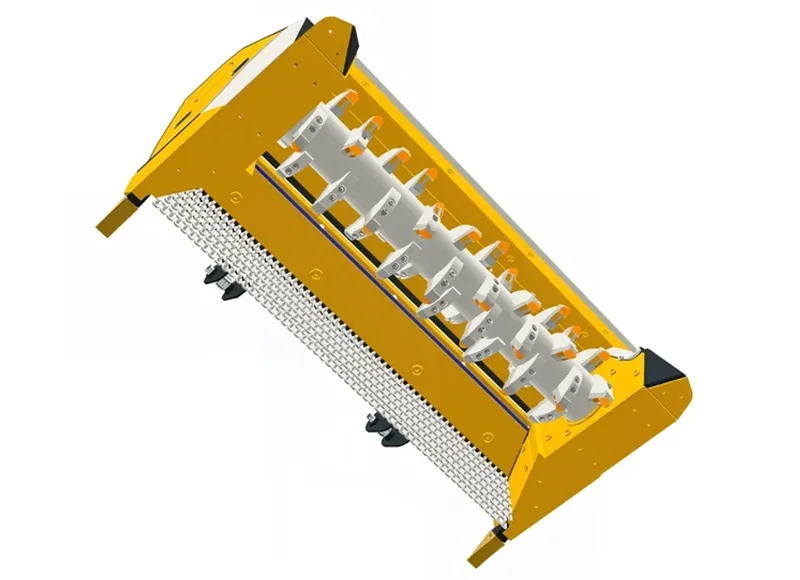
2. Action Principle: How a PTO Stone Crusher Breaks Rock
The operating mechanism of a pto stone crusher is fundamentally different from that of a rock picker or a rock rake. Rather than collecting and transporting stones, the stone crusher machine pulverizes them in situ, leaving the crushed material on the ground surface where it becomes part of the soil matrix. This in-place processing is what makes the pto stone crusher genuinely valuable in vineyards — removing stones from dense vine rows would require specialized collection equipment and additional passes, each carrying the risk of cane and trunk contact. Crushing them where they lie eliminates secondary handling entirely.
At the heart of the machine is a horizontal rotor driven by the tractor’s power take-off (PTO) shaft, running at either 540 RPM or 1000 RPM depending on the model and tractor specification. The rotor carries a series of hardened steel cutting tools — carbide-tipped picks, chisels, or combination teeth types — arranged in a helical pattern to ensure progressive, balanced engagement with the ground surface. As the tractor advances at working speed, typically 1–5 km/h in rocky vineyard conditions, the rotor spins at high velocity, and the cutting tools impact, fracture, and shatter stone through a combination of impact force and shearing action.
The crushed fragments are contained within a rear shroud and deflector system before being deposited behind the machine in a leveled layer. The adjustable rear scraper blade — sometimes called the bulldozer component — performs a secondary grading function, smoothing the crushed material into the inter-row surface. This integrated leveling action means one pass of an agricultural stone crusher achieves what would otherwise require separate crushing and grading operations, reducing total time in the vineyard and minimizing tractor traffic between vine rows.
Maximum working depth is a key parameter for vineyard selection. In limestone terrain where stones are embedded just below the topsoil, a working depth of 150–200 mm is typically sufficient for the PSC series models, while the STCM series achieves 200 mm depth. In Châteauneuf-du-Pape’s characteristic galet-covered plots, working depth rarely needs to exceed 100–120 mm because the galets sit predominantly on or just at the surface, making the lighter PSC models ideal for this application. For operators dealing with heavier limestone outcrops in the southern Rhône or Burgundy, the STCM 150 through STCM 225 configurations — supporting up to 220 hp tractors with a 550 mm rotor diameter — offer the combination of rotor mass and tooth count needed to fracture harder rock without stalling.
3. Manufacturing Structure: Frame, Rotor, and Transmission Design
A well-built pto stone crusher relies on three structural subsystems working in concert: the main frame, the rotor assembly, and the mechanical transmission between the tractor PTO and the rotor shaft. Each subsystem must be engineered to absorb the shock loads generated by hard stone impact — forces that can momentarily exceed the steady-state torque rating by a factor of three or more in hard rock conditions. Understanding this structure helps buyers assess whether a given machine will endure the specific geological challenges of French vineyard terrain.
The main frame is fabricated from thick-section structural steel, typically welded into a torsionally rigid closed-section box that houses the rotor bearings on both ends. The frame connects to the tractor via a Category 2 three-point linkage system, which is the standard for most tractors in the 70–230 hp range typically used in French vineyards. The three-point connection allows the crusher to follow ground undulations to a limited degree, essential in hillside vineyard plots where the inter-row floor is rarely perfectly level. The THOR 2.4 model, for instance, uses a drawbar kit that gives additional flexible positioning capability compared to a pure three-point mount, making it particularly useful on steep Alsatian or Burgundian slopes.
The rotor itself is a precision-balanced steel drum onto which the cutting tool holders are welded or bolted. Rotor diameter varies by series: the PSC (STCL) series uses a 450 mm diameter rotor, while the STCM series steps up to 550 mm. The larger diameter rotor carries greater peripheral velocity at the same RPM, delivering proportionally more impact energy per tooth strike. The helical tooth arrangement — rather than a straight row of teeth — ensures that at any given rotor angle, only a fraction of the total tooth count is in simultaneous ground contact. This staggered engagement reduces peak torque demand, protects the tractor’s PTO shaft, and produces a more uniform crushed particle size.
The power transmission train typically includes a driveline shaft with telescoping joints and slip-clutch or shear-bolt overload protection. This protection system is non-negotiable in vineyard applications because vine posts, irrigation pipes, and trellis anchor stakes are occasionally encountered beneath the soil surface. Without overload protection, a single undetected obstacle could damage the gearbox, rotor, or PTO shaft in milliseconds. The gearbox — either a direct-flange type or a belt-and-pulley reduction assembly — steps down from 540 or 1000 RPM PTO input to the rotor operating speed, with internal lubrication designed for continuous high-torque operation across full working shifts.
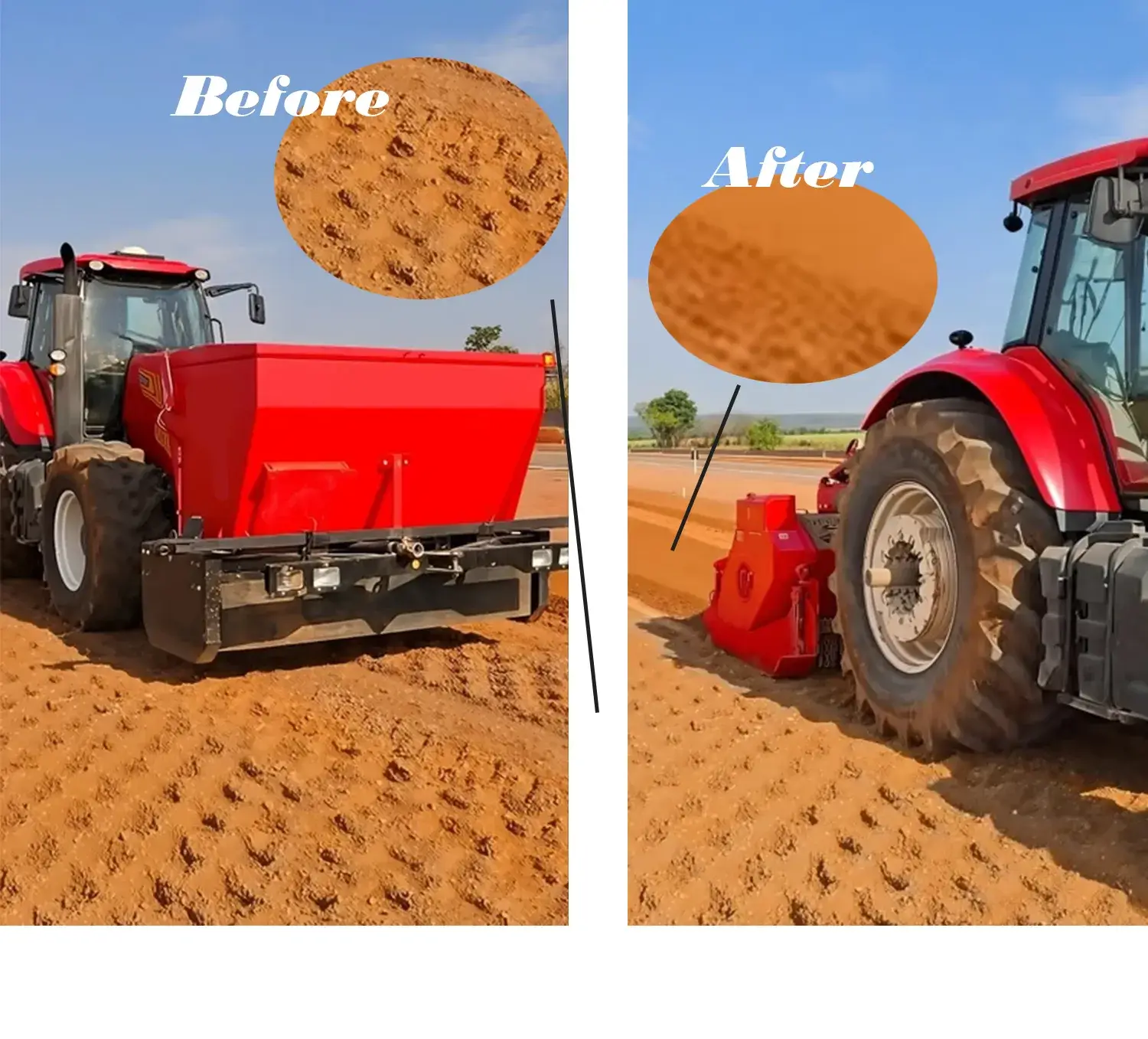
4. Material System: Steels, Carbide Alloys, and Wear-Resistant Components
The material choices in a pto stone crusher determine whether the machine will operate profitably in abrasive, hard-rock vineyard conditions or will consume its cutting tools — and the operator’s maintenance budget — within the first season. The fundamental challenge is that cutting tools must be simultaneously hard enough to fracture stone without excessive wear, yet tough enough to absorb the repeated impact loading without brittle fracture. These requirements are contradictory in plain steel and can only be reconciled through carefully specified alloy grades and surface treatment processes.
The rotor body and main frame components are fabricated from high-strength structural steel, typically EN S355 or equivalent grades, which provides the combination of weldability and yield strength needed for fabricating thick-walled sections under controlled workshop conditions. Critical stress zones — particularly the rotor hub and bearing journals — may be machined from low-alloy engineering steel such as 42CrMo4 (AISI 4140), which provides superior fatigue resistance compared to plain carbon grades when heat-treated to a tempered martensite microstructure.
Cutting tools in the agricultural stone crusher context are most commonly manufactured from medium-carbon Boron steel (e.g., 27MnCrB5) with a surface hardness of 58–62 HRC after quench and temper treatment. Boron steel’s combination of moderate carbon content and hardenability-enhancing boron addition produces a tooth that resists surface abrasion without the brittleness characteristic of higher-carbon tool steels. The most demanding vineyard applications — particularly hard Jurassic limestone common in Burgundy and Châteauneuf-du-Pape’s quartzite galets — benefit from tungsten carbide-tipped picks, where a sintered WC-Co insert brazed or mechanically fastened into the steel holder provides dramatically extended wear life against quartz-bearing rock types.
The rear shroud and side panels, which absorb significant impact from ejected fragments, are typically lined with bolt-on Hardox 500 or equivalent wear-resistant steel plates. Hardox grades offer a nominal hardness of 500 Brinell — roughly 2.5 times the hardness of mild steel — and are used as replaceable liners rather than structural members, keeping repair costs manageable and downtime minimal when liner replacement becomes necessary after extended operation in particularly abrasive vineyard soils.
5. Specific Application: Galets Roulés, Limestone, and Vine Row Safety
The term galets roulés — French for “rolled pebbles” — describes the distinctive smooth quartzite stones that cover the surface of Châteauneuf-du-Pape’s AOC vineyards in the southern Rhône. These stones, deposited by the ancient Alpine glacial melt across the Costières plateau, serve a genuine viticultural function: they absorb solar heat during the day and radiate it back at night, moderating temperature extremes and accelerating grape maturation. However, when frost and cultivation cycles gradually bury these pebbles at irregular depths, they interfere with inter-row management machinery including sprayers, mowers, and leaf removal equipment.
A small pto stone crusher operating in a narrow-vineyard configuration — particularly the PSC 100 or PSC 125 models with working widths of 1,110 mm and 1,350 mm respectively — can be precisely positioned within a vine row of 1.8–2.0 m width without encroaching on the vine trunk zone. The adjustable side skids and the machine’s well-defined outer profile allow the operator to maintain a 150–200 mm clearance from the cordon training wires. This spatial precision, combined with the machine’s controllable working depth, means galets can be partially crushed to reduce their above-surface profile without disturbing the deep root zone or undermining the thermal heat-retention function that winegrowers deliberately preserve.
For Burgundy’s côteaux vineyards — particularly in Gevrey-Chambertin, Meursault, and the Côte de Nuits more broadly — the geological substrate is Jurassic Bathonian limestone, which weathers into angular, friable surface slabs rather than rounded pebbles. These slabs work progressively upward through frost-heave cycles and become a seasonal hazard for tractor operators and equipment. The STCM series agricultural stone crusher handles this material type efficiently: the maximum shredding diameter of 300 mm accommodates the typical slab sizes encountered in these appellations, and the 550 mm rotor delivers sufficient impact energy to fracture the harder calcium carbonate matrix without requiring multiple overlap passes.
6. Technical Specifications Comparison — PSC Series vs STCM Series
Selecting the right stone crusher machine for vineyard use depends on four primary variables: the available tractor horsepower, the vine row width, the dominant stone type, and the required working depth. The table below compares the core PSC (STCL) models — ideal for narrow rows and smaller tractors — with the higher-output STCM series for operations requiring greater crushing capacity or wider working widths. All data below is taken from the officially published product specifications.
| Model | Tractor (hp) | PTO (rpm) | Working Width (mm) | Rotor Dia. (mm) | Max Stone Dia. (mm) | Max Depth (mm) | Weight (kg) |
|---|---|---|---|---|---|---|---|
| PSC 100 | 70–120 | 540–1000 | 1,110 | 450 | 150 | 150 | 1,230 |
| PSC 125 | 80–120 | 540–1000 | 1,350 | 450 | 150 | 150 | 1,280 |
| PSC 150 | 90–120 | 540–1000 | 1,590 | 450 | 150 | 150 | 1,440 |
| PSC 175 (ST) | 100–120 | 540–1000 | 1,830 | 450 | 150 | 150 | 1,570 |
| PSC 200 (DT) | 120–150 | 1000 | 2,070 | 450 | 150 | 150 | 1,750 |
| STCM 150 | 150–220 | 1000 | 1,584 | 550 | 300 | 200 | 3,000 |
| STCM 175 | 160–220 | 1000 | 1,824 | 550 | 300 | 200 | 3,250 |
| STCM 200 | 170–220 | 1000 | 2,064 | 550 | 300 | 200 | 3,550 |
| STCM 225 | 180–220 | 1000 | 2,304 | 550 | 300 | 200 | 3,800 |
| თორი 2.4 | 180 min. | — | 2,400 | — | — | — | 2,300 |
All specifications sourced from official product pages at pto-stone-crusher.com. THOR 2.4 requires 2 control valves; bottom linkage category 2 for all models.
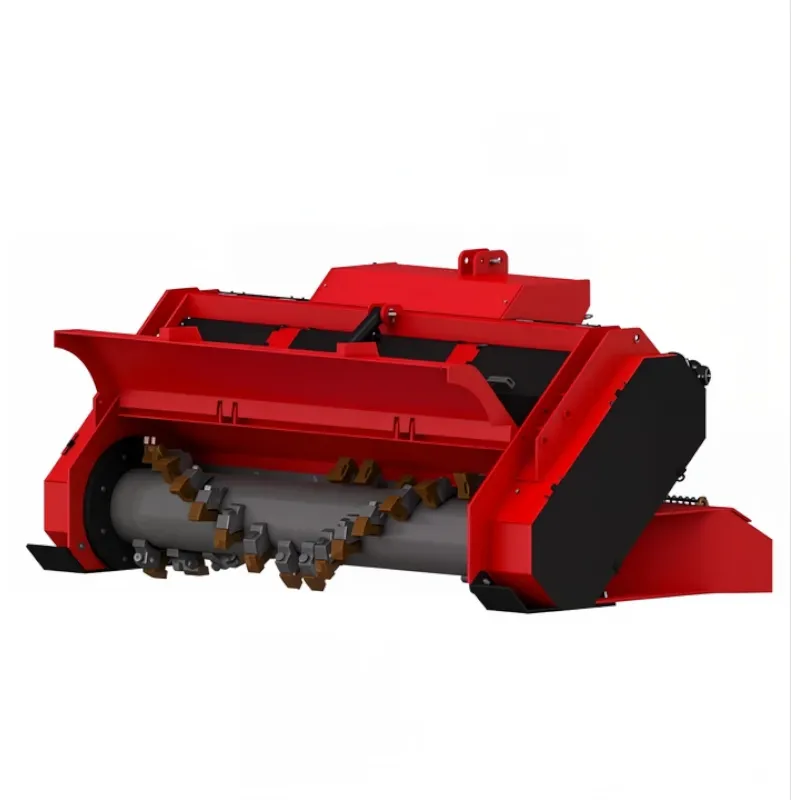
7. What Is Crusher Stone Used For? Agronomic Benefits in Vineyard Soils
The question of what crusher stone is used for goes beyond simple field clearance. In vineyard soils, crushed limestone performs a secondary role as a soil amendment: the fractured surfaces of calcium carbonate particles accelerate their dissolution in soil moisture, gradually releasing calcium ions that improve soil structure, displace sodium, and raise pH in acidic terroir contexts. For Burgundy winegrowers managing soils prone to compaction from heavy clay fractions, the incorporation of crushed limestone fragments enhances macroporosity over successive seasons — a documented benefit in the viticultural science literature that justifies the investment in stone crushing equipment beyond the immediate equipment-protection argument.
In the Côtes du Rhône and broader Languedoc-Roussillon context, crushed galets act as a mulch layer that reduces inter-row weed pressure, improves moisture retention between irrigation events, and provides a stable, well-drained walking surface for vineyard workers during harvest operations. Estates that have transitioned from stone collection to stone crushing consistently report shorter tractor hours per hectare in ongoing inter-row management, because the crushed surface is easier for mower and sprayer equipment to navigate than a galet-strewn, uneven floor.
From a practical agricultural standpoint, crusher stone output also has applications beyond the vineyard itself. Excess crushed rock can be graded to field margins and tracks, improving drainage and load-bearing capacity on farm roads without the cost of importing aggregate. For Korean agricultural importers evaluating this category of stone crushing equipment, the multi-functionality of the pto stone crusher — combining land clearance, agronomic improvement, and infrastructure support into a single attachment — is a compelling commercial argument when presenting the product to domestic fruit and specialty crop growers facing similar rocky terrain challenges.
8. Regulatory Compliance — France, the EU, and Key Import Markets
Agricultural machinery sold and operated in France must comply with European Union product safety and environmental legislation, with the most directly applicable framework being the EU Machinery Regulation 2023/1230/EU, which from 2027 onwards replaces the earlier Machinery Directive 2006/42/EC. Under this regulation, a pto stone crusher sold commercially in France and throughout the EU must carry CE marking, be accompanied by a Declaration of Conformity, and be supplied with a comprehensive operator’s manual in the language of the country of sale. The manufacturer must have conducted a risk assessment addressing noise, vibration, projectile ejection hazards, and PTO shaft entanglement risks, with engineering controls and guarding implemented accordingly.
In France specifically, agricultural machinery noise levels are regulated under the Arrêté du 5 décembre 2006 (transposing Directive 2000/14/EC on outdoor equipment noise), which sets guaranteed sound power levels for PTO-driven equipment. Vibration exposure for operators is governed by Directive 2002/44/EC (Physical Agents — Vibration), transposed into French labor law, limiting daily vibration exposure values and requiring employers to conduct vibration risk assessments for machine operators working extended shifts with crushing equipment. Stone crusher manufacturers targeting the French wine estate market should ensure vibration emission data is available in their technical documentation.
For agricultural machinery exported from or through to Korea, the relevant regulatory framework is managed by the Rural Development Administration (RDA) and the Ministry of Agriculture, Food and Rural Affairs (MAFRA). Imported agricultural machinery must comply with the Agricultural Machinery Certification System under MAFRA’s oversight, with safety performance evaluated per Korean Agricultural Machinery Safety Standards (KS B ISO series). The Agricultural Machinery Industry Law (농업기계화 촉진법) requires imported machinery to meet Korean agricultural safety and efficiency certification before sale through official distribution channels. Korean importers and buyers sourcing a tractor stone crusher for sale should verify that their supplier has documentation supporting certification compatibility.
For the North American market (relevant to exporters from France or Korea), the ASABE S431.1 standard covers tractor-mounted implements including stone crushers. OSHA 29 CFR 1928 covers agricultural operations safety in the United States, with specific provisions for tractor-mounted equipment guarding. Globally, ISO 11684 covers safety signs on agricultural machinery, and compliance with this standard is expected by professional buyers in multiple markets simultaneously.
9. Recommended Models for French Vineyard Operations
The following five models from the Mulchers / Stone Crushers series cover the full range of vineyard applications, from compact narrow-row configurations to high-output estate operations. Each can be explored in detail at our full product catalogue.
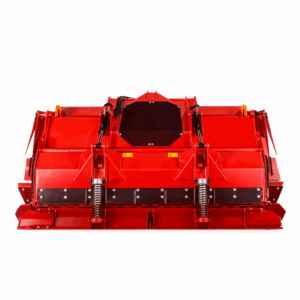
EP-THOR 2.4 + Kit Drawbar
Working width: 2,400 mm. Min. 180 hp. The drawbar configuration gives exceptional manoeuvrability in hillside vineyards where three-point linkage geometry causes uneven depth. Requires 2 control valves.
EP-RockMaster Agricultural Stone Crusher
A robust agricultural stone crusher designed for heavy-duty field operations. Well-suited to vineyard estate managers who need a reliable, high-cycle-life machine for seasonal clearance work across multiple plots.
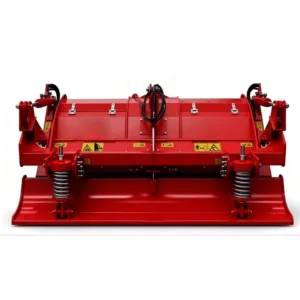
EP-PTO Stone Crusher PSC Models
The lightweight PSC series (PSC 100 through PSC 200). Ideal as a small pto stone crusher for narrow vine rows, rural road maintenance, and versatile farm use. Working widths from 1,110 to 2,070 mm, 450 mm rotor, 70–150 hp tractors.
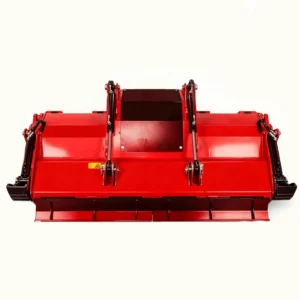
EP-Tractor Mounted Rock Crusher
A versatile tractor stone crusher engineered for direct three-point linkage connection. Category 2 mount suits the 100–200 hp tractor range common in Burgundy and the Languedoc. Suitable for on-row and inter-row stone management.
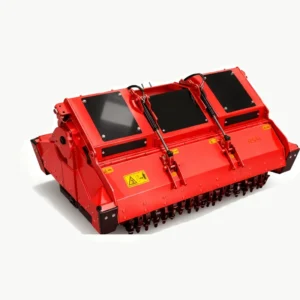
Agricultural Tractor Mounted Rock Crusher (Korea)
Specifically configured and documented for the Korean market. For Korean buyers evaluating a small pto stone crusher for sale domestically, or importers seeking certified stone crushing equipment suitable for Korea’s mixed rocky farmland terrain, this is the recommended starting point.
10. How to Select the Right Tractor Stone Crusher for Your Vineyard
Selecting a pto stone crusher for vineyard use involves matching five interconnected parameters. Getting any one of them wrong — particularly the tractor power match — can lead to underperformance, premature mechanical failure, or inadequate stone reduction. Use the guidance below as a practical framework before requesting a quote from a supplier.
❶ Tractor PTO Power
Match the required minimum hp to your available tractor. For narrow PSC models (PSC 100–PSC 125), a 70–80 hp vineyard tractor is sufficient. The STCM 150 and above require a minimum of 150 hp, which aligns with larger estate tractors.
❷ Row Width and Machine Width
Subtract at least 300 mm on each side from your vine row width to get the safe machine width. For 1.8 m rows: max safe working width ≈ 1,200 mm. For 2.5 m rows: max ≈ 1,900 mm. Total machine width is typically 290–304 mm wider than working width.
❷ Stone Size and Hardness
For galets and soft limestone: PSC (150 mm max shredding diameter) is adequate. For large limestone slabs or mixed hard-rock vineyard soils: STCM series (300 mm max diameter) handles the task without stalling or excessive tool wear.
❸ Required Working Depth
Surface and near-surface work (0–150 mm): PSC series sufficient. Buried stone removal (150–200 mm): STCM series. Note that increasing depth significantly increases rotor load — always confirm adequate tractor power before increasing depth setting.
❹ Terrain Slope and Linkage Type
For steep hillside vineyards: the THOR 2.4 drawbar configuration offers superior depth control on slopes. For flat or gently rolling plots: standard three-point linkage (Category 2) is simpler to operate and maintain.
11. About Our Stone Crushing Equipment Line
We are a specialist supplier of agricultural stone crushing equipment and PTO-driven land preparation machinery, serving professional buyers across Korea, Europe, and international markets. Our product range covers the full stone crusher spectrum — from compact small pto stone crusher models suitable for vineyard rows and rural road maintenance, through to high-output field stone crushers for large-estate or contractor use. Every model in our catalogue is selected and documented with the professional buyer in mind: full technical specification sheets, dimensional drawings, and certification documentation are available on request.
Frequently Asked Questions
Editor: PXY