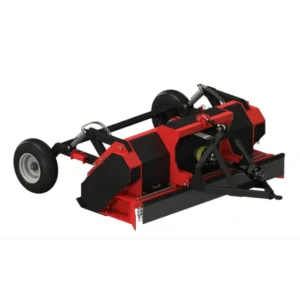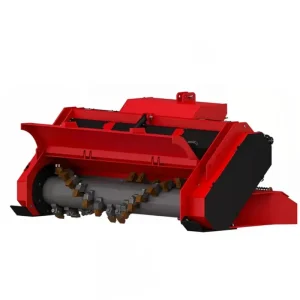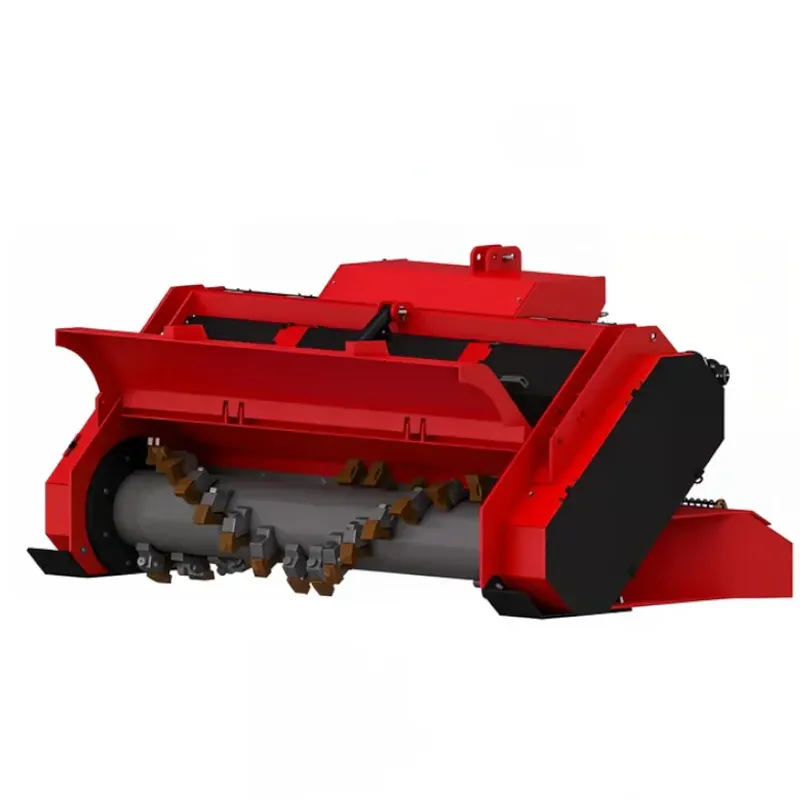
EP-200–360HP Agricultural Stone Crusher in Korea

ATMRC RSM Series: High-Power Agricultural Stone Crushers (200–360 HP) engineered for heavy-duty land reclamation, the ATMRC RSM series delivers robust performance for tractors ranging from 200 to 360 HP. Available in four models—RSM 200/225 and RSM/HP 200/225—these crushers feature working widths of 2080 mm or 2320 mm and a consistent maximum working depth of 400 mm.

Key specifications include a massive G/3 rotor diameter of 940 mm and an R rotor diameter of 915 mm, capable of shredding stones up to 500 mm in diameter. The machines operate at a standard PTO speed of 1000 rpm and weigh between 5060 kg and 5490 kg. With versatile tooth configurations (G/3+STC/3/FP+STC/FP or R/65+R/65/HD+STC/3/FP+STC/FP), the ATMRC series ensures efficient soil preparation and stone management for demanding agricultural environments.

カテゴリー: タグ:

説明

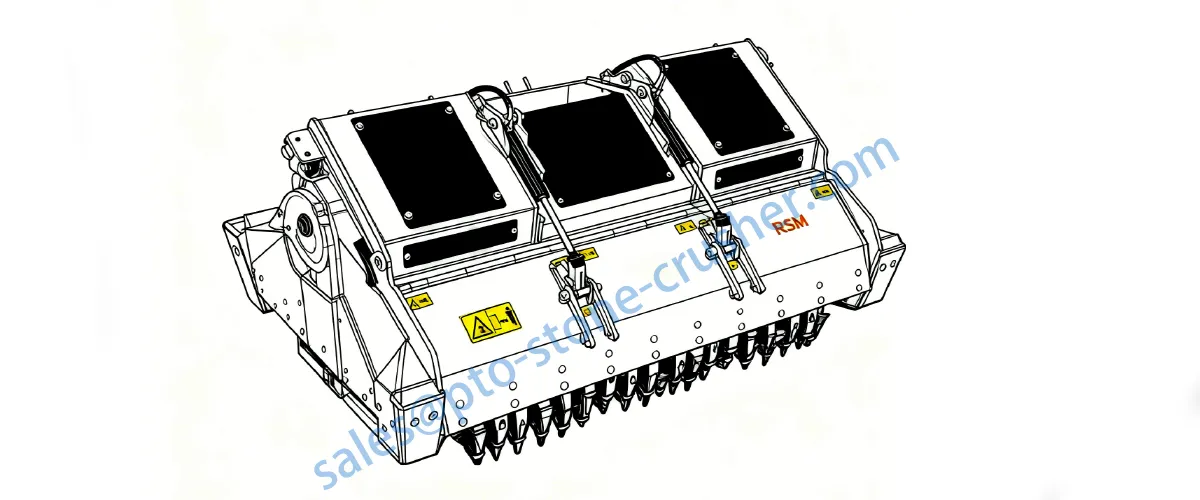
EP-200–360HPHeavy Duty Agricultural Stone Crusher — ATMRC Series PTO Stone Crusher

The ATMRC series is a heavy-duty agricultural stone crusher and the flagship of our agricultural stone crusher line, engineered for large-scale land clearance, orchard renovation, and rockfield reclamation projects. Operating as a PTO stone crusher directly driven by the tractor’s power take-off shaft, the ATMRC range covers tractor power bands from 200 hp through 360 hp across four model configurations. With a maximum shredding diameter of 500 mm and a maximum working depth of 400 mm, this tractor mounted stone crusher sets the benchmark for high-output rock crushing performance in professional agricultural and land management operations. Its dual-rotor architecture — combining a G/3 primary rotor with an R secondary rotor — allows it to handle boulders, root systems, and surface rock simultaneously in a single tractor pass, making it one of the most capable agricultural stone crusher and professional agricultural stone crusher solutions available to B2B buyers worldwide, including the Korean agricultural market. When Korean farmers, land developers, and agricultural contractors search for a dependable agricultural stone crusher, the ATMRC’s combination of raw power, engineering depth, and proven field performance consistently positions it at the top of the evaluation shortlist.

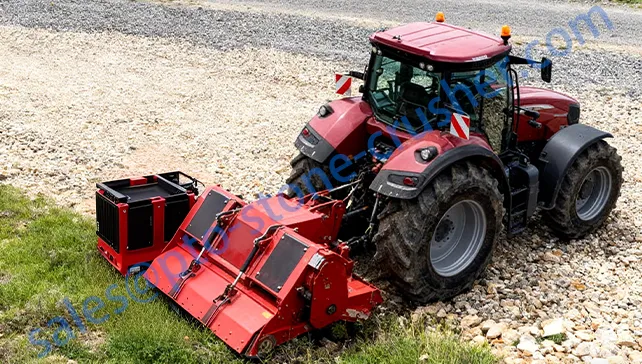
Agricultural tractor mounted rock crusher application

1. Technical Specifications — ATMRC Series

The table below provides complete performance and dimensional parameters for all four ATMRC agricultural stone crusher models. Selecting the correct agricultural stone crusher model begins with matching tractor horsepower to the model range. Both working width and HP-series designation are secondary decisions once the correct power bracket for the agricultural stone crusher has been confirmed. Use these figures to match the correct model to your tractor’s power output and your project’s working width requirement. All dimensional values are in millimetres (mm); weight in kilograms (kg); PTO speed in rpm; tractor power in horsepower (hp).

ParameterATMRC 200ATMRC 225ATMRC/HP 200ATMRC/HP 225
Tractor power (hp)200–300220–300300–360300–360
PTO speed (rpm)1000100010001000
Working width (mm)2,0802,3202,0802,320
Total width (mm)2,4902,7302,4902,730
Weight (kg)5,0605,4905,0605,490
G/3 rotor diameter (mm)940940940940
R rotor diameter (mm)915915915915
Max shredding diameter (mm)500500500500
Max working depth (mm)400400400400
No. teeth — type G/3+STC/3/FP+STC/FP94+4+4106+4+494+4+4106+4+4
No. teeth — type R/65+R/65/HD+STC/3/FP+STC/FP126+20+4+4144+20+4+4126+20+4+4144+20+4+4

HP-suffix models (ATMRC/HP 200 and ATMRC/HP 225) are reinforced internally for the higher torque loads associated with 300–360 hp tractors. Working width and frame size are identical to the standard-series models at the same numeric designation. Buyers comparing agricultural stone crusher models should note that the HP-series agricultural stone crusher is not simply a heavier machine but a re-engineered version optimised for the specific torque curve of high-horsepower tractors.

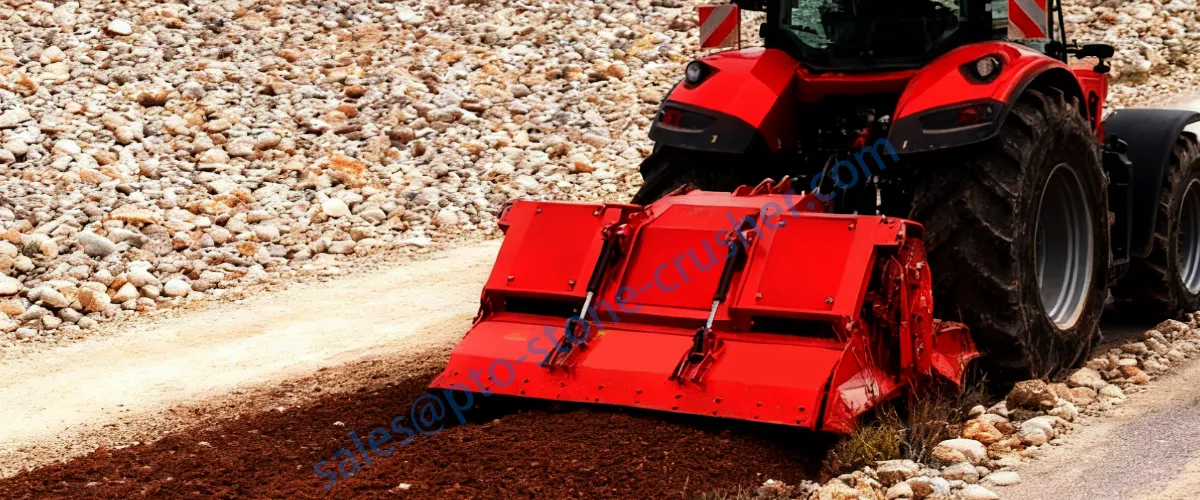
Agricultural Tractor-Mounted Rock Crusher for draft

2. About Our 200–360HP Agricultural Stone Crusher

The ATMRC series agricultural stone crusher is purpose-designed for professional land preparation tasks that standard rotary tillers or mulchers cannot handle effectively. Where the ground surface carries embedded stones, quarried rubble, or exposed bedrock outcrops, conventional tillage equipment risks catastrophic blade damage and costly downtime. The ATMRC PTO stone crusher and agricultural stone crusher addresses this directly with a purpose-hardened hammer and tooth assembly rated for continuous impact against rock material up to 500 mm in diameter, reducing surface stones to gravel-sized fragments that can be left in place to consolidate topsoil or be further processed for use as construction aggregate.

Four models make up the ATMRC range: the ATMRC 200 and ATMRC 225 for tractors in the 200–300 hp and 220–300 hp bands respectively, and the ATMRC/HP 200 and ATMRC/HP 225 for higher-power tractors in the 300–360 hp bracket. Working widths of 2,080 mm and 2,320 mm match the two frame sizes, with total machine widths (including side guards) of 2,490 mm and 2,730 mm. This tractor stone crusher and heavy-duty agricultural stone crusher range is specifically engineered for applications where a smaller, lighter small pto stone crusher would be underpowered — for example, commercial orchard establishment on rocky hillsides in South Korea’s mountainous farming regions, or large-scale reclamation projects on former quarry sites.

All four ATMRC agricultural stone crusher models operate at a PTO input speed of 1,000 rpm — the standard “economy PTO” speed found on all modern high-horsepower agricultural tractors — meaning no additional gear reduction is required between the tractor PTO shaft and the machine’s input gearbox. This direct-drive approach keeps the agricultural stone crusher powertrain simple, reduces energy losses, and ensures that the full rated horsepower of the tractor is available at the crusher’s rotor shafts. For buyers evaluating pto stone crusher for sale and agricultural stone crusher options in the professional and commercial agricultural sector, the ATMRC series represents a well-engineered, field-proven solution backed by full technical documentation and B2B supply capability.

3. Five Key Product Advantages

Dual-Rotor System for Maximum Rock Reduction

The ATMRC series combines a G/3 primary rotor (940 mm diameter) and an R secondary rotor (915 mm diameter) in a single machine pass. This two-stage crushing architecture means incoming boulders are first fractured by the primary rotor’s heavier hammer teeth, then further reduced by the secondary rotor before material exits the rear of the machine. The result is a finer, more uniform output fragment size compared with single-rotor stone crusher machines and entry-level agricultural stone crusher designs, and a significantly lower pass count needed to achieve a given land preparation standard — a critical advantage in time-limited land preparation windows during the Korean farming calendar.

High Throughput: 500 mm Max Shredding Diameter

Rated for stones up to 500 mm in diameter, the ATMRC agricultural stone crusher handles surface rocks that would destroy a standard flail mulcher or tiller in a single encounter. This 500 mm capability places it clearly in the heavy-duty stone crushing equipment and high-end agricultural stone crusher category and makes it suitable for post-construction site clearance, mountain orchard land development, and the reclamation of land previously used for quarrying or mining — applications that are particularly common in South Korea’s Gangwon and North Chungcheong provinces where rocky highland agriculture is expanding.

400 mm Maximum Working Depth

With a maximum working depth of 400 mm, the ATMRC tractor pto stone crusher can address subsurface stones that surface-acting equipment simply cannot reach. This depth capability is particularly valuable in vineyards and orchards where deep tillage is required before planting, and in reclamation projects where historical stone dumping has buried material well below the surface horizon. The combination of 400 mm depth and 500 mm shredding diameter means this agricultural stone crusher design can genuinely replace multiple pieces of specialist equipment, simplifying the machinery fleet required for large-scale land preparation projects.

Scalable Power Range: 200 to 360 HP

Four model configurations cover tractor horsepower from 200 hp (ATMRC 200) through to 360 hp (ATMRC/HP 225), ensuring that buyers can match the PTO stone crusher and agricultural stone crusher to their existing tractor fleet without the expense of a new tractor purchase. The HP-suffix models are optimised for the higher torque and power levels delivered by 300–360 hp tractors, with reinforced internal components rated for the increased loads. This scalability makes the ATMRC range attractive to both mid-scale farm operations and large commercial land management contractors who operate a diverse tractor fleet across multiple projects simultaneously.

1,000 rpm Direct PTO Drive — No Speed Adapter Needed

All ATMRC models are rated for the 1,000 rpm PTO speed standard used on all modern high-horsepower tractors. Operating at 1,000 rpm rather than the older 540 rpm standard delivers significantly higher rotor tip speed for a given rotor diameter, which directly improves impact energy and shredding performance. Because 1,000 rpm is the native PTO speed of the matched tractor classes — 200 hp and above — no speed-step-up adapter is required, reducing drivetrain complexity and eliminating a common point of failure found on lower-specification pto driven stone crusher machines that use adapters to achieve the required rotor speed.

4. How the ATMRC Agricultural Stone Crusher Works

The operating principle of the ATMRC agricultural stone crusher — like any quality agricultural stone crusher — begins at the tractor’s PTO output shaft, which transmits rotational power through a telescoping PTO driveshaft to the machine’s input gearbox. The gearbox splits and conditions the input torque, distributing drive to both the G/3 primary rotor shaft and the R secondary rotor shaft at the correct speed and torque ratio for each rotor’s design function. Both rotors turn at high speed within the reinforced steel housing of the machine, creating a crushing chamber in which rock material is subjected to repeated high-energy hammer impacts.

As the tractor advances, the front stone guard (a heavy-duty rubber or steel flap assembly mounted ahead of the primary rotor) channels surface material into the crushing chamber. The G/3 primary rotor — equipped with 94 or 106 teeth depending on the model width, in the tooth configuration G/3+STC/3/FP+STC/FP — delivers the first impact to incoming stones, fracturing larger boulders and beginning the size-reduction process. Stones that pass through the primary rotor of this agricultural stone crusher enter the inter-rotor zone, where further impacts from both the primary rotor’s recirculation and the secondary rotor’s leading teeth complete the fragmentation. The R secondary rotor of the agricultural stone crusher carries a tooth count in the configuration R/65+R/65/HD+STC/3/FP+STC/FP, with a total tooth assembly of 126+20+4+4 for the 200 series and 144+20+4+4 for the 225 series, providing a high tooth density that ensures thorough comminution of material before it exits through the rear of the machine.

Crushed material exits through the rear deflector, which can be adjusted to control the spread pattern and fragment throw distance. The depth of operation of the agricultural stone crusher is controlled by the tractor’s three-point linkage lower link arms and depth skids or depth roller assemblies mounted on the machine frame. The maximum working depth of 400 mm is set by adjusting the three-point linkage height from the tractor cab, giving the operator real-time control over penetration depth to manage the machine’s load relative to the tractor’s available traction and power. This intuitive depth-control system is one reason that experienced operators of tractor mounted stone crusher and agricultural stone crusher equipment consider the three-point-linkage PTO configuration to be the most practical arrangement for professional land preparation, compared with self-propelled or trailer-mounted crushing alternatives.


5. Material & Construction

The structural durability of the ATMRC agricultural stone crusher — a key purchasing consideration for any agricultural stone crusher — is determined by the material choices made throughout its construction. The machine’s outer housing and side panels are fabricated from high-tensile structural steel plate, with critical impact zones on the inner crushing chamber lined with hardened wear-plate steel. This sacrificial lining approach allows the wear-resistant material to absorb the high-energy impacts of stone crushing without requiring the entire housing to be made from expensive alloy steel, reducing both manufacturing cost and overall machine weight while maintaining a long service life in the impact zone.

The rotor shafts and rotor discs for both the G/3 primary rotor and the R secondary rotor are machined from heavy-section alloy steel bar, dynamically balanced to eliminate vibration at operating speed, and surface-hardened at the bearing contact zones to resist fretting and wear. The tooth assemblies — the most wear-intensive consumable components in any stone crusher machine or agricultural stone crusher — are manufactured from high-chromium-content alloy steel castings, with a hardness specification (typically in the 55–62 HRC range) that balances toughness against abrasion resistance. Brittle teeth shatter on contact with large boulders; too-soft teeth wear rapidly in abrasive siliceous rock. The ATMRC tooth alloy specification is selected to perform optimally across the mixed rock types — granite, limestone, sandstone, and conglomerate — most commonly encountered in agricultural land preparation in South Korea and other target markets.

The input gearbox housing is cast from spheroidal graphite (ductile) iron, combining the casting economy of grey iron with the impact toughness of forged steel. Internal gears are cut from case-hardened alloy steel to achieve the tooth flank hardness needed for high-torque PTO applications. The gearbox lubricant for this agricultural stone crusher is specified by viscosity grade and quantity for the operating temperature range, with fill and drain points accessible without removing the unit from the machine — an important maintenance-accessibility feature for machines that may be operating remotely on large farm sites in rural South Korea where workshop facilities are not immediately available. All external fasteners are grade 8.8 or higher, with critical structural joints using grade 10.9 high-tensile bolts to match the structural steel members they join. The material specification of an agricultural stone crusher is not a static document — our engineering team continuously reviews field wear data from operating ATMRC machines and updates tooth alloy and liner plate specifications to reflect the hardest real-world rock conditions encountered across our global agricultural stone crusher customer base, including the granitic and basaltic soils commonly found in South Korean highland farming districts.

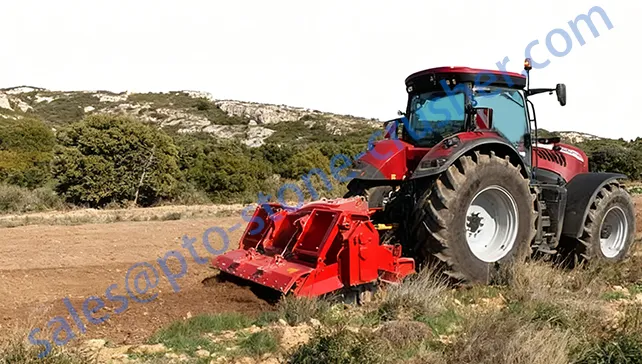
Agricultural Tractor-Mounted Rock Crusher for application

6. Application Scenarios

The ATMRC agricultural stone crusher is purpose-designed to handle the full range of land clearing and stone crushing tasks encountered in professional agriculture, land development, and site reclamation. The following are the primary application categories for which this tractor stone crusher is specified and deployed.

Orchard & Vineyard Establishment on Rocky Land

Establishing orchards on the rocky highland terrain common across South Korea’s Gangwon, North Gyeongsang, and Jeolla provinces requires deep stone removal before tree planting becomes viable. The ATMRC agricultural stone crusher — a truly heavy-duty agricultural stone crusher — can reduce surface and near-surface boulders to a fragment size that allows subsequent deep tillage and tree-pit excavation without equipment damage. A single machine pass with the ATMRC at 400 mm depth effectively prepares rockfield sites for orchard establishment in a timeframe that would be impossible with manual or excavator-based methods. No other category of agricultural stone crusher can match this combination of speed, depth, and stone-size capability in a standard tractor-mounted implement configuration.

Post-Construction Site Clearance & Land Reclamation

Construction sites, former quarries, and mine-disturbed land frequently carry a mixed burden of concrete rubble, natural stone, and broken masonry that makes the land unusable for agriculture without prior processing. The ATMRC PTO stone crusher and agricultural stone crusher can handle concrete fragments and natural rock up to 500 mm in a single pass, reducing site clearance time compared with excavator-and-crusher combinations and avoiding the cost of off-site rubble disposal by processing material in place. This application is particularly relevant to South Korea’s ongoing programme of converting marginal brownfield and post-industrial sites to productive agricultural use under national land improvement initiatives. For these projects, a purpose-built agricultural stone crusher provides a much faster solution than manual clearance and avoids the site access challenges associated with bringing mobile jaw crusher plants to remote locations — making the tractor-mounted agricultural stone crusher the preferred choice for Korean land reclamation contractors.

Roadside & Embankment Rock Clearing

Rural road maintenance and slope stabilisation projects in mountainous areas generate ongoing demand for mobile rock crushing capability. A tractor driven stone crusher and purpose-designed agricultural stone crusher mounted on a high-horsepower tractor can operate on the irregular terrain and varying gradients encountered in roadside rock clearing — conditions where static jaw crusher installations are impractical and where excavator-based methods are too slow for large-area treatment. The ATMRC agricultural stone crusher‘s 2,080 mm or 2,320 mm working width allows efficient coverage of roadsides and embankments in a manageable number of tractor passes.

Paddock Renovation & Improved Pasture Development

Existing paddocks and grazing land in rocky regions accumulate frost-heaved stones over successive winters, progressively reducing the effective productive area and creating hazards for livestock and for any machinery subsequently used on the ground. An annual or biennial pass with the ATMRC stone crusher for tractor — operating as a dedicated agricultural stone crusher — removes freshly surfaced stones and processes them in place, effectively re-setting the stone burden to zero without the need to manually gather and remove stones — a labour-intensive task that is increasingly uneconomical in markets like South Korea where agricultural labour costs are high. This use case creates a recurring equipment hire and service revenue stream for agricultural contractors who operate an agricultural stone crusher as a hire asset, and represents one of the most commercially attractive use cases for an agricultural stone crusher investment in the Korean market.

Forest Clearing & Land-Use Conversion

Where secondary forest or scrubland is being converted to agricultural use, the ATMRC agricultural stone crusher — uniquely among agricultural stone crusher designs — — a true multi-purpose agricultural stone crusher — can process not only the rock burden exposed by clearing but also the stumps, root masses, and woody material left behind by the tree removal operation. The tooth assembly’s ability to handle mixed materials — stone and biomass simultaneously — eliminates the need for a separate stump grinder or mulching pass, consolidating two stages of land preparation into one. This combined-operation capability is a significant logistical advantage for large-area conversion projects where multiple machine passes per field add up to substantial additional cost and time.

Aggregate Production for On-Farm Use

In remote farming regions where purchased aggregate is expensive to deliver, the ATMRC stone crusher machine tractor and agricultural stone crusher configuration allows farm operators to produce their own drainage aggregate, road-base material, and hard-standing fill from stones already present on the farm. Field stones crushed in place by the ATMRC agricultural stone crusher can be collected after the crushing pass using a stone rake attachment and stockpiled for later use in farm road construction, drainage channel bedding, or building foundations. This value-adding application transforms the stone burden — conventionally seen as a cost — into a useful raw material resource, and it is one that is only feasible with an agricultural stone crusher rather than conventional tillage equipment. The economics of on-farm aggregate production using an agricultural stone crusher are particularly compelling in remote Korean farming districts where purchased aggregate delivery costs are high., improving the economics of both land improvement and farm infrastructure development.

7. Applicable Standards & Regulatory Considerations

Buyers of a PTO stone crusher or agricultural stone crusher for professional agricultural and land management use should be aware of the regulations governing tractor-mounted machinery and PTO-driven equipment in their operating country. The following frameworks are most relevant for B2B buyers and equipment suppliers in Korea and other global markets.

South Korea — Agricultural Machinery Safety Act (농업기계화 촉진법) & KMST Certification — Agricultural machinery operated commercially in South Korea must comply with the Agricultural Mechanisation Promotion Act. PTO-driven implements, including stone crusher for tractor and agricultural stone crusher configurations, are subject to safety evaluation requirements administered by the Korea Agricultural Machinery Certification System (KMST). Buyers sourcing a pto stone crusher for sale or agricultural stone crusher in the Korean market should confirm that the supplied machine carries relevant safety documentation and that the PTO shaft guard complies with Korean agricultural machinery safety standards, which align with ISO 4254-1 requirements for agricultural machinery safety.

EU Machinery Regulation 2023/1230 (and predecessor Directive 2006/42/EC) — Tractor-mounted stone crushers and agricultural stone crusher equipment sold in Europe must carry a CE marking confirming conformance with the essential health and safety requirements of the EU Machinery Regulation. For PTO-driven machines, this includes specific requirements on PTO shaft guard design (aligned with ISO 11684 for safety sign requirements and ISO 4254 for agricultural machinery safety), maximum exposed PTO stub-shaft length, and guard retention force. The input gearbox and its mounting must also satisfy structural integrity requirements under the EHSR. Korean buyers importing EU-origin equipment can expect CE-marked machines to meet these standards.

ISO 11684 — Safety Signs on Agricultural and Forestry Machinery — This international standard specifies the design, location, and legibility requirements for safety signs fitted to agricultural machinery including tractor stone crusher and PTO-driven equipment. Machines — including any agricultural stone crusher — supplied to markets in Asia, the Americas, and Oceania as well as Europe are increasingly expected to carry ISO 11684-compliant safety labelling as a baseline, even where local regulations do not explicitly mandate it.

USA — ASABE (American Society of Agricultural and Biological Engineers) Standards — The ASABE S318 and related standards govern PTO dimensions and safety requirements for agricultural equipment sold in the United States. Buyers in North America should confirm that any PTO石破砕機 or agricultural stone crusher procured for the U.S. market uses a PTO shaft connector dimensioned to ASABE S318 specifications and that the machine complies with applicable OSHA guarding requirements for PTO machinery used commercially.

Australia — AS 2091 & State Agricultural Machinery Regulations — Australian buyers of agricultural stone crusher equipment — particularly any agricultural stone crusher used commercially — must comply with AS 2091 (Safety of agricultural machinery) and relevant state machinery regulations. PTO-driven implements require PTO shaft guards that meet the containment requirements of AS 2091, and commercially operated machinery may require registration with the relevant state agricultural authority. The National Heavy Vehicle Regulator (NHVR) requirements also apply when transporting tractor-mounted machinery on public roads above threshold axle masses.

Agricultural Stone Crusher

8. Compatible Components & Related Products

The ATMRC agricultural stone crusher is the primary machine in the system. Like any high-power agricultural stone crusher, it requires matched drivetrain components, but a complete, reliable system also depends on matched PTO shafts, gearboxes, and ancillary components. We supply a full ecosystem of compatible power transmission products to support the complete drivetrain from tractor PTO output to crusher rotor.

PTO Shafts & Driveline Components

A correctly specified PTO shaft is as critical to the performance and safety of a PTO stone crusher and agricultural stone crusher as the crusher itself. The shaft must be rated for the full torque output of the tractor at its maximum PTO horsepower, must include a properly rated overrunning clutch or shear-bolt torque limiter to protect the machine against rotor jam-ups, and must carry a full-length shaft guard meeting applicable safety standards. We supply PTO shaft assemblies matched to the ATMRC series across all four model configurations. Our gear products are compatible with the drivetrain requirements of the full ATMRC range.

Sprockets, Drive Components & Wear Parts

Internal drive chains and sprockets within the ATMRC agricultural stone crusher‘s secondary drive system — distributing power between the primary and secondary rotor shafts — require correctly specified sprocket tooth profiles and chain pitches. Wear parts for the agricultural stone crusher — including crusher teeth, tooth holders, and rotor disc inserts — are available as service replacements and should be kept in stock at the operating site for prompt replacement when worn components are identified during routine maintenance inspections. Maintaining a stock of consumable wear parts is the single most effective way to minimise unexpected downtime during peak land preparation seasons.

Stone crusher drive components and sprockets

9. About Us – Agricultural Stone Crusher Manufacturer

We are a specialist manufacturer and global B2B supplier of heavy-duty agricultural stone crushers, PTO-driven land preparation equipment, and associated power transmission components. Our product development focuses on the professional end of the market — equipment designed for commercial agricultural contractors who operate agricultural stone crusher machines at the highest intensity and who need an agricultural stone crusher that keeps working without costly downtime, large farm operations, and land development companies that require machinery capable of sustained high-output operation rather than occasional light-duty use. The ATMRC series represents the top tier of our agricultural stone crusher range, built for the demanding conditions encountered in large-scale rocky land preparation. Every ATMRC agricultural stone crusher that leaves our production facility has been assembled and tested to a documented quality standard that we are prepared to disclose in full to B2B buyers on request.

Our engineering team has accumulated extensive field experience across diverse geology and climate conditions — from the granitic highland soils of South Korea’s interior provinces to the limestone-dominated agricultural zones of Southern Europe and the basalt-heavy soils of volcanic farming regions in Southeast Asia and the Americas. This breadth of field experience informs every design decision in the ATMRC agricultural stone crusher series, from tooth alloy selection to gearbox oil seal specification. We work closely with B2B distributors and agricultural equipment dealers in Korea, Japan, Australia, the United States, and Europe to ensure that local customers have access to both the equipment and the after-sales technical support needed to operate it productively.

Our after-sales support package includes spare parts supply with fast international shipping, technical documentation in multiple languages, and access to an engineering helpline for troubleshooting complex operational issues. For buyers evaluating pto stone crusher manufacturers and agricultural stone crusher suppliers and comparing agricultural stone crusher options as potential long-term partners, we are able to provide references from existing agricultural stone crusher customers, field demonstration videos from comparable operating environments.

Frequently Asked Questions

Q1. What is an agricultural stone crusher and how does it differ from a standard stone crusher machine used in quarrying or construction?

An agricultural stone crusher is a tractor-mounted, PTO-driven machine designed specifically to process surface and near-surface stones in agricultural fields — converting boulders and rock fragments into gravel-sized pieces that can remain in the soil or be collected for use as aggregate. Unlike fixed or mobile quarry crushers, an agricultural stone crusher is designed to work at field speed across large areas of land, integrating with a standard farm tractor via the three-point linkage and PTO shaft. The ATMRC agricultural stone crusher operates at 1,000 rpm PTO speed on tractors from 200 hp to 360 hp and can handle stones up to 500 mm in diameter — parameters specifically calibrated for large-scale agricultural land preparation rather than quarry-scale production.

Q2. Which tractor horsepower range is compatible with the ATMRC PTO stone crusher, and how do I know if my tractor is powerful enough?

The ATMRC range covers tractor horsepower from 200 hp (ATMRC 200) to 360 hp (ATMRC/HP 225). The minimum tractor power recommendation is 200 hp for the entry-level model, rising to a minimum of 300 hp for the HP-suffix models. To verify compatibility with the ATMRC agricultural stone crusher, check your tractor’s rated PTO horsepower — not just engine horsepower — in your tractor operator’s manual. PTO horsepower is typically 80–88% of engine horsepower in modern high-horsepower tractors. Your tractor must also have a 1,000 rpm PTO output and a category III or IV three-point linkage rated for the machine’s operating weight. If you are unsure, contact our technical team with your tractor make, model, and year and we will confirm compatibility before you place an order.

Q3. Where can I find a reliable agricultural stone crusher supplier in South Korea or nearby for B2B equipment procurement?

We supply the ATMRC series agricultural stone crusher to B2B customers in South Korea through a combination of direct export and regional distribution partnerships. We maintain technical documentation in formats suitable for Korean customs clearance, KMST safety assessment submissions, and local agricultural stone crusher dealer onboarding. To find a stone crusher near me or agricultural stone crusher supplier in Korea or to arrange a direct supply quotation, contact our international sales team with your operating region, tractor details, and intended application. We can typically provide a formal quotation within two business days for standard ATMRC configurations.

Q4. How does a PTO stone crusher work, and what makes the dual-rotor design of the ATMRC series more effective than a single-rotor stone crusher?

A PTO石破砕機 receives rotational power from the tractor’s PTO shaft, which drives the machine’s internal gearbox and from there the crushing rotors. In the ATMRC agricultural stone crusher‘s dual-rotor configuration, the G/3 primary rotor (940 mm diameter) delivers the first high-energy impact that fractures incoming boulders, while the R secondary rotor (915 mm diameter) completes the size reduction in the same pass. This two-stage process produces a finer, more consistent output particle size than a single rotor can achieve in one pass — which means fewer tractor passes are needed to reach a given land preparation standard, saving both fuel and time. The dual-rotor design also allows the ATMRC to maintain high throughput even when the input material varies significantly in hardness and size, because the primary rotor conditions the feed for the secondary rotor rather than both rotors competing for the same unprocessed material.

Q5. What size and type of stones can the ATMRC agricultural stone crusher handle, and are there rock types it cannot process?

The ATMRC agricultural stone crusher series is rated for stones up to 500 mm in diameter, covering the vast majority of field stones and surface boulders encountered in agricultural land preparation. It performs well on the common agricultural rock types — granite, limestone, sandstone, basalt, and conglomerate — which represent the dominant geology across South Korea’s agricultural regions. It is not a substitute for industrial jaw or cone crushers in quarrying operations and should not be used on reinforced concrete with exposed steel rebar, on very large granite boulders above the 500 mm diameter rating, or on friable shale that tends to generate fine dust rather than gravel-sized output. For borderline rock sizes or unusual geology, we recommend a field trial assessment before committing the agricultural stone crusher to full-scale deployment.

Q6. How do I get a quote for the ATMRC series PTO stone crusher from a manufacturer that exports to Korea and other Asian markets?

To request a quotation for the ATMRC agricultural stone crusher — the leading heavy-duty agricultural stone crusher in our product line —, provide your tractor make, model, and rated PTO horsepower; your preferred working width (2,080 mm or 2,320 mm); your intended application and the dominant rock type you will be crushing; and your delivery destination and preferred Incoterms. We can supply to South Korea, Japan, Taiwan, Southeast Asia, and other markets in the region. Our quotation will include machine specification, packing list, documentation for import clearance, and estimated shipping cost. For buyers evaluating multiple pto stone crusher manufacturers, we can also provide a comparison sheet against common competing agricultural stone crusher machine specifications on request.

Q7. What maintenance does a tractor-mounted PTO stone crusher require, and how often should the crusher teeth be replaced?

Routine maintenance for the ATMRC tractor mounted stone crusher and agricultural stone crusher includes daily pre-operation inspection of the PTO shaft guard and U-joint, tooth condition check, bolt torque verification on critical joints, and gearbox oil level check. After every 50 operating hours, a full inspection of tooth wear should be conducted — individual teeth should be replaced when worn beyond the manufacturer’s minimum height specification to prevent tooth-holder damage, which is more expensive to repair than a routine tooth replacement. Gearbox oil change intervals are typically every 500 operating hours or annually, whichever comes first. A stock of 10–15% of the agricultural stone crusher‘s total tooth count should be maintained on-site during intensive operating periods to allow same-day replacement of worn teeth without interrupting the work schedule.

Q8. What is crusher stone used for after processing by an agricultural stone crusher, and can the output material be used for road construction in Korea?

The crushed stone output from the ATMRC agricultural stone crusher — as with most quality agricultural stone crusher machines — can be used for a range of on-farm and local construction applications. Material crushed to 0–50 mm is suitable for farm road base course, hard-standing yard construction, drainage aggregate, and building foundation fill. In South Korea, use of on-site crushed aggregate for private farm roads and on-site construction generally does not require specific regulatory approval, but any use on public roads or for construction requiring building permits should be verified against local authority requirements. The particle shape produced by hammer-impact crushing is typically more angular than quarry-crushed aggregate, which is advantageous for road base compaction but may require screening to remove fines before use in drainage applications.

Q9. Is the ATMRC agricultural stone crusher available for hire or rental in South Korea, and what should I look for when hiring a tractor stone crusher for a project?

The ATMRC agricultural stone crusher is available through agricultural equipment hire (rental) operators in South Korea’s main farming regions, as well as through direct purchase from authorised dealers. When hiring a tractor stone crusher for hire or agricultural stone crusher, always verify that the hire includes a correctly rated PTO shaft with functional overrunning clutch or shear-bolt limiter, that the hire company can confirm the machine’s tooth condition and last maintenance date, and that the hire contract specifies who is responsible for tooth replacement during the hire period — as tooth consumption rate depends on the rock type and operating depth, which vary by project. Also confirm the tractor requirement (minimum horsepower and PTO speed) before committing to a hire arrangement to avoid arriving on-site with a tractor that cannot power the machine safely.

Q10. How does a gravel crusher differ from a PTO stone crusher, and which type of equipment is better suited to agricultural land preparation in South Korea?

A gravel crusher — in the industrial context — typically refers to a jaw, cone, or impact crusher designed to produce a specific graded aggregate product from quarried or blasted rock feed material. A PTO石破砕機 like the ATMRC is designed for in-situ processing of field stones at agricultural site — it does not produce a graded aggregate output but reduces stone size sufficiently that the land can be tillaged and planted. For agricultural land preparation in South Korea, a pto driven stone crusher is almost always the correct tool choice: it is tractor-powered, field-mobile, covers large areas efficiently, and does not require the site infrastructure (electrical supply, aggregate stockpile management, transport logistics) that a static gravel crusher installation demands. For buyers with both agricultural preparation and aggregate production goals on the same site, the two approaches can be combined — the agricultural stone crusher efficiently prepares the field, and the agricultural stone crusher‘s output material is then further processed, and a subsequent screening and crushing stage processes the coarser output for aggregate.

Editor: PXY