If you’ve been farming on rocky ground for any length of time, you already know what stone damage does to equipment, tires, and yields. Surface rocks and buried rock slabs slow tillage, break implement points, and create hazardous conditions for workers. A properly matched PTO stone crusher addresses all of this — but only if the tractor feeding it has the right horsepower. Undersizing a crusher match is one of the most common and costly errors farmers make when investing in stone crushing equipment.
This guide unpacks exactly how tractor horsepower requirements are calculated for a PTO stone crusher, what the engineering behind different machine classes looks like, and which specific models suit which operations. Whether you’re looking at a compact agricultural stone crusher for orchard and vineyard rows or a full-scale field stone crusher capable of handling boulders up to 500 mm in diameter, there’s a horsepower range that fits your existing tractor — and a matching machine on the market today.
The information here draws on real technical data from current product lines, including the STCL, STCM, STCH, RSL, RSM, and RSH series, as well as the Thor 2.4 and Thor 3.0 mulcher/stone crusher models, so every recommendation is grounded in verified specifications rather than rough estimates.
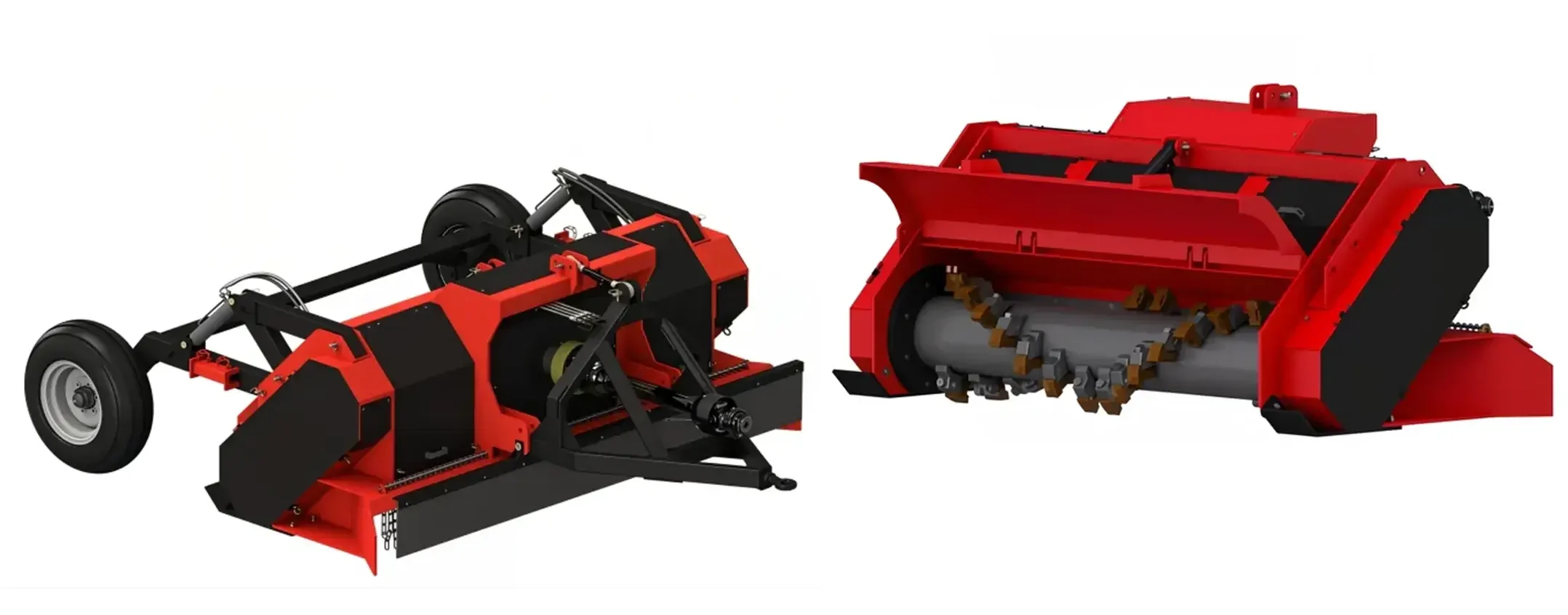
1. How a PTO Stone Crusher Actually Works
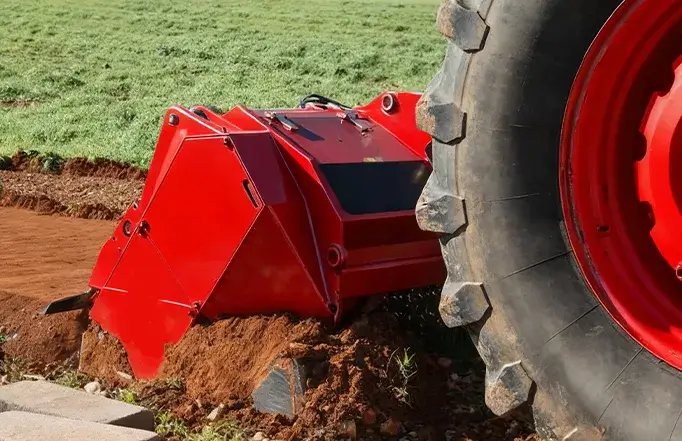
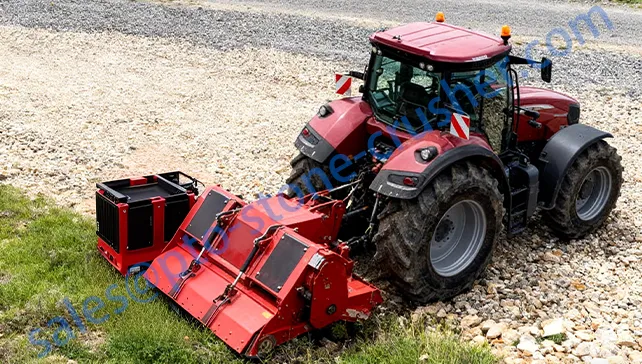
Understanding the mechanical action of a PTO stone crusher is the foundation for understanding why horsepower matters so much. These machines are 3-point hitch-mounted implements driven through the tractor’s power take-off (PTO) shaft, which spins at either 540 RPM or 1000 RPM depending on the model and the tractor configuration. Inside the crusher housing, a heavy-duty rotor fitted with hardened steel teeth or picks rotates at high speed. As the implement travels across the field, stones and rock slabs are drawn into the crushing chamber, struck by the rotating teeth, and fragmented against a steel counter-blade mounted at the rear of the chamber. The finished material, broken down to a specified maximum diameter, is deposited back into the soil profile or discharged onto the surface.
The critical energy demand in this process is the inertia required to keep the rotor spinning under impact load. A rotor striking a dense granite slab 200–500 mm in diameter absorbs enormous shock force in a fraction of a second. The tractor’s engine must supply enough torque through the PTO shaft to prevent rotor stall, maintain cutting speed, and provide sufficient reserve power for traction. This is why even a 100 hp tractor can struggle with a machine rated for 80–220 hp if the actual rocks being processed are at the upper size limit for that machine.
Action Mechanism
High-speed rotor impact + counter-blade fragmentation
PTO Speed
540 RPM (lighter models) or 1000 RPM (mid- and heavy-duty)
Working Speed
Typically 2–5 km/h for most stone crusher models
2. Manufacturing Structure: What’s Inside a Stone Crusher
The build quality of a stone crusher determines both its performance under load and its service life in demanding agricultural conditions. Rotor diameter is one of the most telling indicators of machine class. Light-duty models in the STCL series operate with a 450 mm rotor, while mid-range STCM models use a 550 mm rotor, giving them greater circumferential velocity and more kinetic energy per strike. Heavy RSM and RSH series machines feature rotor diameters of 940–1115 mm, which is why they can absorb and deliver the forces necessary to fragment rock slabs up to 500 mm in diameter at working depths exceeding 400 mm.
The crushing chamber itself is lined with Hardox wear-resistant steel panels — a Swedish specialty steel with hardness ratings typically between 400 and 600 HBW. These interchangeable liners protect the housing from abrasion and can be replaced independently, dramatically reducing maintenance costs compared to integral-weld chamber designs. The counter-blade, which deflects material back into the rotor for secondary fracturing, is also made from Hardox and on higher-end models is hydraulically adjustable from the tractor cab. This allows the operator to vary final particle size without stopping.
Protection chains hanging at the front and rear of the crushing chamber are another structural detail worth noting. They contain ejected material and reduce hazard to bystanders — a requirement under several national farm machinery safety standards. In dual-transmission (DT) models, twin belt or gear drives split the power input, reducing stress on individual drive components and enabling the wider working widths that high-productivity operations demand. The Thor 2.4 and Thor 3.0 drawbar-equipped models use a 3-point hitch category 2 connection and incorporate a robust chassis designed to tolerate the lateral forces generated when striking embedded boulders at speed.
“The rotor diameter and tooth geometry together determine how aggressively a PTO stone crusher processes material — and these figures must be matched to available horsepower or premature failure of drive components is inevitable.”
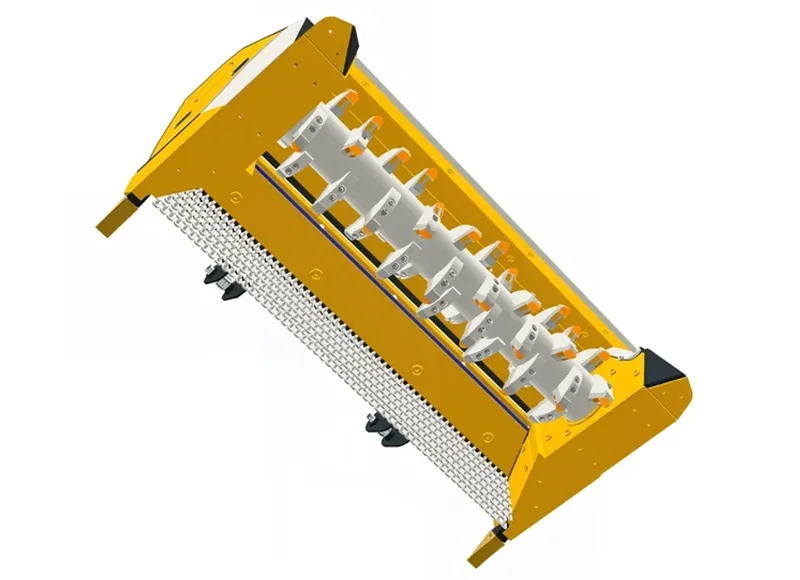
3. Material System: Teeth, Picks, and the Hardox Advantage
The cutting element — whether called a tooth, pick, or bit — is the consumable at the heart of every agricultural stone crusher. The geometry, metallurgy, and mounting system of these elements directly determine how much horsepower is consumed per tonne of crushed material. Fixed carbide-tipped teeth of the STC/3 type are standard on STCL and STCM models. These deliver reliable fragmentation of stones in agricultural soils with moderate rock content. Where rock density is higher or material hardness greater, STC/3/HD (heavy-duty) teeth provide increased wear resistance at a modest cost premium. For applications involving very hard basalt, granite, or consolidated limestone, STC/3/FP (fused-point) teeth maintain cutting edge geometry longer and deliver more uniform particle size.
RSL, RSM, and RSH series machines incorporate two distinct rotor options: the G/3 rotor equipped with STC-type fixed teeth, and the R rotor fitted with R/65 and R/65/HD conical picks. The conical pick design is borrowed from road milling and mining equipment, providing 360-degree rotational symmetry so that wear is distributed evenly around the pick body rather than concentrated on one face. This significantly extends service intervals and reduces the total cost of ownership for operations running high-hours equipment. On RSH models, the combined G/3 rotor and R/65 rotor system delivers 104–132 main teeth plus 20+ picks plus additional blade elements — a configuration that requires a tractor in the 360–500 hp range to sustain adequate rotor speed through continuous heavy-material passes.
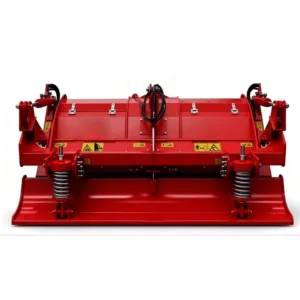
The Thor 2.4 and Thor 3.0 models available in the Mulchers/Stone Crushers product line use a drawbar-supported 3-point configuration that places machine weight more favorably on the tractor’s rear axle, improving traction efficiency in loose or stony soils. These machines weigh 2,300 kg and 2,800 kg respectively, with working widths of 2.4 m and 3.0 m — dimensions that require a minimum of 180 cv and 230 cv accordingly to maintain productive throughput.
4. The Horsepower Sizing Chart: Which Model Fits Your Tractor?
The table below consolidates verified horsepower requirements across current PTO stone crusher model lines. Use this as your starting reference — and remember that the figures represent minimum tractor power for the specified machine at rated working conditions. Operating at the absolute minimum hp leaves no reserve for hills, wet soil, or unusually large embedded stones.
| Model Series | Tractor HP Range | PTO (rpm) | Max Stone Ø (mm) | Max Depth (mm) | Working Width (mm) |
|---|---|---|---|---|---|
| STCL | 70–150 hp | 540–1000 | 150 | 150 | 1110–2070 |
| STCM | 80–280 hp | 540 / 1000 | 300 | 200 | 1340–2304 |
| STCH | 280–400 hp | 1000 | 500 | 250 | 2080–2560 |
| RSL | 80–190 hp | 540 / 1000 | 300 | 150–280 | 1000–2200 |
| RSM / RSM/HP | 200–360 hp | 1000 | 500 | 400 | 2080–2320 |
| RSH / RSH/HP | 360–500 hp | 1000 | 500 | 500 | 2107–2587 |
| Thor 2.4 (PSC Series) | Min 180 cv | — | — | — | 2400 |
| Thor 3.0 (PSC Series) | Min 230 cv | — | — | — | 3000 |
cv = metric horsepower; hp = SAE horsepower. 1 cv ≈ 0.986 hp. Values listed represent manufacturer minimums at standard operating conditions.
5. Light-Duty Range: 70–150 HP — Vineyards, Orchards, and Row Crops
The STCL series is designed specifically for situations where working widths between 1.1 m and 2.07 m are sufficient and where the tractor available falls between 70 and 150 hp. This is the range that covers most compact utility tractors and specialty vineyard machines common in Korean highland agricultural zones and small-scale farms across East Asia. The STCL’s 450 mm rotor processes stones up to 150 mm in diameter to a maximum working depth of 150 mm — enough to remove surface stones and shallow embedded fragments that would otherwise damage disc harrows and planter assemblies.
What makes the STCL attractive for these applications is that it runs on 540–1000 RPM PTO — meaning an older tractor with a standard 540 RPM output can still operate the machine effectively. The six model variants (STCL/ST 100 through STCL/DT 200) span working widths from 1110 mm to 2070 mm with weights from 1,230 kg to 1,750 kg. A 100 hp tractor can confidently run the narrower variants; the widest STCL/DT 200 is better served by 120–150 hp. Because the machine weight stays manageable, 3-point hitch category 2 tractors in this HP range carry the implement without straining rear axle lift capacity.
For Korean farmers dealing with the volcanic basalt and granite deposits common in highland regions of Gyeonggi-do and Gangwon-do provinces, the STCL offers a practical entry point into mechanized stone management without requiring a large high-horsepower tractor investment. It handles the 80–120 hp tractors that make up the majority of the Korean agricultural fleet.
6. Mid-Range Power: 80–280 HP — The Workhorse STCM Class
The STCM is arguably the most versatile stone crusher series available for agricultural PTO applications. Its HP range spans from 80 hp right up to 280 hp, meaning it covers a huge proportion of modern row-crop tractors currently operating in Korean agriculture, from the common 100–130 hp machines used in rice and vegetable operations to the 200+ hp tractors favored by larger grain and feed crop operations. Seven models (STCM/ST 125 through STCM/HP 225) cover working widths from 1,340 mm to 2,304 mm with machine weights from 1,850 kg to 3,840 kg.
The 550 mm diameter rotor and 300 mm maximum shredding diameter represent a significant step up from the STCL, enabling the machine to handle much larger embedded stones and slabs. Maximum working depth of 200 mm is sufficient for most field preparation tasks before deep tillage. On the STCM 150 through STCM 225, the enclosed dust-resistant machine body, Hardox wear plates, hydraulically adjustable counter-blade, and trapezoidal belt transmission all become standard — these are not luxury features but operational necessities when crushing high-silica granite content materials for hours at a time. Machines in this class typically cover 0.5 to 1.5 hectares per hour depending on stone density and working speed.
The dual-transmission STCM/HP 200 and STCM/HP 225 variants are particularly relevant for farmers using 200–280 hp tractors on wide, open fields. The DT configuration allows wider working widths while maintaining rotor speed, improving area coverage per hour significantly. For a grain farmer in Chungcheongnam-do running a 220 hp tractor, the STCM 200 or STCM 225 hitting the sweet spot of horsepower utilization — roughly 75–85% of available engine power going to the crusher — is the optimal match.
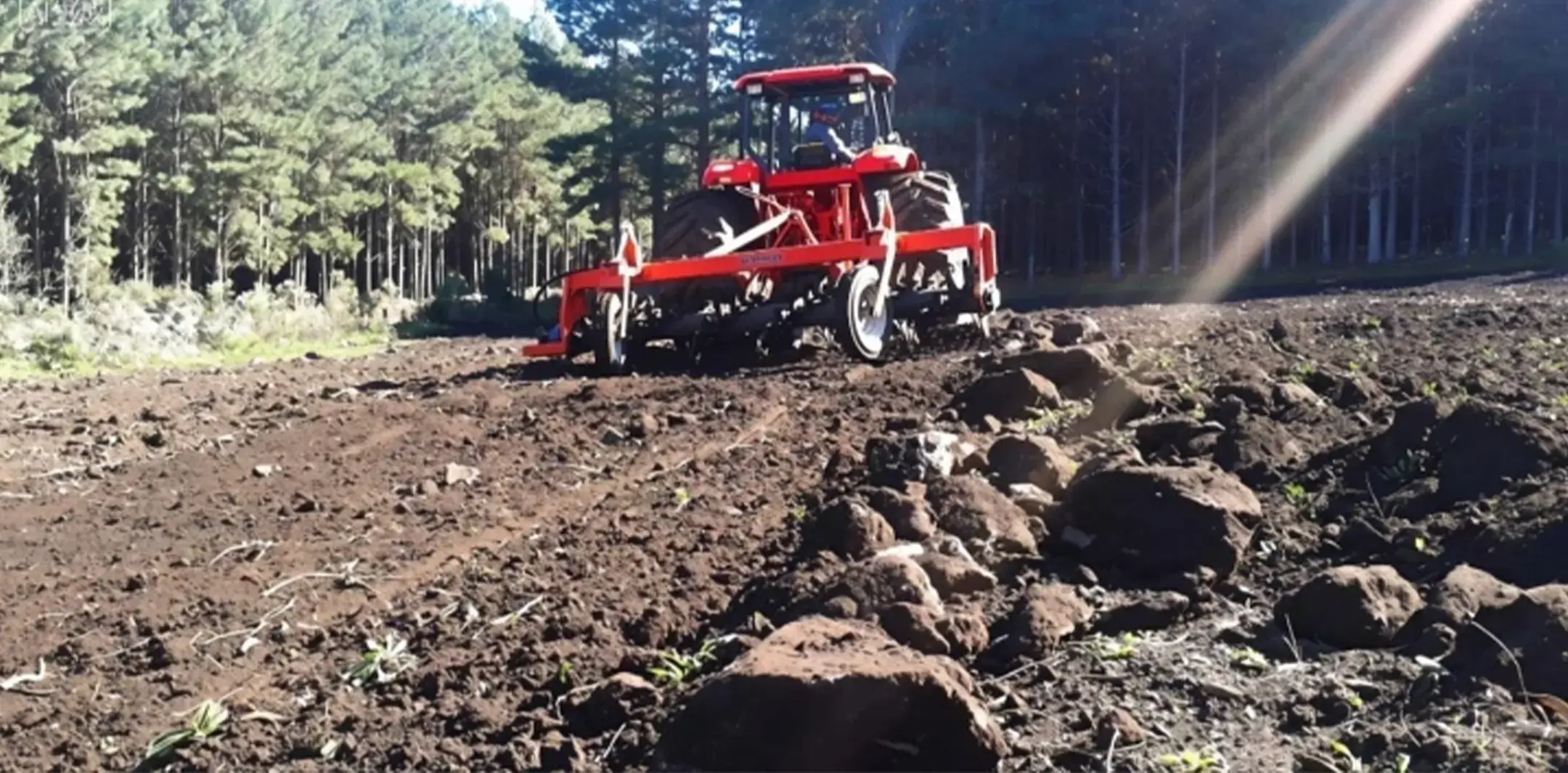
7. Heavy-Duty Applications: 200–500 HP — RSL, RSM, RSH, and STCH
Once stone size exceeds approximately 300 mm in diameter or working depth requirements push past 200 mm, you are in territory where light and mid-range machines simply cannot operate safely or efficiently. The RSL, RSM, RSH, and STCH series exist for exactly these conditions. These machines are built for land reclamation, orchard establishment, roadside clearing, and the preparation of rocky hillside terrain — applications where the agricultural stone crusher must double as genuine rock processing equipment.
The RSL (80–190 hp) bridges the gap between the STCM class and the heavy RSM series, and its gear transmission (rather than belt) is a key differentiator. Reduction gear transmission provides better power transfer to the rotor with lower traction power demand, making it particularly suited to steep terrain where tractor wheel slip is a concern. The RSL can carry either a G/3 fixed-tooth rotor or an R-type pick rotor, giving operators flexibility for different rock types. RSL models weigh 1,600–2,650 kg across the six variants, requiring 3-point hitch systems capable of handling these loads — typically tractors of 90 hp and above will qualify.
The STCH (280–400 hp) is a fixed-tooth rotor machine with a 700 mm diameter rotor capable of crushing stones up to 500 mm at depths to 250 mm. Its three model widths (STCH 200, 225, 250) provide working widths from 2,080 mm to 2,560 mm and machine weights from 4,850 kg to 5,250 kg. A tractor in the 300–400 hp category — such as a modern Fendt 700 Vario, New Holland T7 Heavy Duty, or comparable Korean-market large tractor — is essential to operate this machine at full capacity. At its rated working speed of around 2–5 km/h, the STCH can clear significant acreage of heavily stoned land per day.
RSM and RSH machines push into specialist territory. The RSM (200–360 hp) handles stones and rock slabs to 500 mm diameter, working to 400 mm depth, with machine weights up to 5,490 kg. The RSH (360–500 hp) is the top of the PTO-driven range, with a 1,115 mm G/3 rotor, working depths to 500 mm, and machine weights from 7,050 to 7,850 kg. Only the largest modern agricultural tractors can drive an RSH safely. These machines are typically seen on large-scale land clearing projects, infrastructure corridor preparation, and commercial aggregate surface management operations.
8. Featured Models: Thor Series Mulchers / Stone Crushers
The Thor 2.4 and Thor 3.0 with Kit Drawbar are available in the Mulchers / Stone Crushers product range. Below are their verified technical specifications.
9. Full Mulchers / Stone Crushers Product Range
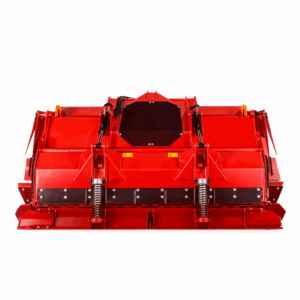
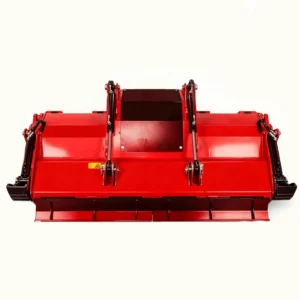
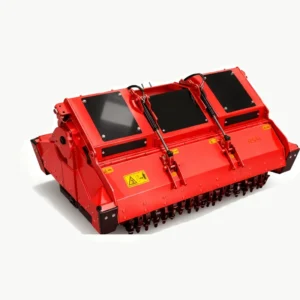
In addition to the Thor series, the following models are available in the product range. Click any product to view full specifications and configuration options.
10. Beyond Horsepower: Other Factors That Affect Stone Crusher Sizing
Tractor horsepower is the headline figure, but correct matching involves several additional variables. Getting these right separates productive, low-maintenance operation from a machine that underperforms and overloads its driveline prematurely.
Rear Axle Lift Capacity
Heavier models (2,300–7,850 kg) require verified rear hitch lift capacity. Always check the tractor’s rated 3-point hitch lift at the ball ends.
Hydraulic Flow Rate
Hydraulically adjustable counter-blades and rear doors require adequate SCV flow. Most models specify a minimum of 40–60 L/min at operating pressure.
PTO Type and Stub
Confirm whether the tractor has a 540 RPM, 1000 RPM, or 540E economy PTO. Mismatched PTO speed is a common and avoidable installation error.
Tractor Ballasting
Heavy rear implements need front ballast to maintain steering control and prevent rear axle overload. Insufficient ballasting increases tractor wear and reduces safety.
Stone hardness is another dimension that rated horsepower alone cannot capture. A 120 hp tractor running a stone crusher rated at 80–220 hp will handle soft limestone comfortably but may struggle with dense quartzite cobbles at the same rated size. When stone hardness is unknown, it’s worth requesting a site assessment or selecting the next-higher machine class to provide adequate performance margin. This is especially true in Korea’s granite-rich upland zones, where Mohs hardness values of 6–7 are common and rotor tooth consumption is significantly faster than in softer sedimentary zones.
Soil conditions also matter. Wet clay soils increase traction demand on the tractor, effectively reducing the power available to the PTO. On sloped terrain exceeding 15°, traction absorption increases again. For these reasons, experienced equipment suppliers routinely recommend sizing one model wider than the theoretical minimum — for instance, choosing an STCM 175 over an STCM 150 when the tractor is rated at 160 hp — to ensure adequate performance buffer in real-world field conditions.
11. Where Is PTO Stone Crusher Equipment Used in Korean Agriculture?
Korea’s agricultural sector presents a distinct set of conditions for stone crusher deployment. The peninsula’s geology — predominantly granitic gneiss and schist in the central mountain belt, with sedimentary deposits along coastal plains — means that stony soils are common in upland arable areas and in land being converted from forestry or orchard use. Korea’s Rural Development Administration has identified stone removal and land leveling as priority mechanization areas in its agricultural equipment promotion programs, and PTO stone crushers are increasingly listed among supported machinery categories.
In Gyeonggi, Gangwon, and the northern provinces, farmers converting terraced highland plots to field-crop or vegetable production regularly encounter buried rock layers 100–300 mm below the surface. A tractor stone crusher for this work needs to reach at least 150–200 mm depth and handle stones in the 100–250 mm range — which places the STCM 150 or STCM 175 as the most common appropriate choice for tractors in the 100–160 hp range typical in these areas. Jeju Island’s volcanic basalt presents a harder challenge requiring STC/3/HD or R-type pick tooling and higher horsepower ratios.
For contractors and land-clearing services operating across multiple sites, a portable stone crusher machine with a flexible horsepower range — such as the RSL 125 or STCM 200 — provides the versatility to work with multiple client tractors at different horsepower levels without requiring dedicated matched equipment at each site. Understanding the minimum hp threshold for each model allows a contractor to quote clearly on projects and avoid field-day failures due to underpowered tractor supply.
12. Maintenance Schedule and Service Life: Getting Full Value from Your Investment
A well-matched PTO stone crusher operating within its rated horsepower range will deliver many thousands of operating hours before major component replacement becomes necessary. The opposite is also true — a machine chronically operated at below its recommended PTO speed, or paired with a tractor unable to sustain rated torque under load, will suffer accelerated bearing wear, belt slippage, and eventual driveline failure in a fraction of the designed service life.
Tooth inspection should be performed after every 50–100 working hours, or whenever productivity noticeably drops — often the first indicator of tooth wear is increased fuel consumption for equivalent work rate. Hardox wear-plate inspection at 200-hour intervals is standard practice. Rotor bearing lubrication intervals vary by model but are typically every 50 operating hours with NLGI Grade 2 lithium complex grease. Drive belt tension should be checked at 100-hour intervals on belt-transmission models.
Stone crushers that have been run without the correct tractor horsepower will frequently show premature wear on the Hardox counter-blade face, uneven tooth wear patterns (indicating inconsistent rotor speed), and fretting of the 3-point hitch linkage pins. These diagnostic signs are useful when evaluating used tractor stone crusher equipment before purchase — they indicate whether the machine has been operated correctly throughout its service history. When sourcing used tractor stone crusher for sale, always ask for the matched tractor HP that was used during operation and cross-reference against the model’s specification plate.
13. About Our PTO Stone Crusher Range
We specialize in sourcing, supplying, and supporting professional-grade PTO stone crushers and agricultural rock crusher equipment for farming, land development, and infrastructure preparation operations across Korea and global markets. Our product range spans the full spectrum from compact small pto stone crusher models suited to 70–100 hp tractors up to heavy-duty stone crushing equipment for 400–500 hp machines.
Every machine in our catalogue is selected based on verified technical performance, availability of genuine spare parts, and manufacturer support. We work with agricultural contractors, large-scale farmers, and land development companies to identify the right stone crusher for tractor pairing that matches existing equipment and operational requirements.
Frequently Asked Questions
Editor: PXY