Agricultural Land Preparation · Italy · Korea
PTO Stone Crusher for Italian Farms:
Crushing Tufo, Limestone, and River Gravel
in Emilia-Romagna and Puglia
A comprehensive guide to selecting, operating, and maintaining a tractor stone crusher for the challenging geological conditions found across Italy’s most productive agricultural regions — including insights relevant to Korean farmers working comparable rocky terrain.
Italy’s agricultural heartland presents a deceptively beautiful problem: the very soils that yield world-class wine grapes and olives are littered with rocks that snap tillage equipment, damage irrigation lines, and prevent uniform seed germination. In Emilia-Romagna, river gravel and compacted limestone outcrops are a perennial headache for producers working the Po plain fringes and the foothills toward the Apennines. In Puglia, the iconic trulli landscape tells part of the story — beneath those domed stone rooftops lies some of the most densely rock-strewn farmland in southern Europe, where tufo, calcarenite, and hardened limestone sit close to the surface and resist conventional soil preparation machinery.
The solution that has transformed land reclamation and field prep across both regions is the PTO stone crusher — a tractor-mounted rotary machine driven directly from the tractor’s power take-off shaft that reduces surface and sub-surface rocks to fine gravel or dust in a single pass. Rather than excavating stones by hand or with a bucket loader, the pto stone crusher for tractor processes material on the spot, leaving behind a prepared seedbed that requires minimal follow-up work. This article examines how the technology works, what it is built from, which models suit Italian soil conditions, and the regulatory framework operators must navigate in Italy, Korea, and beyond.
1. How a PTO Stone Crusher Works: Action Mechanism Explained
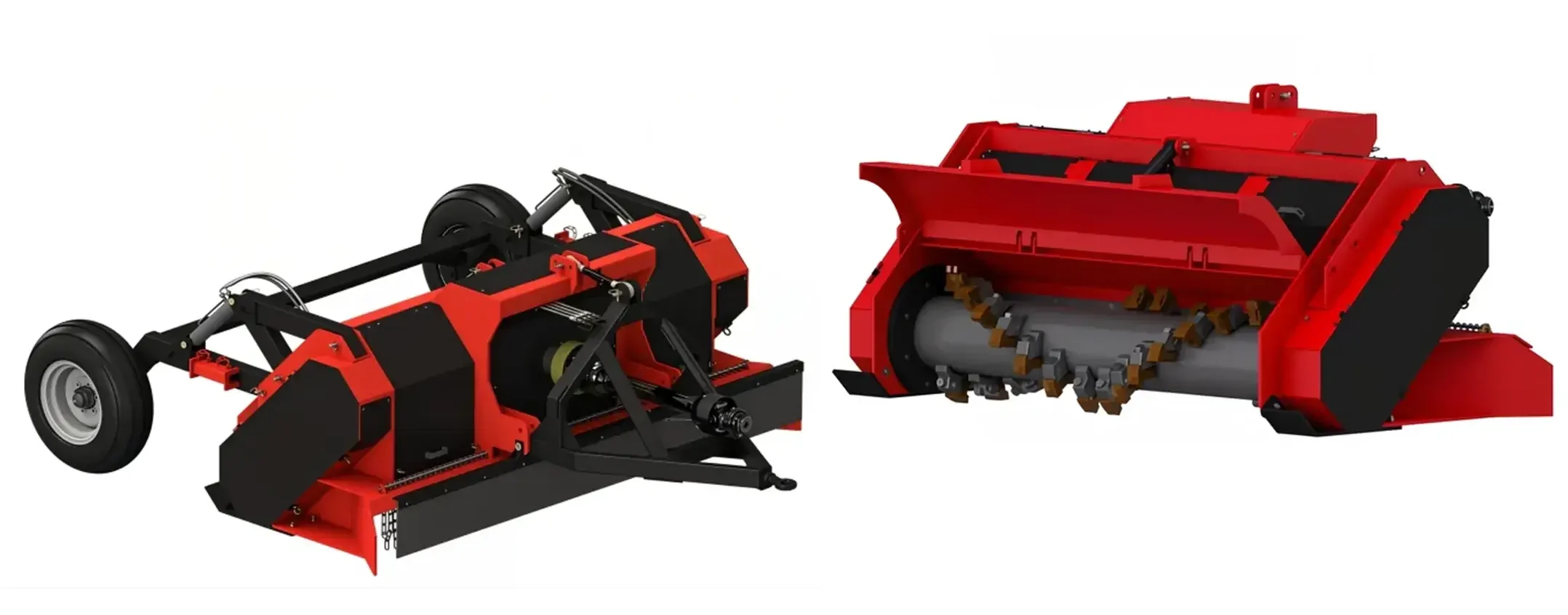
Understanding the action mechanism helps farmers choose the right machine and avoid costly mismatches. A tractor stone crusher mounts to the tractor’s three-point linkage (category 2 in most agricultural models) and receives rotational power through the PTO shaft. The PTO typically runs at 540 RPM or 1000 RPM depending on the model series. This shaft input is transmitted — through either a belt drive, chain drive, or reduction gear system — to a high-speed rotor that spins between 1,200 and 2,200 RPM at the rotor tips.
The rotor carries a series of hardened steel tools — variously called teeth, picks, or hammers depending on the series — arranged in a helical or staggered pattern around a central drum. As the tractor advances slowly (typically 2–5 km/h for stone crushing tasks), the spinning rotor contacts surface and near-surface rocks, delivering repeated high-energy blows that fracture the stone through a combination of impact and shear. Fractured fragments are thrown against an adjustable hardened steel counter-blade inside the crushing chamber, where secondary reduction takes place. The rear door and counter-blade position control the final output particle size, allowing the operator to dial in a coarse gravel finish for drainage layers or a finer crush for direct incorporation into topsoil.
For Italian conditions, two broad action-mechanism families dominate the market. Fixed-tooth rotor machines (such as the PSC series and STCM series available at pto-stone-crusher.com) use rigidly mounted forged steel teeth that grind and pulverize rock. Pick-type rotor machines (RSL and RSM series) add a milling capability for rock slabs — particularly relevant in Puglia where contiguous calcarenite slabs sit at 15–25 cm depth. Belt-driven models tend to suit lighter limestone and tufo work, while gear-reduction transmission units handle the higher sustained torque demands of river gravel and dense basaltic inclusions.
2. Manufacturing Construction: What Makes a Quality Stone Crusher Machine
The durability of any stone crusher machine in the field ultimately comes down to how it is manufactured. When comparing machines — from a small PTO stone crusher designed for compact tractors to heavy-duty units for 400+ hp machines — the following structural elements separate long-lasting equipment from machines that fatigue prematurely under Italian field conditions.
Main Frame and Housing
High-quality agricultural stone crushers use structural steel frames that are fully welded, not bolted, at primary stress points. The crushing chamber itself — the box-shaped enclosure surrounding the rotor — must withstand constant percussion from rock fragments. Top-tier machines line this chamber with interchangeable Hardox® wear plates, a Swedish ultra-hard steel (typically 400–500 Brinell hardness) that can be replaced in the field once worn rather than requiring full housing replacement. The thick-gauge outer housing resists denting from ejected debris while the internal plates absorb the actual abrasion load.
Rotor Assembly
The rotor is the heart of the machine. Rotor diameters across the product range span from 450 mm (STCL light series) to 1,115 mm (RSH/HP heavy series), with intermediate sizes at 550 mm (STCM), 595 mm (RSL), and 940 mm (RSM). Larger diameter rotors generate higher tip speeds and can process larger rocks; the STCM series handles stones up to 300 mm diameter, RSL handles up to 300 mm, while the STCH and RSM/RSH series tackle material up to 500 mm in diameter. The rotor shaft itself should be forged steel — not cast — to withstand the bending and torsional stresses involved. Tool holders are also heat-treated forged steel in premium units, ensuring reliable tool retention even under extreme impact loads.
Transmission System
Three transmission types appear across the product family. Belt drive (used in lighter STCL/STCM-125 models) provides some shock absorption through belt slip but requires periodic tension adjustment and belt replacement. Gear reduction transmission, featured in the RSL and RSM series, transmits power with minimal loss and delivers consistently optimal torque across varying load conditions — essential when rotor tips engage unexpectedly large rock formations. Dual transmission (DT suffix models) allows the operator to fine-tune power flow for particularly demanding conditions. A torque limiter integrated into the PTO shaft connection provides overload protection, preventing drivetrain damage if the rotor stalls on an immovable obstruction.
Gearbox Design and Sealing
The gearbox in a stone crusher for tractor faces a uniquely hostile environment: high dust concentrations, vibration, and temperature cycling. Quality gearboxes use sealed, oil-bath lubrication with dust-resistant lip seals and are rated for continuous high-load operation. The heavy-duty gearbox sealed against dust and debris infiltration is a critical reliability feature — fine silica dust from crushed stone is highly abrasive and will rapidly destroy unsealed bearings and gear contacts. In the Korean market and EU markets alike, service intervals and oil specifications are detailed in the machine documentation and must be followed to maintain warranty coverage.
3. Material System: Teeth, Picks, and Wear Components
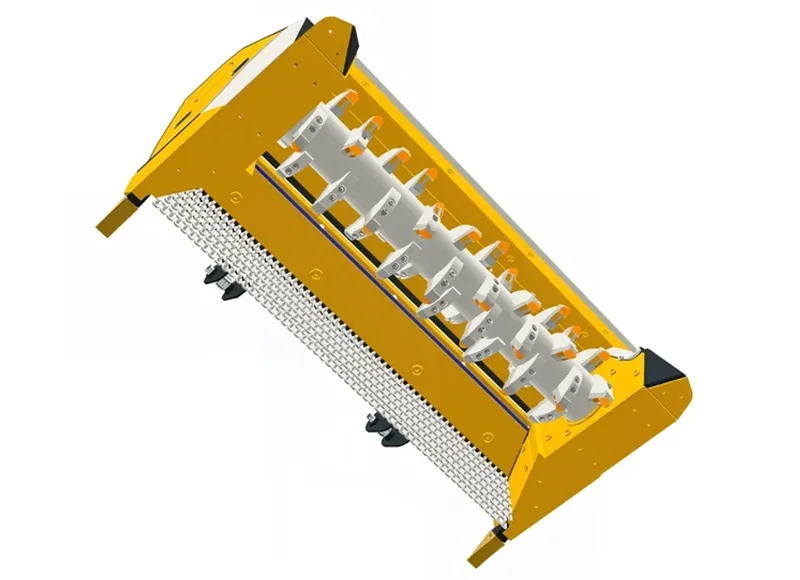
The tool selection — sometimes called the material system — is arguably the most consequential specification decision when purchasing or configuring a stone crusher for tractor. Different rock types require different tool geometries, and mismatching tools to material leads to accelerated wear and poor throughput. Three primary tool families serve the range of Italian and global agricultural conditions:
| Tool Type | Code Designation | Best Application | Typical Italian Use Case |
|---|---|---|---|
| Fixed carbide tooth | STC/3 | Loose and semi-embedded stones, tufo | Puglia vineyards and olive groves — surface tufo removal before replanting |
| Heavy-duty fixed tooth | STC/3/HD | Harder limestone and embedded river stones | Emilia-Romagna hillside plots — limestone and compacted calcareous hardpan |
| Flat profile tooth | STC/3/FP | Slab milling, bedrock layer reduction | Southern Puglia terrace preparation — calcarenite slabs at 20–30 cm depth |
| Conical pick (G/3 rotor) | R/65 | Rock slab milling and asphalt cutting | Rural road preparation and drainage trench work across Apennine foothills |
| Heavy conical pick | R/65/HD | Extremely hard consolidated rock layers | Deep land reclamation projects in rocky hillside vineyard establishment |
Wear life is directly affected by rock hardness, abrasivity, and silica content. Tufo — the volcanic tuff common in central and southern Italy — is relatively soft (Mohs 3–4) and low in silica, resulting in longer tool life than river gravel or quartz-bearing limestone. Conversely, Emilia-Romagna river gravel derived from Alpine erosion often contains quartzite and flint nodules with Mohs hardness of 6–7, demanding more frequent tool inspection and replacement. Leading suppliers pre-treat their tools with tungsten carbide tip inserts or through-hardened alloy steel to extend service intervals. Keeping a set of spare tools on-site and checking tool condition every 4–6 hours of operation is standard practice among experienced Italian operators.
4. Matching the Machine to Italian Geology: Tufo, Limestone, and River Gravel
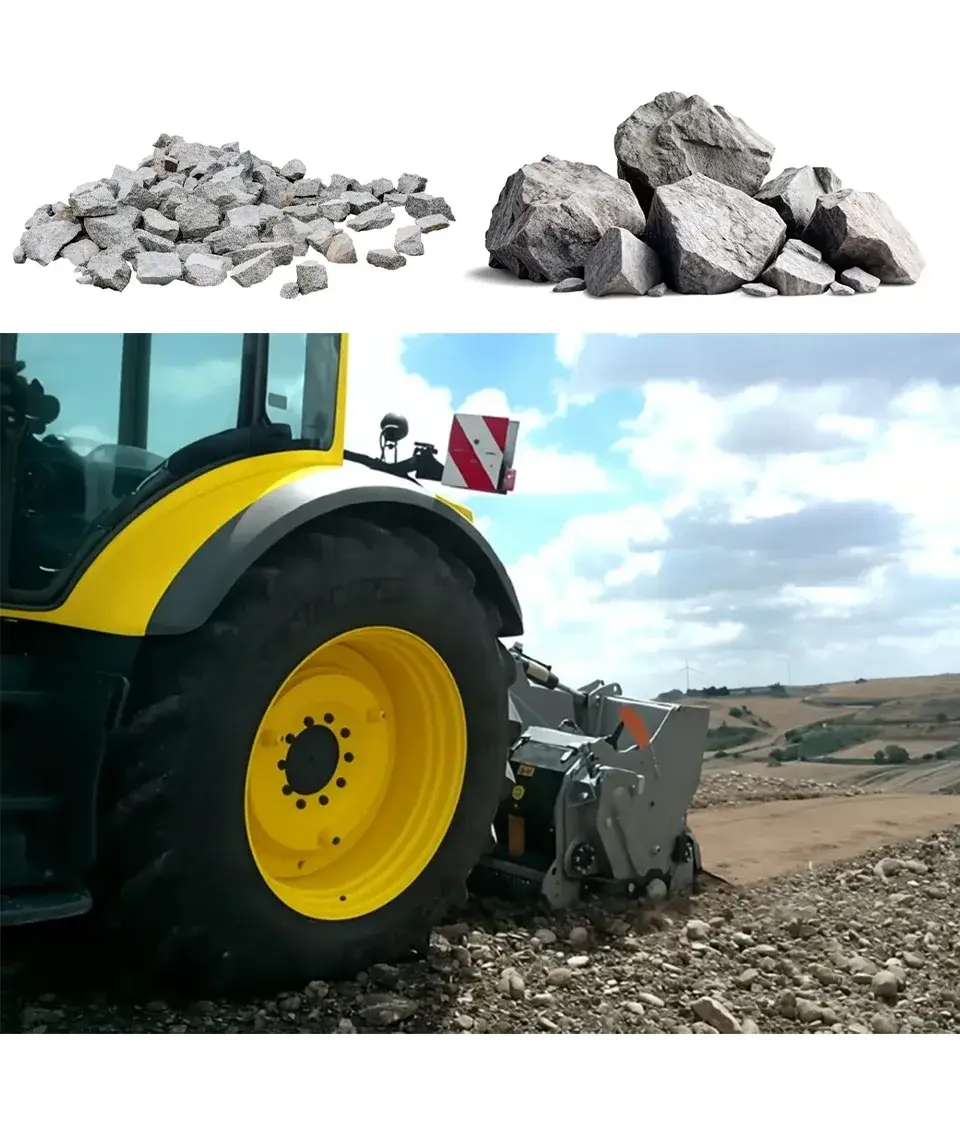
No two Italian regions present identical rock problems, and selecting the right agricultural stone crusher hinges on understanding what you are actually crushing. Below is a practical breakdown of the three dominant materials encountered in Emilia-Romagna and Puglia and how crusher specifications map to each.
Tufo (Volcanic Tuff) — Puglia and Central Italy
Tufo is a porous volcanic rock formed from consolidated ash and pumice. It is common around Matera, the Murge plateau, and parts of the Salento peninsula. While not particularly hard, tufo often forms coherent slabs 10–40 cm thick that sit immediately below the cultivated horizon, blocking root penetration and drainage. The STCL series (70–150 hp tractors) and the lighter STCM models handle tufo very efficiently with standard STC/3 teeth. Working depth of 150 mm on the STCL and up to 200 mm on the STCM models is typically sufficient to fragment tufo slabs into workable aggregate that can remain in the field without removal.
Limestone (Calcarenite and Compact Limestone) — Puglia and Apennine Foothills
Puglia’s calcarenite is a cemented biocalcarenite with compressive strengths ranging from 10 to 80 MPa depending on degree of cementation. Compact limestone in the Apennine foothill zones of Emilia-Romagna (particularly in the provinces of Piacenza, Parma, and Modena) can reach 150 MPa. For softer calcarenite, the STCM 150–200 series with STC/3/HD teeth performs well, crushing stones up to 300 mm and working to 200 mm depth. For harder consolidated limestone, upgrading to the STCH series (280–400 hp) or the RSL gear-transmission series is advisable. The RSL’s pick rotor configuration (R/65 type picks on the R rotor) excels at milling through continuous rock layers rather than just fracturing loose stones.
River Gravel — Emilia-Romagna Po Plain
The Po Valley and its tributary plains deposit mixed river gravel of Alpine origin — rounded and sub-rounded clasts of granite, quartzite, flint, and limestone in a sandy matrix. Gravel beds are typically encountered 20–50 cm below the cultivated surface, exposed by erosion or disturbed by land leveling. Individual clasts range from 30 to 200+ mm. The STCM series handles standard river gravel up to 300 mm effectively. Where larger cobbles (300–500 mm) are encountered near the old river channels, the STCH or RSM series is the appropriate choice. The RSM 200/225 models, with maximum working depth of 400 mm and ability to crush 500 mm stones, are the workhorses of intensive Po Valley land reclamation projects.
5. Product Series Overview: Which Stone Crusher for Your Tractor?
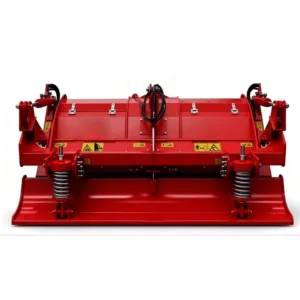
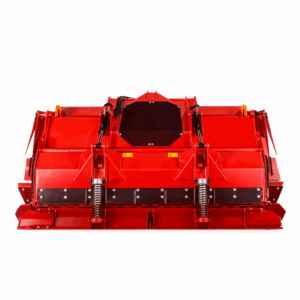
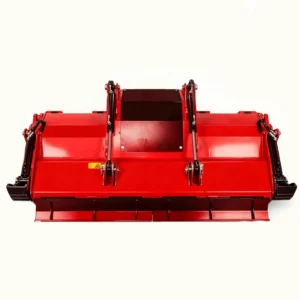
The following product lineup represents the core range of pto stone crusher for sale models suitable for Italian farming conditions. Each is available for inquiry through pto-stone-crusher.com/products/.
6. Technical Specifications at a Glance
| Model Series | Tractor HP | PTO RPM | Max Stone Ø (mm) | Max Depth (mm) | Rotor Ø (mm) | Transmission |
|---|---|---|---|---|---|---|
| STCL | 70–150 | 540–1000 | 150 | 150 | 450 | Belt / Direct |
| STCM | 80–280 | 540–1000 | 300 | 200 | 550 | Belt / Dual (DT) |
| STCH | 280–400 | 1000 | 500 | 250 | 700 | Gear reduction |
| RSL | 80–190 | 540–1000 | 300 | 280 | 595–612 | Gear reduction |
| RSM / RSM/HP | 200–360 | 1000 | 500 | 400 | 915–940 | Gear reduction |
| RSH / RSH/HP | 360–500 | 1000 | 500 | 500 | 1065–1115 | Gear reduction |
7. Gearbox Regulations and Agricultural Machinery Law: Italy, Korea, and Beyond
Operating a stone crusher machine attached to a tractor is subject to a layered set of safety and equipment regulations that vary by jurisdiction. Farmers, contractors, and equipment dealers must be aware of the applicable rules before putting a machine to work — especially when operating cross-border or importing frantoio per pietre PTO equipment from international suppliers.
European Union (Including Italy): Machinery Directive 2006/42/EC and Successor Regulation (EU) 2023/1230
All agricultural machinery placed on the EU market must comply with the Machinery Directive 2006/42/EC, which is being superseded by Regulation (EU) 2023/1230 (fully applicable from January 20, 2027). Under these rules, PTO-driven implements must carry CE marking demonstrating conformity with essential health and safety requirements. Key requirements include: guarding of all rotating PTO shafts (per ISO 4254-7 for PTO drive shafts of agricultural machinery), compliance with noise emission limits under Directive 2000/14/EC, and vibration limits under Directive 2002/44/EC for operators using handheld or whole-body vibrating machinery. The gearbox specifically must meet the lubrication, seal, and operating temperature requirements outlined in the manufacturer’s technical documentation, which accompanies the CE declaration of conformity.
Italy: National Implementation and Agricultural Tractor Safety
Italy implements EU machinery regulations through Legislative Decree 81/2008 (Testo Unico sulla Salute e Sicurezza sul Lavoro), the comprehensive occupational health and safety code. For agricultural equipment specifically, operators must carry out risk assessments under Article 28 of the decree, including noise and vibration risk. Italian agricultural contractors (conto terzi operators) are additionally regulated under the sector collective agreement (CCNL Cooperative Agricole) and must maintain equipment inspection records. In regions with nitrate-vulnerable zones (including parts of the Po Valley under Directive 91/676/EEC), soil disturbance operations including stone crushing may need to be coordinated with regional agroenvironmental plans. Emilia-Romagna’s Regional Rural Development Program (PSR) has historically offered investment grants for mechanization equipment including stone crushers, accessible through the regional AGREA agency.
Republic of Korea: Agricultural Mechanization Promotion Act (농업기계화 촉진법)
Korea’s Agricultural Mechanization Promotion Act (Law No. 18489, amended 2022) governs the manufacture, distribution, and use of agricultural machinery including tractor-mounted implements. Agricultural machines must undergo safety certification testing through the Korea Agricultural Machinery Industry Cooperative (KAMICO) or an accredited testing agency before sale. PTO implements specifically must comply with Korean Industrial Standard KS B ISO 500 (tractors and machinery for agriculture — PTO drive shafts and power-take-off drive shaft guards) and KS B ISO 4254 (agricultural machinery safety standards). Gearboxes in imported implements must demonstrate compatibility with 540 RPM and/or 1000 RPM Korean-market tractor PTO specifications. Importers must obtain an Agricultural Machinery Approval Certificate (농기계형식검정 합격증) and register the equipment with the Rural Development Administration (RDA, 농촌진흥청) before distribution. Korean operators working on designated preservation farmland (농업진흥지역) may also need to submit a soil alteration report to the local municipality before undertaking deep stone crushing operations.
United States: OSHA and ASABE Standards
In the US market, PTO-driven stone crushers must comply with OSHA 1928.57 (guarding of farm field equipment, farmstead equipment, and cotton gins) and ASABE Standard S318 (safety for agricultural equipment). PTO shaft guards must meet ASABE S205 specifications. While no federal certification scheme applies to agricultural implements, operators should verify compliance with state-level right-to-farm acts where applicable.
Australia: AS/NZS Standards
Australian operators using tractor-mounted stone crushers must comply with Safe Work Australia’s Model Code of Practice for Managing Risks of Plant in the Workplace and AS 4024 (safety of machinery series). PTO shaft guarding requirements align with ISO 4254-7. State-level WorkSafe and SafeWork authorities additionally enforce farm safety regulations specific to each jurisdiction.
Regardless of jurisdiction, best practice dictates that gearbox oil is changed at manufacturer-specified intervals (typically every 200–500 hours), all rotating guards are fitted and secured before operation, and operators read the complete safety chapter of the operator’s manual before first use.
8. Operational Benefits and Return on Investment in Italian Agriculture
Farmers often ask: is a stone crusher for sale truly worth the investment compared to manual stone removal or occasional rental? The answer depends on the scale of rocky land being managed, but the economics typically favor ownership or long-term lease for farms above 20 hectares of stone-affected land in Puglia or Emilia-Romagna. Consider a Puglian olive producer with 40 ha being converted from dry-farming to irrigated production. Hand-clearing tufo slabs at 8–12 workers per hectare costs approximately €600–900 per hectare in labor alone. A single pass with a mid-range small pto stone crusher on a 100 hp tractor achieves comparable preparation at an estimated €150–250 per hectare in fuel, labor, and amortized equipment cost — a saving of 60–70% per hectare, achieved simultaneously with better integration of crushed material into the soil profile.
Beyond direct cost savings, field-scale benefits include improved water infiltration (crushed limestone improves macroporosity in clay-dominant soils), better root penetration for permanent crops, reduced equipment damage to downstream tillage and seeding implements, and improved trafficability across the field surface. In the context of the Italian SQNPI (Sistema di Qualità Nazionale Produzione Integrata) certification framework for integrated production, documented soil preparation practices including stone management contribute positively to the site assessment scoring used in regional quality scheme audits.
9. Maintenance Schedule and Common Troubleshooting
Consistent maintenance is the single biggest factor separating machines that deliver 3,000+ hours of reliable service from those that fail prematurely. Italian operators working in the dusty conditions typical of Puglia’s summer field preparation season should adhere to tighter service intervals than the standard recommendations given the extremely fine silica dust generated by calcarenite crushing. A practical schedule for a medium-duty stone crusher machine (STCM / RockMaster class) looks like this:
| Interval | Task | Notes |
|---|---|---|
| Before each use | Inspect all tools (teeth/picks) for wear or breakage; check PTO shaft guard integrity; verify counter-blade position | Replace any tool showing more than 50% wear before engaging; bent guards must be straightened or replaced |
| Every 8 hours | Grease all rotor shaft bearings; check belt tension (belt-drive models); inspect wear plates visually | Use manufacturer-specified grease grade; over-greasing is as damaging as under-greasing |
| Every 50 hours | Check gearbox oil level; inspect all hardware for loosening; examine rotor shaft seal for dust ingress | Any milky or foamy oil indicates water contamination — drain and refill immediately |
| Every 250 hours | Replace gearbox oil; replace belt drive belts (belt models); inspect Hardox wear plate thickness; check counter-blade wear | Use ISO VG 220 gear oil unless manufacturer specifies otherwise; record service in logbook for warranty tracking |
| Seasonally | Full strip and inspection of rotor assembly; replace all worn tools proactively; clean and repaint exposed steel surfaces; check all fastener torques | Pre-season inspection before the peak April–June field prep window in Emilia-Romagna and Puglia |
10. Buyer’s Guide: How to Choose the Right Stone Crusher for Your Farm
When you’re sourcing a pto stone crusher for sale — whether looking for a new unit or a used tractor stone crusher for sale — the following checklist will help prevent costly mismatches. The Italian and Korean agricultural markets are both served by the product range available at pto-stone-crusher.com, with technical support available for model selection and compatibility checks.
Step 1: Know your rock. Determine the predominant rock type (tufo, limestone, river gravel, granite), the maximum size of individual stones, and the approximate depth at which rock is concentrated. This alone determines the required rotor diameter and tool type.
Step 2: Match to your tractor. A stone crushing equipment unit running on too little power will bog down, overheat the PTO clutch, and cause premature gearbox wear. Conversely, an undersized machine on an overpowered tractor will limit throughput and waste fuel. Match minimum tractor HP to the machine’s stated requirement with 10–15% headroom.
Step 3: Consider working width versus maneuverability. Wider machines cover more ground per pass but are harder to maneuver in small fields, terraces, and inter-row work. The 1,110–1,590 mm working width of the STCL series is well-suited to vineyard inter-rows and small orchard plots. Wider STCM and STCH units (2,064–2,560 mm) maximize efficiency on open field operations.
Step 4: Verify PTO compatibility. Confirm whether your tractor’s PTO runs at 540 or 1000 RPM (or both), and whether the PTO output is standard 6-spline or 21-spline. Most modern European and Korean tractors offer both speeds, but older Italian two-wheel-drive tractors may be limited to 540 RPM only.
Step 5: Consider future service access. Genuine replacement tools, Hardox wear plates, and gearbox seals should be obtainable locally or through a short supply chain. Verify parts availability before purchase, particularly for pto stone crusher manufacturers whose distribution network may not extend to your region.
11. About Us
We are an international agricultural equipment supplier specializing in land preparation machinery for farmers, contractors, and agribusinesses across Europe, Asia, and beyond. Our focus is on delivering proven stone crushing equipment solutions — from entry-level units for small farms to high-capacity machines for commercial land reclamation — backed by technical expertise and accessible after-sales support.
Our product range spans the complete spectrum of PTO-driven stone crusher and mulcher categories, alongside rock rakes, rock pickers, rotavators, and complementary soil preparation equipment. We work closely with end users to match machinery to local geological conditions, tractor compatibility, and budget — whether you’re establishing a new vineyard in Puglia, reclaiming riverine farmland in Emilia-Romagna, or preparing rocky paddocks in Korea’s mountainous agricultural zones.
Frequently Asked Questions
Editor: PXY