Olive Grove Management & Agricultural Stone Crushing
PTO Stone Crusher for Spanish Olive Groves:
Working Limestone and Silex Soil in Andalucía and Extremadura
A field guide to selecting, operating, and maintaining a tractor-mounted stone crusher across the calcareous and flint-studded soils of Spain’s premier olive-producing regions — with regulatory context and model-specific data.
Spain holds more than 2.6 million hectares under olive cultivation — a figure that makes it the largest olive oil producing nation on earth. The bulk of that area sits across Andalucía and Extremadura, two regions whose soils present a distinctive and often challenging mix of limestone outcrops, embedded silex (flint) fragments, and calcium-carbonate-rich substrates that have accumulated over millennia on the ancient Iberian plateau. For growers replanting aging groves, expanding into marginal land, or simply maintaining inter-row accessibility, surface and near-surface rock management is a recurring operational challenge. A well-chosen PTO stone crusher addresses this need in a single tractor pass — eliminating rocks in place without the labor, cost, and soil disruption of hand-picking or excavation.
This page examines the specific soil and rock conditions encountered in Andalucía and Extremadura olive groves, explains the mechanical principles behind ट्रैक्टर स्टोन क्रशर equipment, covers the build and material characteristics that determine longevity in abrasive calcareous soils, and maps available models to the tractor horsepower ranges common in Spanish olive farming. Regulatory requirements relevant to gearbox and PTO equipment use in Spain and the broader EU are also addressed in detail, alongside a comparative product overview to help growers make an informed purchasing decision.
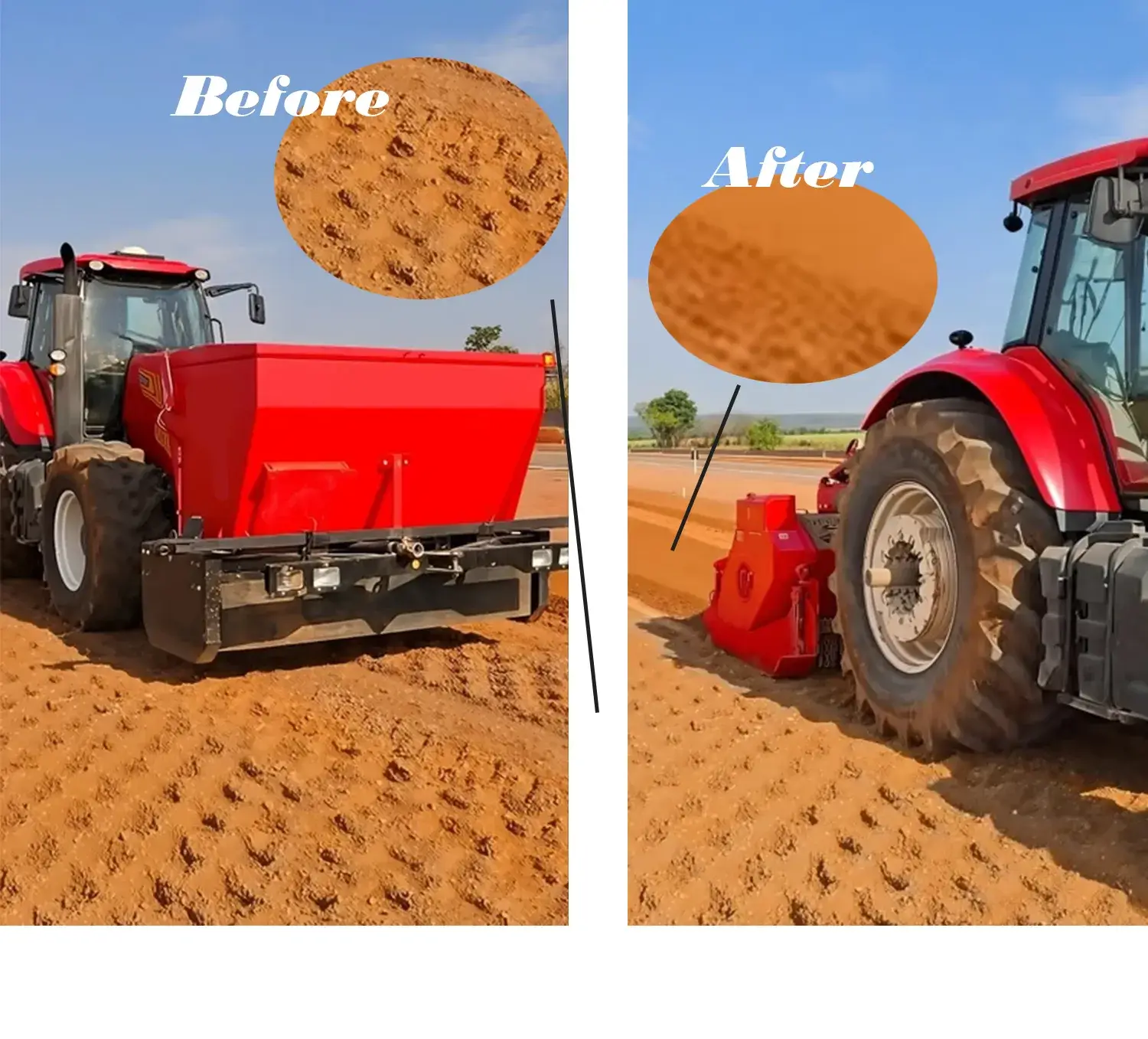
1. Understanding the Rock Challenge in Andalucían and Extremaduran Olive Soils
The soils of Jaén, Córdoba, Sevilla, and the eastern reaches of Badajoz share a geological character shaped by Jurassic and Cretaceous marine sediments uplifted during the Alpine orogeny. The result, particularly across the subbética and prebética zones, is a landscape where limestone bedrock sits close to the surface and where ploughing or subsoil movement routinely exposes angular calcareous stones ranging from fist-sized chunks to boulders exceeding 300 mm. In the Extremaduran dehesa edges — transitional zones between cork oak woodland and olive cultivation — the soil profile shifts to include significant quantities of silex: hard, glassy flint nodules embedded within a reddish ferralitic matrix.
Silex and limestone behave very differently under a पत्थर तोड़ने वाली मशीन rotor. Limestone is relatively brittle and responds well to the repeated impact of carbide picks; it fractures along cleavage planes and reduces quickly with a moderate number of tooth strikes. Silex, by contrast, is one of the hardest naturally occurring minerals — Mohs hardness 7 — and its conchoidal fracture pattern produces razor-edged fragments that can accelerate tooth wear significantly. In mixed soil profiles where both rock types occur together (common in much of Extremadura and the transitional zones north of Sevilla), selecting a machine with sufficiently hard-grade carbide tips and adequate tooth count is more important than in pure-limestone environments. Operators who have tried a small pto stone crusher designed for softer fieldstone and then encountered embedded silex learn this lesson quickly and expensively.
Ground surface coverage also varies enormously across the olive belt. In intensively managed irrigated groves on flatter terrain — increasingly common in Córdoba and the Guadalquivir basin — rock coverage may be relatively low (8–15% of surface area) and stones are mostly surface-weathered fragments. In older dryland groves on sloped terrain, particularly on the hillsides of Sierra Morena or the granite-limestone transition zones of western Extremadura, coverage can reach 40–60%, with stones that are only partially exposed and require the rotor to engage the soil to dislodge and crush them completely.
2. Action Mode: How a PTO Stone Crusher Engages Rock
ए पीटीओ पत्थर कोल्हू is a rotary impact machine. It connects to the tractor’s three-point hitch — Category 2 in almost all olive farming applications — and draws rotational energy from the PTO shaft, typically at 540 or 1000 RPM depending on the model and tractor configuration. That input speed is transmitted through a gearbox and, in most designs, a supplementary belt-and-pulley drive stage before reaching the rotor drum. The rotor carries rows of carbide-tipped picks or teeth arranged in a staggered helical pattern. As the drum spins at high speed, those picks strike exposed stones and reduce them through successive impact events into fragments small enough to remain distributed within the soil profile — harmless to machinery and beneficial to soil structure through improved drainage.
What makes this mechanism particularly suited to olive grove conditions is its combination of crushing and leveling action. After the rotor chamber processes the material, a heavy rear deflector hood controls fragment trajectory, and most models incorporate an adjustable rear leveling blade or drag bar that redistributes fine crushed material evenly across the surface. For olive growers who irrigate via surface channels or manage micro-catchment berms between tree rows, leaving a flat, stone-free working surface after a single pass is operationally valuable — it removes the need for a follow-up grading pass and allows mechanical weed control equipment to work unobstructed for the rest of the season.
Travel speed during operation is constrained by rotor engagement time. Most agricultural stone crushers work between 2 and 5 km/h for typical olive grove conditions. Attempting to increase tractor forward speed beyond the recommended range in order to cover more ground per hour invariably produces an incomplete crush — stones are struck fewer times, fragment size increases, and the material left on the surface can still damage harvester equipment or erode irrigation distribution networks. The relationship between forward speed, stone size, and fragment output is more sensitive in silex-rich soils because flint requires more impact energy per unit volume to fracture than limestone of equivalent size.
3. Manufacturing Structure: What Determines Durability in Abrasive Conditions
The structural integrity of a ट्रैक्टर के लिए पत्थर तोड़ने वाली मशीन attachment is tested most severely in abrasive, rocky soils — exactly the conditions found across much of the Spanish olive belt. The outer shell or hood assembly is typically fabricated from 8–16 mm high-tensile structural steel plate, with heavier gauge used in the side panels flanking the rotor chamber where fragment impact is most concentrated. In quality machines, the inner surface of the rear hood incorporates wear-resistant overlays or bolt-on liner plates that can be replaced without replacing the entire hood — an important consideration given the abrasive nature of calcareous grit and siliceous dust generated when crushing silex-bearing soils.
The rotor itself is the most mechanically demanding component. It must be precision-balanced to minimize vibration at operating speed, fabricated from material that can withstand the cyclic shock loading of continuous stone impact, and designed to allow straightforward tooth holder replacement in the field. Most rotor bodies are either cast steel or heavy-wall tube, with forged or cast tool-steel tooth holders welded or bolted at regular intervals along the drum length. The tooth holders are the wear interface — they position and retain the carbide-tipped picks and absorb the lateral forces that occur when a pick strikes a stone at an angle. In mixed limestone-silex environments, tooth holders with reinforced side walls last considerably longer than standard holders because flint strikes produce higher lateral loading than limestone fracture events.
The gearbox is the component most growers ask about when evaluating used machinery or comparing new equipment. A properly sized gearbox for this application must handle both continuous rated torque from the PTO and the peak shock loads generated when the rotor encounters a large embedded stone at speed. Most manufacturers address this with an overload protection mechanism — either a shear bolt PTO shaft adaptor, a friction clutch on the driveline, or a belt-slip drive stage between the gearbox output and the rotor. The THOR 2.4 Kit Drawbar model, which specifies a minimum 180 cv tractor, uses a robust gearbox-and-belt combination capable of absorbing the high shock loads expected when working deeper deposits of large embedded limestone. Lighter models like the PSC/STCL series are designed with smaller gearboxes matched to the lower torque demands of surface-stone work in lighter soils.
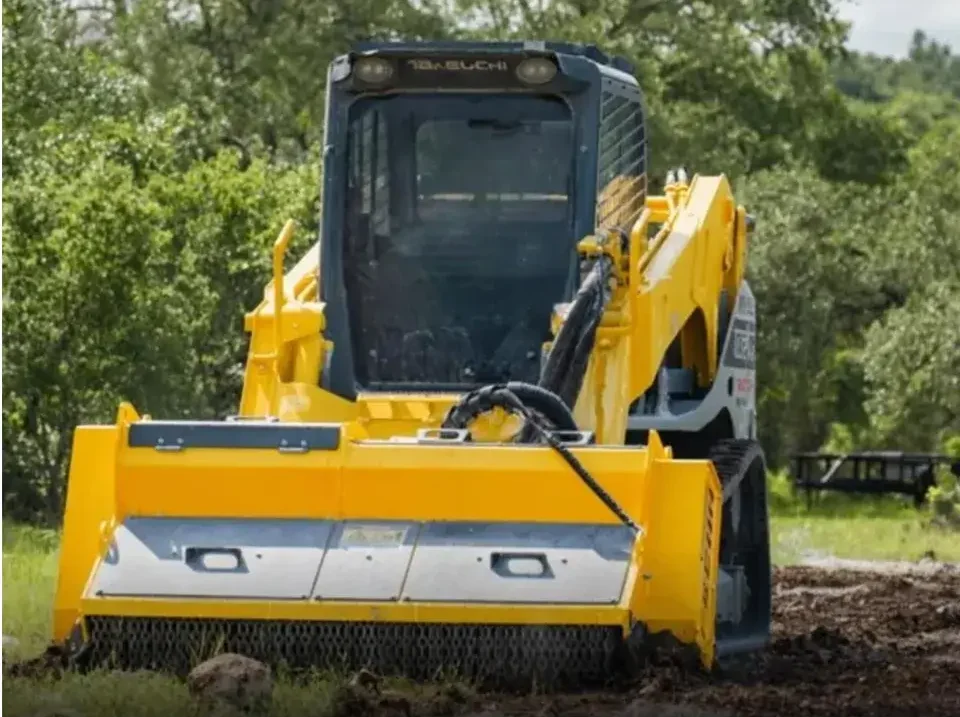
4. Material System: Carbide Grades, Tooth Types, and Silex Resistance
The carbide tip is the consumable heart of any कृषि पत्थर क्रशर. Tungsten carbide is used almost universally for stone crusher teeth because it combines extreme hardness with sufficient toughness to withstand repeated impact without shattering. However, not all carbide is identical: the cobalt binder content, grain size, and sintering process determine the balance between hardness and impact resistance. In pure limestone environments, a fine-grain carbide with moderate cobalt content delivers the best combination of wear life and toughness. In silex-heavy conditions, a slightly coarser carbide grade with higher cobalt content performs better — it sacrifices some hardness but gains the toughness needed to survive the higher-energy impacts that flint produces.
Tooth type selection also matters considerably for Spanish olive grove applications. The STC/3 standard pick is the baseline configuration for most STCL and STCM series machines — it is optimized for moderate-hardness fieldstone and performs well on limestone. The STC/3/HD heavy-duty pick uses a thicker body and a more robust tip geometry; it is the better choice for mixed or silex-dominant soils. The STC/FP flat-profile tooth is included in some configurations to improve surface finishing — its low-relief geometry produces a finer fragment distribution at the expense of depth capability. For the STCH series machines used on larger commercial olive estates with 280–400 hp tractors, the combination of STC/3, STC/3/HD, and STC/FP teeth on a single rotor provides the versatility to handle both the surface finishing desired for mechanically harvested groves and the heavier embedded stone encountered during land preparation.
RSL and RSM series machines carry R/65 and R/65/HD picks alongside the standard STC/3 teeth — these longer, more aggressive picks are positioned to engage deeper rock and are particularly effective when working at the 200–280 mm working depth settings available on the RSL/DT variants. For an olive farmer reclaiming heavily stoned land in western Badajoz or preparing a new grove site on the foothills of Sierra de Hornachos, the RSM 200 or RSM 225 with its dual rotor configuration (G/3 rotor diameter 940 mm and R rotor diameter 915 mm) provides crushing capability well beyond what any single-rotor STCL or STCM machine can deliver — handling stones up to 500 mm in diameter and working to 400 mm depth.
5. Model Specifications: Key Data for Olive Grove Applications
The table below summarizes the primary technical parameters of available stone crusher model series, mapped to their suitability for different olive grove conditions in Andalucía and Extremadura. Rock categories: Type A = surface limestone up to 150 mm; Type B = mixed limestone/silex up to 300 mm; Type C = large embedded or mixed stone up to 500 mm.
| मॉडल श्रृंखला | ट्रैक्टर (एचपी) | कार्य चौड़ाई (मिमी) | Max Stone (mm) | अधिकतम गहराई (मिमी) | Rock Type Suited | Typical Grove Scenario |
|---|---|---|---|---|---|---|
| PSC / STCL Series | 70–150 | 1110–2070 | 150 | 150 | Type A | Small dryland groves, track maintenance |
| STCM Series | 80–280 | 1340–2304 | 300 | 200 | Type A, B | Mid-scale Jaén/Córdoba limestone groves |
| STCH Series | 280–400 | 2080–2560 | 500 | 250 | Type B, C | Large commercial estates, reclamation |
| THOR 2.4 Drawbar | 180+ | 2400 | 300+ | 200 | Type A, B | Wide-row plantations, flat Guadalquivir terrain |
| RSL Series | 80–190 | 1000–2200 | 300 | 150–280 | Type B | Mixed silex/limestone, terraced hillside groves |
| आरएसएम / आरएसएम/एचपी | 200–360 | 2080–2320 | 500 | 400 | Type B, C | Land reclamation, heavy Extremadura silex |
6. Gearbox Standards, PTO Compliance, and Applicable Regulations
Stone crusher attachments used in Spain and across the EU are subject to a layered regulatory framework governing machinery safety, PTO driveline protection, and gearbox design standards. Understanding these requirements is relevant both when selecting new equipment and when evaluating a used tractor stone crusher for sale — older machines may not carry current CE marking and may require upgrades before legal use by hired agricultural contractors.
Spain & European Union
All PTO-driven stone crushers placed on the EU market must carry CE marking and a Declaration of Conformity under the EU Machinery Directive 2006/42/EC. This Directive will be superseded by the EU Machinery Regulation 2023/1230, which becomes fully applicable from 20 January 2027. Under both frameworks, the machine must comply with essential health and safety requirements covering guarding, stability, control systems, and risk assessment documentation. In Spain, the competent authority for market surveillance of agricultural machinery is MAPA (Ministerio de Agricultura, Pesca y Alimentación) and regional agricultural departments (Consejerías de Agricultura) in each autonomous community.
PTO driveline guarding is specifically addressed by harmonized standard EN 12965:2019 (Tractors and machinery for agriculture and forestry — Power take-off drive shafts and their guards), which mandates full telescopic tube guards and end guards on Cardan shaft assemblies. Gearbox design for agricultural machinery is covered by EN ISO 4254-1:2015 (general safety requirements) in conjunction with manufacturer-specific design standards. For Andalucían and Extremaduran operations where equipment is frequently transported between farm plots along rural tracks, the tractor-machine combination must comply with Real Decreto 2822/1998 (Reglamento General de Vehículos) and its agricultural vehicle provisions when moving on public roads.
Spain’s autonomous community of Andalucía also enforces Decree 208/2011 of the Junta de Andalucía on agricultural machinery registration, requiring that professional agricultural contractors operating stone crushing equipment maintain current machinery records with the regional registry (ROMA — Registro Oficial de Maquinaria Agrícola).
Italy
Italy is the EU’s second-largest olive oil producer and a significant market for stone crusher machines in olive grove applications. Italian agricultural machinery regulations are administered through the Ministero delle Politiche Agricole Alimentari e Forestali (MiPAAF). PTO machinery must comply with D.Lgs. 81/2008 (Testo Unico sulla Salute e Sicurezza sul Lavoro), which transposes EU workplace safety directives into Italian law and requires that all PTO-connected implements used by agricultural employees carry current CE marking and conform to EN 12965 driveline guarding requirements. Gearbox oil changes and mechanical inspections must be documented in the machinery maintenance register when equipment is used in contexts covered by D.Lgs. 81/2008.
Greece & Turkey
Greece, as an EU member, applies the Machinery Directive framework and CE marking requirements in the same manner as Spain. The Hellenic Ministry of Rural Development and Food administers machinery market surveillance. For olive groves in Crete and the Peloponnese — where calcareous soils with embedded conglomerate pebbles are common — the regulatory requirements are the same as for Andalucía, including EN 12965 PTO guarding and EN ISO 4254-1 safety standards.
Turkey, a major olive producer outside the EU, applies its own machinery safety regulation under Makina Emniyeti Yönetmeliği (Machine Safety Regulation, aligned with 2006/42/EC under the Turkey-EU customs union agreement). PTO driveline guarding requirements broadly follow the EU approach, and CE-marked machinery is generally accepted for import and use in Turkish agricultural operations without additional national certification.
Morocco & Tunisia
North African olive producers importing stone crushing equipment from Europe typically reference EU standards in their procurement specifications, though there are no binding equivalents to CE marking requirements for agricultural machinery in Morocco or Tunisia. The Institut National de la Recherche Agronomique (INRA) in Morocco and the Office de l’Huile in Tunisia provide guidance on suitable machinery for local soil conditions. Gearbox maintenance documentation is not legally mandated but is strongly advised given import constraints on spare parts.
South Korea (한국) — Import & Safety Context
Korean importers of EU-manufactured stone crushing equipment should be aware that CE-marked machinery is acceptable for import but must comply with Korea’s Agricultural Mechanization Promotion Act (농업기계화 촉진법) for registration and field use. PTO attachment safety is regulated under Korean Industrial Standard KS B 6040 for power take-off covers. Equipment imported for use by agricultural contractors must be registered with the Rural Development Administration (RDA / 농촌진흥청) and operators must hold valid agricultural machinery operator licenses when moving equipment on public roads under the Road Traffic Act.
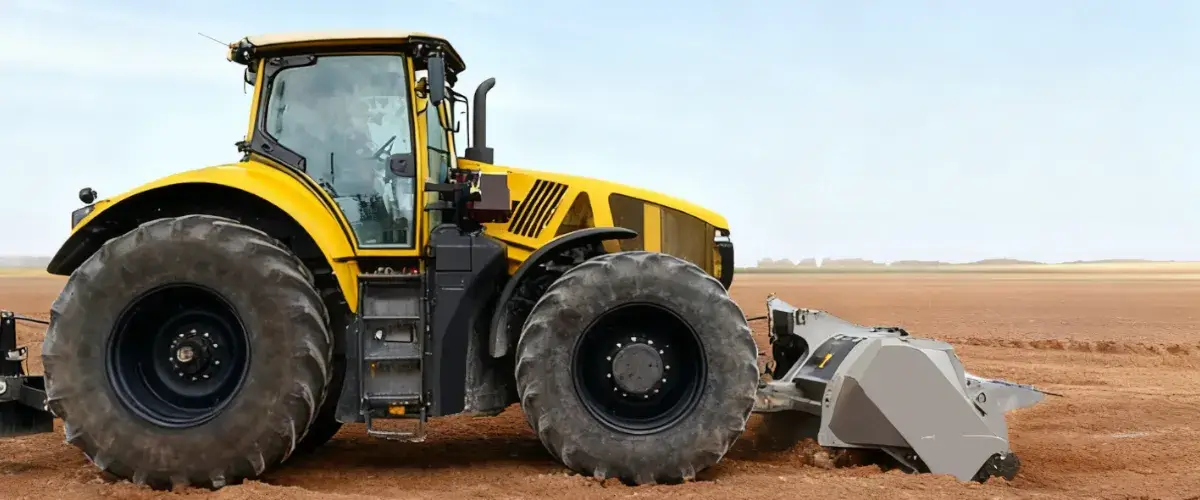
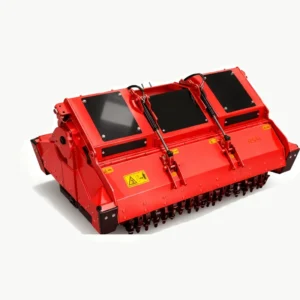
7. Available Stone Crusher Models for Olive Grove Applications
8. Operational Considerations Specific to Olive Grove Stone Crushing
Working a stone crusher in olive groves introduces constraints not present in open arable field applications. Row spacing, tree canopy clearance, terrain gradient, and the timing of operations relative to the harvest cycle all affect the practical application of stone crushing equipment.
Row Spacing & Turning
Traditional Andalucían dryland grove rows are typically 7–10 m apart — wide enough to accommodate most STCM-range machines. Super-intensive groves on trellised systems may have rows as narrow as 3.75–4 m, requiring the most compact models in the STCL range. Total machine width, not just working width, determines whether the tractor-crusher combination can maneuver in headlands without damaging peripheral trees.
Harvest Timing
Stone crushing work in the olive inter-row is most productively done in late winter (February–March) after the harvest, before soil moisture drops and ground hardness increases. In dry years, extremely hard sun-baked soil in June through September reduces maximum working depth and increases wear. Late winter operations also mean the fresh crushed aggregate is incorporated into the soil profile before spring weed emergence, reducing the need for later herbicide application.
Gradient & Slope Work
Sierra Morena olive slopes and the terraced hillside groves of Jaén and Granada regularly exceed 15% gradient. On steeper slopes, PTO power delivery is reduced by the tractor working harder to maintain position, and the machine must be operated at reduced depth settings to prevent overload. For gradients above 20%, evaluate whether the tractor’s lower link geometry still maintains consistent ground contact on the leading depth-control skids throughout the working pass.
9. Silex vs. Limestone: Wear Rate Comparison and Tooth Management
One of the most common planning errors made by olive growers acquiring their first पत्थर तोड़ने वाली मशीन is assuming tooth wear rates from supplier brochures — which are usually measured against medium-hardness limestone — will hold true in their specific soil. In the red ferralitic soils of Extremadura where silex nodules are abundant, tooth consumption can be three to five times higher than in a comparable limestone-only environment. This has direct implications for operating cost and for the practical scheduling of machine downtime.
The table below provides a comparison of approximate STC/3 and STC/3/HD tooth service life across three representative rock conditions encountered in Spanish olive groves:
| स्थिति | Rock Type | STC/3 Life (hrs) | STC/3/HD Life (hrs) | Recommended Tooth |
|---|---|---|---|---|
| Córdoba basin flatlands | Soft limestone, calcareous | 80–120 | 130–180 | STC/3 acceptable |
| Jaén hillside subbética | Hard limestone + some silex | 45–70 | 80–110 | STC/3/HD recommended |
| Extremadura dehesa edge | Dense silex in red ferralite | 20–40 | 45–70 | STC/3/HD essential |
Figures are illustrative averages under moderate stone density. Very high stone coverage or exceptionally hard rock reduces service life by a further 20–40%.
10. About Our Stone Crushing Equipment Range
We specialize in supplying professional stone crushing and land preparation equipment matched to real agricultural conditions — not showroom demonstrations. Our range is selected with attention to the soil types, tractor fleets, and operational constraints faced by working farmers across olive-producing regions, dryland arable systems, and mixed farming operations. Each model in our Mulchers / Stone Crushers catalog has been evaluated against the demands of high-abrasion applications including calcareous and silex-bearing soils of the kind encountered throughout southern Spain.
We offer pre-purchase technical consultation to help match machine model and tooth specification to your specific rock type and tractor configuration. After-sales support covers carbide teeth, tooth holders, wear components, and gearbox service parts. Whether you are considering your first बिक्री के लिए पीटीओ स्टोन क्रशर, comparing model options, or looking for a supplier who can advise on silex-specific tooth specifications, our team is available to help you make the right call before you commit to a purchase.
11. Which Stone Crusher Should an Olive Grower in Andalucía Actually Buy?
The answer depends on four inputs: your tractor’s PTO horsepower, the maximum rock size in your grove, the proportion of silex in your soil profile, and your total area requiring treatment. With those four variables in hand, the decision becomes considerably more straightforward than most agricultural equipment purchases.
For a grower with a 100–120 hp tractor working an established 20-hectare dryland grove in Jaén with predominantly surface limestone stones under 150 mm diameter, the STCL/ST 175 or STCL/DT 175 (PSC series) offers the right combination of working width — 1,830 mm — and depth capability (150 mm) to process the typical stone burden in two or three working days. The machine weight of 1,570 kg is well within the three-point hitch lift capacity of a 120 hp tractor, and the 38+4 tooth count provides adequate impact density for medium-hardness limestone without over-specifying the machine.
For a contractor serving multiple olive growers across the Jaén and Córdoba subbética zone where larger embedded stones and mixed silex content are the norm, the STCM 175 or STCM 200 with a 160–220 hp tractor provides the 300 mm maximum stone capability and 200 mm working depth needed to handle the full range of conditions encountered in a mixed contractor workload. The wider working widths (1,824–2,064 mm) improve daily coverage and justify the higher machine investment across a multi-client operation.
A large private estate in Extremadura reclaiming 100+ hectares of previously uncultivated land with heavy silex deposits would be best served by the RSM 200 or RSM 225 paired with a 200–300 hp tractor — the dual-rotor design and 500 mm maximum stone capability eliminates the need for pre-screening or hand-removal of oversized stones, and the 400 mm maximum working depth allows single-pass treatment of deeply embedded rock horizons that lighter machines would leave incomplete.
अक्सर पूछे जाने वाले प्रश्नों
संपादक: पीएक्सवाई