Practical Guide for Large Properties
Using a PTO Rock Crusher to Create Gravel Paths and Landscape Aggregate on Large Properties
Learn how tractor-mounted stone crushers transform surface rocks into functional, professional-grade gravel — without hauling a single load off-site.
1. Why Large Property Owners Are Turning to On-Site Stone Crushing
If you manage a farm, rural estate, or large agricultural holding, you have probably spent years looking at rocks scattered across your fields or buried just below the surface of your access roads. Bringing in gravel by truck is expensive, and manually clearing stones takes time you rarely have. A PTO rock crusher attached to your tractor changes the equation entirely. Instead of hauling raw material away or paying for aggregate deliveries, the machine grinds existing surface stones directly into usable landscape aggregate and gravel path material. The result is a firm, well-drained surface produced from material that was already on-site, at a fraction of the cost of conventional road-building approaches.
Across Colombia’s diverse landscape — from the coffee-growing hillsides of Antioquia to the broad cattle plains of the Llanos — landowners are adopting tractor-mounted PTO rock crusher technology to reclaim stony ground, build internal access routes, and create decorative aggregate paths around estates and agrotourism facilities. The compact design of modern stone crushers means even a mid-size farm tractor can carry out work that previously required renting an excavator and a full crushing crew.
This guide walks through the action method, structural types, manufacturing characteristics, material systems, and practical application workflow for using a PTO rock crusher to produce gravel paths and landscape aggregate on large properties. Specific product data references are drawn from verified specifications for machines in the STCM, PSC, and THOR series lines.
2. Action Method: How a PTO Rock Crusher Actually Works
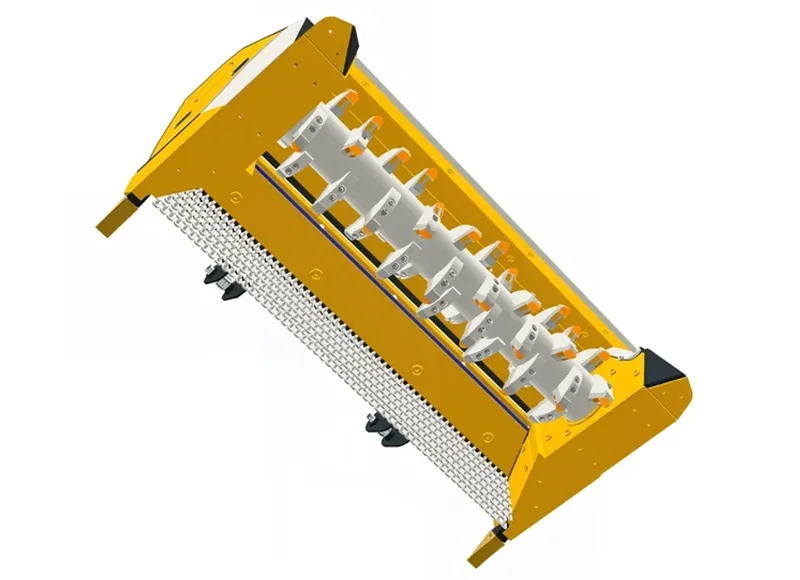
The operating principle of a PTO rock crusher depends on a high-speed rotor mounted horizontally inside a heavy steel housing. The tractor’s power take-off shaft — running at either 540 or 1000 RPM depending on the model selected — drives the rotor through a gearbox and universal joint assembly that adapts engine power into the rotational energy needed to spin the crushing drum. As the rotor accelerates, the carbide-tipped teeth or picks mounted along its circumference impact stones passing beneath the housing, fracturing them into progressively smaller fragments. A rear deflector curtain or rear baffle controls fragment throw-back, ensuring the crushed output stays within the machine’s working zone rather than being projected dangerously behind the tractor.
The rotor itself does not simply smash stones once; material circulates within the crushing chamber through a combination of direct impact and secondary collision against the hardened housing walls. This two-stage breakage is what allows a PTO rock crusher to consistently reduce stones up to 300 mm (12 inches) in diameter — such as those in the STCM and PSC model series — down to the 20–40 mm gravel fraction most useful for path construction. The working depth, adjustable via rear roller or skid shoes, governs how deeply the machine penetrates below the existing ground surface. For gravel path creation, operators typically run at the shallowest recommended working depth of around 50–100 mm to process surface material without unduly disturbing road base layers already in place.
Ground speed during operation is kept deliberately slow — typically 3 km/h for heavy stone-crushing passes with the THOR and STCM series — because excessive forward speed reduces dwell time in the crushing chamber and results in a coarser, less uniform output. In the field, experienced operators often make two passes: a first pass at working depth to fracture the largest stones and a second, shallower pass to refine the output and achieve a more consistent gravel fraction distribution across the path surface.
Rotor Action Types Explained
| Rotor Type | तंत्र | Best For | Output Fraction |
|---|---|---|---|
| G/3 Tooth Drum | High-speed impact with triple-helix tooth arrangement | Field stones, limestone, moderate hardness rock | 20–60 mm gravel |
| R/65 Pick Drum | Conical carbide picks on large-diameter rotor | Hard volcanic rock, granite fragments, basalt | 15–50 mm gravel |
| STC/3 Combination | Mixed tooth and flat-plate arrangement for two-stage crushing | Mixed stone fields, rocky road base reclamation | 10–40 mm aggregate |
| FP Flat Plate | Wide-surface impact for shallow secondary passes | Finishing passes on gravel paths, aggregate refinement | 5–25 mm fine gravel |
3. Structure Types: Matching the Machine to Your Property
PTO rock crushers are manufactured in several structural configurations, each suited to a different combination of tractor horsepower, stone density, and intended application. Understanding the structural distinctions helps property owners select a model that delivers the right output without overloading their tractor or underperforming on stony ground.
Three-Point Hitch Rear-Mounted (Category 2 Linkage)
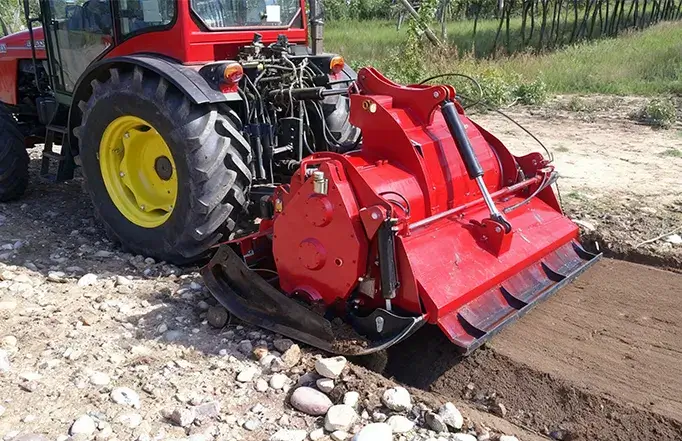
The majority of PTO rock crusher models attach via Category 2 three-point linkage to the tractor’s rear hitch. This is the standard configuration for machines in the STCL, STCM, and PSC series. The three-point mount provides excellent depth control through the hitch’s hydraulic lift, allows rapid attachment and detachment, and keeps the machine’s weight over the rear axle for balanced traction. For gravel path work across large Colombian fincas, this setup is ideal because the tractor can lift the crusher completely clear when repositioning between path sections, avoiding unnecessary stone scattering.
Drawbar-Assisted Trailed Configuration
Larger machines like the THOR 2.4 and THOR 3.0 use a combination of three-point hitch and drawbar kit. The drawbar provides additional stability for the wider working widths (2.4 m and 3.0 m respectively) that would otherwise create leverage problems on standard Category 2 hitch receivers. On long, straight path runs common on large agricultural estates, the drawbar-assisted configuration allows the machine to track more accurately behind the tractor, producing a more consistent path width without edge taper. The THOR 2.4 weighs 2300 kg and requires a minimum of 180 cv, while the THOR 3.0 at 2800 kg steps up to 230 cv minimum, figures that clearly indicate these are intended for larger estate tractors rather than compact utility machines.
Self-Leveling and Floating Frame Designs
Advanced models in the RSM and RSH families incorporate floating frame or self-leveling mounting systems that allow the crushing rotor to independently follow ground contours while the tractor’s hitch remains at a fixed height. For Colombian properties with uneven topography — volcanic hillsides in Nariño, the rocky piedmont of Cundinamarca, or the stony alluvial plains near the Cauca River — this feature is particularly valuable. A self-leveling PTO rock crusher maintains consistent working depth across undulating terrain, producing a more uniform aggregate output and reducing the risk of scalping high spots that would leave bare sub-base exposed in the finished path surface.
4. Manufacturing Structure: What Goes Into a Quality Stone Crusher
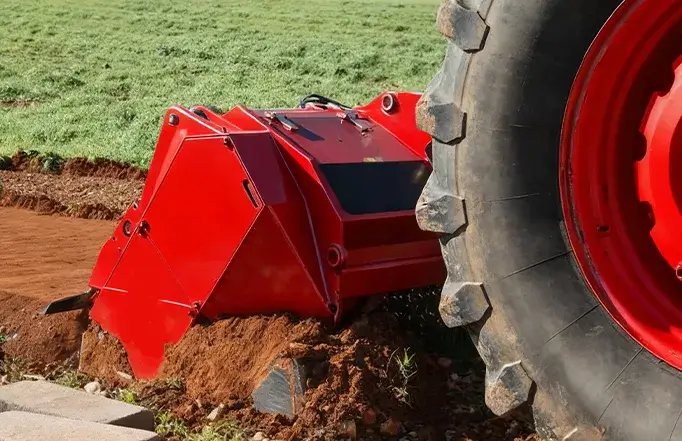
The working environment inside a PTO rock crusher is extraordinarily harsh. At 1000 RPM, rotor tip speed can exceed 80 km/h. Each tooth or pick strikes a stone hundreds of times per minute, generating intense shock and heat. Understanding how quality machines are built to withstand this environment helps buyers distinguish between machines designed for long-term professional use and lighter units that will fail prematurely under the stone volumes typical of large property path-building projects.
Main Housing and Side Plates
The outer housing of a commercial-grade PTO rock crusher is fabricated from high-yield structural steel plate, typically 10–16 mm thick on side panels and up to 25 mm on the rear deflector wall that takes the highest stone impact loads. Laser-cut profiles ensure dimensional accuracy during assembly, and full penetration welds on all stress-bearing joints are inspected before assembly. Some premium lines also use wear-plate liners on the inside surfaces of the crushing chamber, allowing the liner panels to be replaced independently when worn rather than replacing the entire housing shell — a significant long-term cost saving for high-volume users such as road maintenance operations on large Colombian estates.
Rotor Shaft and Bearing Assembly
The rotor shaft is the most mechanically stressed component in the entire machine. It carries the combined weight of the rotor drum and teeth, experiences continuous cyclic bending loads from stone impacts, and must transmit full PTO torque without deflection. Heavy-duty machines use solid alloy steel shafts machined to tight tolerance, supported by large-bore spherical roller bearings in labyrinth-sealed housings. The bearing housings are usually positioned outside the main crushing chamber, protecting them from stone dust and water contamination. Manufacturers targeting long-term reliability also incorporate replaceable shaft sleeves at the bearing seats to allow reconditioning without machining the main shaft in the event of bearing-related fretting wear.
PTO Driveline and Gearbox
Power delivery from the tractor’s PTO shaft to the rotor passes through a telescoping cardan shaft and an intermediate gearbox. The gearbox typically incorporates a shear bolt or slip clutch assembly to protect both the tractor PTO and the machine driveline if the rotor strikes a buried metal object or a particularly large embedded boulder. A properly specified overload protection system is essential for gravel path work, where the operator may be crushing over ground that has never been fully surveyed for buried debris. The gearbox oil should be checked at the start of each working season and changed according to manufacturer guidelines, typically every 50–100 working hours under heavy crushing conditions.
5. Material System: Carbide Teeth, Wear Steel, and Grease Lubrication
The material selection for the PTO rock crusher’s cutting and wearing components directly determines running costs, downtime for tooth replacement, and the quality of the aggregate output. Any property owner operating one of these machines at scale needs to understand the consumable material system and plan accordingly.
Carbide-Tipped Cutting Teeth
The working tools on most stone crushing rotors are tungsten carbide-tipped teeth or conical picks. Tungsten carbide (WC-Co composite) has a hardness of approximately 1400 HV, roughly twice that of hardened tool steel, which accounts for its exceptional resistance to abrasive wear against silicate and calcium carbonate stone. Teeth are press-fitted or bolted into holders machined into the rotor circumference. The holder system allows individual tooth replacement without removing the entire rotor — a key practical advantage when running teeth to their wear limit in the field. For Colombian property owners crushing igneous volcanic rock in the Andes, harder grade carbide tips with higher cobalt binder percentage are recommended because volcanic material tends to be more abrasive than sedimentary limestone.
Hardox and Wear-Resistant Steel Components
Surfaces inside the crushing chamber that are not protected by replaceable carbide teeth use abrasion-resistant steel grades such as Hardox 400 or 500. These materials have Brinell hardness values in the 370–500 HB range, giving them considerably better stone-wear resistance than standard structural steel while retaining enough ductility to absorb the repeated impact loads without cracking. The rear baffle wall, rotor hood inner face, and side protection plates are the primary wear surfaces in this category. Machines designed for high-throughput commercial path construction typically use thicker Hardox sections in these areas compared to lighter agricultural models.
Bearing and Gearbox Lubrication
All major rotating components require appropriate lubrication for their operating conditions. Rotor bearings are typically greased via centralized grease nipples, with re-greasing intervals of 8–10 working hours in dusty stone-crushing conditions. The gearbox uses EP (extreme pressure) gear oil, usually ISO VG 220 for most operating temperatures. In the lower-altitude regions of Colombia where ambient temperatures are high, operators should verify that the specified oil viscosity grade is appropriate for local conditions and switch to a higher viscosity grade if the gearbox runs above 70°C during sustained crushing operations.
6. Step-by-Step: Creating Gravel Paths on Large Properties
Step 1 — Route Survey and Stone Assessment
Walk the proposed path route and estimate average stone density per square meter. Classify stones by diameter: material smaller than 150 mm is generally suitable for STCL and PSC-series machines; material up to 300 mm can be handled by STCM models; stones above 300 mm require either pre-breaking or stepping up to an RSM or STCH-class machine. Also check for buried metal objects using a metal detector on previously farmed ground — these must be cleared before the PTO rock crusher begins working.
Step 2 — Initial Clearing Pass at Full Depth
Set the rear roller or depth skids to the maximum intended working depth for your machine model. Drive the PTO rock crusher along the route at 3 km/h to fracture and partially bury the largest stones. The goal of this pass is volume reduction, not final surface quality. Tractor throttle should maintain PTO at rated RPM throughout — dropping below rated speed causes the rotor to slow and allows stones to pass through with incomplete fracturing, leaving oversized fragments in the output.
Step 3 — Refinement Pass for Gravel Sizing
Raise the working depth by 30–50 mm and make a second pass over the same route in the opposite direction. This secondary crush targets fragments left from the first pass that are still too large for usable path gravel. On machines with interchangeable rotor configurations, this is the point where switching to a combination tooth/flat-plate drum can refine output to the 20–40 mm fraction ideal for permeable-surface path construction.
Step 4 — Profile Grading and Compaction
After crushing, the path surface contains a mix of freshly produced gravel and broken stone interleaved with native soil. Grade the surface with a tractor-mounted box blade or road grader attachment to establish a slight crown (2–3% cross-slope) that drains water off the path edge. Compaction with a vibrating roller achieves the load-bearing capacity needed for vehicle access. In Colombia’s rainy season, paths built from locally crushed material typically require less maintenance than imported gravel because the crushed native rock interlocks better with surrounding soil chemistry.
7. Regulatory Considerations for On-Site Stone Processing
Operating a PTO rock crusher for path construction or field clearing involves considerations under environmental, occupational safety, and land-use frameworks. While PTO-powered rock crushers are generally classified as agricultural implements rather than industrial mining equipment, some jurisdictions do apply specific rules that property owners should review before beginning large-scale stone processing operations.
Colombia — Environmental Regulations
In Colombia, the extraction and commercial processing of mineral aggregates falls under the Código de Minas (Law 685 of 2001) administered by the Agencia Nacional de Minería (ANM). Importantly, on-site processing of naturally occurring surface stones for use exclusively within the same property and without commercial sale is generally considered agricultural land preparation rather than mineral extraction, and does not typically require a mining license. However, if crushed aggregate is sold or removed from the property for commercial use, the activity may constitute artisanal mining, requiring registration with the ANM under the Programa de Legalización Minera. Property owners in departamentos with specific suelo de protección zoning — particularly near wetlands, páramo ecosystems, or Zonas de Reserva Forestal — should consult CORPORINOQUÍA, CORMACARENA, or the relevant CAR before beginning stone crushing operations near ecologically sensitive areas.
Worker Safety — Colombian Standards
The Ministerio de Trabajo, through Resolución 0312 de 2019 (Estándares Mínimos del Sistema de Gestión SST), requires employers to identify and manage all significant workplace hazards including those from tractor-mounted machinery. Operators must use hearing protection, eye protection against stone fragments, and maintain safe exclusion distances from the machine during operation. Tractor operators should have completed formal training on PTO shaft safety, as PTO-related entanglement incidents rank among the most serious agricultural equipment injuries recorded annually by the Federación Colombiana de Ganaderos and crop insurance sector data.
International Reference — EU, USA, Brazil
The European Union’s Machinery Directive 2006/42/EC and its successor Machinery Regulation 2023/1230 set design and safety standards for agricultural crushers sold in EU markets, requiring CE marking, ROPS-compatible operation procedures, and clearly marked exclusion zones. In the United States, OSHA 1928 Series Agricultural Operations standards apply to hired labor using PTO equipment, while the ASABE (American Society of Agricultural and Biological Engineers) standard S207.16 covers PTO drive shaft guarding requirements. Brazil’s NR-31 (Segurança e Saúde no Trabalho na Agricultura) directly mirrors many of these provisions for Brazilian farm operations, relevant context given the significant trade in agricultural equipment between Brazil and Colombia through Mercosur-adjacent channels. Property owners importing equipment manufactured for European or North American markets can generally confirm that CE or ASABE-certified machines exceed Colombian domestic safety requirements for agricultural implement operation.
8. Recommended Models for Large Property Path Projects
The models below cover the range of tractor sizes and stone conditions most commonly found on large Colombian agricultural and estate properties. Each link leads to the full product specification page.
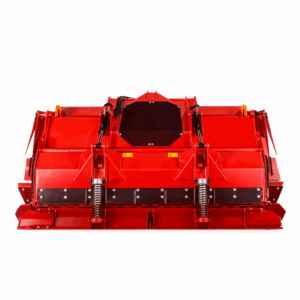
THOR 2.4 + किट ड्रॉबार
2.4 m working width · 180 cv min · 2300 kg · Ideal for wide path construction on large flat terrain.
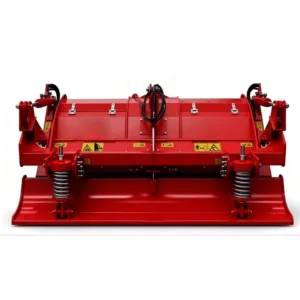
रॉकमास्टर कृषि पत्थर कोल्हू
Versatile field stone crusher for general agricultural clearing and path preparation across diverse terrain types.
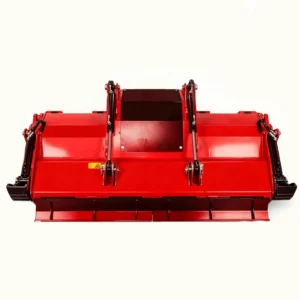
पीएससी सीरीज स्टोन क्रशर
Compact and highly maneuverable, the PSC series suits medium-sized farm tractors and narrower path widths.
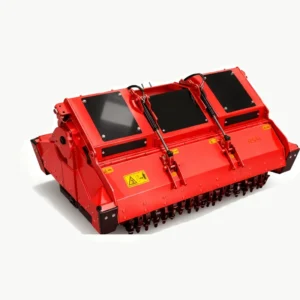
ट्रैक्टर पर लगा हुआ पत्थर कुचलने वाला यंत्र
Three-point hitch mount for straightforward installation. Strong performance balance across mixed field stone conditions.
कृषि रॉक क्रशर
Purpose-designed for mixed-rock agricultural ground. Proven performance in varied stone density conditions across multiple climates.
9. About Our Team & Manufacturing Standards
Our team has spent more than two decades developing, field-testing, and refining PTO-driven stone crushing equipment across a wide range of real-world agricultural and land management environments. Every machine we produce is evaluated against actual field conditions — not just laboratory benches — because the variance in soil composition, stone hardness, and tractor connectivity that operators encounter on large properties demands engineering grounded in practical experience rather than theoretical models alone. We work directly with farm operators, estate managers, and agrotourism developers across Latin America, including clients in Colombia’s Andean coffee zones, the Llanos, and the Pacific piedmont, to understand how stone crushing technology fits into local land management workflows.
Our manufacturing follows ISO 9001 quality management principles for welding, machining, and component sourcing. Carbide tooth blanks are sourced from certified metallurgical suppliers and inspected for hardness consistency before rotor assembly. Final machines undergo a test run under load before shipping to verify bearing temperature, PTO shaft alignment, and rotor balance. We provide technical support and spare parts supply for the full product range, with parts documentation available for local workshop servicing to minimize downtime on large properties where proximity to dealer networks may be limited.
अक्सर पूछे जाने वाले प्रश्नों
संपादक: पीएक्सवाई