Knowledge Guide — PTO Stone Crusher Series
What Output Sizes Does a PTO Rock Crusher Produce?
Gradation and Sieve Analysis Explained
For farmers, land developers, and agricultural contractors evaluating a concasseur de pierres à prise de force, understanding the output gradation is just as important as knowing the machine’s horsepower requirements. This guide walks through the mechanics of how a concasseur de pierres pour tracteur breaks rock, what sieve analysis means in practical fieldwork, and why output particle size matters for soil tillage, drainage, and seedbed preparation — with particular relevance for Korean farmland conditions where basaltic and granite field stones are common.
1. What Is Output Gradation in a Stone Crusher?
Output gradation refers to the distribution of fragment sizes produced after a concasseur de pierres processes field stones. When an concasseur de pierres agricoles passes over a rocky field, it does not produce a single uniform particle size — instead, the crushed material spans a range of dimensions, from fine sandy particles just a few millimetres across to chunky gravel-sized fragments approaching the machine’s maximum shredding diameter. The relative proportion of each size class in the total output is what engineers and agronomists call the “gradation curve.”
In civil engineering, gradation is measured using a sieve analysis: a sample of crushed material is passed through a series of wire-mesh sieves with progressively smaller openings (for example, 50 mm, 25 mm, 10 mm, 5 mm, 2 mm, 0.5 mm), and the mass retained on each sieve is weighed. The result is plotted as a cumulative passing curve. While farm operators rarely perform formal sieve tests, understanding the principles behind gradation helps enormously when choosing the right concasseur de pierres à prise de force model for a specific application — whether that’s reclaiming rocky highland fields in Gangwon Province, preparing paddy-field edges in Jeolla, or clearing stony orchard soil in Gyeongbuk.
The key variables that control output gradation in a PTO-driven field stone crusher are the rotor design and tooth geometry, the working speed of the tractor, the rotor’s RPM (which is directly linked to PTO shaft speed), the hardness and structure of the rock being processed, and — critically — the maximum shredding diameter setting of the machine itself. We will examine each of these factors in the sections below.
2. Action Mode: How the Crushing Motion Creates Particle Distribution
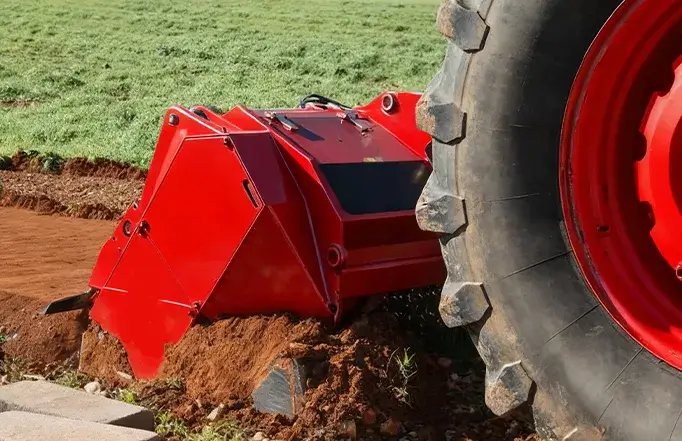
UN tractor mounted rock crusher powered through the PTO (Power Take-Off) shaft operates on the principle of high-speed rotary percussion combined with confined-chamber fragmentation. The tractor’s engine transmits rotational energy through the driveshaft to an internal rotor. As the rotor spins — typically at 540 RPM or 1000 RPM depending on the PTO setting — the fixed or free-swinging cutting teeth (also called picks) mounted on the rotor drum slam into stones at high velocity. This repeated impact shatters rock through a combination of compressive stress and tensile cracking along natural grain boundaries.
Unlike a jaw crusher or cone crusher that squeezes rock between two converging surfaces, a PTO field stone crusher relies on kinetic energy rather than sustained static pressure. This is an important distinction because it means the fragmentation is less controlled — the output is somewhat stochastic in terms of individual fragment shape — but the overall gradation is highly repeatable across a given machine-rock combination. The confined working chamber formed by the front blade, rotor housing, and rear curtain forces oversized fragments back into the rotor path for a second or third impact, effectively creating a natural upper size limit in the output. This internal recirculation is the primary mechanism by which manufacturers can quote a “maximum shredding diameter” specification.
After fragmentation, the crushed material is discharged backwards and mixed back into the soil profile. This means the output is not collected for separate sieve analysis in the way a quarry would test it — instead, the treated soil surface serves as the practical result, with stones reduced to a size that no longer interferes with tillage implements, seeding machinery, or root development.
3. Manufacturing Structure: Rotors, Teeth, and Chamber Design
The rotor is the heart of any Concasseur de pierres pour tracteur. Its diameter, the number and type of teeth arranged around its circumference, and the material hardness of those teeth all determine both the crushing capacity and the resulting fragment size distribution. In the field stone crusher product range, rotor diameters scale with machine class: compact light-duty models suitable for 70–150 hp tractors use rotors in the 450 mm range, mid-range machines step up to 550–595 mm, while heavy-duty versions designed for 280–500 hp tractors run rotor drums of 700 mm, 940 mm, and even 1,065–1,115 mm in diameter.
Tooth type has a direct influence on gradation. Two principal tooth geometries are used across the product range. The STC/3 type tooth is a blunt-nosed, high-wear-resistant pick optimised for general stone crushing — it delivers a broad output gradation with a relatively fine average particle size, because the blunt geometry creates more secondary impacts and finer fines. The STC/3/HD (heavy-duty) variant has a harder alloy tip for abrasive granite and quartzite. The STC/FP (flat plate) tooth works more as a secondary crusher — spreading the force over a wider contact area — which tends to produce a slightly coarser, more uniform gradation with fewer fines. The R/65 and R/65/HD picks used on the RSL, RSM, and RSH rotors are designed as conical point-attack picks, which penetrate rock more aggressively and generate a coarser output compared with chisel-type STC teeth.
The rear curtain or deflector plate inside the crushing chamber also plays a significant role. This adjustable component determines how long a fragment circulates in the crushing zone before being released. A tighter curtain gap forces more recirculation, producing finer output. Operators who want a coarser crushed stone surface for drainage gravel effects can open the curtain slightly; those needing fine tilth for direct seeding would use a tighter setting and a slower working speed.
4. Material System: Rock Type and Its Effect on Fragment Size
Not all rocks respond the same way to percussive crushing. The output gradation from an concasseur de pierres agricoles varies considerably depending on the mineralogical structure of the rock being processed. Understanding this relationship is critical for Korean operators dealing with the diverse geology of the Korean Peninsula — from the ancient metamorphic rocks of the Sobaek and Taebaek mountain ranges to the volcanic basalt of Jeju Island and the granite intrusions common across Gyeonggi and Chungcheong provinces.
Sedimentary rocks (limestone, sandstone, shale) are generally the most straightforward to process. They tend to be relatively soft and isotropic, fracturing into sub-angular fragments with a moderate spread of sizes. A standard STCL or PSC-series petit concasseur de pierres à prise de force at 70–150 hp can typically reduce limestone cobbles up to 150 mm diameter into fragments predominantly passing a 50 mm sieve in a single pass at 3 km/h.
Igneous rocks (granite, basalt, diorite) are harder and often show a pronounced bimodal fracture pattern — the rock either shatters into coarse angular chunks along crystal grain boundaries, or it powder-fractures into very fine mineral dust. The result is a broader gradation curve with a higher proportion of both coarse fragments and fine dust compared with sedimentary material. For basalt-dominated fields like those found in Jeju or Gyeonggi highlands, selecting a machine with STC/3/HD or R/65/HD heavy-duty picks is advisable. Harder rocks also wear teeth faster, which progressively coarsens the output gradation as tooth geometry changes — a practical reason to monitor tooth condition regularly.
Metamorphic rocks (schist, gneiss, quartzite) present the most challenging gradation profile. Their foliated structure means fracture propagates preferentially along cleavage planes, producing elongated plate-like fragments rather than equidimensional chunks. This flat-fragment output can be problematic because plates pass through sieve openings more easily than their actual thickness suggests, making conventional sieve analysis slightly misleading. Tractor speed and rotor RPM both need to be reduced when working hard metamorphic material to maintain acceptable fragmentation quality.
5. Typical Output Size Ranges by Machine Series
The table below summarises the typical maximum shredding diameter (stone input limit) and representative output gradation characteristics for each machine class in the concasseur de pierres à prise de force lineup, based on standard operating conditions — 1000 RPM PTO, 3 km/h field speed, and medium-hardness limestone. Real-world results will vary based on rock type, soil moisture, and tooth wear condition.
| Series | Puissance du tracteur | Régime de prise de force | Max Input Stone (mm) | Max Working Depth (mm) | Rotor Dia. (mm) | Typical Output: % passing 50 mm sieve (est.) |
|---|---|---|---|---|---|---|
| STCL | 70 – 150 | 540 / 1000 | 150 | 150 | 450 | ~80 – 90% |
| STCM | 80 – 280 | 1000 | 300 | 200 | 550 | ~75 – 88% |
| STCH | 280 – 400 | 1000 | 500 | 250 | 700 | ~65 – 80% |
| RSL | 80 – 190 | 540 / 1000 | 300 | 150 – 280 | 595 / 612 | ~70 – 85% |
| RSM / RSM-HP | 200 – 360 | 1000 | 500 | 400 | 940 / 915 | ~60 – 78% |
| RSH / RSH-HP | 360 – 500 | 1000 | 500 | 500 | 1065 – 1115 | ~55 – 72% |
Estimated percentage figures are indicative for medium-hardness limestone at standard operating speed. Harder igneous or metamorphic rock will shift the curve toward coarser output.
6. What Does Sieve Analysis Actually Tell a Farm Operator?
Formal sieve analysis is rarely performed on farm-crushed material, but the underlying concept translates directly into practical field assessments that any operator of a concasseur de pierres à prise de force à vendre should understand. In essence, gradation data answers three agronomically relevant questions: Are the fragments small enough not to damage downstream machinery? Is there a sufficient proportion of fine material to support moisture retention and seedling establishment? And are the coarser particles distributed in a way that helps rather than hinders soil drainage?
For cereal and vegetable crop production — the dominant use case for concasseur de pierres agricoles machines in Korean highland farming — the general target is to reduce all rock fragments to below 50 mm after a single pass, with the majority of the crushed material falling below 25 mm. This standard aligns with Korea’s Rural Development Administration (RDA) guidelines for soil preparation quality in mechanised vegetable production zones, where seeders and transplanters with ground-engaging elements cannot tolerate surface stones larger than 40–50 mm without risk of damage or seedbed disruption.
In practice, an operator assessing output quality after a crushing pass uses a combination of visual inspection and a simple field sieve test: taking a representative 5 kg sample from the treated surface and hand-sieving it through a 50 mm and a 25 mm ring sieve. If more than 10% of the sample mass is retained on the 50 mm ring, a second pass at reduced speed is typically warranted. This informal field protocol gives results sufficiently accurate for agricultural decision-making without the cost of laboratory analysis.
It is also worth noting that a petit concasseur de pierres à prise de force operating at 540 RPM PTO speed produces a systematically coarser output than the same machine at 1000 RPM, all else being equal. The higher rotor tip speed at 1000 RPM delivers more kinetic energy per tooth impact, resulting in more complete fragmentation and a finer output gradation. Korean operators running tractors with electronically regulated PTO that can maintain precise 1000 RPM regardless of load — common in modern 100–200 hp Korean-brand tractors from LS, TYM, or Daedong — will achieve more consistent output quality than older tractors with less stable PTO speed control.
7. Operating Parameters That Control Output Size
Four tractor and machine settings directly influence the gradation of crushed stone output. Understanding how each lever works lets operators fine-tune results for different downstream land uses without purchasing additional equipment.
Forward Speed (km/h)
Slower passes — typically 2–3 km/h — give each stone more residence time in the rotor zone, resulting in finer output. Moving at the upper end of the operating range (4–5 km/h) reduces energy delivery per unit area, producing a coarser gradation with proportionally more fragments in the 25–80 mm range. For reclamation of very stony fields where multiple passes are planned, a first pass at 4 km/h followed by a finishing pass at 2.5 km/h produces economical work rates with acceptably fine final output.
PTO Shaft Speed (RPM)
This is the single most influential parameter after machine model selection. At 1000 RPM, rotor tip speed typically exceeds 20 m/s for mid-range machines, delivering high-energy impact fragmentation and fine output. At 540 RPM, the same machine operates at roughly half the impact energy, generating a noticeably coarser gradation. Whenever fine output is the priority — for direct-seeded crops or precision transplanting — 1000 RPM operation should be the default setting on any concasseur de pierres à prise de force capable of it.
Profondeur de travail (mm)
Deeper rotor engagement (approaching the maximum working depth of 150–500 mm depending on model) draws more stones into the crushing chamber simultaneously, which can actually coarsen the output because stones shield each other from direct tooth impact. For the finest output in shallow surface-stone situations, a working depth of 80–120 mm is often more effective than maximum depth engagement — allowing the rotor to make clean, unobstructed contact with each stone individually rather than ploughing through a dense matrix of material.
Tooth Wear and Type
New STC/3 teeth with sharp tips deliver the finest output gradation. As teeth wear, the effective impact geometry changes — the blunt worn tip is less efficient at fracturing rock along grain boundaries, and more energy is absorbed as heat and plastic deformation. The practical consequence is that worn teeth produce a progressively coarser output for the same machine settings. Tooth inspection and timely replacement — following the manufacturer’s wear indicator marks — is not just about protecting the rotor drum, it’s about maintaining consistent output gradation quality across the full service life of the machine.
8. Gradation Requirements Under Korean Agricultural and Environmental Standards
Korea’s agricultural sector operates under a well-developed regulatory framework that touches on land reclamation, soil quality management, and the use of mechanised equipment in designated agricultural zones. Understanding where équipement de concassage de pierres use intersects with these frameworks is important for any farmer or contractor purchasing a concasseur de pierres pour tracteur à vendre in Korea.
Korea’s Farmland Act (농지법, Act No. 18522) governs alterations to designated agricultural land, including land reclamation and soil improvement works. Crushing field stones in situ — which leaves the crushed material in the field rather than removing it — is generally treated as a soil improvement activity rather than a prohibited land alteration, provided the work does not change the topographic contour of the farmland or alter drainage patterns in ways that affect adjacent parcels. Operations in designated agricultural protection zones should be pre-confirmed with the relevant local government office (시·군·구) before commencing large-scale crushing works.
Korea’s Rural Development Administration (농촌진흥청, RDA) publishes soil preparation guidelines for major crops. For upland crop production (밭 작물), the RDA recommends a stone-free soil depth of at least 300 mm and specifies that surface stone content (stones > 25 mm) should not exceed 5% by volume in intensively managed vegetable production areas. A single pass with a properly sized concasseur de pierres à prise de force under typical Korean upland conditions (granite-derived sandy loam, moderate stone content) generally achieves RDA’s surface stone targets if the machine is matched to the correct horsepower range.
Environmental Impact Assessment (환경영향평가) may apply when large-scale land reclamation projects involve repeated stone crushing over areas exceeding thresholds set by the Environmental Impact Assessment Act. For typical small-to-medium farm operations involving reclamation of rocky marginal fields, the scale generally falls below EIA thresholds.
From an international regulatory perspective, operators exporting to or consulting with markets in the EU should also be aware of Directive 2006/42/EC (EU Machinery Directive), which covers the design and safety standards applicable to PTO-driven agricultural implements. All CE-marked concasseur de pierres agricoles machines sold in EU markets must meet these design standards, including specific requirements for PTO shaft guards, emergency stop provisions, and operator protection from projectile discharge — the latter being directly relevant to output gradation control, since higher rotor speeds that produce finer output also generate higher-velocity projectile risk.
ISO Standards 11684 (safety signs and pictograms for agricultural machinery) and ISO 4254-1 (general safety for agricultural machinery) are referenced in Korean Standard KS B ISO 11684 and are required for machinery sold through formal channels in Korea. When sourcing a concasseur de pierres à prise de force à vendre in Korea, confirming that the machine carries the relevant KS or CE conformity mark and that the Korean import documentation reflects compliance with current emission and machinery safety standards is a practical pre-purchase step.
9. Comparing Output Gradation Across the PSC, STCL, and STCM Model Ranges
Pas tous concasseur de pierres à prise de force machines in the product catalogue are aimed at the same output fineness target. The PSC-series (Field Stone Crusher STCL Model) designed for 70–150 hp tractors is built for light-to-medium stone work in orchard rows, vineyard inter-rows, and vegetable field margins — applications where the goal is a finely crushed surface suitable for tractor wheel passage and hand-harvesting access. The compact dimensions and 450 mm rotor make it highly manoeuvrable in confined spaces, and the 150 mm maximum stone input reflects its design intent: this is a machine for field stones, not boulder fields.
Moving up to the STCM series — working range 80 to 280 hp, 550 mm rotor diameter, 300 mm maximum stone input, and 200 mm working depth — the machine is built for more aggressive stone removal in commercial arable farming. The larger rotor stores more rotational kinetic energy, meaning it handles abrupt stone contacts without stalling, and it operates at 1000 RPM PTO exclusively for maximum output energy. The STCM’s output gradation for standard limestone field stones is typically in the 75–88% passing 50 mm range, with the median fragment size around 15–25 mm — ideal for seedbed preparation that must be suitable for precision cereal seeders.
The STCH heavy-duty series — 280 to 400 hp tractors, 700 mm rotor, 500 mm maximum input stone — takes the process a step further into boulder-strewn terrain. Here the gradation curve shifts coarser: the larger stones entering the machine require more impact events before reaching the maximum size limit, so there is a higher proportion of 30–80 mm fragments in the output alongside the sub-30 mm fines. Operators using the STCH for rocky pasture reclamation in Korean highland areas (where very large granite boulders are partially embedded) should expect to make two passes for the finest possible result — one pass at full depth engagement to break boulders, followed by a shallower finishing pass for surface refinement.
10. Explore the PTO Stone Crusher Product Range
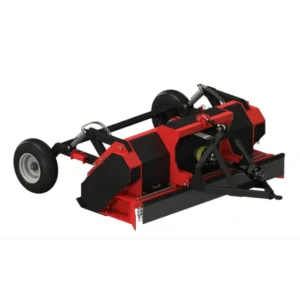
Thor 2.4 + Kit Drawbar
Min. 180 hp · 2.4 m working width · 2300 kg · 3 km/h working speed
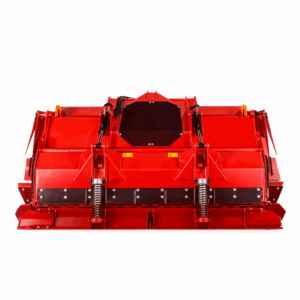
Concasseur de pierres agricoles RockMaster
Heavy-duty field stone clearing · wide working widths available
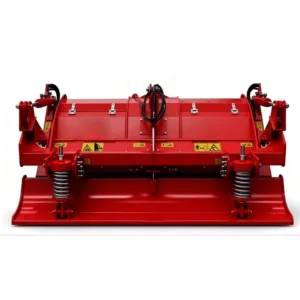
PSC Series Field Stone Crusher (STCL)
70–150 hp · rotor dia. 450 mm · max stone 150 mm · light to medium duty
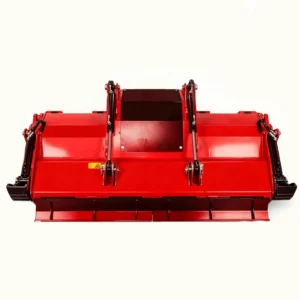
Concasseur de roche monté sur tracteur
Mid-range HP · versatile 3-point hitch attachment · ideal for arable reclamation
11. Multi-Pass Strategies for Achieving Finer Gradation
When the target gradation requires more than 90% of crushed material to pass a 25 mm sieve — as might be specified for a market garden or nursery operation — a single-pass strategy rarely achieves this regardless of machine size. The practical approach used by experienced contractors operating a concasseur de pierres portable or tractor-mounted unit is a two-pass protocol with staggered working directions.
On the first pass, the machine works at maximum rotor depth and moderate tractor speed (3–3.5 km/h) to break down the primary stone population. At this stage, there will remain a proportion of 30–80 mm fragments on the surface. On the second pass — ideally conducted perpendicular or at 45 degrees to the first — the already-partially-crushed material is presented to the rotor again. Because the fragments entering the rotor on the second pass are smaller and less structurally coherent than the original stones, the crushing energy per fragment is proportionally higher, and the output from the second pass is markedly finer. Tests on medium-hardness limestone fields have shown that a two-pass protocol with the same machine achieves roughly equivalent output fineness to a single pass with the next machine class up — a relevant consideration for operators deciding between purchasing a petit concasseur de pierres à prise de force versus a heavier model.
The trade-off, of course, is time and fuel. A two-pass strategy roughly doubles the fuel consumption and field time compared with a single pass — which partly justifies the selection of a larger machine for operations where throughput matters. For Korean farmers reclaiming small, irregularly shaped highland parcels where maneuverability matters more than area throughput, the smaller PSC-series machine in a two-pass strategy often makes more practical and economic sense than a large machine that cannot efficiently navigate field corners and headlands.
Foire aux questions
Éditeur : PXY