استفاده از سنگ شکن تراکتوری برای ساخت کانال آبیاری و جوی زهکشی
A practical guide to PTO stone crusher applications in water management infrastructure — with field insights for Colombian agricultural operators and Andean terrain conditions.
1. Why a Tractor-Mounted Rock Crusher Changes the Calculus on Channel Construction
Building a functioning irrigation channel or drainage ditch across rocky agricultural ground has traditionally meant one of two things: hiring a dedicated excavator with a hydraulic rock breaker, or abandoning the intended route in favour of a path around the stone obstacles. Neither option is attractive for a farm operator working with a standard agricultural tractor and a seasonal window for infrastructure work. The emergence of purpose-built tractor-mounted rock crushers — connected via the Power Take-Off (PTO) shaft — has opened a third option that delivers genuine stone reduction directly from the tractor’s existing power plant.
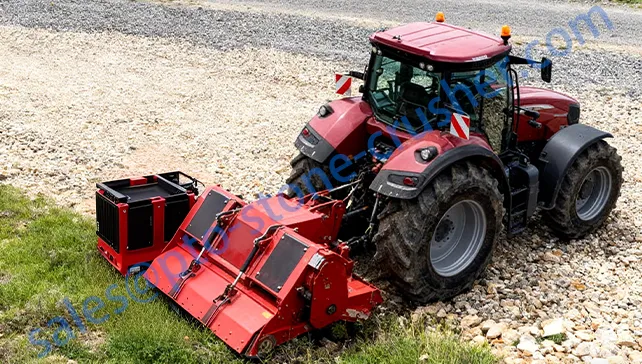
The core principle is simple but the implications are significant. A PTO-driven stone crusher attaches to the tractor’s three-point linkage and receives rotational power from the tractor’s PTO shaft, typically at 540 or 1000 RPM depending on the model series. The machine’s rotor — fitted with hardened steel hammers or pick-type teeth — spins at high speed inside a reinforced crushing chamber, shattering surface and sub-surface rocks into fragments small enough to be redistributed in place or bladed aside. For irrigation and drainage channel work, this means a farmer or contractor operating in Colombia’s volcanic Andean highlands, the rocky foothills of Antioquia, or the stone-laden soils of the Nariño coffee belt can now prepare a rock-free channel bed in a single tractor pass — without mobilising a separate machine, without importing crushed aggregate, and without removing soil continuity in the zone that will later carry water.
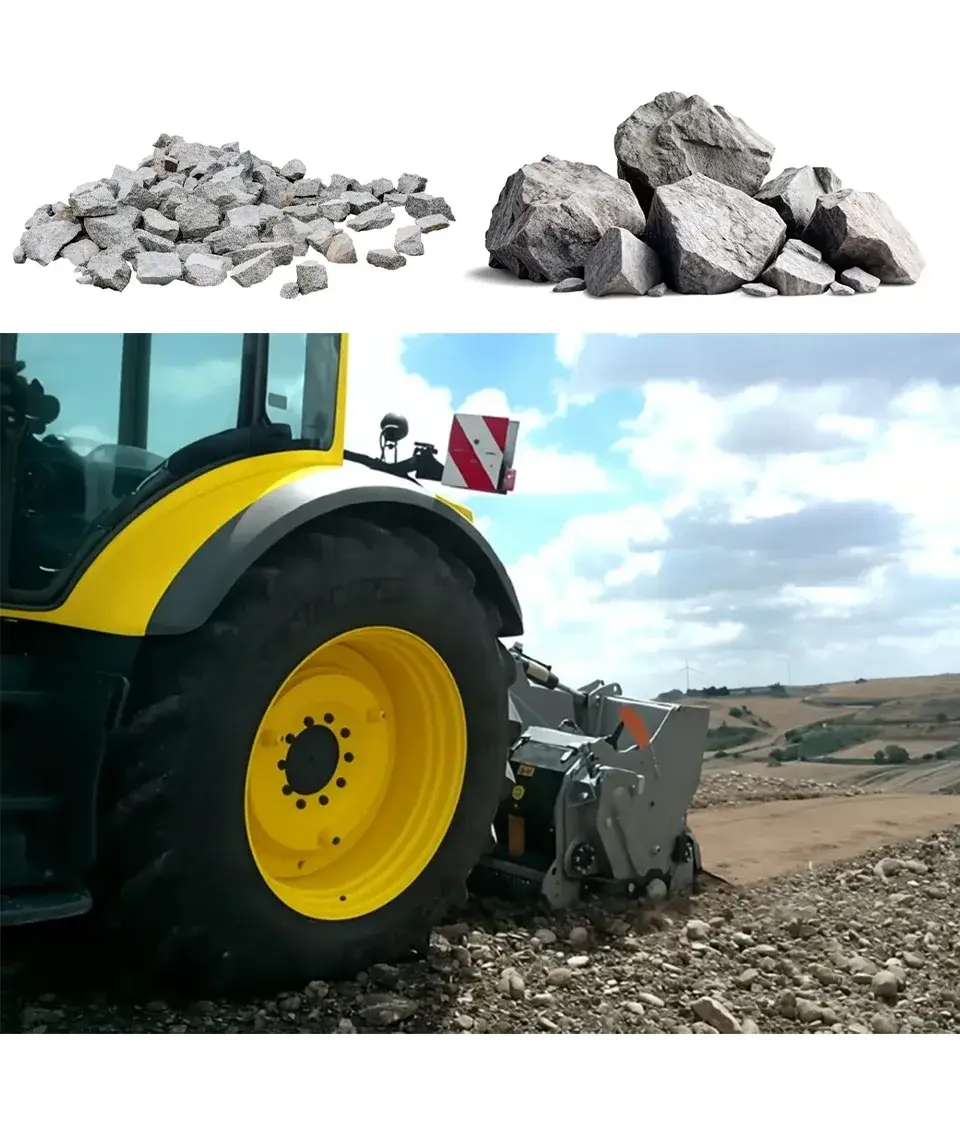
2. Action Mode — How the Machine Engages the Ground
The action mode of a tractor-mounted rock crusher in channel construction work combines two simultaneous mechanical processes: rotary crushing and surface scarification. As the tractor advances at low working speed — typically 2 to 4 km/h for rock-heavy soil conditions — the rotor spins continuously at operating RPM. The hammers or picks mounted on the rotor strike exposed and buried stones with enormous kinetic energy. The strike geometry is not a simple blow; each tooth traces a circular arc at the rotor’s peripheral speed, delivering an impact that fractures stone along natural cleavage planes. Fragments are then trapped inside the chamber between the rotor and a hardened counter blade or grid, where repeated secondary impacts reduce the material further before it exits at the rear of the machine.
For irrigation channel preparation specifically, the operator sets the working depth using the three-point linkage depth control and the machine’s own skid shoes. Channel centreline preparation typically requires working depth in the range of 150 to 250 mm — enough to remove the sub-surface rock layer that would obstruct a subsequent digging pass or liner installation. The STCM series, for example, achieves a maximum working depth of 200 mm; the STCH reaches 250 mm; and the larger RSL and RSM series, equipped with dual rotor configurations, can work 280 mm and 400 mm deep respectively — relevant where the drainage ditch must penetrate a substantial rock pan before reaching permeable subsoil.
The result is a prepared strip of ground where stones above a defined size threshold have been reduced to sub-75 mm fragments. This crushed material actually improves drainage by creating a permeable zone of irregular aggregate at the channel base — a benefit that excavation without crushing cannot replicate, since excavation removes material rather than converting it in place.
3. Structure Type — Single Rotor vs. Dual Rotor Configurations
The structural classification of PTO stone crushers matters considerably when specifying a machine for irrigation channel work. The two fundamental rotor configurations — fixed-tooth single rotor and dual-rotor (pick/hammer combined) systems — produce different fragment size distributions and suit different stone populations.
Single-rotor machines like the STCL and STCM series carry their STC/3-type fixed carbide teeth arranged in a helical pattern on a solid steel drum. The STCL’s rotor diameter is 450 mm and handles stones up to 150 mm diameter in a working depth of 150 mm — ideal for surface stone layers and light sub-surface conditions common in upland Colombian fields. The STCM steps up with a 550 mm rotor diameter, reaching stones up to 300 mm in diameter at 200 mm working depth, making it the workhorse specification for mid-range irrigation channel preparation across a wide range of Colombian soil types. The STCH series, designed for tractors in the 280–400 hp class, carries a 700 mm rotor diameter and processes stones up to 500 mm diameter at 250 mm depth — a relevant specification where main irrigation canals traverse volcanic boulder fields in the Eje Cafetero or similar geologies.
Dual-rotor configurations — represented by the RSL, RSM, and RSH series — place two rotors in sequence: a G/3 fixed-tooth primary rotor and a pick-type R-series secondary rotor. The RSL, suited to 80–190 hp tractors, uses a 595 mm G/3 rotor combined with a 612 mm R rotor, achieving working depths from 150 to 280 mm. This sequential crushing action is particularly effective for drainage ditch preparation in mixed sedimentary geology where both embedded boulders and fractured rock shelves are present, since the primary rotor shatters large stones and the secondary rotor pulverises the resulting fragments — producing a finer, more consistent output that requires less subsequent grading.
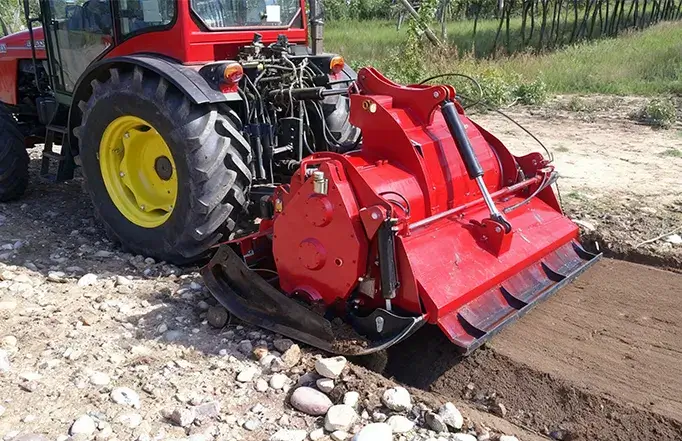
4. Manufacturing Construction — What Goes Into a Field-Grade PTO Crusher
The manufacturing construction of a tractor-mounted rock crusher must withstand operating conditions that would destroy components from lighter machinery within a single working session. The main structural frame is fabricated from high-tensile structural steel, typically S355 or equivalent grade, with critical stress points reinforced by gusset plates and box-section weldments. The entire assembly must survive the torsional shock of a rotor tooth striking an unexpected boulder — a load event that transmits instantaneous peak torques far exceeding steady-state operating values.
The crushing chamber interior — where the bulk of wear occurs — is lined with replaceable Hardox 500 wear plates. Hardox is a Swedish-origin abrasion-resistant steel with a Brinell hardness of approximately 500 HB, significantly harder than ordinary structural plate, and it substantially extends the interval between liner replacement cycles under continuous stone crushing duty. The counter blade, which provides the fixed anvil surface against which the rotor delivers the final fragment reduction, is also constructed from Hardox-grade material and is designed for field replacement without special equipment. On advanced models the counter blade position is adjustable via the tractor’s hydraulic system, allowing the operator to change the outlet gap size while moving — important for tailoring fragment dimensions to the intended channel bed use.
The rotor shaft is carried on heavy-duty sealed roller bearings housed in robust bearing blocks bolted to the outside of the main frame. Bearing protection from stone dust and soil ingress is provided by multi-stage labyrinth seals or contact seals, since bearing contamination under field conditions is among the most common causes of premature failure in PTO-driven crushing equipment. The PTO driveline connection uses a heavy-duty Cardan shaft with shear-bolt or cam-clutch overload protection, preventing rotor seizure from transmitting destructive torque spikes back into the tractor’s gearbox and PTO system.
5. Material System — Tooth Types and Alloy Selection for Channel Work
The individual crushing teeth (also called hammers, picks, or bits depending on their geometry) represent the primary wear consumable in any PTO stone crusher, and their material specification determines both wear life and fragment quality. Several distinct tooth types are available across the product range:
STC/3 fixed teeth are the standard carbide-tipped option used across the STCL and STCM series. The carbide tip — typically a cemented tungsten carbide grade with a cobalt binder content in the range of 8–14% — provides the hard, abrasion-resistant striking surface. These teeth are bolted or keyed into pockets machined into the rotor body, allowing individual replacement without rotor removal. For irrigation channel preparation in moderately stony soil, the STC/3 tooth offers an effective balance of wear resistance and impact toughness.
STC/3/HD (Heavy Duty) teeth use a higher-hardness carbide grade and reinforced body geometry for very abrasive conditions — appropriate when the channel route passes through quartz-rich volcanic soils or river gravel deposits, where standard carbide grades wear quickly. STC/3/FP (Flat Profile) teeth produce a wider, flatter impact footprint useful for rock slab fragmentation and surface milling — relevant when an irrigation channel must be cut through a naturally occurring flat rock shelf rather than through soil containing discrete boulders.
The R/65 and R/65/HD pick-type teeth used on the RSL, RSM, and RSH rotor systems operate on a different principle: instead of a fixed hammer geometry, the pick rotates freely on its mounting shank, self-aligning to present its carbide tip at the optimal angle to the stone surface. This self-rotation mechanism distributes wear more evenly around the carbide tip’s circumference, extending service life in continuous-duty channel preparation work. The RSL Rotor R configuration, for instance, carries between 58 and 154 picks (R/65 and R/65/HD combined) depending on working width, plus additional STC/3/FP flat-profile teeth at the rotor ends for edge definition.
6. Step-by-Step Workflow — Preparing an Irrigation Channel Route with a PTO Crusher
Understanding the typical working sequence helps operators plan their time and manage expectations for output quality. Channel preparation with a tractor-mounted rock crusher follows a logical progression that differs somewhat from conventional excavation practice.
The first step is a slow scouting pass along the intended channel route without engagement. The operator assesses visible stone distribution, surface topography, and any obstacles that require detour or pre-treatment. This reconnaissance informs the crushing direction of travel (always work uphill on slopes exceeding 12° to maintain tractor stability) and identifies zones where stone density may require a second or third pass.
The second step is the first crushing pass. Depth is set conservatively — typically at 60–70% of maximum capacity — to avoid overloading the rotor in unexpectedly dense stone zones. Forward speed is adjusted to maintain rotor RPM within the target operating range; the tractor’s engine RPM should not drop more than 5–8% below the target PTO output speed under load. On the STCM series operating at 1000 PTO RPM, this means monitoring that the tractor does not lugg below approximately 920–950 RPM under peak impact load events.
Following the first pass, the operator inspects the channel strip for remaining large stones and adjusts depth for a second pass if required. On typical Colombian Andean soil conditions — characterised by volcanic origin, high stone content from andesite and basalt, and relatively shallow topsoil over harder geological layers — two crusher passes are normally sufficient to reduce surface and near-surface stones to the point where a subsequent grader blade pass can establish the channel profile. The crushed material is partially redistributed in the channel bottom, creating the permeable base aggregate layer that facilitates drainage.
The third step is final profile establishment using the tractor’s own rear blade (grader blade) or a dedicated channel profiler, followed by inspection of the base gradient to ensure positive water flow towards the outlet. For lined irrigation channels where concrete or HDPE liner will be installed, the crushed stone surface provides an excellent stable base that eliminates the differential settlement common in fine-soil channel beds.
7. Recommended Models for Irrigation and Drainage Channel Work
Matching the machine to the tractor and the terrain is the single most important decision in this application. The following models are well-suited to the range of conditions encountered across Colombian and Andean irrigation infrastructure projects.
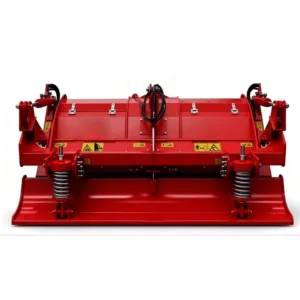
Covers tractors from 70 to 220 hp. Handles stones up to 300 mm diameter at depths to 200 mm. Ideal for mid-scale channel preparation on family farms and cooperative irrigation schemes in Boyacá, Cundinamarca, and Nariño departments.
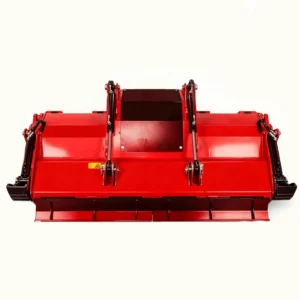
The STCM range from 80 to 280 hp with 550 mm rotor diameter delivers consistent 200 mm working depth across a working width from 1340 to 2304 mm. Strong choice for larger channel projects requiring continuous multi-hour operation.
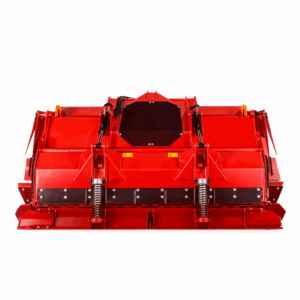
Purpose-built for agricultural stone management including channel and drainage route preparation. Dual-rotor configuration delivers thorough fragmentation for operators needing fine-output material at channel bed level.
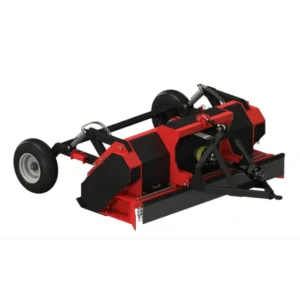
2.4 m working width, 2300 kg machine weight, minimum 180 hp tractor requirement. The drawbar kit makes this unit highly manoeuvrable in channel construction contexts where access is constrained by existing fencing or slope geometry. Working speed: 3 km/h.
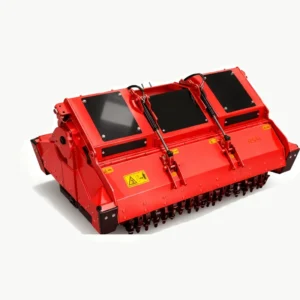
Developed for compact and medium tractors in high-stone-density environments. The compact frame geometry suits terraced field irrigation channel work in mountainous Colombian agricultural zones where large machines cannot manoeuvre.
8. Channel Design Considerations When Using a Rock Crusher for Bed Preparation
The mechanical capabilities of the PTO stone crusher should inform the hydraulic design of the channel itself. Working width — which ranges from approximately 1.0 m (RSL/ST 100) to over 2.5 m (STCH 250, RSH HP 250) — sets the minimum practical channel base width for a single-pass preparation. Where the channel design calls for a narrower base (less than 1.0 m, as is common in secondary furrow irrigation channels), the operator should plan a centred single pass and accept that the shoulder material will require separate treatment.
Working depth dictates the maximum stone removal depth and therefore the minimum practical excavation depth that can follow. For unlined earth channels in permeable rocky subsoil — a common requirement for farm drainage ditches in Colombia’s rainy-season flood management applications — a crusher working depth of 200 mm (STCM series) combined with a subsequent pass by a rear-mounted ripper typically achieves a usable channel depth of 350–400 mm, sufficient for lateral drainage of waterlogged crop beds.
For lined channels where precise base geometry is required — such as the concrete-lined irrigation laterals used in Colombia’s ADIAR-managed irrigation districts in Valle del Cauca and Tolima — the crushed stone surface may need one additional pass with a laser-guided motor grader before the concrete is placed. This is still considerably faster than conventional rock breaking followed by material removal, and the crushed-in-place aggregate reduces the need for imported base layer material.
9. Safety, Operator Protection, and Regulatory Context
کلمبیا
In Colombia, agricultural machinery operations — including PTO-driven implements — are governed under Decreto 1072 de 2015 (Decreto Único Reglamentario del Sector Trabajo), specifically the occupational health and safety (SG-SST) requirements applicable to agricultural employers. Operators working with PTO-powered rock crushers must complete hazard identification and risk assessment for the tasks, document safe operating procedures, and ensure that all personnel in the work zone are at a safe distance during operation — a minimum exclusion zone of 30 metres is standard practice for stone crushing work, given the risk of ejected rock fragments. Protective equipment including safety glasses or a full visor, hearing protection, and steel-toe boots are mandatory. The Ministerio de Agricultura y Desarrollo Rural (MADR) provides guidance on agricultural equipment safety through its technical assistance networks (Umatas), particularly in irrigation infrastructure development programmes.
اتحادیه اروپا
PTO-driven agricultural implements supplied to the EU market must comply with EU Machinery Directive 2006/42/EC (being superseded by EU Machinery Regulation 2023/1230 from January 2027). This requires CE marking, a technical construction file, conformity assessment, and a Declaration of Conformity before the machine is placed on the European market. Specific to stone crushers, the EN ISO 11684 series covers safety signs and hazard marking requirements, and EN ISO 4254 governs safety requirements for soil-working machinery including PTO-driven implements. The PTO driveline must comply with ISO 5674 requirements for guards on agricultural tractors and implements.
ایالات متحده
In the US, OSHA standard 29 CFR 1928.57 specifically addresses guarding for agricultural PTO-driven equipment. The standard requires that PTO shafts be fully guarded against operator contact and that implements with rotating components carry appropriate warning labels. ASABE (American Society of Agricultural and Biological Engineers) standards S205.5 and S331.2 cover PTO shaft specifications and guard requirements respectively, providing the engineering basis against which US-market stone crusher designs are verified.
Irrigation Infrastructure Regulations in Colombia
Construction of irrigation channels and drainage ditches on private agricultural land in Colombia is subject to water resource regulation under Ley 99 de 1993 and Decreto 1076 de 2015 (the Environmental and Natural Resources sector regulation). Works affecting watercourses, wetlands, or riparian zones require a permiso de aprovechamiento de aguas from the relevant Corporación Autónoma Regional (CAR). For on-farm irrigation channels that do not intersect natural drainage lines, a Concepto Técnico from the local CAR environmental authority may suffice. Operators planning channel construction in proximity to protected wetlands (humedales) — present across many Colombian highland agricultural zones — should confirm the applicable Environmental Impact Assessment requirements before beginning earthworks.
10. Comparing PTO Rock Crusher vs. Conventional Channel Construction Methods
| Factor | سنگ شکن PTO | Hydraulic Rock Breaker (Excavator) | Manual Labour + Crowbar |
|---|---|---|---|
| Equipment Required | Farm tractor (existing) | Separate excavator + operator | Hand tools only |
| Stone Removal | Crushed in place; no hauling | Broken and excavated; hauling needed | Physical removal; very slow |
| Daily Output (m of channel) | 400 – 1000+ m/day | 100 – 300 m/day | 10 – 40 m/day |
| Base Aggregate Layer | Created automatically in place | Must be imported separately | None created |
| Mobilisation | Farm tractor; very easy | Requires low-loader transport | None needed |
۱۱. درباره ما
We are a specialist supplier and technical resource for PTO-driven stone crushing and land clearing equipment, with deep product knowledge across the full range of tractor-mounted rock crusher configurations — from compact 70 hp single-rotor field machines through to dual-rotor giants suited to 500 hp contractor tractors. Our team works with agricultural operators, irrigation engineers, and land development contractors across Latin America, with particular focus on the diverse terrain and geological conditions present in Colombia’s agricultural regions.
We understand that equipment purchasing decisions in the irrigation and drainage infrastructure sector require technical confidence — the right working depth, the correct tooth specification for the local stone type, and the appropriate tractor power class. Our product pages include detailed specifications drawn from verified manufacturer data, and our technical team is available to assist with application-specific selection guidance.
Whether your project involves preparing a new gravity-fed irrigation channel across volcanic highland terrain, clearing and profiling a farm drainage network, or maintaining an existing stone-plagued channel system, we can point you to the most suitable PTO stone crusher configuration and connect you with local supply options across Colombia and the broader Andean market.
سوالات متداول
Q1. How does a tractor-mounted rock crusher actually prepare an irrigation channel route on rocky Colombian farm land?
The rock crusher attaches to the tractor’s three-point rear linkage and receives power from the PTO shaft at 540 or 1000 RPM depending on the model. As the tractor advances slowly over the channel centreline, the high-speed rotor inside the crusher strikes and fragments embedded stones to depths of 150–500 mm depending on the series. The crushed material stays in place, forming a permeable stone-aggregate base that actually aids drainage. The channel route is then profiled with a rear blade or grader in a follow-up pass.
Q2. Which PTO stone crusher model is best for building irrigation channels on a small Colombian cattle farm with a 100–150 hp tractor?
For a 100–150 hp tractor, the STCM 150 or STCM 175 models are the natural fit — both run at 1000 PTO RPM, handle stones up to 300 mm diameter, and work to 200 mm depth with working widths of 1584 mm and 1824 mm respectively. The RSL/ST 150 is another strong option if the stone population is mixed, since its dual-rotor configuration delivers finer fragment output for smoother channel bed preparation. We can provide a product quote based on your specific tractor model and channel specifications.
Q3. What is the working speed when using a PTO stone crusher for drainage ditch construction, and how much ground can it cover per day in Colombia?
Working speed depends on stone density and depth setting. For typical stone-heavy Colombian Andean agricultural soil, expect 1.5–3 km/h under load. In practical terms, a STCM 175 operating at 2 km/h over a 10-hour working day covers approximately 1,800 m of channel centreline per pass — far exceeding what is possible with conventional rock breaking and excavation methods. Lighter stone conditions allow 3–4 km/h, increasing daily output proportionally.
Q4. Where can I get a supplier quote for a tractor-mounted rock crusher for irrigation channel work in Boyacá or Cundinamarca, Colombia?
You can request a quote directly through the contact form on this site. Provide your tractor’s PTO horsepower rating, the approximate stone diameter present in your channel route, and the length of channel you need to prepare. Our team will match you with the appropriate series (STCL, STCM, RSL, or larger) and provide pricing and lead time information for Colombia and the Andean region.
Q5. What depth can a PTO stone crusher reach when preparing a drainage ditch on a volcanic rock-heavy farm in the Colombian Eje Cafetero?
The achievable depth varies by series. The STCL (70–150 hp) reaches 150 mm; the STCM (80–280 hp) reaches 200 mm; the STCH (280–400 hp) reaches 250 mm; and the RSL dual-rotor series reaches 280 mm. For the heavy volcanic boulder soils common in the Eje Cafetero — where basalt and andesite boulders are deeply embedded — the RSL or STCM series with STC/3/HD heavy-duty teeth is typically the appropriate specification.
Q6. How often do the crushing teeth need replacement when using the machine continuously for irrigation channel construction in abrasive Colombian soils?
Tooth replacement interval depends on soil abrasivity, stone hardness, and the tooth type fitted. In highly abrasive quartz-rich or volcanic soils typical of highland Colombian farming zones, STC/3 standard teeth may require replacement every 80–150 working hours. Upgrading to STC/3/HD heavy-duty teeth can extend this interval to 200+ hours in the same conditions. Teeth are individually replaceable in the field without rotor removal, keeping downtime short. Carrying a spare set of teeth and the required fitting tools on the tractor during channel preparation work is strongly recommended.
Q7. What are the Colombian environmental and water use permit requirements before beginning irrigation channel construction with a rock crusher?
For on-farm irrigation channels that divert or redistribute water within a single property and do not intersect natural watercourses, the primary requirement is a water use permit (permiso de aprovechamiento de aguas) from the relevant CAR (Corporación Autónoma Regional). Works near wetlands, páramo ecosystems, or areas above 3,000 metres altitude require additional environmental review under Decreto 1076 de 2015. Consulting the local CAR office before beginning works is strongly recommended, especially in environmentally sensitive Andean agricultural zones.
Q8. Can a single PTO stone crusher pass prepare the full base for a concrete-lined irrigation canal, or does a separate grading step always follow?
A single rock crusher pass reduces stones in place but does not produce a precisely levelled surface. For concrete-lined irrigation canals where base geometry must be held to ±15–25 mm tolerance, a follow-up grader blade pass — using the tractor’s own rear blade or a dedicated profiling attachment — is necessary before concrete placement. The crushed stone surface from the crusher pass does, however, significantly reduce grading effort by eliminating the large stone protrusions that would otherwise require individual hand-breaking before blading.
Q9. How does the PTO stone crusher handle sloped terrain when building drainage ditches on hillside farms in the Colombian Andes?
The machine can operate on slopes up to approximately 20–25° depending on model and tractor specification, but the working direction is important. On slopes exceeding 12–15°, always operate the tractor heading uphill — this keeps weight distribution on the rear driving axle, maintains rotor engagement pressure against the slope, and avoids the forward momentum load on the three-point linkage that occurs on downhill passes. For steep terraced channel construction above 20° slope, a compact-frame model like the Korean-spec tractor-mounted crusher is preferable due to its lighter overall weight and tighter turning radius in terraced plots.
Q10. What is the cost difference between hiring a PTO stone crusher for channel work versus renting a hydraulic excavator with rock breaker in Colombia?
We are not able to quote specific rental or purchase prices here, but the productivity comparison is well-established: a PTO stone crusher operating on a farm tractor covers three to five times more channel length per hour than a typical excavator-mounted hydraulic breaker in equivalent rock conditions, with no separate machine mobilisation cost. For operators who already own an appropriate tractor, adding a PTO stone crusher attachment represents a dramatically lower cost per metre of channel prepared when amortised over a seasonal channel construction programme. Contact us for detailed equipment pricing and availability in Colombia.