راهنمای تجهیزات کشاورزی
How Fast Can a PTO Stone Crusher Process Rock?
Tons-Per-Hour Production Rates Explained
A practical breakdown of throughput rates, influencing factors, and model-specific performance data for agricultural stone crushing operations — with a focus on Korean farmland conditions.
If you’ve been researching a سنگ شکن PTO for your farm, one of the first questions that comes up is simple but critical: how much ground can it actually cover in a day? The answer is more nuanced than most product brochures suggest, and understanding the variables behind those numbers makes the difference between choosing the right machine and discovering its limits the hard way. This guide breaks down the real production rates of tractor-mounted stone crushers, explains what drives throughput, and maps specific model data to realistic field scenarios — including the rocky volcanic soils and terraced paddies common across Korea’s agricultural regions.
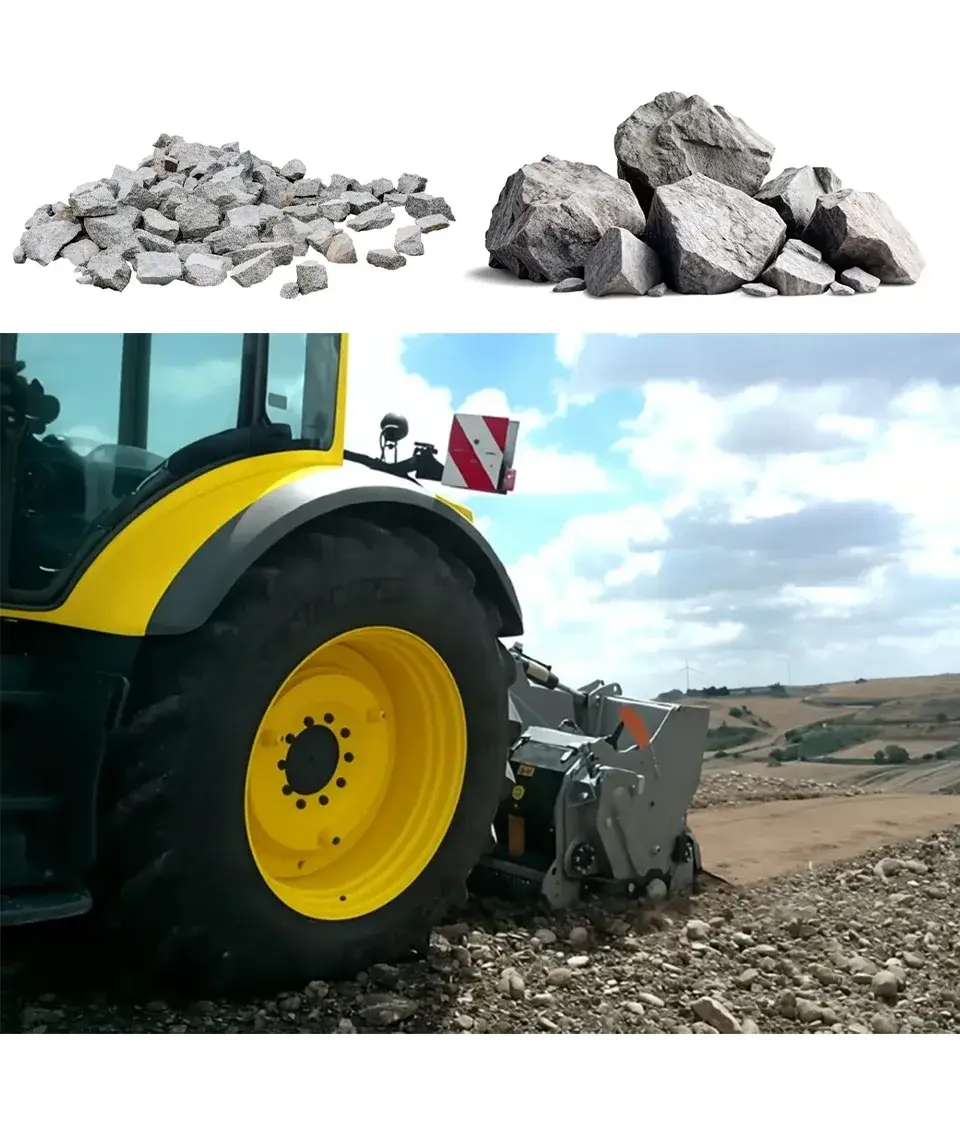
Whether you’re clearing a new orchard site in Jeju, reclaiming a slope in Gyeongbuk, or maintaining a gravel driveway on a livestock farm in Gangwon, the operating principles are the same. The pto stone crusher draws power from your tractor’s power take-off shaft, spins a rotor carrying hardened carbide teeth at high RPM, and pulverizes surface rocks into fragments small enough to be safely left in the soil. The process is continuous and single-pass, which is part of what makes it so compelling for agricultural use — but output still varies enormously depending on rock size, density, soil type, tractor horsepower, and the specific machine model.
1. Action Mode: How a PTO Stone Crusher Actually Processes Rock
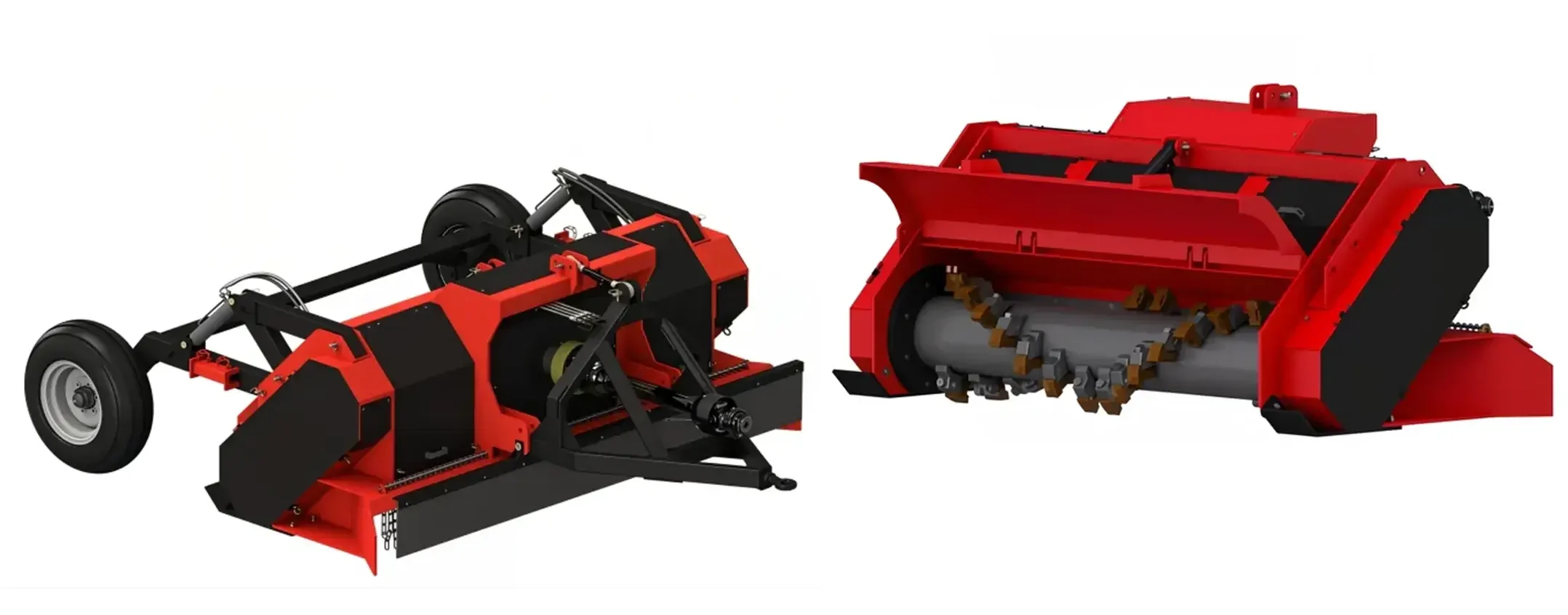
The fundamental operating principle of any سنگ شکن تراکتوری is rotary impact crushing. Power from the tractor’s PTO shaft — typically running at 540 or 1000 RPM depending on the model — is transmitted through a gearbox and belt drive system to a heavy steel rotor. Mounted on that rotor are dozens of carbide-tipped picks or teeth arranged in staggered helical rows. As the rotor spins at high speed, those teeth strike rocks with tremendous kinetic energy, breaking them progressively until fragments are small enough to pass beneath the rear deflector hood and be left uniformly distributed across the soil surface.
The crushing action is not a single blow but a series of repeated impacts as the rotor cycles. A single rock may be struck 8 to 20 times before it’s reduced to the target size. This is why rotor diameter and tooth configuration matter so much to throughput: a larger diameter rotor sweeps a greater arc per revolution, delivering more impacts per second, while the tooth type determines whether the machine is optimized for small scattered fieldstones or large embedded boulders. The STCM series, for example, uses a 550 mm rotor diameter with a combination of STC/3 primary teeth and STC/3/HD heavy-duty picks — designed to handle stones up to 300 mm in diameter, which is roughly the size of a volleyball. The more powerful STCH series steps up to a 700 mm rotor and can handle rocks up to 500 mm with working depths reaching 250 mm.
Speed of travel during operation is constrained by the need for sufficient contact time between the rotor and rock material. Most agricultural stone crushers operate at 2 to 5 km/h — slower than a brisk walking pace. Increasing tractor speed beyond the recommended range doesn’t increase productivity in any meaningful sense; it simply reduces the number of strikes each rock receives and risks leaving oversized fragments in the field. For this reason, output is usually expressed not just in tons per hour but in hectares per hour, which accounts for both travel speed and working width.
2. Manufacturing Structure: What’s Inside the Machine
Understanding how a PTO stone crusher is built explains a great deal about its rated capacity and longevity under continuous load. The chassis is fabricated from high-tensile structural steel, typically 10–16 mm plate, with reinforced side panels flanking the rotor chamber. The rotor itself is a precision-balanced cylinder — often made from cast steel or fabricated from thick-wall tube — because even minor imbalance at high RPM creates destructive vibration that accelerates bearing wear and can damage the tractor’s PTO shaft.
The gearbox is one of the most critical components in the drivetrain. In heavy-duty agricultural stone crushers, it transmits input torque from the PTO shaft and multiplies it to drive the rotor at the required crushing speed while also protecting the system during shock loads. In many models, the drive also incorporates a belt-and-pulley stage that acts as a mechanical fuse — the belts slip under overload rather than transmitting damaging peak forces to the gearbox internals. The THOR 2.4 Kit Drawbar model uses a 180 cv minimum tractor requirement precisely because the combination of its 2.4 m working width and the energy demands of continuous rock breaking puts sustained strain on the drivetrain components.
Behind the rotor, a heavy steel deflector hood controls the trajectory of crushed fragments, preventing them from being thrown rearward at dangerous velocity. Adjustable skids or depth-control wheels on either side of the machine regulate how deeply the rotor engages the soil, which directly affects both the size of rock the machine can tackle and the load placed on the tractor. For the PSC models (based on the STCL series), working depth reaches up to 150 mm — appropriate for surface and semi-embedded fieldstones common in Korean upland crop areas. The heavier STCM series pushes to 200 mm working depth, while the RSM series can engage up to 400 mm deep for serious subsoil rock management.
3. Material System: Teeth, Picks, and Carbide Grades
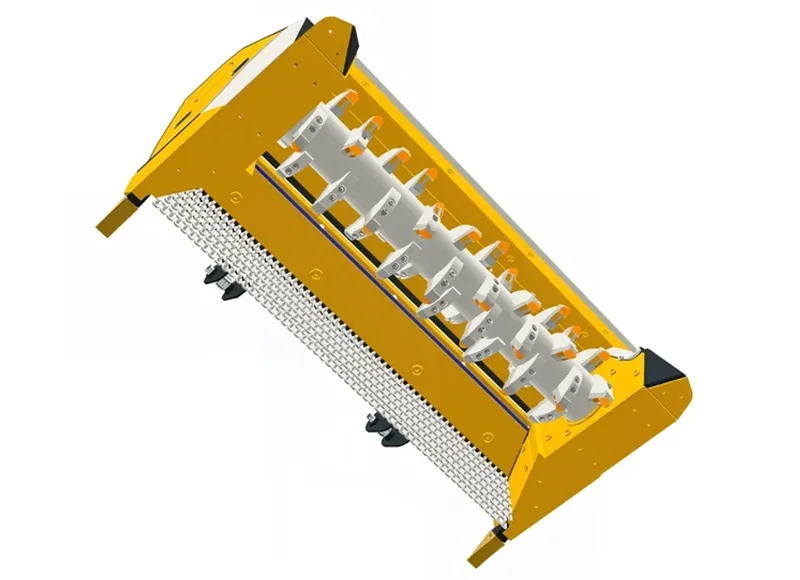
The teeth on a stone crusher rotor are consumable parts — they wear down over time and must be replaced periodically, much like tractor tires or tillage points. But not all teeth are the same. The carbide-tipped picks used in serious سنگ شکن کشاورزی equipment come in several configurations that affect both crushing efficiency and wear life. Understanding the tooth types available on different models helps explain why production rates differ even between machines with similar working widths.
The STC/3 tooth type is a standard flat-face pick suited for mixed fieldstone in lighter-density soil conditions. The STC/3/HD variant uses a heavier body with a more robust carbide tip geometry — it takes more energy to operate but lasts significantly longer in highly abrasive granite or quartz-heavy soils like those found in parts of Gyeonggi-do and Chungcheongbuk-do in South Korea. The STC/FP flat-profile tooth is optimized for situations where the priority is surface finishing rather than deep crushing — it produces a finer fragment distribution and is often used on the outer rows of the rotor drum. The R/65 and R/65/HD picks used in the RSL, RSM, and RSH series are longer, more aggressive picks designed for larger diameter rotors and harder rock types, with working depths and maximum stone diameters that exceed what standard STCL or STCM models can handle.
Tooth count also matters directly to throughput. The STCM 200 model carries 42 primary teeth plus 4 side cutters, while the larger STCM 225 uses 48 teeth. More teeth means more impact events per rotor revolution, which translates to finer fragment size, more consistent output, and the ability to maintain forward speed without leaving oversized fragments. When purchasing a small pto stone crusher or evaluating a used tractor stone crusher for sale, checking the tooth count and verifying the tooth type matches the expected rock conditions is just as important as confirming the horsepower requirement.
4. Estimated Production Rates by Model Series
The following table summarizes key specifications from the PSC (STCL), STCM, and STCH model series alongside estimated area coverage rates under typical agricultural conditions. Actual tons-per-hour throughput varies with rock density, coverage percentage, and soil type — values below represent moderate stone density scenarios (approximately 15–30% surface rock coverage).
| سری مدل | تراکتور (اسب بخار) | عرض کاری (میلیمتر) | حداکثر قطر سنگ (میلیمتر) | حداکثر عمق (میلیمتر) | Est. Area/hr (ha) | Best Use |
|---|---|---|---|---|---|---|
| PSC / STCL Series | 70–150 | 1110–2070 | 150 | 150 | 0.4–0.8 | Orchards, driveways, small fields |
| سری STCM | 80–280 | 1340–2304 | 300 | 200 | 0.6–1.2 | Medium fields, pasture renovation |
| سری STCH | ۲۸۰–۴۰۰ | 2080–2560 | 500 | 250 | 0.9–1.6 | Large farms, heavy rock, reclamation |
| THOR 2.4 Drawbar | 180+ | 2400 | 300+ | 200 | 0.7–1.1 | Drawbar farms, wide coverage |
| RSM / RSM/HP | 200–360 | 2080–2320 | 500 | 400 | 0.8–1.4 | Deep rock, rough terrain, reclamation |
Area coverage estimates assume 3–4 km/h working speed and moderate stone density. Heavy infill or large embedded rock reduces throughput by 30–50%.
5. What Actually Determines Your Tons-Per-Hour Output
Production rate figures are never absolute — they are averages built around a set of assumed conditions that may or may not match your field. Five factors above all others determine whether your سنگ شکن کشاورزی hits the high end or low end of its rated output range:
Soft limestone crushes two to three times faster than hard basalt or granite at the same machine setting. Volcanic soils in Jeju and parts of Gyeongbuk contain very hard igneous rocks that shorten tooth life and reduce forward speed by 30–40% compared to sedimentary stone regions.
A field with 10% surface rock coverage will allow the machine to travel faster between contacts than one with 60% coverage. At very high stone densities, the machine must work harder and slower to avoid overloading the rotor drive, significantly reducing hectares per hour.
Machines rated for 150 mm maximum stones (PSC/STCL series) will struggle or stall against 250 mm rocks that a STCM handles routinely. Attempting to force oversized rock through an undersized crusher doesn’t just slow output — it risks gearbox damage and broken teeth.
Running a crusher at the minimum recommended horsepower means the tractor is working at full load continuously. This is acceptable for short sessions but produces heat and PTO drive stress over long days. Ideally, the tractor should have 10–15% more than the minimum rated power, allowing a safety margin that also sustains better forward speed.
Sloped fields require the tractor to work harder just to maintain position, reducing available PTO power. In Korea’s terraced farming areas of Gyeongnam and Jeonnam, gradient-related power loss can reduce effective rotor speed enough to cause incomplete crushing and require a second pass.
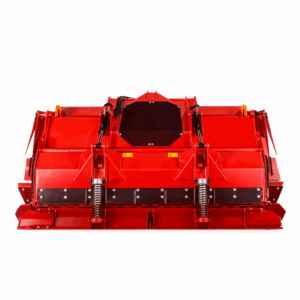
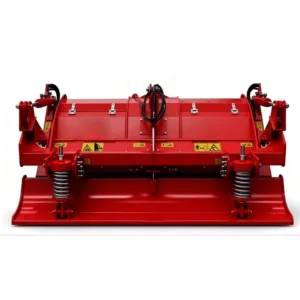
6. Our Stone Crusher Series: Model Overview & Specifications
The following products represent the core of the Mulchers / Stone Crushers lineup currently available. Each model is matched to a specific tractor power range and application profile. Choose based on your field size, rock type, and the horsepower available from your existing tractor.
7. Gearbox Standards, PTO Compliance, and Agricultural Equipment Regulations
The gearbox and PTO driveline components of stone crushers are subject to regulatory frameworks in multiple jurisdictions, particularly where the machinery is used on public roads or by hired operators. Understanding these rules is important whether you’re sourcing a سنگ شکن برای تراکتور in Korea, Australia, the EU, or North America.
کره جنوبی (한국)
In Korea, agricultural machinery including tractor attachments is regulated under the Agricultural Mechanization Promotion Act (농업기계화 촉진법). Tractors and implements must meet safety standards set by the Rural Development Administration (RDA / 농촌진흥청). PTO-driven implements require CE-equivalent safety guarding on the driveshaft in line with Korean Industrial Standard (KS) B 6040 for power take-off covers. Operators of agricultural machinery weighing over 3,000 kg must hold a valid agricultural machinery operator license under the Road Traffic Act when moving between fields on public roads.
Stone crushing equipment used near residential areas or waterways may also require prior notification to local municipal offices under environmental impact provisions of the Agricultural Land Act (농지법), particularly when work involves soil modification or land grading activities.
اتحادیه اروپا
In the EU, PTO-driven stone crushers must comply with the EU Machinery Directive 2006/42/EC (due to be superseded by EU Machinery Regulation 2023/1230 from 2027). This requires CE marking, a Declaration of Conformity, and compliance with EN ISO 4254-1 (agricultural machinery general safety) and EN ISO 11684 (safety signs on agricultural machinery). PTO driveline guarding must comply with EN 12965. Gearboxes must be adequately lubricated and include overload protection mechanisms meeting the requirements of EN ISO 11684-3.
Germany and Austria additionally impose regional operator certification requirements for machinery above certain weight thresholds when used by agricultural contractors rather than farm owners.
استرالیا و نیوزیلند
PTO-driven attachments must carry compliance with AS 2153 (guarding of power take-off) and the broader Work Health and Safety Regulations in each state. In New Zealand, the Health and Safety at Work Act 2015 applies to all farm machinery, and the gearbox / driveline assembly must be inspected annually when the equipment is used by employees. Stone crushers used in New Zealand’s South Island high-country sheep stations have specific requirements around topsoil disturbance and re-seeding obligations under regional council resource consents.
United States & Canada
In the US, OSHA Standard 29 CFR 1928.57 covers agricultural machinery guarding, including PTO drive protection. ASABE (American Society of Agricultural and Biological Engineers) standards S318 and S207 govern PTO shaft guarding on tractor implements. Canadian provinces generally follow the Canadian Agricultural Safety Standards (CASS) framework, with Quebec and Ontario having more detailed provincial regulations around operator certification for commercial agricultural contractors operating equipment above 100 hp.
8. How to Match the Right Stone Crusher to Your Operation
Before requesting a quote from any pto stone crusher manufacturer or supplier, gather four pieces of information: your tractor’s rated PTO horsepower, the maximum diameter of rocks you typically encounter, the percentage of your field area that carries surface or near-surface rock, and your target area per day. With those four inputs, you can narrow your choice quickly.
Small Korean Farms (<5 ha)
Consider the PSC / STCL series or the compact end of the STCM range. These pair with 70–150 hp tractors common in Korean upland farming operations and handle the fieldstone sizes typical of volcanic Jeju soils or granite-strewn Gangwon hillside fields.
Medium Commercial Farms (5–30 ha)
The STCM 175 to STCM 225 range, or the THOR 2.4 with Kit Drawbar, suits farms where efficiency matters and a 150–220 hp tractor is available. Working widths of 1,800–2,400 mm allow a single pass per row on typical Korean field layouts.
Land Reclamation & Contractors
For contract stone crushing work or land reclamation where rocks may reach 400–500 mm diameter, the RSM or STCH series combined with a 280–400 hp tractor delivers the depth capacity and daily throughput that justifies the investment. Multiple passes are rarely required.
9. Real-World Application: Where PTO Stone Crushers Are Used in Korean Agriculture
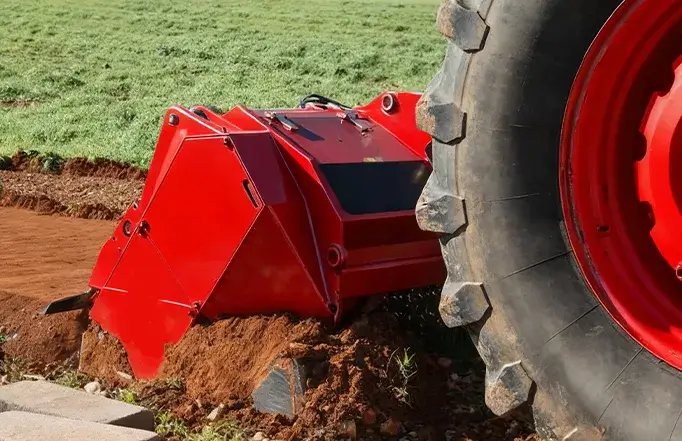
Stone clearing has been a part of Korean farm management for generations — done historically by hand, then by excavator, and now increasingly by PTO-driven crushing machinery. The appeal is clear: a stone crusher processes and leaves rock in place as a fine aggregate that actually improves soil drainage, rather than piling it at field margins or trucking it away. For Korean growers converting mountainous land into orchards or vegetable plots, this single-pass solution can reduce land preparation time from weeks to days.
In Jeju Island, where basalt rock is essentially ubiquitous beneath the thin topsoil, the demand for capable ماشین آلات سنگ شکن has grown sharply as tangerine orchards age out and are replanted with higher-value crops. The hard volcanic basalt requires machines from the STCM or STCH range — lighter PSC models will wear teeth rapidly and may not achieve full depth in the dense basalt layer. On the mainland, Gyeonggi-do apple and pear orchard renovation projects commonly use smaller STCL or STCM units because the granite fieldstones there tend to be smaller and more scattered.
Driveways and unpaved farm access roads represent another common application. A دستگاه سنگ شکن قابل حمل in the PSC/STCL compact range can clear and resurface a gravel driveway in a single pass, eliminating the need for gravel delivery and spreading. The crushed material compacts naturally underfoot and wheel traffic, creating a durable, low-maintenance surface — a practical benefit that resonates with the practical mindset of Korean farm operators looking to reduce ongoing labor costs.
10. Maintenance and Its Direct Effect on Sustained Production Rate
A well-maintained stone crusher delivers consistent throughput day after day. A poorly maintained one degrades quietly — tooth wear reduces crushing efficiency, worn bearings allow rotor runout that reduces impact velocity, loose belt tension drops rotor RPM, and contaminated gearbox oil causes overheating that can reduce the allowable continuous operating period before shutdown.
Tooth inspection should happen every 20–30 operating hours under moderate conditions, or as frequently as every 8–10 hours in hard basalt or granite environments. Most modern agricultural stone crushers use bolt-on tooth holders — replacements take minutes per tooth with the right tools, and keeping a spare set on the tractor or trailer ensures a field stop never becomes an all-day delay. The carbide tip on STC/3 and STC/3/HD teeth typically lasts 60–150 hours depending on abrasivity; R/65/HD picks for the RSL and RSM series often last longer in normal sedimentary stone conditions but wear faster in siliceous volcanic rock.
Gearbox oil level and quality should be checked at the start of every extended working period. Most stone crusher gearboxes specify ISO VG 220 gear oil; some high-torque models in the STCH and RSH range may specify a higher viscosity grade, so always confirm with the machine documentation. Belt tension, rotor bearing play, deflector hood condition, and skid depth adjustment complete the pre-operation checklist that separates operators who sustain maximum production from those who spend afternoons making unscheduled repairs.
11. About Our Agricultural Stone Crushing Equipment
We are a dedicated supplier of professional stone crushing and agricultural land preparation equipment, with a particular focus on serving farm operators across South Korea and the broader Asia-Pacific region. Our product catalog brings together proven engineering from established manufacturers with the practical needs of real working farms — from small family operations on Jeju to commercial vegetable farms in Chungnam.
Each model in our Mulchers / Stone Crushers range has been selected for its compatibility with tractors commonly available in the Korean market and its ability to handle the rock types and soil conditions found across the Korean peninsula. We offer pre-sales technical consultation to help match the right machine to your specific field conditions, as well as after-sales support for spare parts including carbide teeth, tooth holders, and wear components.
سوالات متداول
تدوینگر: PXY