Agricultural Equipment Deep-Dive · South African Farms
PTO Rock Crusher for South African Farms:Dealing with Dolerite, Granite, and Sandstone
A thorough technical guide examining how a PTO stone crusher handles South Africa’s three most challenging agricultural rock types — covering action mechanics, manufacturing construction, material specifications, model selection, and the regulatory landscape operators need to understand.
Ask any farmer in the Karoo, the Western Cape Winelands, the Limpopo bushveld, or the basalt-capped flatlands of KwaZulu-Natal what slows field preparation down the most, and the answer is invariably the same: rock. Whether it’s the dark, dense dolerite intrusions that cut across farmland from Colesberg to Beaufort West, the exposed granite outcrops of Mpumalanga’s escarpment country, or the friable Karoo sandstone that fractures unpredictably under equipment, South Africa’s geology presents farm operators with a persistent, costly challenge that conventional tillage tools are simply not designed to solve.
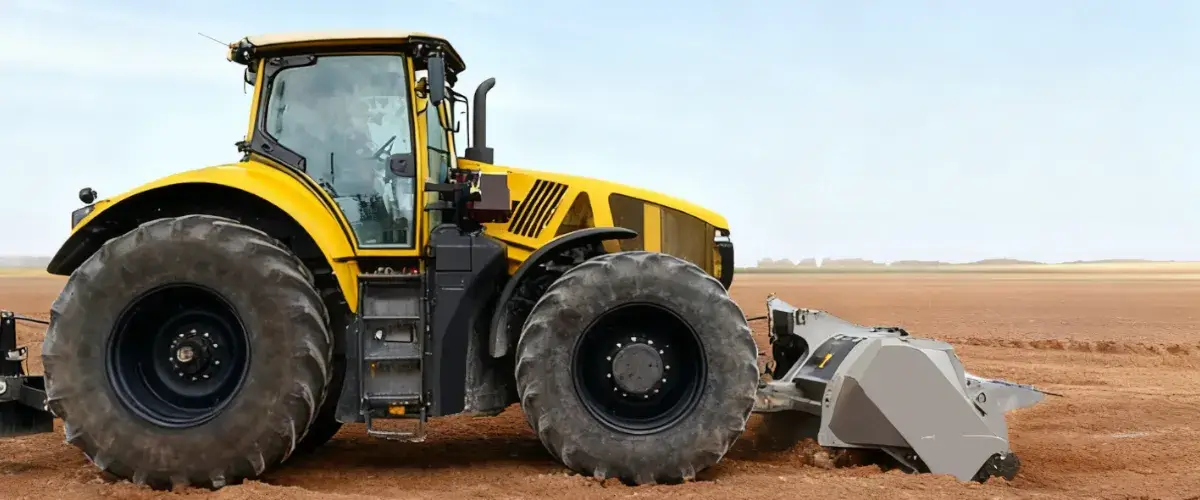
The trituradora de piedra con toma de fuerza — a rotor-driven implement attached to the tractor’s three-point hitch and powered through the power take-off shaft — addresses this problem directly and permanently. Rather than collecting and disposing of surface stone, the machine processes it in place, fracturing rock into fragments small enough to remain in the soil profile without interfering with subsequent cultivation, planting, or grazing. For South African farms where the cost and logistics of physical rock removal are substantial, this approach can dramatically change the economics of land preparation and pasture renovation.
This article is written for South African grain farmers, game lodge developers, vineyard operators, vegetable producers, and land developers who need a clear technical picture of what a tractor stone crusher does, how it’s built, which rock types it can realistically handle, and what regulatory obligations apply when attaching PTO-driven stone crushing equipment to a tractor in South Africa and other key markets.
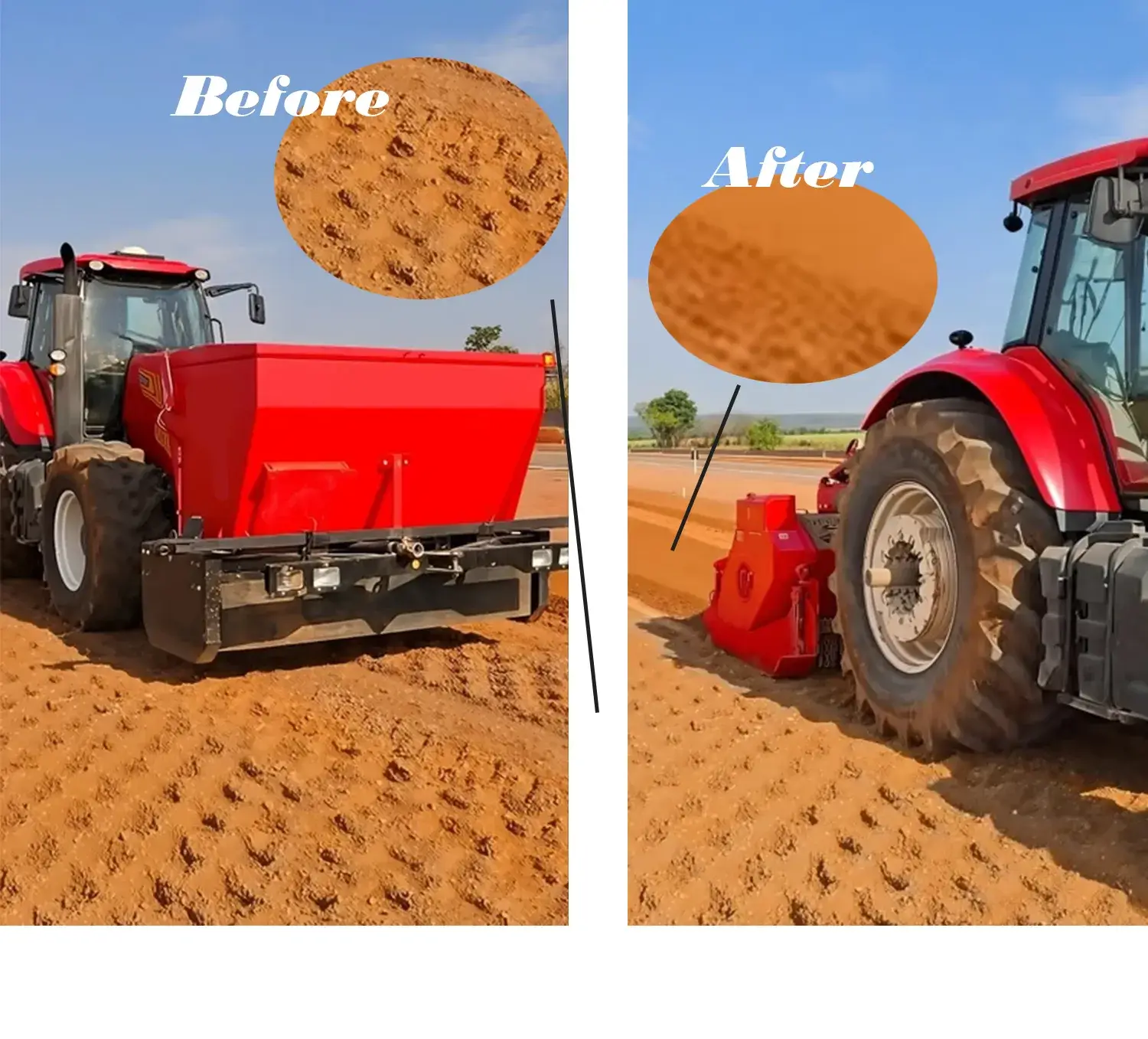
1. South Africa’s Three Problem Rock Types: What You’re Actually Crushing
Understanding the mechanical challenge before selecting a machine is essential. Each of South Africa’s dominant surface rock types demands something different from the stone crusher machine, and choosing an under-specified unit for your regional geology is one of the most common — and expensive — mistakes a farmer or contractor can make.
Dolerite (Karoo Dolerite Dykes and Sills)
Dolerite is by far the most geographically widespread and mechanically punishing rock type that South African farm operators encounter. Formed by the intrusion of magmatic material into Karoo sedimentary rock during the Jurassic period approximately 183 million years ago, dolerite dykes and sills cross the landscape of the Karoo, Eastern Cape, Free State, and parts of KwaZulu-Natal in dense networks — in some areas covering up to 30% of the surface. Dolerite is a fine-grained mafic igneous rock with a Mohs hardness of approximately 6–7 and a compressive strength of 200–350 MPa, making it significantly harder than average sedimentary rock. When exposed at the surface, it presents as irregular, rounded boulders and sharp-edged fragments ranging from 50 mm pebbles to 400 mm diameter stones. Processing dolerite demands a heavy-duty stone crusher for tractor operations — specifically, machines with high rotor mass, carbide-tipped cutting teeth, and robust gearbox ratings designed for sustained impact loading.
Granite (Bushveld Complex and Mpumalanga Granites)
Granite and related coarse-grained igneous rocks are prevalent across the Bushveld Complex — the world’s largest known layered mafic intrusion, covering much of North West Province, Limpopo, and Mpumalanga. Granite outcrops are also common in the Northern Cape around Pofadder and across parts of the Western Cape mountains. South African granite typically has a Mohs hardness of 6–7, a compressive strength of 130–200 MPa, and is highly abrasive due to its quartz mineral content. Large rounded boulders, often 200–500 mm across, sit partially buried in the weathered laterite soils of the highveld. These stones blunt cutting teeth rapidly and generate significant abrasive wear in the crushing chamber. A small pto stone crusher with light-duty teeth and standard steel liners will wear through quickly in granite conditions; tungsten carbide inserts and Hardox-lined chambers are genuinely necessary rather than optional when working in granite-rich terrain.
Karoo Sandstone
Karoo sandstone — the sedimentary bedrock of much of the Great Karoo and Little Karoo — is considerably softer than dolerite or granite, with a Mohs hardness of 3–5 and compressive strength typically in the range of 30–80 MPa depending on cementation. However, it presents a different challenge: it fractures in irregular slabs and plates rather than rounded boulders, which can enter the crushing chamber at awkward angles. The semi-arid nature of the Karoo also means that soil moisture is low, which produces fine dust during crushing operations — raising operator dust exposure concerns that need to be managed with appropriate protective equipment. On the positive side, sandstone conditions are where lighter-duty models like the PSC series and smaller TMRC configurations deliver excellent results without oversized power requirements, making them a practical and cost-effective choice for sheep farmers and small holdings across the Karoo.
2. Action Mode: Step-by-Step — How a PTO Stone Crusher Processes Rock in South African Conditions
The operational sequence of a tractor stone crusher begins at the moment the tractor’s PTO shaft engages. Power exits the tractor gearbox at either 540 or 1000 RPM depending on the model selected — a choice that significantly affects how the implement performs against dense dolerite compared to softer Karoo sandstone. That rotational input passes through the implement’s gearbox, which multiplies torque and converts it to the working speed required for the rotor to fracture rock rather than merely push it aside.
As the tractor advances at a typical field speed of 1–3 km/h — slower on dolerite, slightly faster on sandstone — the rotor’s hardened steel teeth make contact with surface stones. The rotor spins at high angular velocity, and the radial impact energy delivered by each tooth to the rock is proportional to the square of the tip speed. This means rotor diameter matters considerably: a 595 mm diameter rotor (as on the TMRC series) generates higher tip speed and greater impact energy per tooth strike than a smaller rotor at the same RPM, which translates directly to better fragmentation of hard materials like granite and dolerite.
Inside the crushing chamber, the counter-blade positioned above and behind the rotor creates a secondary crushing event: fragments thrown by the rotor strike the counter-blade and fracture further, producing a more consistent final fragment size. The adjustable rear hood — hydraulically controlled on premium models — allows the operator to fine-tune how much crushed material is recirculated through the chamber versus how much passes through immediately, which is useful when working on hard dolerite where a finer output size is preferred for subsequent seedbed preparation.
Adjustable depth skids on each side of the machine set the working depth, which on the TMRC series ranges from 150–280 mm. For South African conditions, most farmland stone clearing operations are conducted at 100–200 mm depth — sufficient to eliminate all surface stones that would damage planting equipment — with the deeper capability reserved for renovation work on long-neglected paddocks where stones have partially subsided below the immediate surface.
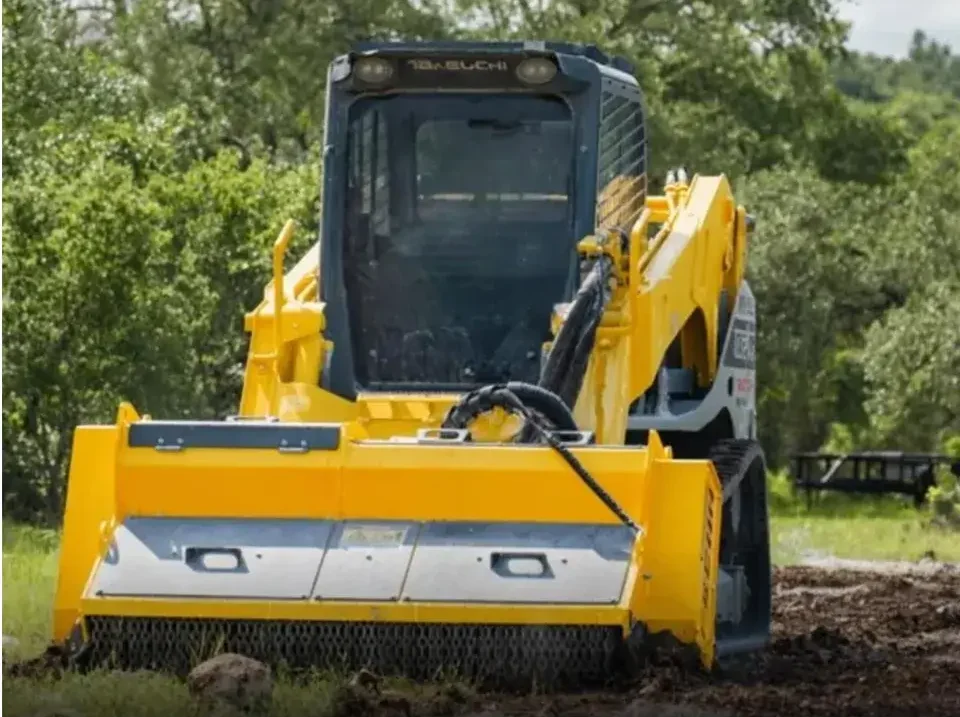
3. Manufacturing Structure: What Separates a Crusher Built for Dolerite from One That Isn’t
South Africa’s hard-rock conditions are a genuine stress test for agricultural stone crushing equipment. Machines built to lighter commercial standards that perform acceptably on soft European limestone or light gravel may fail rapidly when confronted with the compressive strength of Karoo dolerite. Understanding the specific structural elements that matter in this context helps buyers make sound purchasing decisions and helps operators know what to inspect when evaluating a used tractor stone crusher for sale.
Outer Frame and Housing
The outer frame is fabricated from thick structural steel sections — typically S355 or equivalent high-yield plate — with wall thicknesses of 12–20 mm at the critical load-bearing zones. Welded joints at the rear hood pivot, the depth skid brackets, and the three-point linkage attachment points are full-penetration welds, not surface stitching. On models designed for hard-rock conditions, additional external reinforcing gussets are welded at these points. The top and rear panels of the crushing chamber use replaceable wear plates that can be unbolted and swapped without cutting or grinding, keeping scheduled maintenance work achievable in a basic farm workshop.
Rotor Assembly
On the TMRC series, the rotor is a forged and heat-treated steel drum of 595 mm diameter across all six models (TMRC 100 through TMRC 225). The rotor is dynamically balanced at the factory to ISO 1940-1 tolerance levels — a specification that matters enormously when machine weights reach 2,000–2,650 kg and the rotor is spinning at high speed. An imbalanced rotor generates vibration that accelerates bearing failure and stresses the tractor’s rear axle and three-point linkage — particularly problematic when operating on uneven terrain, which is common on South African farms with dolerite dyke topography that creates irregular surface undulations. The rotor shaft is forged steel, heat-treated for surface hardness and core toughness, seated in tapered roller bearings at both ends with sealed lubrication chambers that protect against the dust generated during dry-season Karoo operations.
Gearbox Construction
The gearbox is the component most frequently cited in equipment failures when stone crushers are used beyond their rated capacity. For South African hard-rock applications, the gearbox must be rated for sustained impact loading rather than just continuous torque. Quality implementations use helical or bevel-helical gear sets precision-ground to DIN 3960 or equivalent tolerances, housed in cast ductile iron (GGG-50 or similar) with a generous oil volume that provides thermal buffering during extended working periods in high-temperature South African summer conditions. On larger-capacity models like the TMRC 175, 200, and 225 — which operate at 1000 RPM PTO input — the gearbox must handle higher shaft speeds, and the side reduction gears are oil-cooled to manage thermal load during sustained hard-rock crushing operations. Gearbox oil temperature regularly exceeds 90°C when working in dense dolerite without adequate cooling design, leading to accelerated gear and bearing wear that may not manifest until significant damage has already occurred.
Three-Point Linkage Integration
All models in the range use Category 2 three-point linkage, which is compatible with the vast majority of tractors in the 80–190 hp range currently operating on South African farms. The lower link pins and quick-coupler mounting plates are machined from high-tensile steel with sufficient cross-sectional area to handle the shock loads generated when the crusher contacts a partially buried dolerite boulder unexpectedly. Shear bolt or friction clutch protection in the PTO driveshaft is a critical safety and protection element — these devices are designed to disengage drive before the gearbox or tractor PTO absorbs a damaging shock load from sudden rotor stall.
4. Material System: Teeth, Liners, and Counter-Blades for Hard South African Rock
When working dolerite or granite, the cutting teeth are the primary consumable and the first indicator of whether a machine is genuinely specified for the application. The hierarchy of tooth material options represents a significant range in both performance and cost — choosing incorrectly means replacing teeth every few days rather than every few hundred hours.
Cutting Tooth Specification
The body of a quality agricultural stone crusher tooth is investment-cast or forged from tool steel — typically equivalent to AISI H13 or DIN 1.2344 hot-work tool steel — with a hardness of 50–55 HRC after heat treatment. For soft sandstone, this may be sufficient. For granite and dolerite, however, the contact hardness of the tooth tip needs to significantly exceed that of the rock. Tungsten carbide-tipped teeth, where the cutting tip is a brazed or press-fit carbide grade with hardness in the range of 1,400–1,800 HV, are the correct specification for sustained dolerite and granite work. Carbide-tipped teeth last 5–10 times longer in highly abrasive conditions compared to standard hardened steel tips, which more than offsets their higher unit cost. The tooth holder — the mounting block on the rotor — is typically forged steel with a Cr-Mo alloy heat treatment and is designed to accept replacement tooth bodies without rotor removal, allowing field-side tooth changes in under 30 minutes per tooth.
Crushing Chamber Liners
The internal surfaces of the crushing chamber — particularly the top plate, the rear hood underside, and the side walls — are protected by abrasion-resistant liner plates. On machines designed for hard-rock applications, these liners are manufactured from HARDOX 400 or HARDOX 500 wear-resistant steel, a product of SSAB (Sweden) that has become the de facto standard for agricultural equipment exposed to high-abrasion conditions. HARDOX 500, with a Brinell hardness of 500 HBW, provides approximately 2–3 times the wear life of standard structural plate S355 under dolerite crushing conditions. HARDOX liners are bolt-in replaceable without welding, which matters greatly for South African operators who may be hundreds of kilometres from a well-equipped workshop. On the TMRC series, both internal and external guards are interchangeable, reducing the number of spare parts that need to be stocked on the farm.
Counter-Blade and Rear Hood
The counter-blade is manufactured from hardened tool steel, sometimes with a hardfacing weld deposit applied to the leading edge using a chromium carbide-based welding wire. This builds up a surface hardness of approximately 55–60 HRC that outlasts the base metal by a considerable margin in abrasive conditions. On models with hydraulic rear hood adjustment — available on TMRC 175 and above — the gap between the rotor and the counter-blade can be adjusted from the tractor cab while working, allowing the operator to respond to changing rock conditions (switching from soft sandstone areas to an embedded dolerite dyke crossing) without stopping and dismounting. This operational flexibility has measurable productivity value in South African field conditions where rock type can change across a single paddock.
5. Product Range: Which Model Fits Your South African Operation?
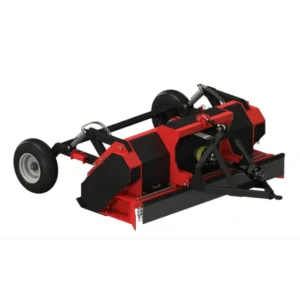
THOR 2.4 + Kit Drawbar
Designed for 180 hp tractors with a 2.4 m working width and machine weight of 2,300 kg. Working speed 3 km/h, Category 2 linkage, 2 control valves required. Ideal for large-scale clearing across dolerite-rich Karoo farmland where maximum throughput per pass is the priority.
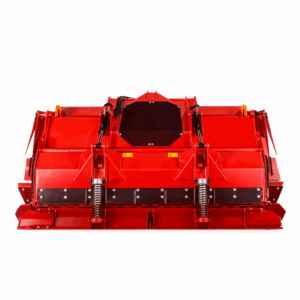
RockMaster Agricultural Stone Crusher
A robust agricultural stone crusher handling up to 300 mm diameter rocks at 200 mm depth, compatible with 80–220 hp tractors. The RockMaster’s design is well-suited to mixed terrain farms in the Limpopo bushveld and Free State where dolerite and softer overburden alternate across the same paddock.
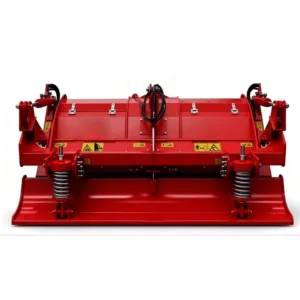
PSC Series — PTO Stone Crusher Models
The compact PSC series (70–150 hp, max 150 mm crush diameter, 150 mm depth) is the right fit for Western Cape vineyard and orchard operations dealing with sandstone and conglomerate. A capable small pto stone crusher configuration for narrow-row fruit farm applications where manoeuvrability matters as much as crushing power.
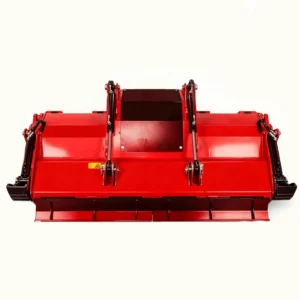
Tractor-Mounted Rock Crusher (TMRC Series)
Six models from 80–190 hp, 1,000–2,200 mm working widths, 595 mm rotor diameter, 300 mm max crush capacity, 280 mm max depth. The most versatile tractor stone crusher for sale in the range for South African large-farm operations — solid capability against dolerite when correctly specified with carbide teeth.
6. Rock Type vs. Model Selection: Quick Reference for South African Conditions
| Rock Type | Hardness (Mohs) | Typical Size (SA) | Recommended Series | Tooth Type |
|---|---|---|---|---|
| Dolerite | 6–7 | 50–300 mm | TMRC 175–225, RockMaster | Carbide-tipped required |
| Granite | 6–7 | 100–500 mm | TMRC 200–225, THOR 2.4 | Carbide-tipped required |
| Karoo Sandstone | 3–5 | Slabs up to 200 mm | PSC Series, TMRC 100–150 | Standard hardened steel |
| Mixed / Variable | Varies | Mixed sizes | TMRC 150–175, RockMaster | Carbide recommended |
7. Where South African Farmers Are Using PTO Stone Crushers
The combination of South Africa’s diverse geology, varied agricultural sectors, and often remote farm locations makes the portable stone crusher machine approach — using the farm tractor and an implement rather than a dedicated self-propelled crusher — particularly practical. Here are the specific applications where South African operators are finding this stone crushing equipment most valuable.
Maize and Dryland Grain Farming — Free State and Mpumalanga: Large-scale grain producers on the highveld’s granite and dolerite-underlain soils deal with annual heaving of subsurface stones, particularly on fields that have been cultivated for decades. A TMRC 150 or TMRC 175 matched to an 80–130 hp tractor can clear a stone-loaded maize land in 4–6 hours per hectare — significantly faster and more cost-effective than mechanical stone picking — while leaving the crushed mineral material to improve soil structure over subsequent growing seasons.
Game Farm and Conservation Area Development — Limpopo and Mpumalanga: The rapid expansion of game farming in the bushveld has driven substantial demand for farm track construction and land preparation on properties where roads must cross or follow dolerite and granite outcrops. Stone crushed in situ from surface material provides on-site aggregate for track building without the cost of importing crushed stone. The TMRC 200 or TMRC 225 can process a game farm track surface to trafficable standard at a fraction of the cost of contracted road-building machinery.
Vineyard and Fruit Farm Establishment — Western Cape: The Western Cape’s wine, pome fruit, and table grape industries are dominated by farms with shallow rocky soils over sandstone, shale, and in some areas weathered granite. Mechanised land preparation for new vineyard blocks or orchard establishments requires stone-free seedbeds, and the PSC series or TMRC 100 (1,000 mm working width) is well-suited to the 3–4 m inter-row spacing of trellised vineyards. Operators in the Swartland, Winelands, and Elgin areas have found that a single crushing pass before subsoil ripping eliminates the stone accumulation that would otherwise prevent effective deep tillage.
Vegetable Production and Irrigation Development — Northern Cape and Limpopo: Converting dry-land grazing or veld into irrigated vegetable production fields requires a level, stone-free surface for drip tape installation and mechanical harvesting. Dolerite dyke intersections — a common feature on farms between Upington, Prieska, and Britstown — can be processed in-situ with a TMRC 175 or above, eliminating the need for costly excavation and rock disposal. The RockMaster configuration handles the transition from sandstone to dolerite outcrops that frequently occurs on the same field in this region.
8. What Is Crusher Stone Used For? Agricultural and Infrastructure Uses in South Africa
People asking “what is crusher stone used for” often have a mining or construction context in mind. In agricultural use, the purpose and value of crushed stone is somewhat different and worth understanding clearly, because it informs how you manage the material output of a stone crusher machine in your fields.
The primary agricultural use of in-situ crushed stone is soil improvement. Dolerite and granite both contain calcium, magnesium, potassium, phosphorus, and a range of trace minerals that are released into the soil as crushed fragments continue to weather. On the highly acidic, mineral-depleted soils that are common on long-farmed highveld properties, a stone-crushing programme can contribute to soil remineralisation over a period of 3–10 years without additional input costs. This effect is most pronounced on fine-grained dolerite, which weathers more rapidly than coarse granite. Crushed sandstone contributes less in terms of mineral content but improves drainage on clay-dominant soils that are common in the Karoo and parts of the KwaZulu-Natal midlands.
Crushed material that passes through a pto stone crusher for sale on a grain or pasture field is typically 0–50 mm in fragment size — suitable for direct incorporation into the seedbed. It does not need removal or disposal, which is a significant operational advantage compared to mechanical stone picking. The only exception is when very large boulders (over 400 mm diameter) are encountered — these may need mechanical removal before the crushing pass.
On game farms and smallholdings, crushed stone material is also used to surface farm tracks, where the processed fragments compact into a stable base without the need for imported crushed stone aggregate. This use of in-situ material for road building has become increasingly common on remote Limpopo and Northern Cape game properties, where the delivery cost of purchased aggregate from a quarry can rival the cost of the stone crushing operation itself.
9. Maintenance Schedule for Hard-Rock South African Conditions
Maintenance intervals for dolerite and granite applications should be shorter than those specified for standard European conditions. The following schedule is appropriate for sustained hard-rock operations in South Africa.
| Interval | Task | Focus Component |
|---|---|---|
| Every 6 hours | Visual tooth inspection; check PTO shaft guard completeness | Cutting teeth, PTO shaft |
| Every 25 hours | Grease rotor shaft bearings; check frame bolt torque | Bearings, fasteners |
| Every 50 hours | Check gearbox oil level; inspect counter-blade gap and wear edge | Gearbox, counter-blade |
| Every 250 hours | Full gearbox oil change; replace worn teeth; measure liner thickness | Gearbox oil, teeth, liners |
| Annually | Full rotor balance check; shaft runout measurement; bearing replacement if needed | Rotor assembly, bearings |
Note: In dense dolerite or abrasive granite conditions, halve all intervals compared to standard recommendations. Keep a minimum of six replacement teeth on site during active clearing seasons.
Frequently Asked Questions
Editor: PXY